Understanding the Landscape of Radiology Board Exams
Diagnostic radiology residents face a unique examination structure and content emphasis compared with other specialties. To select the right board exam study resources, you first need a clear map of what you are preparing for.
Key U.S. Exams for Diagnostic Radiology
USMLE/COMLEX (Pre-residency but still relevant)
- USMLE Step 1 and Step 2 CK (or COMLEX equivalents) form the foundation of your radiology knowledge.
- Strong performance here affects the diagnostic radiology match but also provides the physiology, pathology, and pharmacology base you’ll rely on when interpreting imaging.
ABR Core Exam (Residency)
- Typically taken at the end of PGY-4 (R3).
- Covers:
- Physics (a large, often underestimated chunk)
- Organ systems (CNS, MSK, chest, abdomen, pelvis, GU, breast, etc.)
- Modalities (CT, MRI, US, nuclear medicine, IR)
- Non-interpretive skills (quality, safety, management, ethics)
- Image-rich, vignette-based; heavy emphasis on recognizing classic imaging patterns and applied physics.
ABR Certifying Exam (Post-residency)
- Taken after 15 months of independent practice post-core.
- More emphasis on:
- Practice-based decision making
- Integrating imaging with clinical management
- Your chosen “modules” or areas of focus.
While this article centers on radiology board exam resources (mainly Core and Certifying), we’ll connect them to earlier resources like UWorld tips and Anki USMLE where relevant, because smart residents leverage prior study systems instead of starting from scratch.
Core Principles for Building Your Study Plan
Before diving into specific board exam resources, anchor your strategy on a few core principles.
1. Start with the Exam Blueprint
- Download the latest ABR Core Exam study guide and content outline from the ABR website.
- Highlight:
- Organ systems with higher question volume (e.g., chest, abdomen, neuro, MSK).
- Physics domains (x-ray, CT, MR, US, nuclear medicine, radiation safety).
- Non-interpretive skills domains: professionalism, quality, safety, biostatistics.
Use this document as your “syllabus.” Every resource you choose should map clearly to multiple elements in that outline.
2. Integrate into Daily Clinical Work
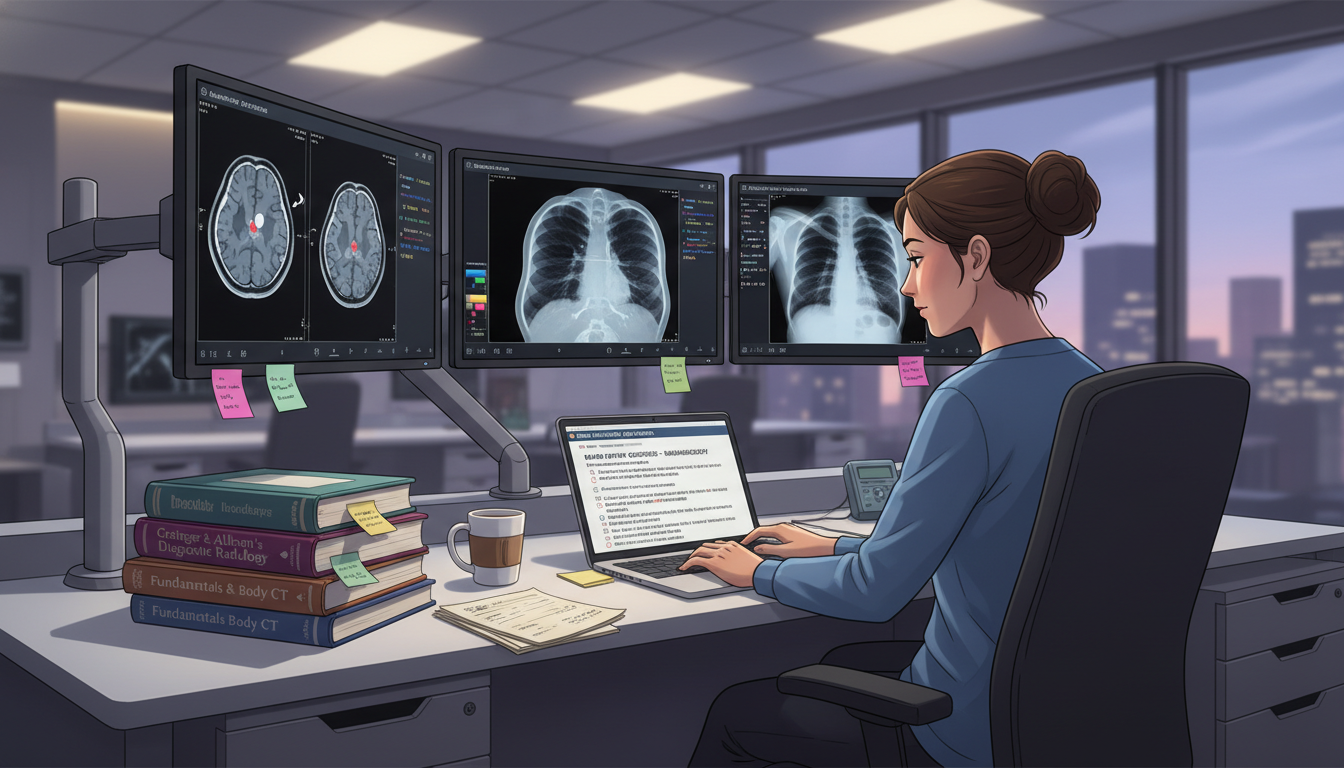
For radiology residency, your reading room is your most powerful board exam resource:
- Dictate with intention: when you see classic exam cases (e.g., sigmoid volvulus, vestibular schwannoma), keep a log.
- Screenshot (within HIPAA rules) and maintain a de-identified teaching file or “Core Pearls” folder.
- After each call shift, list 3–5 cases that illustrate board-relevant diagnoses or pitfalls.
Later, these become flashcards or mini case sets—one of the highest-yield ways to study.
3. Use Question-Based Learning as the Spine
The ABR Core is a pattern-recognition and application exam. Reading alone is not enough.
- Use case-based question banks and online modules as your main driver.
- Let missed questions dictate what you read next.
- Maintain an error log: diagnosis, modality, key imaging features, and why you missed it.
This Q-driven approach mirrors how you used UWorld for USMLE—but adapted to image-heavy radiology content.
4. Spaced Repetition and Active Recall
You already know the power of Anki USMLE decks. The same principles apply here:
- Create concise, image-based or concept-based flashcards.
- Use cloze deletions for tiny but vital facts (e.g., “Most common cause of unilateral sensorineural hearing loss = _______ (vestibular schwannoma)”).
- Review consistently in small daily doses, rather than pre-exam bingeing.
High-Yield Resource Categories for Radiology Board Prep
This section breaks down the major categories of board exam study resources, with pros, cons, and how to use each effectively in diagnostic radiology.
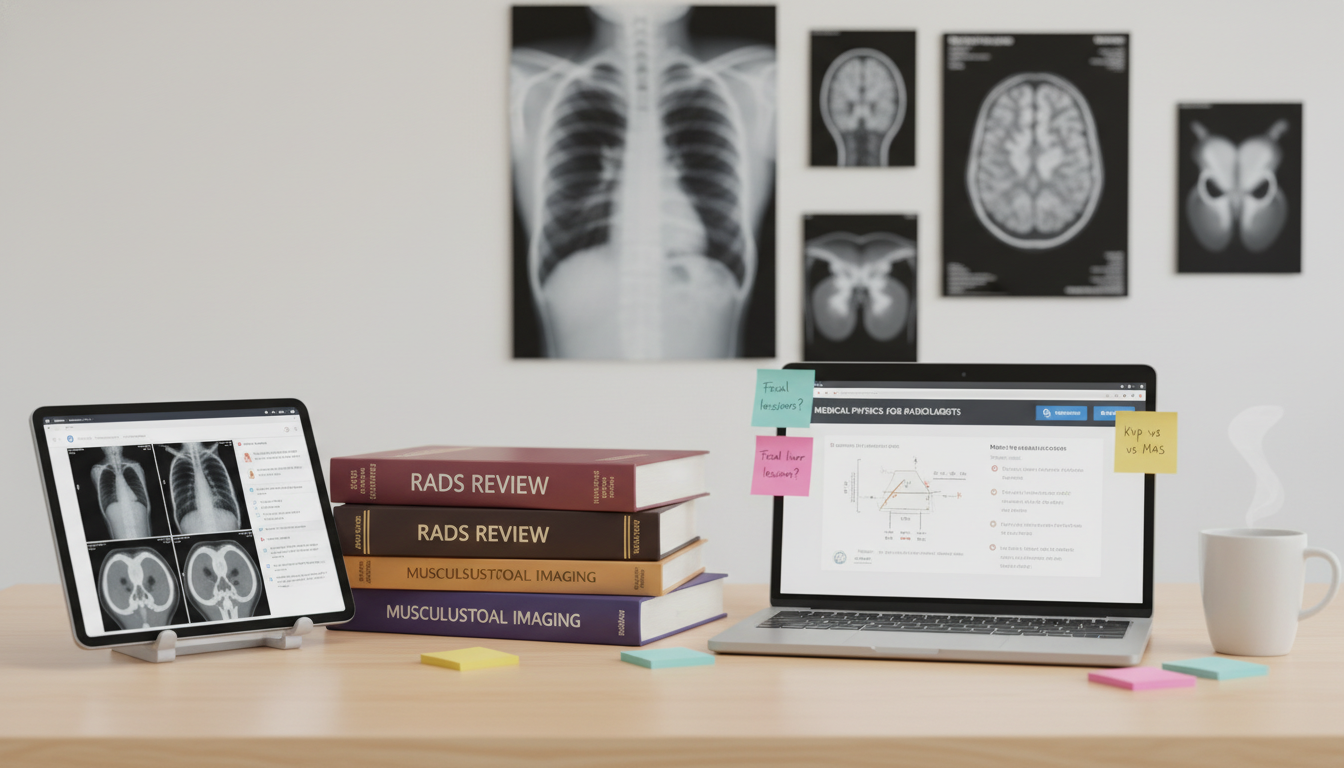
1. Comprehensive Board Review Books
These are your “core texts,” not as dense as full reference books, but thorough enough to cover most of the exam blueprint.
Examples (titles generalized by type):
- Organ-system based board review books (e.g., neuro, chest, abdomen, MSK, pediatrics, breast).
- Integrated ABR Core review books organized by exam section.
- Dedicated non-interpretive skills handbooks (quality, safety, management, statistics).
- Radiology physics review books tailored specifically to the Core exam.
How to use them:
- Don’t read cover-to-cover passively. Instead:
- Use board exam resources outlines to pick high-yield chapters.
- Read a chapter, then immediately reinforce with case questions and flashcards.
- During R1–R2:
- Skim major systems as you rotate through them.
- Use them to build conceptual understanding and vocabulary.
- During the core exam year:
- Focus on review books for areas where you’re consistently missing Qs (e.g., nuclear medicine, physics).
Pros:
- Structured to reflect the exam.
- More concise than full references, easier to finish.
- Often include tables, mnemonics, and summary diagrams.
Cons:
- Limited number of images compared with case-based resources.
- Easy to fall into passive reading without active recall.
2. Case-Based Question Banks and Online Modules
These are the radiology equivalent of UWorld tips on steroids: image-focused, explanation-rich, and exam-mimicking.
Types of question-based resources:
- Online ABR Core-style question banks:
- Timed, mixed-modality, and multi-system questions.
- Detailed explanations with annotated images.
- Online case libraries with built-in quizzes:
- Cases sorted by modality (CT/MRI/US) and organ system.
- Interactive “what’s your diagnosis?” style with feedback.
- Section-specific question sets:
- Dedicated chest, neuro, MSK, abdominal imaging case books or online modules.
- Pediatric, breast, and nuclear medicine mini Q-banks.
How to use them:
- Treat them like UWorld:
- Mixed blocks once you’re in your dedicated Core prep phase (e.g., 40–50 questions/day).
- Subject blocks when building from scratch in weaker areas (e.g., a week of pure neuro, then pure chest).
- After each block:
- Tag missed questions by cause:
- Knowledge gap (need to read)
- Pattern misrecognition (need more cases)
- Rushing or misreading question stem (test strategy)
- Tag missed questions by cause:
- Convert key misses into flashcards:
- One or two concise cards per new concept or pattern.
- Include a low-res screenshot or sketch for visual memory, when allowed.
Pros:
- Closest to what you will see on exam day.
- Actively engages your pattern recognition and decision-making.
- Immediate feedback drives efficient studying.
Cons:
- Time-intensive.
- Subscription-based resources can be expensive.
- Temptation to “binge questions” without properly reviewing explanations.
Practical example:
- You miss multiple questions on lung cancer staging on CT.
- Action plan:
- Read a concise chest oncology/staging chapter in your board review book.
- Do 20–30 additional targeted case questions on thoracic oncology.
- Make 5–10 flashcards summarizing CT staging criteria and classic patterns.
- Action plan:
3. Physics-Specific Resources
Physics is a make-or-break area for the ABR Core. Many residents underestimate it, and yet it’s one of the most “controllable” components if you have the right board exam study resources.
Core physics resource types:
- Dedicated Core exam physics review books:
- Focus on image formation, radiation dose, safety, and modality-specific physics.
- Online video lecture series:
- Short, focused videos on CT, MR, US, nuclear medicine, and radiation safety.
- Often paired with practice questions and diagrams.
- Departmental physics lectures:
- Residents’ noon conference series or formal courses.
- Often tailored to the ABR blueprint by your physicists.
How to use them:
- Start early:
- R2: establish a baseline in X-ray, CT, MR, and radiation biology.
- R3 (Core year): 2–3 months of consistent, targeted review.
- Think in clinical application terms:
- How does increasing kVp affect image quality and dose?
- Why use non-contrast CT in certain scenarios?
- How does MR sequence choice change what pathology you see?
- Use diagrams + simple flashcards:
- Physics is ideal for quick Anki-style cards (equations, basic principles, dose comparisons).
Pros:
- Physics questions are often predictable once you know the patterns.
- High-yield for point gain compared with the time investment.
- Good physics knowledge reinforces your day-to-day clinical practice.
Cons:
- Dense and abstract if approached as pure theory.
- Many residents “cram” late, which leads to superficial understanding and poor retention.
Strategy tip:
Treat physics like you treated biostatistics and pharmacology for USMLE—small, regular doses, integrated with cases and practice questions, rather than a last-minute crash course.
4. Non-Interpretive Skills and “Soft” Content
The Core exam includes non-interpretive skills that can catch unprepared residents off-guard.
Topics include:
- Quality improvement and safety
- Contrast safety and reactions
- Radiation safety and dose management
- Professionalism and ethics
- Basic health policy and practice management
- Research methods and biostatistics
Best board exam resources here:
- Slim, exam-oriented non-interpretive skills books or eBooks.
- Free online modules from national organizations (quality and safety focused).
- Your institution’s contrast reaction protocol and radiation safety guidelines.
How to use them:
- Schedule a 2–3 week “non-interpretive block” a few months prior to the Core.
- Aim for:
- One chapter or module per day.
- 10–20 multiple-choice questions or cases per day.
- Make minimalistic flashcards:
- Contrast reaction management steps
- Dose thresholds
- Basic definitions (sensitivity, specificity, PPV, NPV, relative risk, etc.)
Pros:
- Highly scorable content; most questions are straightforward if you’ve reviewed.
- Directly applicable to safe clinical practice.
- Small volume relative to overall exam scope.
Cons:
- Easy to neglect because residents prioritize imaging and physics.
- Some content can feel “dry,” reducing motivation to review.
5. Digital Flashcards and Spaced Repetition (Anki for Radiology)
You already know the value of Anki USMLE decks. Translating that success into radiology studies requires some adaptation.
What works well in radiology flashcards:
- Classic imaging patterns:
- “Question: 35-year-old with knee pain; radiograph shows epiphyseal lesion with well-defined margins and sclerotic rim. Most likely diagnosis? [Image or description]”
- Key differential clues:
- “Interlobular septal thickening + pleural effusions + cardiomegaly = favors ______ over ______.”
- Staging systems and classification:
- AJCC staging checkpoints, widely used MSK or fracture classification schemes.
- Physics one-liners:
- “As you increase kVp, what happens to patient dose and contrast?”
How to build and use:
- Build cards slowly, not as a huge separate project:
- When you miss a question or encounter a great teaching case, convert it into 1–2 cards.
- Keep cards minimal:
- One fact or image per card.
- Prefer cloze deletions or simple Q&A over paragraphs.
- Aim for:
- 30–60 cards/day during R2–R3.
- Higher volumes nearing your exam if you have a large mature deck.
Pros:
- Facilitates long-term retention of rare but testable diseases.
- Keeps your knowledge “alive” across rotations.
- Perfect for quick review during downtime in the reading room.
Cons:
- Can become overwhelming if you overbuild or add overly complex cards.
- Not a replacement for case-based practice; should be used as a supplement.
6. Traditional Textbooks and Reference Resources
Full-length radiology textbooks are not usually designed as primary board exam study resources, but they still play an important role.
Best uses during Core prep:
- When you repeatedly miss questions in a specific niche area (e.g., pediatrics, cardiac CT, hepatobiliary imaging).
- When you encounter unfamiliar eponyms or rare entities where board review books are too superficial.
- For visually exploring variant anatomy and complex pathophysiology.
Strategy:
- Use textbooks in a targeted manner:
- 1–2 pages around each concept you miss, not entire chapters.
- Take screenshots or notes to distill into 1–2 flashcards rather than trying to memorize full textbook sections.
Putting It All Together: Structured Study Plans by PGY Year
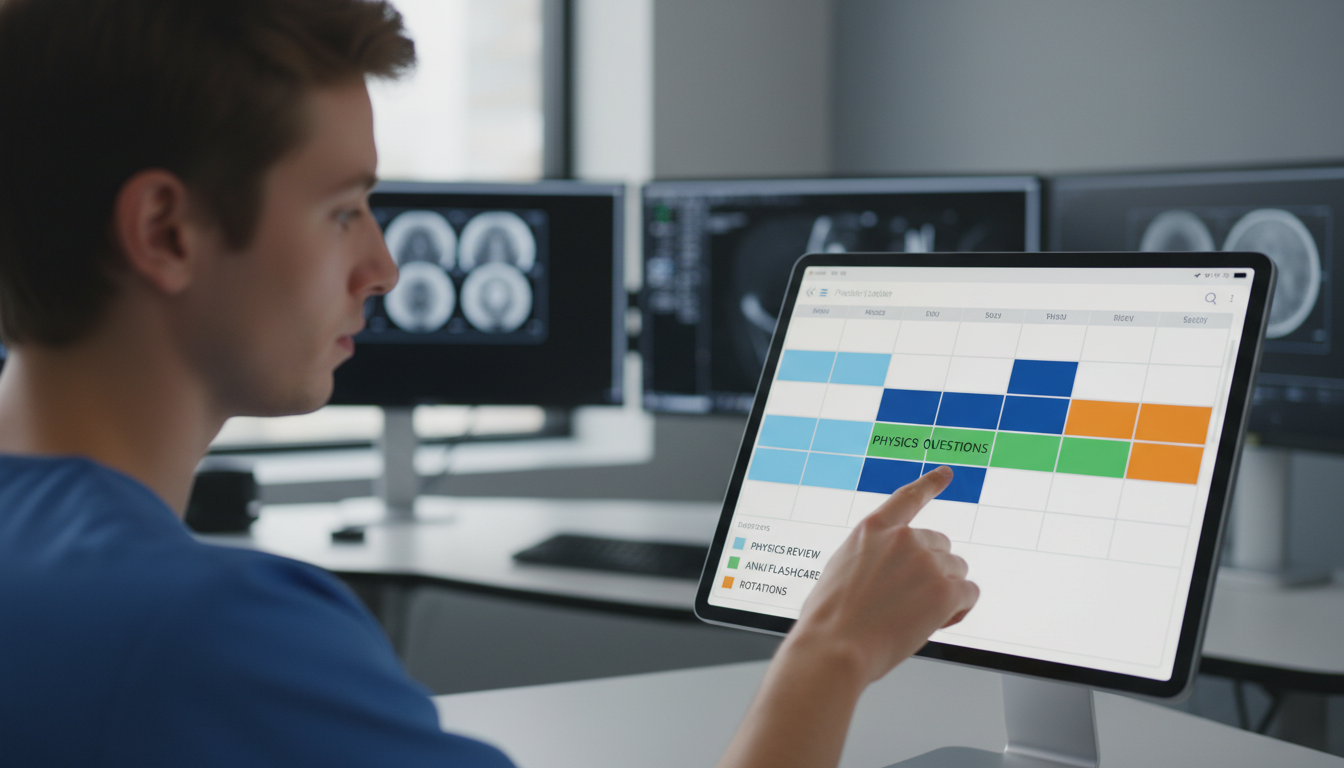
PGY-2 (R1): Foundation and Habits
Objectives:
- Solidify your clinical radiology basics.
- Build sustainable study habits that will carry through to the Core exam.
Key actions:
- Light use of board review books aligned with rotations:
- Neuro rotation → read neuro board review chapters.
- Chest rotation → chest imaging review and cases.
- Start a small Anki or flashcard system:
- 5–10 new cards per day based on interesting cases.
- Attend all physics and didactic lectures; annotate with quick summary notes.
PGY-3 (R2): Depth and Early Core Prep
Objectives:
- Expand your case exposure.
- Start structured preparation for the Core exam.
Key actions:
- Begin using a formal question bank:
- 10–20 questions/day focused on your rotation area.
- Systematic physics review:
- 1–2 hours/week of physics videos or reading.
- Begin physics flashcards.
- Begin dabbling in non-interpretive skills:
- One short module or chapter per week.
PGY-4 (R3/Core Exam Year): Focused, Exam-Oriented Study
Objectives:
- Fully align your studying with the ABR Core exam blueprint.
- Close knowledge gaps and refine test-taking strategy.
3–6 months before exam:
- Daily routine (example):
- 40–60 mixed Q-bank questions.
- 30–60 Anki cards (new + review).
- 1–2 physics topics per week.
- 2–3 non-interpretive chapters per week.
- Weekly checklist:
- One organ system focus (e.g., week of abdomen, week of neuro).
- Review of your “greatest misses” log.
1–2 months before exam:
- Increase focus on:
- Physics and non-interpretive skills (they are finite and high-yield).
- Full-length mixed practice tests simulating exam conditions.
- Taper new flashcards; prioritize reviewing your mature deck.
PGY-5 (R4) and Beyond: Certifying Exam and Lifelong Learning
While the Certifying exam is less resource-driven and more experience-based, many of the same tools remain relevant:
- Case-based question banks for your chosen modules/subspecialties.
- Up-to-date review books in your practice area (e.g., MSK, neuro, IR).
- Continuing medical education (CME) modules as a form of ongoing “question bank.”
Strategies for Choosing Among Competing Resources
There are more radiology board exam study resources than any one resident can use. A few guiding principles can help you choose efficiently:
Seek alignment with the ABR blueprint.
- If a resource doesn’t map clearly to Core exam domains, deprioritize it.
Prioritize image-rich, case-based content.
- Radiology is visual. Emphasize resources that mimic exam-style images and vignettes.
Ask senior residents and recent test-takers.
- They can tell you which resources felt overkill, which were essential, and what they wish they’d started earlier.
Balance breadth and depth.
- Core exam success is about consistently recognizing common and prototypical patterns, not perfection in rare zebras.
- Use textbooks sparingly; let Q-banks and board review books dominate.
Consider cost and time.
- More expensive does not automatically equal better.
- A modest set of well-chosen resources, used thoroughly, beats an overloaded, half-used library.
FAQs: Board Exam Study Resources in Diagnostic Radiology
1. How early should I start using dedicated board exam resources for the ABR Core?
Begin lightly in PGY-2 (R1) by integrating board review books with your clinical rotations and starting a small flashcard deck. Formal Core-focused study (structured Q-banks, systematic physics review, non-interpretive skills) should ramp up in PGY-3 (R2) and intensify in the 6–9 months before your Core exam.
2. How do I balance clinical work, call, and board exam studying?
Anchor your studying in daily habits rather than large, infrequent blocks. For example:
- 20–30 minutes of Anki during downtime or before/after work.
- 10–20 case-based questions on lighter days; 40–60 on study-heavy days.
- Short, focused reading in board review books targeted to your current rotation. Flex your volume up or down based on call and rotation intensity, but keep some minimal daily engagement.
3. Are general USMLE-style resources like UWorld still useful in radiology residency?
Directly, not much for imaging patterns; indirectly, quite a bit. Your USMLE background and UWorld tips experience taught you:
- How to approach complex vignettes.
- How to use question banks and explanations effectively.
- How to leverage spaced repetition (e.g., Anki USMLE decks). Those skills transfer well. The actual USMLE questions won’t help with the Core, but your study process from that era is highly relevant.
4. How much time should I devote to physics compared with imaging?
Most residents benefit from allocating roughly 15–25% of their Core study time to physics:
- Early: 1–2 hours/week for conceptual development.
- Late: 2–4 hours/week for drilling high-yield topics and practice questions. Physics is high-yield and finite; consistent, modest investment over time is more effective than trying to master it in a short cram period.
By building a strategic mix of case-based question banks, targeted board review books, physics and non-interpretive skills resources, and a disciplined flashcard system, you can approach the diagnostic radiology boards with the same confidence you brought to the diagnostic radiology match—only now with far more specialized, practical expertise.