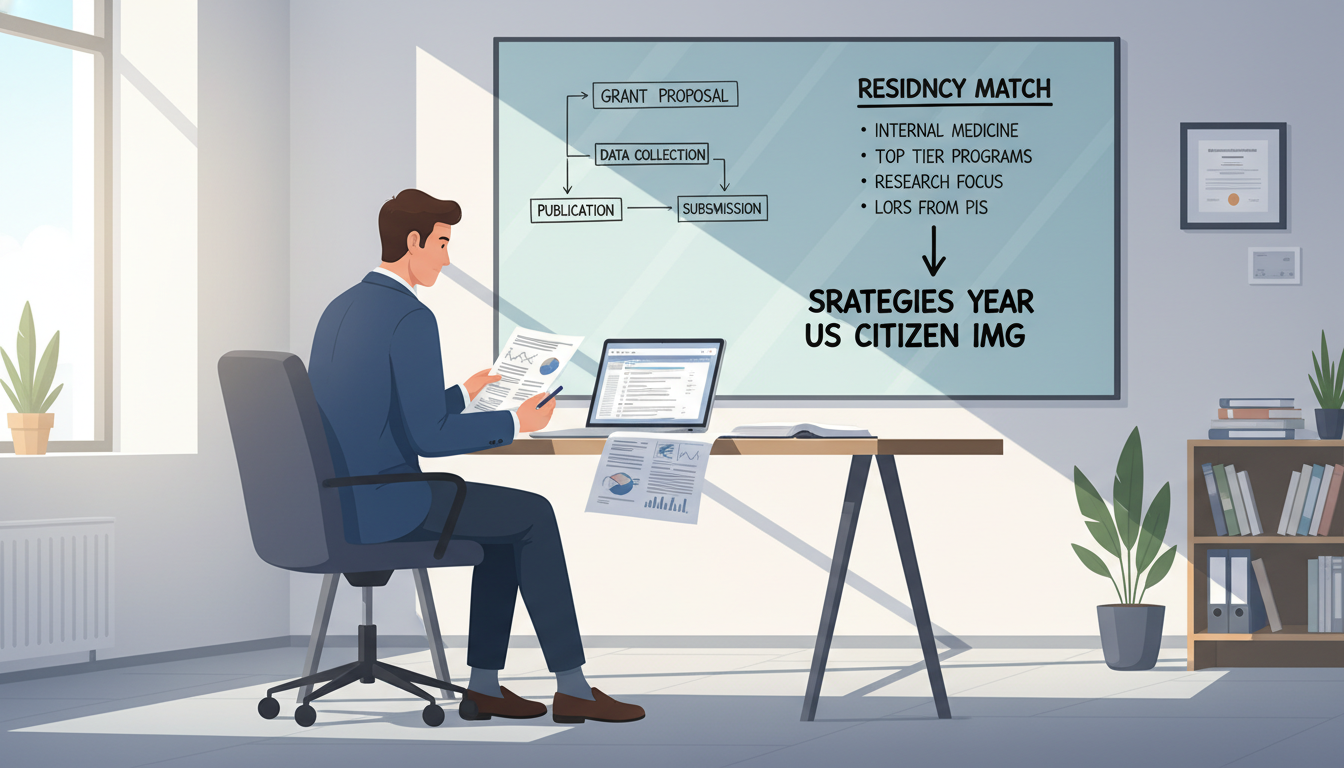
Choosing to take a research year as a US citizen IMG can dramatically change your residency trajectory—for better or worse—depending on how strategically you approach it. Used well, a research year can transform a marginal application into a competitive one, open doors at academic programs, and create powerful mentorship relationships. Used poorly, it can become an unfocused “gap year” with little to show and uncomfortable questions during interviews.
This article breaks down how American students studying abroad can turn a research year into a targeted, high-yield step toward residency.
Why US Citizen IMGs Should Consider a Research Year
For a US citizen IMG or American studying abroad, the playing field in the residency match is different from US MD/DO students. A well-planned research year can help close some of those gaps.
Common challenges for US citizen IMGs
You’re likely facing some or all of these:
- Limited clinical visibility in the US system
- Fewer opportunities for US-based letters of recommendation
- Program bias or unfamiliarity with your international school
- Step score pressures and increasing competitiveness
- A CV that may look thin compared to US grads (few publications, limited leadership roles)
How a research year helps
A strong, well-structured research year can:
Increase your academic credibility
- Publications, abstracts, and posters show you can contribute to scholarship.
- Demonstrates familiarity with US standards of research and evidence-based practice.
Create powerful networking opportunities
- Close contact with attendings, fellows, and residents at US institutions.
- Access to “inside advocates” who can email program directors (PDs) and speak for you.
Generate strong US-based letters of recommendation
- Letters from research mentors in your chosen specialty can carry major weight.
- If you also get clinical exposure at that institution, letters are even stronger.
Signal commitment to a specialty
- Particularly important if you are aiming for competitive fields (derm, ortho, ENT, plastics, neurosurgery, etc.).
- Shows you’re serious, focused, and invested in the specialty culture.
Productively explain a “gap year”
- Programs are wary of unexplained time away from training.
- “I took a research year in internal medicine at [US Institution] and published X papers” is a powerful narrative.
The key is moving from “I’m taking a gap year” to “I’m taking a research year with specific residency-focused goals.”
Step 1: Clarify Your Goals Before Taking a Research Year
Before you commit to a research year, be brutally honest with yourself: what do you actually need to improve to match?
Diagnose your application: where are the weaknesses?
Consider:
Exam performance
- Do you have Step 1 pass but lower performance, or a weak Step 2 CK score?
- A research year won’t erase exam issues, but it can show growth and compensate somewhat with academic strength.
Clinical exposure in the US
- How many US clinical electives or sub-internships do you have?
- Do you have no US letters yet?
Specialty choices
- Are you aiming for a highly competitive specialty?
- Are you undecided and considering a research year to “explore”?
Academic output
- Any publications, case reports, posters, or abstracts?
- Any prior research experience (even pre-med)?
Timeline concerns
- Will your graduation date make you a “non-recent graduate” by match standards?
- Are you taking a research year before or after graduation?
Translate weaknesses into concrete goals
For a US citizen IMG, taking research year time should serve very specific outcomes:
Publication goals
- Example: “At least 1 first-author manuscript submitted, 2–3 abstracts/posters.”
Networking and mentorship goals
- Example: “Work closely with at least 1 attending and 1 fellow who can write meaningful letters.”
Institutional goals
- Example: “Target a research position at a program where I’d be happy to match.”
Skill and credibility goals
- Example: “Gain familiarity with US EMR, institutional workflows, and clinical research protocols.”
If you can’t define clear goals, you may not be ready to commit to a research year. Clarifying why you are taking this path is critical—both for your planning and for future interview answers.

Step 2: Choosing the Right Type of Research Year (and Where to Do It)
Not all research experiences are created equal. For US citizen IMGs, where and how you do your research year can matter almost as much as what you do.
Clinical vs basic science vs outcomes research
Clinical research (often highest yield for residency)
- Directly connected to patient care and clinical questions.
- Often embedded in departments that run residency programs.
- More likely to give you:
- Patient contact (depending on visa/institutional rules)
- Interaction with residents/fellows
- Data for case reports and chart reviews
Outcomes/health services research
- Focused on quality, cost, access, or population health outcomes.
- Increasingly valued in internal medicine, pediatrics, psychiatry, EM, and primary care.
- Very good if you can connect your projects to DEI (diversity, equity, inclusion), disparities, or quality improvement.
Basic science / bench research
- Often less directly connected to clinical practice.
- Can still be powerful, particularly for neuroscience, oncology, or surgical subspecialties with strong lab traditions.
- May be less helpful if your ultimate goal is purely clinical, unless you join a lab directly connected to your target department.
For most American studying abroad students aiming at clinical specialties, clinical or outcomes research within a US department that has a residency program is usually the most strategic.
Where should a US citizen IMG do a research year?
Priority order (ideal to acceptable):
US academic center in your target specialty and target geographic region
- Example: You want to match in internal medicine in the Northeast → Aim for a medicine research year at a university hospital in that region.
- Best for:
- Networking with local program directors
- Institution name recognition
- Possibly transitioning to observerships or electives
US academic center in your target specialty (any region)
- If you can’t get your preferred location, any reputable US institution is still very valuable.
- Especially for ultra-competitive specialties, any strong name gives you credibility.
US non-academic but research-active center
- Some large community hospitals have strong research departments.
- May still provide excellent mentoring and letters.
Remote research or international institution
- This is sometimes necessary logistically, but carries less weight.
- If you choose this route, make sure you’re working with US-based collaborators if possible, or publishing in recognizable journals.
Paid vs unpaid research positions
US citizen IMGs have advantages here over non–US citizen IMGs because of citizenship and fewer visa barriers.
Funded research fellowships
- Some departments offer paid “research fellow” roles open to IMGs.
- These are highly competitive and often require proactive networking and early applications.
Unpaid volunteer research positions
- More common for IMGs.
- Still valuable if:
- The mentor is productive.
- You’re given real responsibility and clear project roles.
- Make sure duties are clearly defined so you’re not just doing endless data entry.
Key tip: The quality of mentorship and department reputation matter more than whether the position is paid or unpaid.
Step 3: How to Secure a Research Year Position as a US Citizen IMG
Landing the right position often requires persistence, strategy, and a willingness to hear many “no’s” before you get a “yes.”
Build a targeted list
Start by clarifying:
- Your target specialty (or two at most)
- Your geographic preferences
- Your timeline (before graduation, after graduation, pre- or post-Step 2)
Then:
Identify academic departments in your specialty:
- Use program websites, PubMed, and Google Scholar.
- Look for faculty who publish frequently and have titles like:
- “Director of Research”
- “Vice Chair for Research”
- “Program Director”
- “Section Chief”
Prioritize:
- Institutions with a history of taking IMGs.
- Programs that list “research fellows” or “postdoctoral scholars” on their websites.
- Faculty who have recently mentored students or residents (look for student/resident co-authors).
Cold emailing effectively
Your cold email must be brief, specific, and show value. Include:
- Who you are (US citizen IMG, school, graduation year)
- Your objective (taking research year before/after graduation to strengthen application in X specialty)
- Why you’re interested in their work (mention a recent paper or project)
- What you can offer (time commitment, skills—stats, programming, prior research, languages)
- A clear ask (virtual meeting or opportunity to volunteer/join a project)
- Attach a concise CV and a one-page summary of any prior research experience.
Consider an email subject line like:
- “US citizen IMG interested in a research year in [Specialty] – availability from [Month/Year]”
- “Prospective research fellow (US citizen IMG) with [specific skill, e.g., R/RedCap/Spanish]”
Send widely and follow up every 7–10 days up to two times per mentor. Persistence is necessary; many faculty simply miss emails.
Leverage your existing network
Even as an American studying abroad, you may have connections you’re overlooking:
- Alumni from your international school now in US residency
- Faculty at your med school with US collaborators
- Family or friends connected to US healthcare systems
- Previous pre-med mentors or research PIs
Ask specifically:
- “Do you know anyone in [Specialty] at a US institution who may be open to working with a research fellow for a year?”
A warm introduction can move your email to the top of a faculty member’s inbox.

Step 4: Designing a High-Yield Research Year (So It’s Not Just a “Gap Year”)
Once you secure a position, you must make the year count. Many IMGs work hard but end the year with little tangible output. Strategy prevents that.
Start with a project roadmap
Within the first 2–4 weeks, schedule a dedicated meeting with your primary mentor to discuss:
- How many projects you’ll be involved in (aim for a mix of:
- 1–2 larger projects where you’re deeply involved
- Several smaller, quicker projects like case reports, retrospective chart reviews
- Realistic timelines for:
- Abstract submissions
- Manuscript drafts
- Conference deadlines
Ask explicitly:
- “Given that I’m taking a research year to strengthen my residency application, what concrete deliverables (papers, abstracts, posters) do you think are achievable by [ERAS submission month]?”
Balance depth and breadth
For a research year residency strategy:
You need depth:
- At least one project where your role is substantial enough to be:
- First author, or
- Second author with significant contributions
- At least one project where your role is substantial enough to be:
You also need breadth:
- Case reports
- Retrospective analyses
- Quality improvement projects
- Conference abstracts/posters
Breadth gives you multiple lines on your CV; depth gives you strong talking points for interviews.
Network intentionally within the department
Don’t just sit at your desk and crunch data. Use the year to become part of the department’s “ecosystem.”
Ways to do this:
- Attend departmental grand rounds and conferences regularly.
- Go to journal clubs, morbidity & mortality conferences, or resident teaching sessions (if allowed).
- Introduce yourself to:
- Fellows and residents
- The program coordinator
- The program director (when appropriate)
- Volunteer for:
- Helping with resident projects
- Assisting with departmental quality improvement efforts
You want to be a known quantity in the department by the time applications go out.
Seek US clinical exposure if possible
Some research positions may allow:
- Limited shadowing
- Involvement in clinical trials where you see patients under supervision
- Access to EMR for chart review (with IRB and proper training)
While this isn’t the same as a formal US clinical elective, it:
- Helps you understand US clinical workflows
- Adds richness to your interview stories
- Strengthens your letters (mentors can comment on your clinical reasoning exposure and professionalism)
Document your achievements as you go
Don’t wait until ERAS season to compile everything. Keep:
- A running log of:
- Projects
- Your specific roles
- Dates of:
- Abstract submissions
- Poster presentations
- Manuscript submissions/acceptances
- Copies or PDFs of:
- Abstracts
- Posters
- Final publications
This will make ERAS entries and interview prep much easier.
Step 5: Positioning Your Research Year for Maximum Residency Impact
The value of taking a research year is only fully realized if you present it well in your application and interviews.
How to frame your research year in ERAS
In your personal statement, if relevant:
- Briefly explain why you chose to take a research year:
- “As a US citizen IMG and American studying abroad, I recognized I needed deeper exposure to [US specialty] and the US academic environment.”
- Highlight what you gained:
- Specific skills (research methods, statistical analysis, critical appraisal)
- Mentorship and understanding of the specialty culture
- How it reaffirmed or refined your career goals
In the Experience section:
- List your position clearly: “Research Fellow,” “Research Assistant,” or “Research Scholar.”
- Describe:
- Types of projects
- Your responsibilities (data collection, analysis, protocol design, patient recruitment)
- Any leadership roles (coordinating teams, mentoring students)
Leveraging letters of recommendation from your research year
Aim for at least one letter from your research mentor, ideally:
- A faculty member who knows you well
- Someone with a title that carries weight (Program Director, Division Chief, etc.)
- Someone who can comment on:
- Work ethic
- Reliability
- Communication skills
- Intellectual curiosity
- How you compare with US grads they’ve worked with
If you’ve worked with more than one faculty closely, consider asking for multiple letters, especially if you are applying broadly within the same specialty.
Answering “Why did you take a year off?” in interviews
Programs will ask why you took a break from “straight-through” medical training. For a gap year research experience, your answer should:
- Avoid sounding like you were forced into it.
- Emphasize proactive learning and intentionality.
- Link directly to your growth as a future resident.
Example framing:
“As a US citizen IMG, I knew that to be a competitive applicant in [specialty], I needed not only strong exam scores but also evidence of commitment to the field and familiarity with the US academic environment. Taking a research year at [institution] allowed me to work closely with [faculty], contribute to projects on [topic], and understand how [specialty] functions within a US healthcare system. It confirmed that this is the right field for me and helped me develop skills in critical appraisal, teamwork, and communication that I’ll bring to residency.”
Aligning your research with your specialty target
For competitive specialties, alignment is especially important:
- Dermatology → dermatology research
- Orthopedics → ortho or musculoskeletal research
- Neurosurgery → neurosurgery or neuroscience research
- ENT → otolaryngology or head & neck surgery research
For less competitive or broader specialties (FM, IM, peds, psych):
- Topic alignment is helpful, but less rigid.
- Outcomes, QI, or patient-safety oriented projects are often highly valued.
Common Pitfalls (and How to Avoid Them)
Many US citizen IMGs taking research year time fall into avoidable traps.
Pitfall 1: Treating it as an unstructured “gap year research” experience
- Problem: No clear projects, no timeline, vague responsibilities.
- Result: Poor productivity, weak letters, and uncomfortable explanations.
Fix: Secure a position with:
- Defined projects
- A mentor experienced in supervising trainees
- A plan for publications and presentations from the start
Pitfall 2: Overcommitting and underdelivering
- Problem: Saying yes to too many projects, missing deadlines.
- Result: Strained relationships with mentors and weak or lukewarm letters.
Fix:
- Start with a few manageable projects.
- Regularly update your mentor on progress.
- Be honest about your bandwidth.
Pitfall 3: Isolating yourself from the clinical environment
- Problem: Only doing data work from home/office, no department presence.
- Result: Limited integration and weaker networking.
Fix:
- Attend rounds, conferences, and teaching sessions when allowed.
- Ask to shadow occasionally to better understand the specialty context of your research.
Pitfall 4: Ignoring the match timeline
- Problem: Projects that will not yield any tangible output before ERAS.
- Result: Hard to show productivity and impact in your application year.
Fix:
- Prioritize at least a few short-term, high-yield projects (e.g., case reports, retrospective chart reviews).
- Time submissions around common abstract deadlines and ERAS opening.
FAQs: Research Year Strategies for US Citizen IMGs
1. Is taking a research year always necessary for a US citizen IMG?
No. A research year is strategic, not mandatory. It’s most helpful if:
- You’re applying to a competitive specialty.
- You lack US clinical experience or US letters.
- Your CV is light on academic productivity.
- You want to build connections in a specific region or institution.
If your scores are strong, you have US rotations and letters, and your target specialty is less competitive, you may not need a research year.
2. Does a research year make up for low Step scores?
A research year cannot erase low scores, but it can:
- Show resilience, growth, and academic potential.
- Help you stand out through publications and networking.
- Provide strong letters that contextualize your performance and advocate for your clinical potential.
Programs still care about Step 2 CK, so combine your research year with a solid exam strategy.
3. What if my research year doesn’t lead to publications before ERAS?
Publications are ideal, but not the only metric:
- Abstracts and poster presentations are valuable and often easier to attain quickly.
- Manuscripts “submitted” or “under review” can still be listed in ERAS.
- Strong letters stating you were essential to a project can offset fewer publications.
Still, aim from the beginning for at least some short-term projects that can produce abstracts or case reports on a faster timeline.
4. How should I time my research year relative to graduation?
Options:
Before graduation:
- Pros: You can go back and do final-year electives with a stronger profile.
- Cons: Coordination with your med school curriculum can be tricky.
After graduation, before applying:
- Pros: Clear focus on research; full-time involvement.
- Cons: You may be “out of clinical practice” longer—offset this with shadowing and clinical research.
After an unsuccessful match (re-applicant):
- Pros: Research year can be framed as a focused effort to strengthen weak areas.
- Cons: You must be even more strategic and realistic about specialty choice.
For many US citizen IMGs, a dedicated research year just before or immediately after graduation is optimal, especially if combined with US rotations near the same time.
A research year, when done thoughtfully, is not just a way of “filling time.” For a US citizen IMG or American studying abroad, it can be a powerful accelerator—turning you from an unknown applicant into a familiar, trusted colleague in your chosen specialty. The difference lies in planning: clear goals, strategic positioning, the right environment, and proactive networking.
If you commit to those elements, your research year can become one of the most impactful phases of your journey toward residency.