Introduction: Why Your Residency Application Strategy Must Be Resilient
Residency applications sit at the intersection of everything you’ve poured into your medical education—years of study, clinical rotations, exams, and personal sacrifice. Yet even strong applicants can feel overwhelmed by the unpredictability of the Residency Match, shifting program priorities, and changing exam landscapes.
A resilient residency application strategy is not just about “being tough” or adding more accomplishments. It’s a structured, adaptive approach that:
- Anticipates obstacles and setbacks
- Uses your unique strengths intentionally
- Protects your mental health and capacity to perform
- Allows you to pivot, adjust, and keep moving forward
This guide reframes the process so you are not simply completing tasks, but deliberately building a strategic, flexible plan that can withstand stress, rejection, and uncertainty—while still positioning you to match into a program where you can thrive.
Why Resilience Matters in the Residency Application Process
Resilience is often described as “bouncing back,” but in the context of residency applications, it is more accurately:
The capacity to plan, adapt, and respond constructively to academic, personal, and systemic challenges—while maintaining your long-term goals and well-being.
The Unique Stressors of Residency Applications
The residency application process combines multiple high-stakes elements:
- Academic performance: USMLE/COMLEX scores, clerkship grades, class rank
- Clinical evaluations: Narrative comments, professionalism, and reliability
- Experiential portfolio: Research, leadership, quality improvement, volunteerism
- Subjective assessments: Personal statement, interview performance, letters of recommendation
- External uncertainty: Program competitiveness, changing requirements, and evolving selection metrics (e.g., pass/fail Step 1)
Without resilience, these pressures can lead to:
- Burnout or emotional exhaustion
- Imposter syndrome and self-doubt
- Avoidance of challenging tasks (e.g., delaying personal statement or interview prep)
- Rigid thinking—clinging to a single “ideal plan” even when data suggest a need to pivot
A resilient residency application strategy helps you manage these pressures and still present your best self.
The Role of Mental Toughness and Emotional Flexibility
Mental toughness does not mean ignoring your emotions or “pushing through” at all costs. In a sustainable strategy, it involves:
- Reality testing: Honestly evaluating your strengths and gaps without catastrophizing
- Reframing setbacks: Viewing a below-target Step score or failed research project as data to guide your next move
- Emotional regulation: Using self-care and support systems to stay functional during peak stress periods
- Growth mindset: Seeing the application process as a final stage of your medical education—an opportunity to refine your professional identity
Resilient applicants do not avoid discomfort; they learn to work with it. They treat the application cycle as a demanding but manageable project, not a referendum on their worth as future physicians.
Core Components of a Resilient Residency Application Strategy
1. Start Early and Build a Realistic, Adaptive Timeline
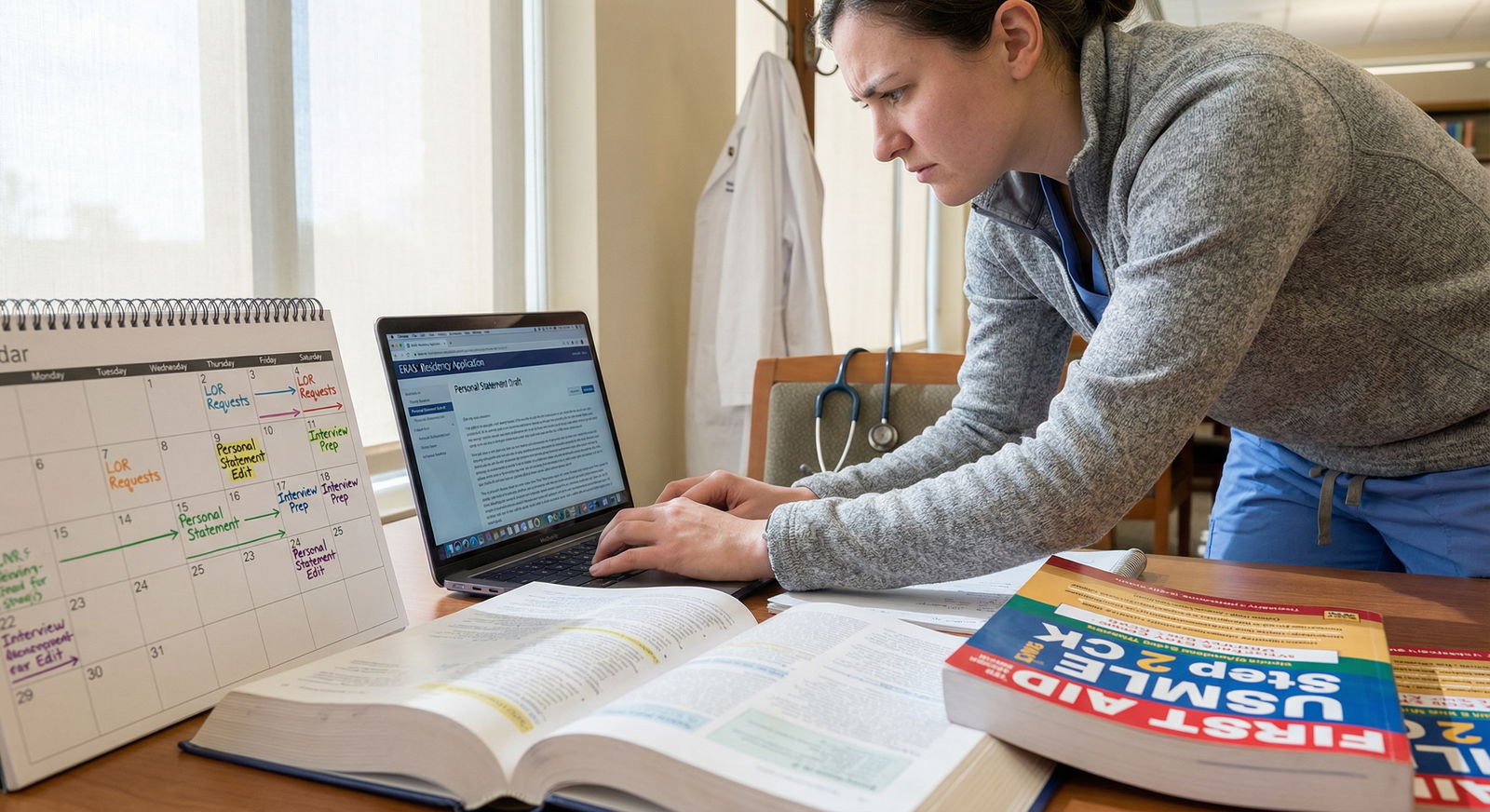
A resilient strategy starts long before ERAS opens. Instead of cramming everything into MS4, spread key tasks across your medical education, creating room to adjust when things don’t go as planned.
A Long-View Timeline for Medical Students
Use this as a flexible framework rather than a rigid checklist:
Preclinical Years (M1–M2 / Freshman–Sophomore Equivalent)
- Prioritize strong foundations in basic sciences and clinical reasoning
- Explore specialties through interest groups, shadowing, and early mentorship
- Begin light involvement in research or community work that aligns with your interests
- Start a living CV: regularly update experiences, roles, and achievements
Early Clinical Years (M3 / Junior Year)
- Treat every rotation as an extended “interview” for letters and narrative evaluations
- Identify potential letter writers early; demonstrate reliability, curiosity, and initiative
- Start reflecting on specialty choice: note what energizes you versus what drains you
- Draft early thoughts for your Personal Statement—even as bullet points or journal entries
Late Clinical/Pre-Application Year (M3–M4 Transition)
- Take USMLE Step 2 CK/COMLEX Level 2 with a strategic timeline based on your performance and goals
- Solidify specialty decision with input from mentors and honest self-reflection
- Map out audition/sub-internship rotations aligned with your target specialty(ies)
- Begin structured Personal Statement drafts and update your CV in ERAS format
Application Year (M4 / Senior Year)
- Spring–Early Summer:
- Finalize specialty choice and create a tiered program list (reach, target, safety)
- Ask for letters of recommendation early with clear timelines
- Mid–Late Summer:
- Finalize Personal Statement(s)
- Enter and double-check ERAS data
- Review application with advisor/mentor for red flags or gaps
- Fall–Winter:
- Prepare and practice for interviews
- Track interviews, communication, and impressions systematically
- Build a ranking strategy based on fit, not prestige alone
A resilient timeline includes buffer zones—extra time for unexpected events like exam delays, illness, or personal challenges. When timeline disruptions occur, you can adjust without derailing your entire strategy.

2. Build a Strength-Based, Coherent Residency Portfolio
Resilience is easier when your application reflects who you actually are, rather than a scattered collection of obligations. A strength-based portfolio emphasizes depth, coherence, and authenticity.
Reflect Systematically on Your Core Strengths
Consider organizing your experiences into a few thematic pillars:
Clinical Excellence and Professionalism
- Rotations where you consistently performed well
- Situations where you went above and beyond for patient care
- Examples of teamwork, reliability, and initiative
Scholarship and Curiosity
- Research projects, QI initiatives, presentations, or publications
- Not just outcomes, but what you learned from the process (even if projects were not published)
Leadership and Service
- Roles in student organizations, advocacy efforts, or community outreach
- Times you improved a process, solved a problem, or supported a vulnerable group
Personal Attributes and Life Experience
- Nontraditional paths, previous careers, caregiver roles, or major life challenges
- Language skills, cultural competence, or lived experiences that shape your approach to care
When you understand these pillars, you can:
- Select experiences to highlight that reinforce your specialty choice
- Present a coherent narrative across your CV, Personal Statement, and interviews
- Avoid the “checklist” trap of doing activities only because you think programs expect them
Aligning Your Portfolio With Specialty Expectations
Each specialty values a slightly different mix of attributes:
- Surgical fields: Technical aptitude, stamina, teamwork under pressure, longitudinal commitment to surgery-related experiences
- Primary care fields: Communication, continuity of care, community engagement, and broad clinical exposure
- Competitive specialties: Early, consistent engagement with the field, strong academic metrics, research, and mentorship
Resilient applicants study NRMP Program Director Surveys, specialty organization guidelines, and match data to understand typical expectations, then build realistic strategies—either to align or to identify complementary backup plans.
3. Craft a Powerful, Reflective Personal Statement
Your Personal Statement is not a prose version of your CV. It is your best opportunity to explain:
- Why this specialty aligns with your values, strengths, and aspirations
- What you have learned from your experiences—especially difficult ones
- How you bring resilience, reflection, and self-awareness to your training
This is especially important for applicants with nonlinear paths, exam setbacks, or red flags; a resilient statement acknowledges reality without self-sabotage.
Key Principles for a High-Impact Personal Statement
1. Lead with a Real Story, Not a Cliché
Avoid generic openings about always wanting to be a doctor. Instead, choose a specific moment that:
- Illustrates how you think, act, or connect with patients
- Connects organically to the core values of your chosen specialty
2. Highlight Growth, Not Perfection
Resilient candidates are honest about moments when they were challenged:
- A difficult patient encounter that forced you to examine your biases
- Balancing caregiving responsibilities with medical school demands
- Recovering from an academic setback and how it changed your approach
Focus on what you did, what you learned, and how it now shapes your practice.
3. Align Clearly With the Specialty
Explicitly connect your experiences to specialty-defining themes. For example:
- For Pediatrics: advocacy, family-centered care, communication with caregivers
- For Psychiatry: curiosity about behavior, comfort with ambiguity, longitudinal relationships
- For Emergency Medicine: rapid decision-making, interprofessional teamwork, adaptability
4. Keep It Focused, Concrete, and Readable
- Aim for 1 page, well-structured paragraphs, and clear transitions
- Avoid overly ornate language or excessive self-praise
- Use 2–3 key experiences that tie together, rather than listing everything
4. Secure Meaningful, Specific Letters of Recommendation
Letters of Recommendation can convert your application from “solid on paper” to “someone I want on our team.” A resilient strategy focuses on quality, specificity, and credibility rather than chasing big names who barely know you.
Choosing the Right Letter Writers
Prioritize individuals who:
- Supervised you directly in clinical or research settings
- Observed your reliability, teamwork, and growth
- Can comment on your suitability for your chosen specialty
Common strong options:
- Clerkship directors in your chosen field
- Sub-I or acting internship supervisors
- Long-term research mentors
- Longitudinal preceptors or continuity clinic attending (for primary care fields)
When possible, aim for at least one letter from your target specialty and one letter that speaks to your character and work ethic across settings.
Setting Your Letter Writers Up for Success
Strengthen your letters by:
- Asking early and in person (or via video if necessary), allowing writers ample time
- Providing a concise “letter packet”:
- Updated CV
- Draft Personal Statement
- Brief bullet list of projects or cases you worked on with them
- Any specific qualities you hope they can address (e.g., resilience, leadership, clinical reasoning)
Resilient applicants also:
- Have a backup plan if a letter writer becomes unavailable
- Track letter status and send polite reminders ahead of deadlines
5. Mastering the Residency Interview as a Test of Fit and Resilience
Interviews are not solely knowledge tests; they are your chance to demonstrate communication skills, professionalism, and how you navigate uncertainty and stress in real time.
Preparation: Practice With Purpose
Instead of memorizing “perfect” answers, build a flexible framework:
- Practice common behavioral questions using the STAR method (Situation, Task, Action, Result)
- Prepare 4–6 core stories that illustrate your:
- Teamwork
- Conflict resolution
- Handling mistakes
- Leadership
- Resilience after setback
- Anticipate questions about:
- Specialty choice
- Your “red flags” (e.g., exam failures, gap years)
- Strengths and weaknesses
- Future goals and fellowship interests
Mock interviews—with peers, faculty, or your career office—are invaluable. Ask for detailed feedback not just on content, but on:
- Nonverbal communication
- Clarity and structure of answers
- Overuse of fillers or tangents
Showing Resilience and Authenticity During Interviews
Program faculty often assess:
- How you respond when caught off guard
- Whether you can reflect on mistakes without defensiveness
- How you handle vague or ethical questions
Demonstrate resilience by:
- Owning your challenges calmly and concisely
- Emphasizing what you learned and how you’ve changed your behavior
- Keeping focus on patient care and team-based practice
Remember that interviews are also your chance to evaluate programs:
- Ask targeted questions about mentorship, wellness, schedule flexibility, and feedback culture
- Look for how residents talk about their program when faculty are not present
- Consider whether the program environment supports resilience or erodes it
6. Flexibility, Backup Plans, and Smart Risk Management
A resilient Residency Application strategy includes contingencies. It doesn’t assume the “dream specialty + dream program” outcome is the only acceptable path.
Honest Self-Assessment and Specialty Choice
Work with advisors to answer:
- Are my exam scores, grades, and experiences consistent with typical matched applicants in my specialty of interest?
- If not, can I reasonably close the gap (e.g., with a strong Step 2, research, or additional rotations)?
- What related specialties or combined programs might also align with my strengths and values?
In some cases, resilient planning may involve:
- Applying to a mix of more and less competitive programs
- Considering a dual-application strategy to a backup specialty
- Planning a dedicated research year or preliminary year if needed
Adapting When the Unexpected Happens
Common curveballs include:
- Lower-than-expected board scores
- Family emergencies or health issues limiting away rotations or exam timing
- Fewer interview invitations than anticipated
Resilient responses might include:
- Expanding your program list strategically
- Seeking targeted advising from your Dean’s office or specialty advisors
- Reframing your geographic flexibility
- Considering SOAP (Supplemental Offer and Acceptance Program) strategies in advance, as a pragmatic—not pessimistic—step
Flexibility does not mean abandoning your goals; it means finding multiple routes to practicing the kind of medicine that fits you.
7. Prioritizing Self-Care and Mental Health Throughout the Process
Self-care is not a luxury; during the residency application cycle, it is a core performance enhancer and essential to resilience.
Building Sustainable Routines
Key self-care strategies tailored to medical trainees include:
- Sleep as a nonnegotiable baseline:
Even during busy rotations or interview season, protect a minimum sleep window whenever possible - Movement and physical activity:
Short, consistent efforts—10–20 minutes of walking, stretching, or bodyweight exercises—can markedly reduce stress - Nutrition basics:
Aim for regular meals and hydration; plan ahead with snacks during long hospital days
Evidence-Based Mental Health Supports
Practical tools that align with the realities of medical training:
- Brief mindfulness practices: 3–5 minute breathing, grounding, or body scans between tasks
- Reflective writing: Short weekly reflections on what went well, what was hard, and what you learned
- Peer support: Informal group chats, co-working sessions for ERAS tasks, or debriefing after interviews
- Professional support when needed:
Consider student mental health services, counseling, or therapy—especially if you notice persistent anxiety, sadness, or burnout symptoms
A truly resilient Residency Application strategy protects your capacity to think clearly, show up fully for patients and interviews, and make sound decisions about your future.

FAQs: Building a Resilient, Successful Residency Application Strategy
1. What is the most important part of a residency application?
Different program directors emphasize different elements, but consistently high-impact components include:
- Letters of Recommendation: Trusted faculty describing your performance and character
- Clinical evaluations and clerkship performance: Especially in your chosen specialty
- Personal Statement: A window into your motivations, resilience, and fit
- Interview performance: Where your on-paper application becomes a real person
Instead of focusing on a single “most important” part, a resilient strategy aims for coherence across all components, telling the same authentic story about who you are as a future resident.
2. How can I make my residency application stand out in a competitive field?
You stand out by being clear, consistent, and authentic, not by trying to be someone you’re not. Practical tactics:
- Align your clinical, research, and leadership experiences with your chosen specialty
- Use your Personal Statement to explain your unique path and perspective
- Demonstrate growth and reflection—particularly around challenges or failures
- Show up to interviews prepared with thoughtful questions and well-articulated goals
- Highlight any distinctive skills or backgrounds (languages, prior careers, community ties, lived experiences)
Programs remember candidates who are genuinely themselves, not those trying to fit a perceived mold.
3. How should I choose a specialty that aligns with my resilience and long-term well-being?
Consider:
- Daily work realities: Do you enjoy acute care, longitudinal relationships, procedures, or cognitive problem-solving?
- Your stress patterns: In which settings do you feel energized versus drained?
- Role models: Which attendings or residents live a life you could see yourself wanting in 10–15 years?
- Lifestyle and values: Consider call schedules, geographic flexibility, family or caregiving responsibilities, and long-term goals
Talk candidly with residents in your fields of interest, and be honest with yourself. A resilient path is one where your work environment and personal traits are aligned, reducing chronic friction.
4. How do I handle setbacks like a low board score or failed exam in my application?
Setbacks do not automatically end your chances of matching, but they do require:
- Honest self-assessment: Understand what contributed—study strategy, timing, life events, test anxiety
- Concrete remediation steps: Adjust your study methods, seek tutoring, plan test retakes strategically
- Thoughtful explanation:
- Acknowledge what happened without making excuses
- Emphasize what you changed and how your later performance reflects that change
- Strategic planning: Consider a broader program list, backup specialties, or additional experiences that demonstrate your true capability
Programs are often more reassured by applicants who own and grow from setbacks than by those who pretend nothing happened.
5. What are practical self-care strategies during residency application and interview season?
Along with foundational sleep, nutrition, and movement, try:
- Time-blocking: Schedule specific, limited periods for ERAS tasks and interview prep to prevent burnout
- Digital boundaries: Set cut-off times for checking email or obsessively refreshing application portals
- Mini-rituals before interviews: Short breathing exercises, power poses, or listening to a favorite song
- Post-interview decompression: Brief reflection or journaling, then intentional disconnect (walk, call a friend, do something non-medical)
Remember: Self-care is a professional responsibility. Protecting your well-being allows you to show up as the best possible version of yourself—for your patients, your colleagues, and your future program.
By treating your Residency Application as a strategic, adaptive process rather than a one-shot performance, you build resilience that will serve you not only through Match Day, but throughout your residency training and career in medicine.