Understanding the Landscape: Can You Really Start a Private IR Practice?
Starting a private practice in interventional radiology (IR) is absolutely possible—but it’s more complex than hanging a shingle and buying a C-arm. The interventional radiology residency and IR match now produce graduates who are clinically trained, procedure-heavy physicians used to inpatient consults and call-heavy services. Transitioning that skill set into an outpatient, entrepreneurial environment requires strategy.
There are three major realities you need to understand early:
IR is capital-intensive. You can do clinic, basic ultrasound-guided procedures, and vein work with relatively modest investment, but a full outpatient-based lab (OBL) or ambulatory surgery center (ASC) with arterial interventions, dialysis work, and complex procedures requires high upfront cost and careful payer contracting.
Referral patterns are everything. Unlike diagnostic radiology, an interventional radiology residency prepares you for consult-based, longitudinal care. Your ability to cultivate and maintain strong referral relationships will make or break your practice.
Employment vs ownership is a spectrum. You don’t have to jump directly into a fully independent OBL. Many IR physicians evolve from hospital employment to hybrid models, and then, when the time and market are right, into full private ownership.
As you map your path from IR match to independent practice, keep this framing in mind:
- 0–3 years post-residency/fellowship: Learn clinical and procedural breadth, understand hospital politics, and observe how money flows.
- 3–7 years: Clarify your vision, build a brand, and test outpatient volumes (e.g., veins, pain, basic endovascular).
- 7+ years: Consider opening medical practice sites (clinic, OBL, ASC), negotiating joint ventures, and building a group.
Throughout this article, we’ll walk step-by-step through how to plan, launch, and grow an interventional radiology private practice that is financially viable and clinically rewarding.
Step 1: Clarify Your Practice Vision and Scope
Before you pick a city or lease space, you need a clear, written vision of what kind of IR practice you intend to build. “Private practice” is not one model; it’s a continuum.
Define Your Practice Type
Common models for interventional radiology private practice include:
Consult-focused clinic + limited procedures
- Office-based consults and follow-up
- Basic ultrasound-guided procedures (paracentesis, biopsies, superficial venous procedures)
- Procedures done either:
- At a local hospital under a professional-fee arrangement, or
- In a small procedure room within your office
Vein and outpatient IR clinic
- Focus on chronic venous disease, superficial venous ablation, sclerotherapy, wound care, and some peripheral arterial disease (PAD)
- Relatively lower capital cost (often no full angio suite needed)
- Heavy on marketing and direct-to-consumer educational outreach
Full office-based lab (OBL)
- Dedicated angio suite(s) with fixed or mobile C-arm
- Bread-and-butter: PAD interventions, dialysis access, uterine fibroid embolization (UFE), prostate artery embolization (PAE), kyphoplasty, outpatient oncology procedures, some pain interventions
- Requires robust payer contracting and careful case selection
Ambulatory surgery center (ASC) or hybrid OBL/ASC
- Higher-acuity procedures, often with anesthesia
- Potential for multi-specialty partnerships (vascular surgery, pain, ortho, GI)
- High regulatory and capital requirements, but strong revenue potential
Hybrid employment + private practice
- Maintain a part-time employed position (e.g., hospital IR service, diagnostic group partnership)
- Run a private clinic/OBL on other days
- Often a lower-risk path to test the market before fully committing
Narrow Your Clinical Focus
For a successful interventional radiology residency graduate, it can be tempting to “do everything.” That’s risky when starting private practice.
Choose 2–4 core service lines that:
- Are in demand in your chosen region
- Fit outpatient/OBL practice safely
- Have reasonable reimbursement and payer support
- Align with your skills and interests
Example service line combinations:
- Vein-centric: Varicose veins, venous insufficiency, DVT/PE follow-up, wound care
- Women’s and men’s health: UFE, PAE, pelvic congestion syndrome, varicocele, pelvic pain
- Vascular & dialysis: PAD, claudication, critical limb ischemia (CLI), dialysis access maintenance
- Oncology IR light: Port placement, biopsies, basic ablation in partnership with a hospital or ASC
Clarifying your targeted scope informs everything: equipment, staffing, space design, and marketing.
Step 2: Market Research, Location, and Competitive Analysis
Location decisions for an interventional radiology residency graduate are often driven by family, lifestyle, or prior ties—but for starting private practice, you must step back and analyze the market.
Analyze Local Demand
Key questions:
Population: Is there sufficient population density to support an IR-focused clinic or OBL? Look at:
- Age distribution (older populations => more PAD and dialysis)
- Obesity and diabetes prevalence
- Existing wound care or vascular service needs
Referral base: Who will send you patients?
- Primary care physicians (PCPs)
- Vascular surgery
- OB/GYNs (for UFE and pelvic pain)
- Urology (for PAE, varicocele)
- Nephrology (for dialysis access work)
- Oncology and general surgery
Conduct informal interviews:
- Ask PCPs: “Where do you send PAD patients?” “Are patients waiting too long for access maintenance?”
- Ask OB/GYNs: “How do you currently manage women with symptomatic fibroids?”
- Ask nephrologists: “Are you satisfied with your current access center turnaround times?”
If you hear complaints about access, long waits, or patients traveling far, that’s opportunity.
Evaluate Competition
You don’t need a competition-free zone, but you do need clear differentiation.
Assess:
- Existing IR groups: Are they largely hospital-based or do they have OBLs?
- Vascular surgery and cardiology presence: Are there strong PAD and vein players already dominating the market?
- Independent access centers: Who is doing dialysis work?
- Large academic centers: Do they draw complex cases out of your region?
Look for gaps:
- Under-served geography (e.g., suburbs, secondary cities, rural hubs)
- Unmet service lines (e.g., no one marketing UFE, limited PAE, limited vein-focused clinics)
- Poor patient experience with current providers (access, communication, outcomes)
Choose a Strategic Location
For a clinic/OBL:
- Proximity to referrers: Within 10–20 minutes of major PCP, nephrology, or OB/GYN hubs
- Accessibility: Plenty of parking, ADA-compliant design, ground-level or elevator access for mobility-limited patients
- Visibility: If you plan direct-to-consumer marketing (veins, UFE), a visible street-front office can reinforce brand awareness
Check zoning and building suitability:
- Is the building zoned for medical use?
- Can it support the electrical, shielding (if needed), and HVAC needs of an angio suite?
- Is there adequate space for recovery bays, sterile storage, crash cart, and staff workrooms?
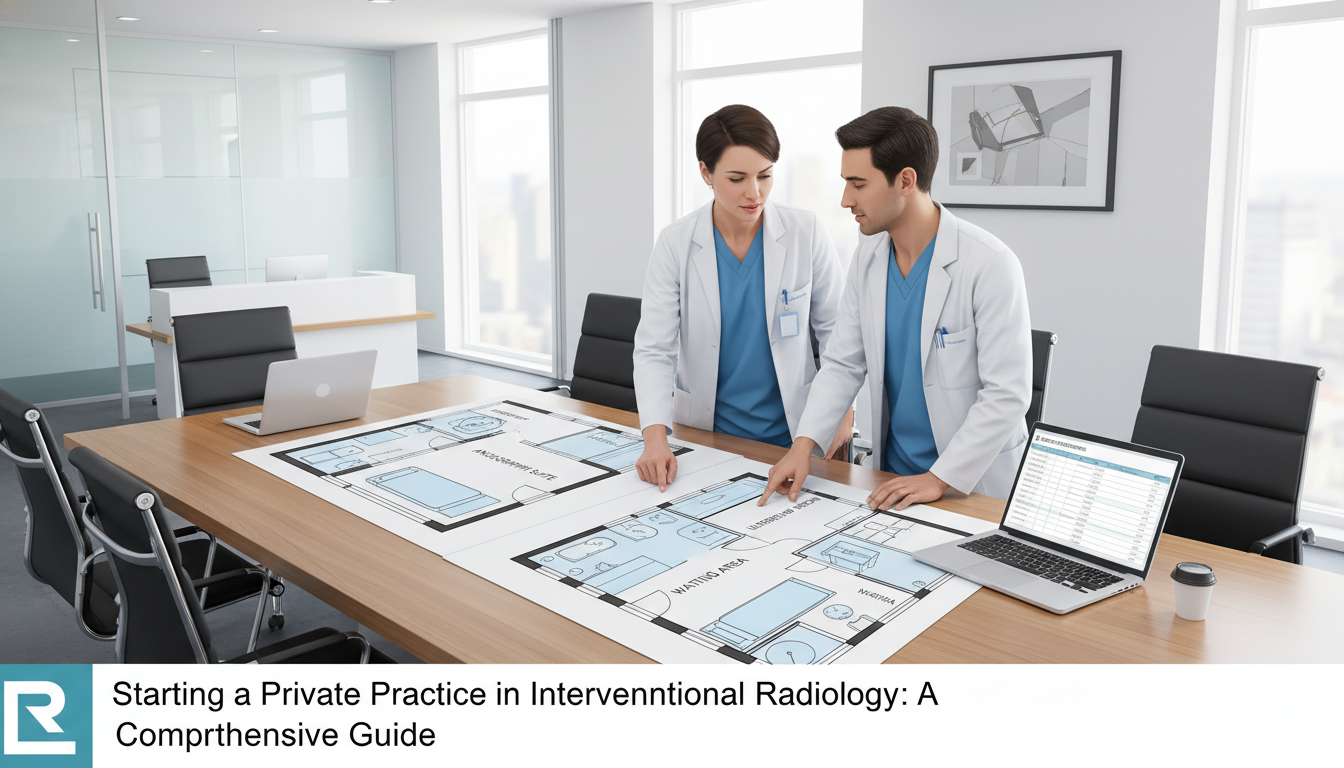
At this stage, begin loosely sketching your space needs (e.g., 3 exam rooms, 1 procedure room, 1 ultrasound room, 4 PACU bays) to guide site selection.
Step 3: Business Planning, Legal Structure, and Financing
Opening medical practice in IR without a solid business plan is dangerous. Even if you dislike spreadsheets, dedicating time to a formal plan will save you time, money, and stress.
Create a Basic Business Plan
Your plan doesn’t have to be 100 pages, but it should clearly cover:
Executive summary
- What type of practice?
- Where?
- What services?
- What makes you different?
Market analysis
- Demographics, referral base, competition summary
- SWOT analysis (Strengths, Weaknesses, Opportunities, Threats)
Operations plan
- Clinical services and days/hours
- Staffing needs (front desk, MA, nurse, technologist, practice manager)
- Patient flow: referral → consult → procedure → follow-up
Marketing strategy
- Physician-to-physician outreach
- Community and patient education
- Digital presence (website, SEO, social media, online reviews)
Financial projections (3–5 years)
- Start-up costs (build-out, equipment, licenses, EMR, malpractice, initial payroll)
- Ongoing fixed and variable costs
- Payer mix assumptions (Medicare, Medicaid, commercial, self-pay)
- Revenue estimates by CPT code and volume assumptions
- Break-even analysis
You can work with:
- A healthcare-specific CPA
- A practice management consultant
- A senior IR in private practice willing to review your assumptions
Choose Legal Structure and Ownership Model
Common structures for IR practices in the U.S.:
Professional Corporation (PC) or Professional Limited Liability Company (PLLC):
- The physician group entity that bills and collects
- Owned solely by licensed physicians (state dependent)
Separate entity for real estate or equipment (LLC):
- Owns building or major equipment
- Leases space/equipment to the professional entity
Joint ventures:
- With hospitals, health systems, or other specialists for ASCs or OBLs
- Typically require careful Stark and Anti-Kickback review
Engage:
- Healthcare attorney
- Tax-savvy CPA
- Possibly a transaction advisor if you’re entering a joint venture
Financing the Practice
For many new owners, financing is the scariest part of starting private practice.
Potential sources:
- Bank loans (SBA or conventional): Common for equipment and working capital
- Equipment financing/leasing: For angio suites, ultrasound, C-arms
- Personal capital: Savings or home equity (higher risk)
- Physician partners: Co-investing to share risk
- Vendor support: Some device and imaging vendors offer financing programs
Prepare:
- Personal financial statement
- CV and proof of training (interventional radiology residency and fellowship if separate)
- Detailed cashflow projections
- Payer enrollment plan and timeline
A realistic buffer:
- At least 6–12 months of operating expenses covered by loans or reserves
- Conservative volume ramp-up assumptions (it always takes longer than expected)
Step 4: Clinic, Equipment, Staffing, and Workflow
This is where the “rubber meets the road” in starting a private practice. Thoughtful planning here prevents daily chaos later.
Clinic and Procedure Space Design
Non-negotiables:
- Separate areas for waiting, check-in, exam rooms, and procedure/recovery spaces
- Clear patient flow (arrival → registration → exam → procedure → recovery → discharge)
- Privacy and dignity: soundproofing, private gowning areas, clear signage
Typical space for a modest IR clinic + OBL might include:
- Waiting room and reception/check-in
- 2–4 consultation/exam rooms
- 1 ultrasound room
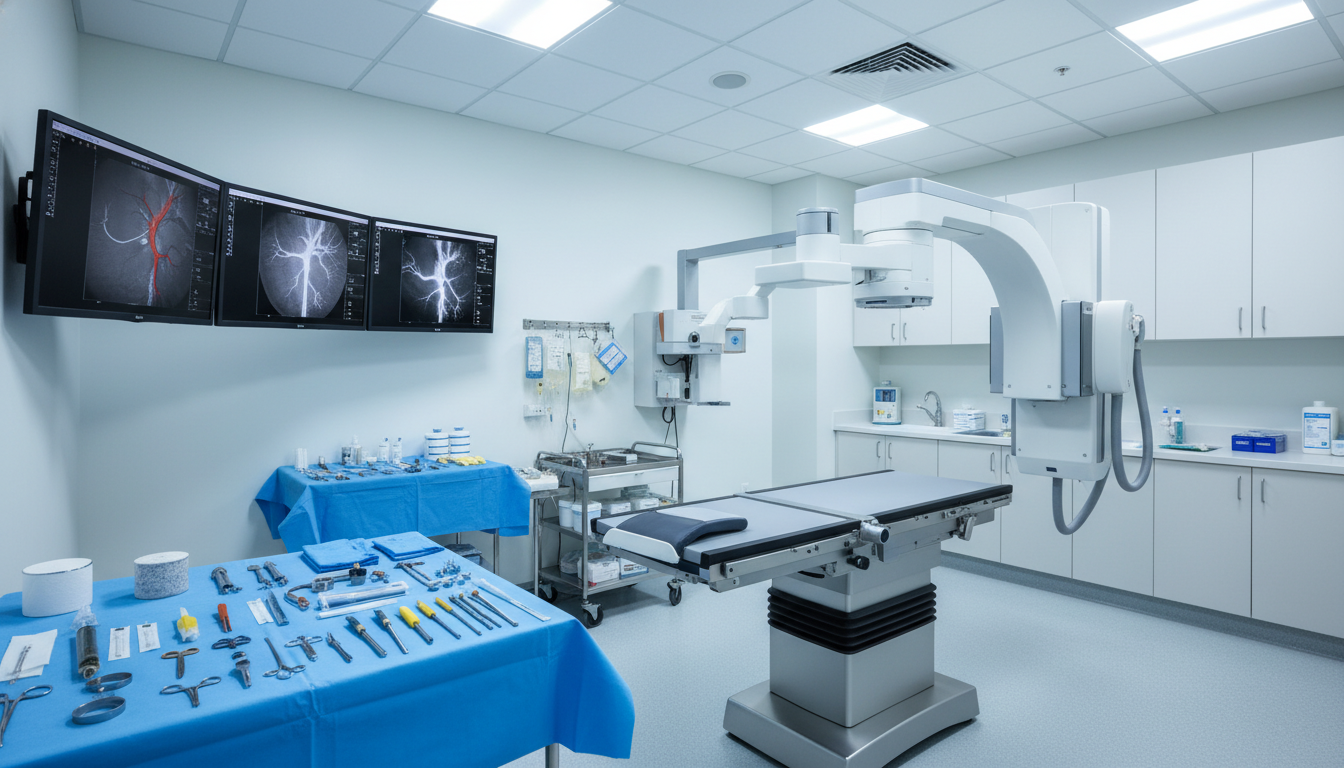
- 1 main procedure room (with C-arm) and possible secondary minor procedure room
- Pre-op area and 3–6 PACU bays
- Clean/sterile storage and soiled/utility space
- Staff break room and workstations
- Administrator/billing office
Work with:
- Architect experienced in healthcare spaces
- General contractor with medical office experience
- Radiation physicist and shielding expert if using fluoroscopy
Equipment Essentials
Your equipment list depends on your chosen scope, but commonly:
Imaging:
- C-arm or fixed angio system (if doing endovascular work)
- Ultrasound machine (with vascular and general probes)
- Standard radiology workstation(s) and PACS access
Procedural:
- Procedure table compatible with C-arm
- Lead shielding and aprons
- Crash cart and emergency drugs
- Monitors for vital signs (NIBP, pulse ox, ECG)
- Infusion pumps, pressure bags, IV supplies
IT and admin:
- EMR with procedure documentation and order sets
- Practice management system for scheduling and billing
- Secure messaging/phone system
- Encrypted data storage and backup solutions
Set up standard operating procedures (SOPs) for:
- Equipment startup/shutdown
- Daily QA and safety checks
- Infection control and instrument sterilization
- Contrast safety and pre-procedure screening
Staffing a Lean but Effective Team
Early on, your practice must balance clinical safety, patient experience, and cost.
Common starting team:
- 1 IR physician (you)
- 1–2 front desk staff (scheduling, check-in, phones)
- 1 MA or nurse for vitals, rooming, basic triage
- 1 IR technologist (for procedures and imaging)
- 0.5–1 FTE billing specialist (in-house or outsourced)
- 0.5–1 FTE practice manager (can be combined role at first)
Over time, you might add:
- Additional IRs or part-time proceduralists
- Nurse practitioner or physician assistant (NP/PA) for clinic and follow-ups
- Additional RNs for pre/post-procedure care
- Dedicated marketing/community outreach coordinator
Create a culture from day one:
- Patient-centered, responsive, and respectful
- Data-driven and quality-oriented
- Transparent communication about roles, responsibilities, and goals
Step 5: Payer Contracts, Compliance, and Revenue Cycle
The difference between a sustainable practice and a failed one often lies in payer strategy and revenue cycle management.
Credentialing and Payer Contracting
Start early—this can take 3–6+ months.
You need:
- CAQH profile (up-to-date)
- NPI numbers (Type 1 individual, Type 2 group)
- State medical license(s) and DEA
- Malpractice coverage in place
Target contracts with:
- Medicare: Essential, especially for PAD, dialysis, older patients
- Key commercial insurers in your region
- Medicaid and Medicaid MCOs (depending on your patient base)
- Worker’s comp if you’ll handle relevant procedures
Strategize:
- Know which payers are critical to your geographic area
- Consider hiring a specialized credentialing service
- Negotiate rates where possible, especially for high-volume codes
Coding, Billing, and Documentation
IR billing is complex; poor documentation is expensive.
Core concepts:
- Correct CPT and ICD-10 coding for IR procedures (often multi-component)
- Detailed procedure notes that support medical necessity and complexity
- Accurate modifier use (bilateral, staged, distinct procedures)
- Documentation of pre- and post-procedure management
Options:
- In-house coder with IR-specific experience
- Outsourced billing company with proven IR track record
Build internal safeguards:
- Regular audits of documentation and coding
- Education sessions for yourself and staff
- Feedback loop for denied claims and appeals
Compliance and Risk Management
As you move from trainee to owner, your personal duty shifts.
Key areas:
- HIPAA: Patient privacy policies, secure data handling, staff training
- OSHA and infection control: Written protocols, safety data sheets, PPE
- Radiation safety: Monitoring badges, ALARA policies, physicist oversight
- Sedation policies: Credentialing, protocols, ACLS training, emergency pathways
- State and federal laws: Stark, Anti-Kickback Statute, self-referral rules (especially in joint ventures)
Retain:
- Healthcare attorney for policy templates and periodic review
- Compliance officer role (can be the practice manager with external guidance in small groups)
Step 6: Referral Building, Branding, and Growth Strategy
This is where private practice vs employment really diverges. In an employed setting, referrals come through internal pathways. Owners must actively build relationships and a brand.
Build and Maintain Referral Relationships
Approach referring clinicians as long-term partners:
- Schedule brief in-person visits with:
- PCP groups
- Nephrology practices
- OB/GYN and urology groups
- Podiatrists and wound care centers
- Bring:
- Clear 1-page service line summaries
- Referral workflow (phone, fax, EMR, online form)
- Your cell number or direct physician line for consults
Follow through:
- Accept same-week or urgent consults when possible
- Call referrers after significant cases to summarize findings and plan
- Send timely consult notes and procedure reports
Offer value:
- CME talks at local hospitals or practices
- Lunch talks on topics like “PAD vs neuropathy in diabetic feet” or “Non-surgical options for fibroids”
- Help referrers solve painful clinical bottlenecks (e.g., delayed access maintenance, long waits for UFE)
Build a Patient-Facing Brand
For service lines like veins, UFE, and PAE, a strong direct-to-patient presence matters.
Essentials:
Professional website:
- Clear explanation of conditions and procedures
- Bios highlighting your interventional radiology residency training and expertise
- Easy online appointment requests
- Patient testimonials (with consent)
Search engine optimization (SEO):
- Include terms like “interventional radiology clinic,” “non-surgical fibroid treatment,” “PAD specialist” tied to your city/region
- Write FAQ-style content answering patient questions in plain language
Reputation management:
- Encourage satisfied patients to leave online reviews (Google, Healthgrades)
- Respond professionally to feedback
Ethically sound patient education:
- Community talks at churches, community centers, and health fairs
- Simple handouts addressing common myths and options
- Social media posts explaining what IR is and when to seek care
Scaling and Evolving Your Practice
Once the practice is stable:
Add service lines strategically
- Example: A vein practice adding PAD or PAE when volumes and payer contracts support it
Consider additional locations
- Secondary clinic sites in underserved areas
- Partnership with local hospitals or ASCs
Bring in partners or associates
- Fellow interventional radiology residency graduates looking for private practice
- Structured partnership tracks with clear buy-in/buy-out formulas
Plan for long-term exit or succession
- Build a practice that has value beyond your individual presence
- Maintain clean financials and compliance for future sale or merger
FAQs: Starting a Private Practice in Interventional Radiology
1. How soon after interventional radiology residency can I realistically start a private practice?
Most physicians are better off working in an employed or group setting for at least 3–5 years before opening medical practice independently. This period allows you to:
- Refine procedural and clinical skills
- Understand local hospital and referral ecosystems
- Build a reputation and physician network
- Learn basics of coding, billing, and practice operations
Exceptions exist—some physicians join established IR groups with a clear path to opening satellite OBLs—but jumping straight from IR match to solo practice is high risk.
2. What are the biggest financial pitfalls for new IR private practices?
Common pitfalls include:
- Underestimating start-up and build-out costs
- Overestimating how quickly volumes will ramp up
- Poor payer mix (e.g., heavy Medicaid in a low-reimbursing state)
- Weak documentation leading to denials and under-coding
- Buying too much equipment too early
Mitigation strategies:
- Conservative financial projections
- Staged equipment purchases
- Lean staffing in the first 12–18 months
- Early and expert help with billing and coding
3. Is private practice vs employment better for interventional radiology long-term?
Neither is universally “better”—they’re different career paths.
Employment:
- More predictable income and benefits
- Less administrative and financial risk
- Often more call and hospital-based work
- Less control over schedule, case mix, and practice style
Private practice:
- High autonomy and control over vision and service lines
- Potential for greater long-term earnings and equity
- More entrepreneurial work and business risk
- Responsibility for staffing, compliance, and growth
Some IR physicians blend both—for example, part-time hospital employment while building a private clinic or OBL.
4. What should I focus on during residency if I ultimately want to open a private IR practice?
During your interventional radiology residency, prioritize:
- Clinical depth: Strong consult skills, longitudinal care, outpatient clinic exposure
- Bread-and-butter procedures: PAD, venous work, dialysis access, UFE, port placement, biopsies
- Rotations in outpatient IR and OBL/ASC settings if available
- Mentorship: Seek mentors in private practice and ask them about their journey, finances, and mistakes
- Non-clinical learning: Sit in on department business meetings, learn basics of RVUs, payer mixes, and call structures
You can also:
- Attend sessions on practice management at SIR or other society meetings
- Read up on IR-specific business models and OBL/ASC regulations
- Keep a running list of what you like and dislike about different practice environments
Starting a private practice in interventional radiology is demanding but deeply rewarding for physicians who value autonomy, long-term patient relationships, and entrepreneurship. With deliberate planning, realistic financial modeling, and a strong commitment to referral relationships and patient-centered care, you can build a practice that reflects the full potential of modern IR—and a career that truly fits you.