Understanding Surgical Fellowship Pathways After General Surgery Residency
Finishing a general surgery residency opens an entire ecosystem of surgical fellowship options. Whether your goal is high-acuity trauma, complex cancer care, minimally invasive techniques, or highly focused niche surgery, the choices can be both exciting and overwhelming.
This guide walks you through the major surgical fellowship pathways available after a general surgery residency, how they align with different career goals, and what you need to know to position yourself competitively for the surgery residency match and beyond.
We’ll cover:
- The major fellowship categories after general surgery
- What each fellowship actually looks like day-to-day
- How long training takes and typical case mix
- Academic vs. community practice implications
- Key factors to consider when choosing a pathway
- How to prepare for fellowship applications starting in residency
1. Big-Picture Overview: Life After General Surgery Residency
General surgery residency provides broad exposure to abdominal, breast, endocrine, trauma, basic vascular, and critical care. However, long-term practice has shifted toward subspecialization. Many residents now pursue at least one additional fellowship to refine their scope of practice.
Common Reasons Residents Pursue Surgical Fellowships
- Desire for focused expertise: Managing complex disease in one surgical subspecialty (e.g., hepatobiliary surgery, colorectal cancer).
- Lifestyle and call considerations: Some fellowships lead to more controllable call schedules (e.g., some breast or endocrine practices), while others are high-intensity (e.g., trauma).
- Academic career goals: Most academic surgical oncology, MIS/foregut, transplant, and pediatric surgery positions expect fellowship training.
- Market competitiveness: In many regions, recently hired surgeons have fellowship training, especially in metropolitan or referral centers.
- Procedural sophistication: Advanced endoscopy, robotics, and complex reconstructions often require dedicated fellowship exposure.
Broad Categories of Fellowships After General Surgery
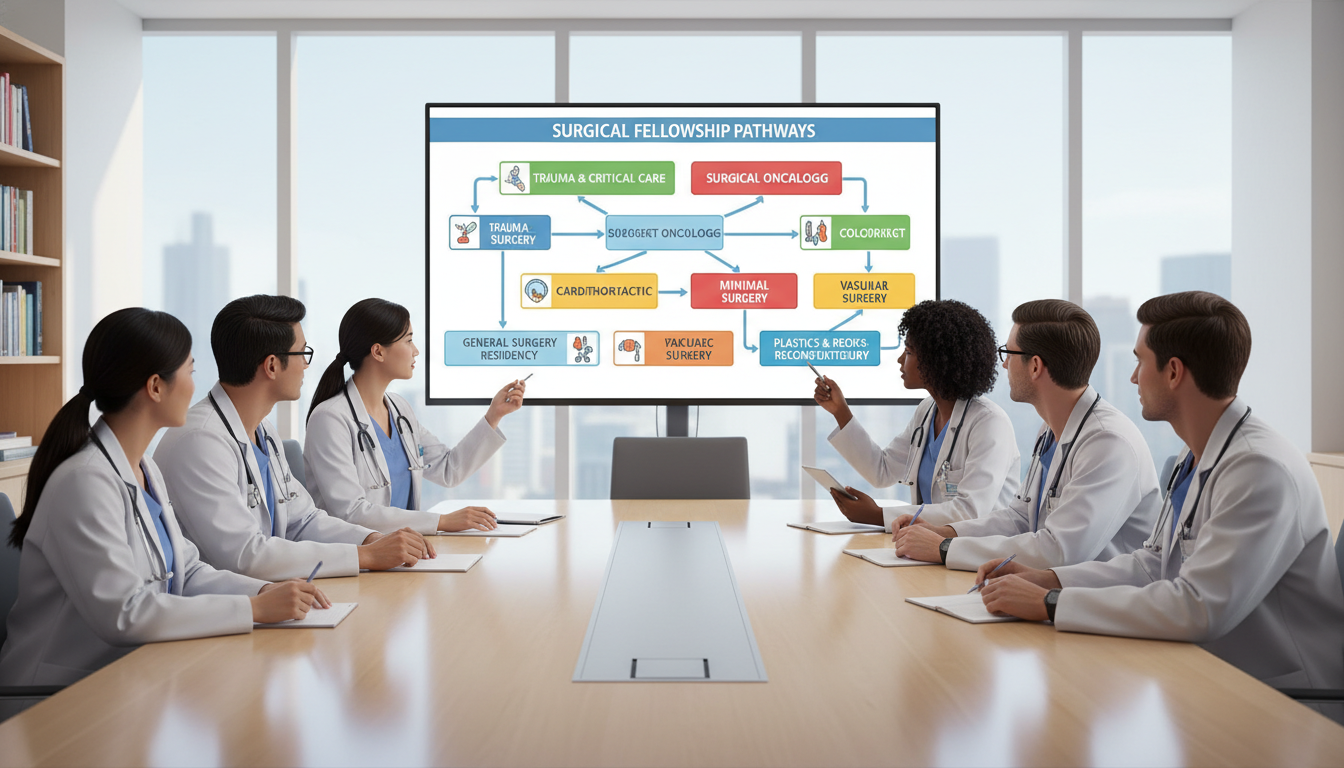
Most post-residency surgical fellowships fall into these groups:
- Oncologic and complex abdominal surgery
- Trauma, critical care, and acute care surgery
- Minimally invasive, bariatric, and foregut surgery
- Colorectal and pelvic surgery
- Vascular and cardiothoracic surgery
- Transplant and hepatopancreatobiliary (HPB) surgery
- Breast, endocrine, and soft-tissue-focused fellowships
- Pediatric surgery and niche subspecialties
- Research, global surgery, and non-ACGME specialized training
Each has distinct structures, accreditation bodies, case mixes, and downstream career paths.
2. Oncologic & Complex Abdominal Pathways
If you enjoy challenging resections, multidisciplinary care, and longitudinal relationships with cancer patients, oncologic pathways may fit you well.
Surgical Oncology Fellowship
A surgical oncology fellowship focuses on complex, multi-organ resections for solid tumors and coordination with medical and radiation oncology.
Typical scope:
- Complex GI cancers (gastric, colorectal, hepatobiliary, pancreatic)
- Retroperitoneal sarcoma
- Melanoma and soft-tissue sarcoma
- Peritoneal surface malignancies (e.g., HIPEC in some programs)
- Skin and soft tissue malignancies
- Management of metastatic disease amenable to resection
Training details:
- Usually 2–3 years, often including dedicated research time
- Accredited primarily through programs like the SSO (Society of Surgical Oncology)
- Strong emphasis on:
- Tumor boards, multidisciplinary care
- Clinical trials and outcomes research
- Longitudinal care and survivorship
Ideal for residents who:
- Like complex anatomy and high-acuity cancer surgery
- Enjoy longitudinal clinic follow-up
- Are interested in academic careers and clinical research
Career outlook:
- Academic cancer centers and comprehensive cancer programs
- Leadership in tumor boards and oncology service lines
- Strong alignment with surgery subspecialty cancer care and research
HPB (Hepatopancreatobiliary) and Upper GI/Foregut Cancer
Some surgeons pursue HPB or foregut fellowships that heavily intersect with oncologic surgery.
HPB fellowships emphasize:
- Major liver resections, bile duct resections, and biliary reconstruction
- Pancreaticoduodenectomy (Whipple) and distal pancreatectomy
- Complex gallbladder and hilar cholangiocarcinoma surgery
- Management of benign and malignant pancreatic disease
Upper GI/Foregut fellowships may combine:
- Esophageal and gastric cancer resections
- Anti-reflux and hiatal hernia surgery
- Foregut functional disorders (achalasia, motility disorders)
- Minimally invasive approaches and advanced laparoscopy/robotics
Many of these positions later function as de facto surgical oncology for specific organ systems.

3. Trauma, Acute Care Surgery, and Critical Care Pathways
If you’re drawn to the ED consult, unstable patients, and fast-paced decision-making, trauma and critical care pathways can be an excellent fit.
Surgical Critical Care Fellowship
Scope:
- Management of critically ill surgical and trauma patients
- Ventilator management, hemodynamics, sepsis, and multi-organ failure
- Interdisciplinary ICU leadership (nursing, pharmacy, respiratory therapy)
- Procedures: tracheostomy, central lines, chest tubes, percutaneous feeding tubes, etc.
Training details:
- Typically 1 year (ACGME-accredited)
- Often combined or followed by:
- Trauma fellowship
- Acute care surgery positions
Career outcomes:
- Surgical intensivist roles in ICUs
- Academic and community hospitals with significant critical care needs
- Key role in trauma centers and complex surgical programs
Trauma & Acute Care Surgery (ACS)
Trauma fellowships (often paired with Surgical Critical Care):
- Focus on penetrating and blunt trauma surgery
- Emergency general surgery and operative damage control
- Systems-based practice: trauma systems, registries, quality improvement
Acute Care Surgery positions (post-fellowship roles):
- Hybrid role: trauma, emergency general surgery, and critical care
- Often shift-based, with more predictable off-service time
- Strong team-based environment, often in Level I or II trauma centers
Best for residents who:
- Enjoy rapid triage and decisiveness
- Like high-acuity resuscitation and operative emergencies
- Prefer less clinic and more inpatient/ICU-based practice
4. Minimally Invasive, Bariatric, and Colorectal Pathways
Minimally invasive and colorectal fellowships are popular choices among general surgery graduates because they build on core skills and are in high demand.
Minimally Invasive Surgery (MIS) and Bariatric/Foregut Fellowships
Scope:
- Advanced laparoscopic and robotic procedures
- Bariatric operations: sleeve gastrectomy, gastric bypass, revisional surgery
- Complex abdominal wall reconstruction (in some programs)
- Foregut procedures: anti-reflux, hiatal hernia repair, paraesophageal hernias
- Advanced hernia work (inguinal, ventral, recurrent, flank, diaphragmatic)
Training details:
- Usually 1 year (some 2-year programs with research)
- Focus on:
- High-volume laparoscopy/robotics
- ERAS protocols
- Outcomes research and quality improvement in metabolic and minimally invasive surgery
Career pathways:
- Community practice with a strong focus on bariatric surgery and hernia repair
- Academic foregut/minimally invasive programs
- Cross-over with surgical oncology/foregut cancer care in some centers
Ideal for residents who:
- Enjoy technical precision and shorter-length-of-stay cases
- Are interested in obesity medicine and metabolic disease
- Want to develop or lead a bariatric or hernia center of excellence
Colorectal Surgery Fellowship
Colorectal surgery is a well-defined surgery subspecialty with its own board certification.
Scope:
- Colorectal cancer: segmental resections, low anterior resection, APR
- Inflammatory bowel disease (IBD): restorative proctocolectomy, ileal pouch-anal anastomosis
- Benign anorectal disease: hemorrhoids, fistula, fissure, pilonidal disease
- Pelvic floor disorders and functional bowel disease
- Endoscopy: colonoscopy, flexible sigmoidoscopy; some advanced polypectomy
Training details:
- 1-year fellowship (ACGME-accredited)
- Extensive exposure to:
- Minimally invasive and robotic colorectal surgery
- Sphincter-sparing techniques
- Multidisciplinary IBD and pelvic floor clinics
Career outlook:
- Academic IBD and pelvic floor centers
- Community practices, often with a regional referral base
- High demand in areas with an aging population and strong screening programs

5. Vascular, Cardiothoracic, Transplant, Breast, Endocrine, and Pediatric Pathways
Some fellowships represent distinct disciplines that partially overlap with general surgery but have their own certification structures and culture.
Vascular Surgery Fellowship
For residents who did not match into an integrated vascular program during the surgery residency match, traditional 5+2 pathways remain.
Scope:
- Open and endovascular procedures:
- Aortic aneurysm repair (open and EVAR)
- Peripheral bypasses and endovascular interventions
- Carotid endarterectomy and stenting
- Dialysis access, limb salvage, and complex wound care
- Non-invasive vascular lab interpretation
Training details:
- Typically 2 years after 5-year general surgery residency
- Strong emphasis on endovascular skills, imaging, and longitudinal disease management
Career paths:
- Vascular-only practices, often high-call but high-autonomy
- Academic vascular programs with research in devices, outcomes, and imaging
Cardiothoracic Surgery
Pathways into CT surgery include:
- Traditional 5+2 or 5+3 (general surgery + cardiothoracic fellowship)
- Integrated 6-year CT residency (matched into from medical school)
For general surgery graduates, CT fellowships focus on:
- Coronary artery bypass grafting (CABG)
- Valve surgery and aortic surgery
- Thoracic oncology (lobectomy, esophagectomy) depends on program structure
- Increasing exposure to structural heart and transcatheter interventions
CT is a high-intensity subspecialty with substantial call, but it can be deeply rewarding for those passionate about cardiac and thoracic anatomy.
Transplant Surgery Fellowship
Scope:
- Kidney, liver, and sometimes pancreas transplantation
- Multi-organ procurement and donor management
- Vascular anastomoses and biliary reconstruction
- Immunosuppression management and longitudinal transplant clinic
Training details:
- Typically 2 years of solid organ transplant fellowship
- Strong emphasis on:
- Organ allocation systems
- Perioperative medical management
- Multidisciplinary care with nephrology, hepatology, and ICU teams
Best for residents who:
- Enjoy complex, high-stakes, often lengthy operations
- Feel comfortable with nighttime and emergency liver transplants
- Are interested in academic practice and transplant research
Breast and Endocrine Surgery Fellowships
For surgeons who desire high clinic volume, strong patient relationships, and more predictable call, breast and endocrine pathways are appealing.
Breast surgery fellowship:
- Focus on:
- Breast cancer surgery (lumpectomy, mastectomy, oncoplastic techniques)
- Axillary staging and sentinel node biopsy
- Risk reduction surgery and genetic counseling integration
- Heavy coordination with:
- Medical oncology, radiation oncology, plastic surgery
- Strong longitudinal care and survivorship focus
Endocrine surgery fellowship:
- Thyroid, parathyroid, adrenal, and sometimes neuroendocrine tumors
- Re-operative neck surgery and minimally invasive endocrine techniques
- Heavy emphasis on imaging, intraoperative nerve monitoring, and calcium management
Both fields offer:
- High proportion of elective cases
- Strong clinic presence and regular working hours in many settings
- Opportunities in academic centers and specialized cancer/endocrine programs
Pediatric Surgery Fellowship
Pediatric surgery is one of the most competitive and specialized options.
Scope:
- Congenital anomalies (TE fistula, diaphragmatic hernia, intestinal atresia)
- Neonatal surgery and ECMO participation
- Pediatric trauma, oncology, and thoracic surgery
- Minimally invasive pediatric procedures
Training details:
- 2-year accredited fellowship
- Often preceded by 1–2 years of dedicated research during residency
- Very strong emphasis on academic productivity and letters from pediatric surgeons
Career outlook:
- Almost exclusively academic or large children’s hospitals
- Fewer community opportunities compared with other fields
- Intense but uniquely rewarding care of infants and children
6. Strategic Career Planning: How to Choose Your Fellowship Pathway
Choosing a surgical fellowship pathway should be thoughtful and deliberate. It starts much earlier than PGY-5.
Key Questions to Ask Yourself
What patient population do you enjoy most?
- Critically ill vs. stable outpatients?
- Cancer patients vs. benign disease?
- Adults vs. children?
What operative profile matches your personality?
- Long, complex cases vs. shorter, high-throughput cases
- High emergency mix vs. mostly elective
- Heavy endoscopy vs. open and reconstructive procedures
What lifestyle and call structure do you want long term?
- Night/weekend call intensity
- Clinic vs. OR balance
- Shift-based vs. traditional call
Do you see yourself in academics, community practice, or hybrid roles?
- Academics often favor:
- Surgical oncology, HPB, transplant, pediatric, CT, trauma/critical care
- Community practice often includes:
- MIS/bariatric, colorectal, breast, endocrine, vascular, ACS
- Academics often favor:
How important is geographic flexibility?
- Some subspecialties are concentrated in tertiary/urban centers (transplant, pediatric)
- Others are needed in a wide range of settings (MIS, colorectal, breast)
Building a Competitive Profile During General Surgery Residency
Regardless of your target fellowship, certain themes recur:
Excellent clinical performance
- Strong evaluations, operative logs, and trusted responsibility
- Being known as a reliable, prepared, and teachable resident
Mentorship and networking
- Identify faculty in your desired field early (PGY-2 or PGY-3)
- Seek longitudinal mentorship, not just a single rotation
- Get guidance on programs, research, and letters of recommendation
Targeted research and scholarly activity
- Prospective fellows in competitive areas (surgical oncology, HPB, pediatric, transplant) often have multiple first-author papers and presentations.
- Quality matters more than sheer quantity:
- Clinical outcomes studies
- Case series in your desired subspecialty
- Participation in national meetings (ACS, SSO, ASTS, EAST, SAGES, ASCRS, etc.)
Deliberate rotation choices
- Electives in your subspecialty of interest
- Away rotations or visiting experiences if your home program has limited exposure
- ICU, trauma, and advanced laparoscopic experiences for broadly enhancing skills
Understanding the application timeline
- Many fellowships use ERAS or specialty-specific match systems.
- Applications often open during PGY-3 or PGY-4, depending on fellowship type.
- Align your research and letter-writing timeline accordingly.
Fellowship Application Nuances by Field
Highly competitive (e.g., pediatric surgery, HPB at major centers, certain surgical oncology programs):
- Early and robust research
- Strong national mentorship and networking
- Consider 1–2 extra years of research if necessary
Moderately competitive (e.g., MIS/bariatric, colorectal, breast, endocrine, trauma/CC):
- Solid clinical performance and focused research
- Strong letters from subspecialty faculty
- A clear narrative of your interest and career goals
Variable competitiveness (e.g., transplant, CT, vascular):
- Depends heavily on program prestige vs. lesser-known centers
- Detailed program-specific research and fit can be crucial
FAQs: Surgical Fellowship Pathways in General Surgery
1. Do I need a fellowship to practice general surgery?
No. Many surgeons practice broad-based general surgery without fellowship training, particularly in rural and some community settings. However, in urban and academic markets, fellowship training is increasingly common and may be expected for certain roles (e.g., surgical oncology, MIS foregut, transplant, pediatric surgery).
2. When should I decide on a fellowship during residency?
Aim to narrow your interests by late PGY-2 or early PGY-3. This allows time for:
- Meaningful mentorship in your target field
- Focused research productivity
- Strategic electives and rotation choices
Fellowship applications often go in during PGY-3 or PGY-4, depending on the subspecialty.
3. Can I change directions if I’m unsure or my interests evolve?
Yes. Many residents initially attracted to one field (e.g., trauma) later choose another (e.g., MIS/bariatric) after more exposure. Keeping your research and networking somewhat broad in PGY-1–2 can help preserve flexibility. Some surgeons pursue a first fellowship, practice, and then add a second fellowship (for example, MIS after a trauma/CC background), though this is less common.
4. How do surgical fellowships affect long-term earnings and lifestyle?
It varies significantly by subspecialty and practice setting:
- High-intensity, high-revenue fields (e.g., vascular, transplant, CT, some HPB) can be financially rewarding but involve substantial call and complex cases.
- Fields like breast or endocrine often offer more predictable hours and clinic-heavy schedules, with competitive compensation in many markets.
- MIS/bariatric and colorectal can be highly profitable and busy in both academic and community contexts.
Ultimately, practice type, regional market, and your productivity usually matter more than the fellowship title alone.
Choosing a surgical fellowship pathway after general surgery residency is one of the defining decisions of your career. By aligning your clinical interests, preferred practice style, and lifestyle goals—and preparing strategically during residency—you can chart a path that is both professionally fulfilling and personally sustainable.