
Why Your First Year Matters (Especially If You’re Informatics‑Minded)
First year of medical school is a shock to the system for almost everyone. Overnight, you go from being a high‑achieving premed to feeling like you’re drinking from a fire hose of content. If you’re drawn to clinical informatics, the transition can feel even stranger: you’re passionate about data, EHRs, and systems thinking, but your days are filled with biochemistry pathways and histology slides.
Yet this “M1” year is the foundation for everything that comes later—from clerkships to residency to a clinical informatics fellowship. How you design your habits, skills, and mindset now will shape both your ability to survive medical school and your competitiveness for informatics‑focused paths down the road.
In this guide we’ll cover:
- Core M1 tips for managing the workload and avoiding burnout
- How to integrate clinical informatics interests into your first year
- Practical strategies for time management, studying, and exams
- Building a professional profile for future health IT training and fellowships
- Common pitfalls and how to avoid them
Think of this as a survival manual plus a long‑term strategy document tailored to future clinical informaticians.
Understanding the M1 Experience: What You’re Really Up Against
The Volume Problem: “Drinking from a Fire Hose” Is Real
First year medical school is less about raw difficulty and more about volume and pace. Typical challenges:
- Compressed timelines: Entire undergraduate courses (e.g., biochemistry, physiology) are packed into weeks.
- New learning expectations: Memorization and application, often under time pressure.
- Constant assessment: Weekly quizzes, midterms, practicals, and high‑stakes finals.
For those interested in clinical informatics, there’s an additional layer: you’re constantly seeing how poorly organized information makes your own learning harder. That awareness is useful—but it can also be frustrating.
Mindset shift: Your goal in first year is not to master every detail forever. It’s to:
- Build a functional framework of medical knowledge
- Learn to learn efficiently
- Stay healthy enough (physically and mentally) to sustain performance
You are building a platform you’ll later augment with informatics and systems‑level thinking.
The Hidden Curriculum: Professional Identity and Systems Thinking
M1 isn’t just about knowledge; it’s about identity formation:
- You’re learning to think like a clinician: pattern recognition, risk management, clinical reasoning.
- You’re also seeing the strengths and flaws of healthcare systems in lectures, case‑based learning, and early patient exposure.
For future clinical informatics physicians, this is prime observational time. Noticing:
- Where information is missing or duplicated
- How miscommunication leads to errors
- Where digital tools support or hinder care
Keep a small, private “systems notebook” or digital doc where you jot:
- “Pain points” in information flow you see in cases or simulations
- Ideas for better workflows, decision support, or patient portals
- Questions about why certain data aren’t routinely collected
These early observations later become fertile ground for research projects, QI work, and eventually your clinical informatics fellowship application.
Core Survival Strategies: Study Skills, Time, and Sanity
Designing a Sustainable Study System (Not Just a Daily Grind)
You will hear endless M1 tips about flashcards, question banks, and study schedules. The key is not copying someone else’s system—it’s designing one you can maintain for months.
A reasonable structure for a typical week:
Macro‑planning (Sunday, 30–45 minutes):
- Map out exam dates, lab sessions, mandatory events.
- Block protected time for:
- Deep study (2–3 hour chunks)
- Sleep
- Exercise
- Something non‑medical you enjoy
Daily study blocks:
- 2–3 deep work sessions (60–90 minutes) with:
- Phone on airplane mode
- Notifications off
- One task only: e.g., “finish renal physiology lectures” or “do 40 practice questions + review”
- 2–3 deep work sessions (60–90 minutes) with:
Micro‑review:
- 15–30 minutes at day’s end:
- Review key concepts or Anki cards
- Preview tomorrow’s topics
- 15–30 minutes at day’s end:
Think of yourself as a “human CPU” with limited RAM. Context switching (checking email, switching tasks, jumping between resources) is the enemy of efficient learning.
Choosing and Using Study Resources Like an Informatician
Clinical informatics is all about choosing and using information wisely. Apply that mindset to your studying:
Standard resources (school + boards‑oriented):
- Lecture slides + required readings
- A primary review resource (e.g., Boards & Beyond, Pathoma, sketch‑based resources if used at your school)
- Anki or another spaced-repetition system
- Question banks (school‑provided or commercial)
Informatics‑relevant mindset for resources:
- Ask, “What’s signal vs noise here?”
- Prioritize:
- High‑yield concepts emphasized repeatedly
- Pathways/structures central to disease states
- De‑prioritize:
- Gratuitous detail not stressed in lectures or practice questions
Practical workflow example:
- Before lecture: skim objectives and any pre‑class materials (10–15 min)
- During lecture: take lean notes focused on:
- Definitions
- Relationships (“X causes Y because…”)
- Any clinical correlations
- After lecture (same day if possible):
- Convert major points into active recall prompts (flashcards, questions)
- Do 5–10 related practice questions if available
This is “information architecture” for your brain—exactly what you’ll later do for EHRs and decision support.
Active Learning: Think Like a System, Not a Photocopier
Rote memorization can get you through an undergrad exam; it will not sustain you in medical school.
M1 tips for effective active learning:
- Teach concepts out loud (to a classmate, stuffed animal, or empty room).
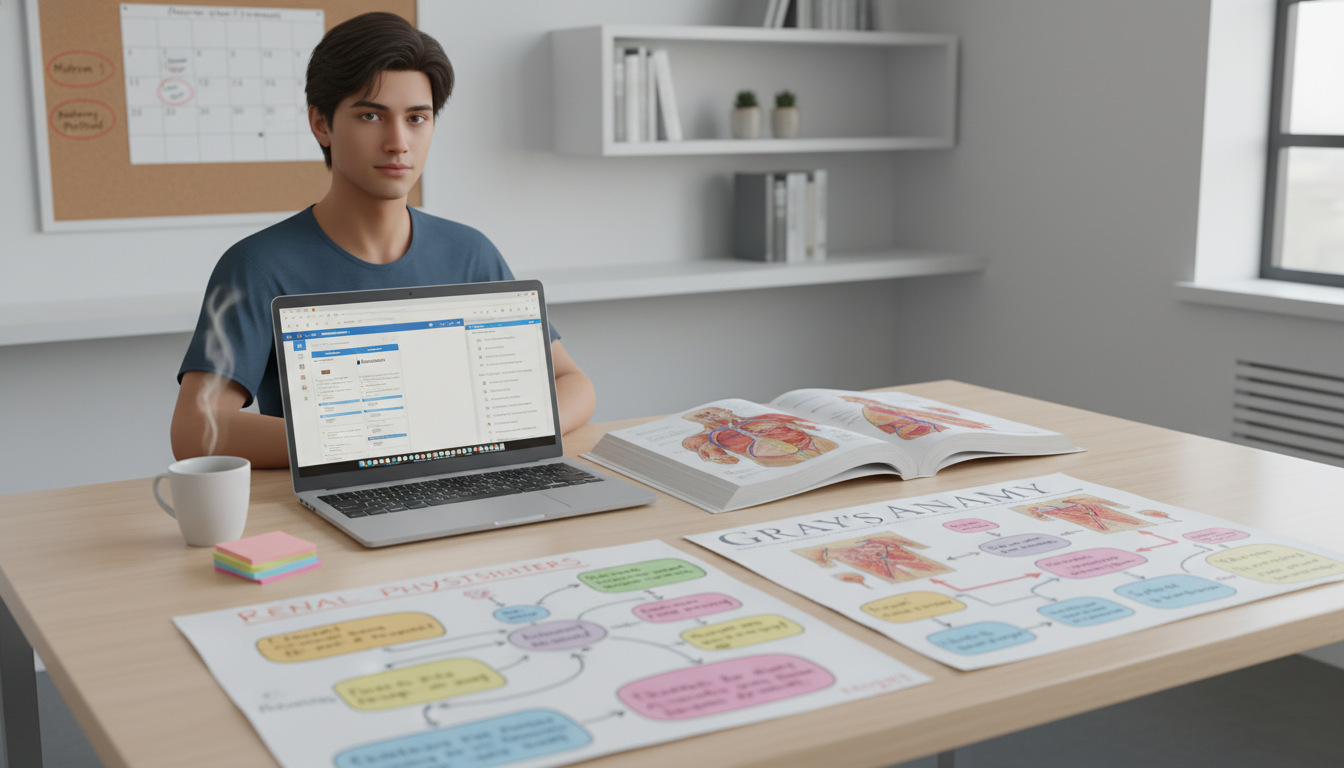
- Draw:
- Pathways (e.g., RAAS, glycolysis, immune signaling)
- Anatomical relationships
- Differential diagnosis trees
- Generate questions:
- “How could this go wrong?” → pathology
- “How would this look in a patient?” → clinical reasoning
- “What data would I need to confirm this?” → informatics mindset
This type of engagement strengthens the conceptual “nodes” and “edges” in your mental network—exactly how clinical informaticians think about data models and knowledge representation.
Protecting Your Health: Burnout Prevention from Day One
Sleep: The Non‑Negotiable Performance Enhancer
Sleep is often the first thing M1s sacrifice, and one of the most costly mistakes when you’re trying to survive medical school.
Target 7–8 hours consistently. To defend that:
- Set a firm “screens off” time 30–60 minutes before bed.
- Establish a simple bedtime ritual (shower, short reading, light stretching).
- Avoid “heroic” all‑nighters; they give the illusion of productivity but degrade memory and reasoning.
Remind yourself: in clinical informatics, you’ll one day be designing systems partly to prevent cognitively fatigued clinicians from making errors. Model the habits you’ll later be supporting.
Physical and Mental Health: Your Real Long‑Term Project
Physical health basics:
- Movement 3–5 times/week:
- 20–40 minutes of moderate exercise (walking, jogging, biking) is enough.
- Short “movement snacks” between study blocks if time is tight.
- Nutrition:
- Aim for stable energy: protein + complex carbs + healthy fats.
- Don’t let caffeine replace meals; it worsens crashes and anxiety.
Mental health:
- Watch for warning signs:
- Persistent hopelessness or dread
- Inability to enjoy anything non‑medical
- Sleep disturbance, appetite changes
- Thoughts of self‑harm or suicidality
If these appear, use your school’s counseling services early. Seeking help is not a weakness; it’s a professional competence. Clinical informatics, like all specialties, needs physicians who understand human factors—including their own.
Social Support and Boundaries
Surviving first year of med school requires community.
- Cultivate a small core group:
- 2–4 classmates with similar goals and compatible study styles.
- Use for accountability, explanation, emotional support.
- Maintain at least one non‑medical relationship:
- Family, partner, or friend who reminds you of life outside school.
- Set boundaries:
- Designate protected time without med school talk (e.g., weekly dinner, hobby time).
- Learn to say “I can’t take on another club/committee right now.”
In informatics terms, think of your time and emotional bandwidth as finite “system resources.” Overloading leads to crashes.
Weaving Clinical Informatics Into Your First Year
You don’t need to choose between surviving medical school and nurturing your interest in clinical informatics. The key is integration rather than overloading.
Learn Medicine First, But See It Through a Data Lens
Priority #1 in M1: build a strong foundation in anatomy, physiology, biochemistry, and pathology. This is what will ultimately make you a credible clinician and a credible informatician.
But as you learn:
- Ask, “If I were building a clinical decision support tool for this disease, what data would it need?”
- When you see a “classic triad” or set of risk factors:
- Think of them as structured data elements that could feed a prediction model.
- When given a case:
- Note where poor documentation, missing labs, or delayed imaging could mislead algorithms as well as humans.
This habit helps you “tag” your medical knowledge with informatics relevance without extra time.
Low‑Effort Ways to Explore Informatics in M1
You do not need to start formal health IT training in first year. You do, however, want to start orienting yourself.
Options that fit into a busy M1 schedule:
Join (but don’t over‑commit to) relevant student groups:
- Clinical informatics, digital health, or medical technology clubs
- Quality improvement or patient safety groups
- Data science or AI in medicine initiatives
Attend occasional talks or grand rounds:
- Prioritize high‑yield topics: EHR optimization, AI in diagnostics, interoperability, data ethics.
- Take 3–5 bullet notes: key problems, key solutions, and what skills were mentioned.
Self‑directed reading (1–2 hours/month):
- Skim introductory articles about:
- What clinical informatics physicians do
- Current challenges with EHRs and decision support
- Basic concepts (interoperability, standards like HL7/FHIR, CDS, workflow design)
- Skim introductory articles about:
Light skills building, only if time allows:
- If you already code: keep skills warm with small, enjoyable projects (e.g., simple data visualization).
- If you don’t code: do not feel pressured to start now; focus on excelling in medical coursework first.
Remember: you are playing a long game. Clinical informatics fellowship applications care more about:
- Strong clinical performance
- Thoughtful, sustained engagement
- A coherent story of how you developed your interest
than about a long list of unfocused tech activities in M1.
Identifying Informatics‑Friendly Mentors Early
Mentorship is critical if you’re eyeing a future in clinical informatics.
In M1, aim for light‑touch mentor relationships:
Look for:
- Faculty who mention EHRs, data, or systems in their lectures
- Attendings involved in QI, digital health, or population health projects
- Resident or fellow role models interested in health IT
Low‑pressure approach:
- After a lecture or event, send a brief email:
- 2–3 sentences thanking them
- 1 sentence about your interest in informatics
- Ask if they’d be open to a 20–30 minute meeting later in the semester to discuss career paths
- After a lecture or event, send a brief email:
During the meeting:
- Ask:
- “How did you become involved in clinical informatics?”
- “What would you recommend I focus on during first year?”
- “Are there any low‑time‑investment ways I could start learning more now?”
- Ask:
Do not push immediately for research or projects unless they suggest it. Your main objective is orientation, not output.

Long‑Term Positioning: From M1 to Clinical Informatics Fellowship
Building a Strong Core for Any Residency
Every clinical informatics fellowship director will tell you: be a solid clinician first. They want fellows who are:
- Competent in patient care
- Reliable and professional
- Able to understand real clinical workflows and pain points
Your pathway will likely be:
- Medical school (M1–M4)
- A clinical residency (e.g., internal medicine, pediatrics, EM, pathology, etc.)
- Clinical informatics fellowship as a subspecialty training period
To support that trajectory, your M1 goals should be:
- Academic strength:
- Pass all courses comfortably
- Identify and remediate any weak areas early
- Professional reputation:
- Be prepared, punctual, and respectful
- Follow through on commitments
- Emerging narrative:
- Start to see how your interests (e.g., systems, data, optimization) connect to future patient care
This combination will help you both in residency applications and, later, in applying for clinical informatics fellowship positions.
Strategically Choosing Activities (Without Burning Out)
When opportunities arise—research, committees, hackathons—ask three questions:
- Does this align with my genuine interests?
- Is the time commitment realistic given my coursework?
- Could this contribute to a coherent story later (e.g., on my personal statement)?
Examples of good fits for someone interested in clinical informatics:
- A small role in a quality improvement project that uses EHR data (e.g., improving order sets).
- Assisting with a study on how clinical decision support affects provider behavior.
- Participating in a short, well‑structured medical hackathon or datathon after exams.
Things to be cautious about:
- Joining multiple leadership roles purely for your CV
- Large, unstructured projects with no clear end point
- Activities that consistently force you to sacrifice sleep or academic performance
Your guiding principle: depth over breadth, and sustainability over spectacle.
Laying the Groundwork for Future Health IT Training
While a formal health IT training program is unlikely in M1, you can begin to:
- Learn the language:
- Terms like interoperability, FHIR, clinical decision support, workflow analysis, human‑computer interaction.
- Notice “failure modes” in cases:
- How missing or misfiled information could derail care.
- Reflect periodically:
- Keep a short document where you summarize:
- Informatics‑related ideas
- Skills you’d like to build later (e.g., analytics, UI/UX, implementation science)
- Types of projects that excite you
- Keep a short document where you summarize:
When the time comes to write residency and clinical informatics fellowship applications, this reflection becomes raw material for:
- Personal statements
- Interview answers
- Descriptions of your trajectory and motivation
Putting It All Together: A Sample Survival Blueprint for an Informatics‑Oriented M1
Here’s how an average week might look for a student trying to both survive first year of med school and cultivate a future in clinical informatics:
Sunday:
- 30–45 min weekly planning (lectures, labs, exams, workouts, rest)
- 2–3 hrs focused study (review last week, preview next)
- 15–20 min reading on a clinical informatics topic or article (optional)
Monday–Friday:
- Morning:
- Attend lectures (or watch recordings if your school allows)
- Minimal, structured note‑taking
- Afternoon:
- One 60–90 min deep study block (lectures → flashcards/notes → practice questions)
- Short break + light movement
- Second 60–90 min block if needed
- Evening:
- 15–30 min flashcard review / concept mapping
- 30–60 min non‑medical activity (walk, hobby, show)
- Wind‑down routine and sleep
Once or twice a month:
- Attend an informatics/digital health talk or student group event
- Briefly connect with or email a mentor/upperclassman about career questions
Once per semester:
- Meet with a potential mentor to discuss long‑term interests
- Reassess how your schedule is working and adjust to protect health and grades
This blueprint is intentionally modest. You do not need to “specialize” in informatics during M1. You only need to build a solid base and keep the door open.
FAQs: Surviving M1 With an Eye on Clinical Informatics
1. Do I need to learn programming or data science during my first year of medical school to match into clinical informatics later?
No. Programming skills can be helpful, but they are not required in M1 and are rarely the bottleneck for future clinical informatics fellowship positions. Your priorities now are:
- Strong performance in your core medical curriculum
- Developing effective study habits and professionalism
- Gaining a basic understanding of what clinical informatics is and whether it truly interests you
If you already have coding experience, keep it warm with small projects as time allows. If you don’t, it’s completely acceptable to postpone serious skills training until later years, during residency, or even early fellowship.
2. How can I show interest in clinical informatics on my residency applications if my school doesn’t have a strong informatics program?
You can build a coherent narrative even without a formal track:
- Seek out any quality improvement, EHR optimization, or patient safety projects; these often involve informatics concepts.
- Attend relevant online webinars, virtual conferences, or talks from national organizations.
- Join or follow groups like AMIA (American Medical Informatics Association) as a student member if feasible.
- Reflect in your personal statement and interviews on:
- How information flow, documentation, and decision support affected patient cases you encountered.
- How your systems‑oriented thinking shaped your learning and clinical experiences.
Residency programs value genuine interest and thoughtful reflection more than a long list of buzzword‑heavy activities.
3. I’m overwhelmed by first year already. Is it okay to “pause” my informatics interests until later?
Yes. Surviving medical school comes first. It is completely acceptable—and often wise—to:
- Focus exclusively on coursework and personal well‑being in your first semester or even first year.
- Keep your informatics curiosity alive informally (occasional articles, talks) without formal commitments.
- Re‑engage more intentionally once your academic foundation and routines feel solid.
Clinical informatics is a field you can enter from many points in your training. Protecting your health and academic performance now will give you more options later.
4. When should I start thinking seriously about clinical informatics fellowship?
You don’t need detailed fellowship plans in M1. A rough timeline:
- M1–M2: Explore; learn what clinical informatics is; focus on strong medical foundations.
- M3: Notice system and information issues during clerkships; seek small projects or mentors in QI/informatics.
- M4 / Early residency: Solidify interest, seek more structured projects, and identify programs that support informatics.
- Residency (PGY2–PGY3, depending on specialty): Decide on clinical informatics fellowship, prepare applications, and deepen your involvement in relevant work.
Your task in first year is simply to keep the path open: do well academically, stay healthy, and remain curious about how information and technology shape patient care.
Surviving first year of med school while nurturing an interest in clinical informatics is absolutely achievable. By focusing on sustainable study habits, protecting your well‑being, building a solid clinical base, and gently weaving in informatics‑related experiences, you set yourself up not only to survive medical school—but to thrive as a future clinician and informatician.