



Understanding the First Year: How It Connects to Pathology
The first year of medical school can feel like a firehose of information—anatomy, biochemistry, physiology, histology, embryology, and more. If you’re already eyeing a pathology residency or just curious about the specialty, it helps to see how your first year of medical school (M1) lays the foundation for your future in pathology.
Why M1 Matters for Aspiring Pathologists
Pathology is the study of disease—its causes, mechanisms, and effects on organs, tissues, and cells. Much of what you’ll do in pathology residency and practice rests on three pillars you’re building in M1:
Normal structure and function
- Anatomy → What normal organs look like
- Histology → What normal tissues and cells look like under the microscope
- Physiology → How organs and systems are supposed to work
Basic mechanisms of disease
- Biochemistry → Molecular processes that go wrong in disease
- Cell biology → How cells respond to injury, damage, and mutations
- Immunology → How the immune system contributes to disease
Clinical reasoning habits
- Learning to link signs, symptoms, and lab data to underlying mechanisms
- Thinking in terms of cause-and-effect, not just memorizing lists
Even if pathology doesn’t show up in your curriculum as a stand‑alone course during first year, you’re already building the mental tools you’ll use in a pathology residency.
How Different Curricula Shape Your Pathology Exposure
Medical schools vary widely, but most fall into one of these structures:
Traditional (discipline-based) curriculum
- Separate courses: anatomy, biochemistry, physiology, histology, etc.
- Pathology usually begins in late M1 or early M2.
- Your best move: focus on mastering each discipline deeply—especially histology, anatomy, and physiology. These are the backbone of pathology.
Systems-based or organ-based curriculum
- Courses organized by organ system (cardiovascular, respiratory, renal, etc.)
- Pathology concepts are woven into how you study each system.
- Your best move: as you learn normal structure/function, consciously ask, “How would this break? What diseases affect this system?” That’s already pathology thinking.
Problem-based or case-based learning
- Heavy emphasis on clinical cases and small-group discussions.
- Pathology often comes through case vignettes, imaging, and lab data.
- Your best move: don’t just memorize the “answer” to a case. Spend extra time understanding the tissue/organ-level changes driving the disease.
Understanding your school’s structure lets you strategically plug into pathology-related learning early, even in M1.
Academic Survival: Study Strategies That Work for Future Pathologists
The volume of material in first year medical school is unlike anything most students have seen. For students drawn to pathology—who tend to appreciate detail, pattern recognition, and mechanism-based thinking—this can be both exciting and overwhelming.
Step 1: Build a Core Study Framework
Whether you’re in a lecture-heavy or PBL curriculum, you need a structured framework. A solid setup for surviving medical school in M1 looks like:
Daily Plan (time-blocked)
- Morning: New material (lectures, modules, assigned reading)
- Early afternoon: Active review (questions, flashcards)
- Late afternoon: Group study or lab (e.g., anatomy, histology)
- Evening: Spaced repetition and quick review of the day
Weekly Review
- Half-day each weekend dedicated to:
- Reviewing the week’s most testable concepts
- Updating Anki decks or notes
- Pre-reading for the upcoming week
- Half-day each weekend dedicated to:
Assessment Loop
- Use frequent self-testing:
- School-provided quizzes
- Question banks (when available for your courses)
- Self-made questions or oral quizzing with a partner
- Identify: What types of questions are you consistently missing (mechanism-based, image-based, lab data interpretation)?
- Use frequent self-testing:
This structure helps transform chaos into a sustainable rhythm.
Step 2: Use Pathology-Informed Study Techniques
Pathology is deeply visual and mechanism-focused. You can integrate this style into your M1 courses to both do better now and prepare for a pathology match later.
A. Visual Anchoring for Anatomy and Histology
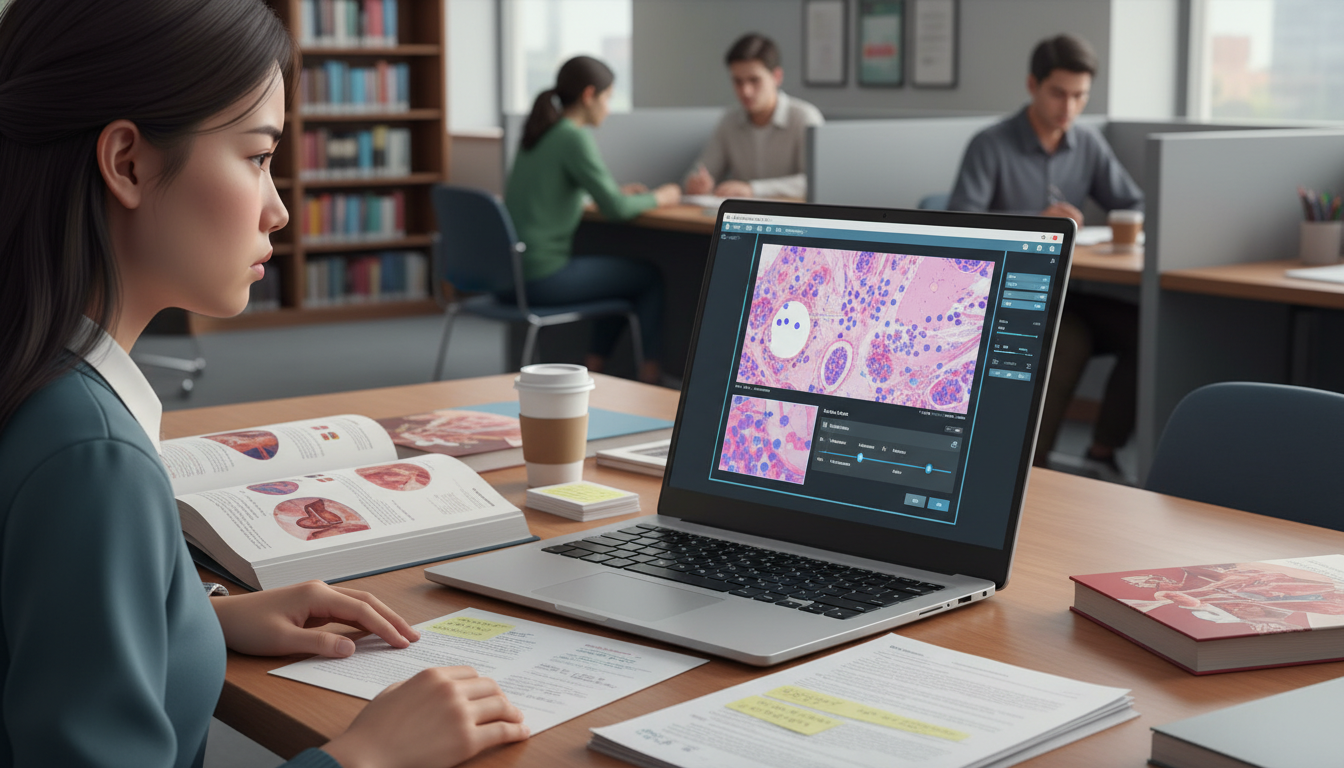
Pathologists must instantly recognize normal vs. abnormal tissue under the microscope. Start this skill now:
For anatomy
- Don’t just memorize structure names. Ask:
- What would this look like in a cross-section?
- How might it appear on CT/MRI?
- Strategy: Draw simplified versions of organ systems and label major structures. The act of drawing builds spatial memory.
- Don’t just memorize structure names. Ask:
For histology
- For each tissue type:
- Save or screenshot representative images from your slides or online atlases.
- Label: cell types, key structures, “signature” features.
- Make a “normal tissue portfolio” folder by organ system. This becomes your mental reference when you later learn pathology.
- For each tissue type:
B. Mechanism Maps for Biochemistry & Physiology
Pathology often boils down to: “What went wrong in this pathway or cell process?”
Convert pathways into cause-and-effect chains, not just diagrams:
- Example (coagulation):
- Normal: Vessel injury → platelet plug → coagulation cascade → stable clot.
- Pathology lens: Where could this fail? (Platelet disorders, factor deficiencies, hypercoagulability)
- Create “What if this step fails?” side notes in your lecture slides.
- Example (coagulation):
Build mechanism maps:
- Start with a physiological process (e.g., RAAS, insulin signaling).
- Add branches:
- What happens if overactive?
- What happens if underactive?
- What labs or findings would you expect?
This kind of thinking mirrors how pathologists interpret lab results and correlate with disease.
Step 3: Active Learning Techniques That Actually Work
Some high-yield M1 tips for academic survival:
Spaced repetition (e.g., Anki)
- Use it specifically for:
- Biochemistry details (enzymes, pathways)
- Pharmacology (if introduced in M1)
- Histology and anatomy identification
- Avoid turning everything into flashcards; prioritize what you truly can’t rely on understanding alone to remember (names, lists, exceptions).
- Use it specifically for:
Teaching others
- Form a small group and assign mini-teaching sessions:
- One person teaches normal kidney function.
- Another teaches major glomerular diseases (even if briefly introduced).
- Explaining mechanisms builds the kind of clarity that pathology demands.
- Form a small group and assign mini-teaching sessions:
Practice image-based learning
- Whenever your course includes images (gross specimens, radiology, histology), pause and:
- Describe what you see out loud before looking at the caption.
- Identify: What is normal? What looks different or abnormal?
- This habit trains your diagnostic eye early.
- Whenever your course includes images (gross specimens, radiology, histology), pause and:
Integrate early board-style questions (when appropriate)
- Don’t obsess over Step-style performance in the first weeks of M1.
- But by mid-year, start sprinkling in board-style questions for:
- Anatomy
- Physiology
- Biochemistry
- Pathology questions often combine mechanisms with clinical vignettes; early exposure will make that transition easier in M2.
Building the Pathologist Mindset in M1
Even in first year, you can start thinking like a future pathologist. This isn’t about locking in your specialty too early; it’s about developing habits that will serve you in any field but especially in pathology.
Learn to Love Mechanisms and Patterns
Pathologists are professional pattern recognizers and mechanism decoders. You’re already practicing this in M1 if you:
Ask “Why?” more than “What?”
- Not just: “This enzyme deficiency causes disease X.”
- Instead: “What accumulates? Where? Why does that cause the specific symptoms we see?”
Compare and contrast similar entities
- Example:
- Compare two anemias based on:
- Mechanism (production problem vs. destruction problem)
- Lab findings (MCV, reticulocyte count)
- Morphology (how RBCs look on a smear)
- Compare two anemias based on:
- Example:
Build concept tables
- For each system, create:
- Normal function
- Most important diseases
- Key lab findings
- Classic clinical scenarios
- For each system, create:
The more you organize information in interconnected webs, the more naturally pathology will later click.
Engage Early with Pathology-Focused Opportunities
Even in the first year medical school phase, you can dip your toe into pathology:
Join your school’s pathology interest group (PIG) if one exists.
- Attend career panels, Q&A nights, and microscope sessions.
- Ask upperclassmen:
- How did they know pathology was right for them?
- What they wish they’d done in M1.
Attend optional sign-outs or gross room sessions (if allowed)
- Some departments let M1s quietly observe:
- Surgical pathology sign-out (review of cases with an attending)
- Autopsy gross examinations (with appropriate supervision)
- Even one or two such experiences can clarify whether pathology truly interests you.
- Some departments let M1s quietly observe:
Meet a pathology mentor early
- Send a brief, respectful email to a pathology faculty member:
- Introduce yourself as an M1 curious about pathology.
- Ask for a 20–30 minute meeting to discuss the field and future steps.
- A mentor can later help you identify research projects, electives, and letters of recommendation—key elements in a strong pathology match application.
- Send a brief, respectful email to a pathology faculty member:

Time, Stress, and Sanity: Non-Academic Survival Strategies
No discussion of surviving first year of med school is complete without tackling the mental and physical demands. This matters for everyone, but it’s particularly relevant if you see yourself in a detail-heavy specialty like pathology.
Time Management for High-Detail Learners
Many students drawn to pathology are perfectionists. That’s an asset—but it can become dangerous in M1 if unchecked.
Common pitfall: Spending 3 hours perfecting notes for one lecture, then falling behind in everything else.
Better approach: “Good enough plus review”
Before lecture
- Skim slides (10–15 minutes).
- Identify “big ticket” topics: major pathways, organ systems, bolded concepts.
During lecture
- Focus on listening for:
- What the instructor emphasizes repeatedly.
- What they say is “classic” or “very testable.”
- Annotate slides rather than creating completely new notes.
- Focus on listening for:
After lecture (same day)
- Spend 30–45 minutes:
- Summarizing the core mechanism or storyline of the lecture.
- Adding 5–15 flashcards (if using Anki) on highest-yield details.
- Move on. Trust your spaced repetition and future reviews.
- Spend 30–45 minutes:
This balanced approach preserves depth where it matters without sacrificing coverage.
Protecting Your Mental Health in M1
Medical training culture can still glorify overwork, but pathology as a specialty tends to value thoughtful, sustainable practice. Start that mindset now:
Set concrete limits
- Pick a cut-off hour for studying most days (e.g., 9 or 10 PM).
- Decide in advance which evenings or half-days are non-negotiable breaks.
Use “micro-rests”
- 50 minutes focused work → 10-minute break:
- Stand, stretch, grab water, short walk.
- This protects your attention and reduces burnout risk.
- 50 minutes focused work → 10-minute break:
Normalize struggle
- Even extremely strong students often feel overwhelmed in M1.
- Use support systems:
- Classmates
- School counseling or wellness services
- Faculty advisors
Watch for red flags
- Persistent insomnia or hypersomnia
- Loss of interest in things you usually enjoy
- Escalating use of substances to cope
- Frequent thoughts of quitting or feeling hopeless
- These warrant reaching out for professional help—early, not later.
Maintaining Identity and Interests (Including Pathology)
Your life can’t be 100% school:
- Keep 1–2 non-medical activities weekly:
- Exercise, music, art, religious community, family time, gaming, etc.
- If pathology genuinely excites you:
- Set aside a small weekly “pathology curiosity” block (30–60 minutes).
- Watch a pathology case video.
- Flip through an atlas of gross pathology.
- Read a short review article about a disease you saw in class.
- Set aside a small weekly “pathology curiosity” block (30–60 minutes).
This helps maintain motivation and reminds you why you’re doing this.
Looking Ahead: Setting Up a Strong Pathology Future During M1
You don’t need to lock in your specialty during first year, but if pathology is on your radar, there are smart moves you can make now that will pay off when you approach the pathology residency application process.
Academic Foundations That Help in the Pathology Match
PDs (program directors) in pathology consistently value:
- Solid performance in:
- Pathology courses (usually M2)
- Related disciplines: histology, anatomy, physiology, hematology
- Comfort with:
- Independent study and reading
- Integrating lab and clinical information
In M1, this translates to:
- Taking histology seriously—not just cramming for ID questions.
- Building a robust understanding of normal physiology.
- Practicing how to interpret basic labs when they show up in your courses.
Your Step exams (Step 1 and Step 2 CK) and preclinical grades will later form a large portion of your residency file, even in a less score-obsessed environment. M1 is where that trajectory starts.
Early CV Building (Without Overloading Yourself)
You do not need a long CV in M1. Focus on 1–3 meaningful activities:
Pathology shadowing or experiences
- A few sessions a semester are enough.
- Keep a brief reflection journal:
- What did you see?
- What aspects of the work appealed to you (or didn’t)?
Introductory research opportunities
- If you’re interested in academic pathology, research helps—but it doesn’t have to start in M1.
- If something low-intensity and well-structured appears (e.g., helping with data entry, case series, or literature review), it can be a gentle start.
Interest group involvement
- Being an active member, then perhaps taking on a leadership role in M2–M3, shows longitudinal interest in pathology but shouldn’t dominate your time now.
Clarifying Whether Pathology Is the Right Fit
Use M1 as data-gathering, not decision-forcing:
- Ask yourself:
- Do I enjoy mechanisms and pattern recognition more than direct patient interactions?
- Do I like visual learning (slides, images, patterns) and thinking deeply about diagnostic details?
- Compare pathology to other emerging interests:
- Are you equally drawn to radiology, internal medicine, dermatology, or neurology?
- That’s normal; many future pathologists sort this out across M2–M3.
By the end of M1, your goal is not to decide for sure—but to have a clearer idea of whether pathology is a serious contender.
FAQs: Surviving M1 with an Eye Toward Pathology
1. Do I need to know I want a pathology residency during first year?
No. Many future pathologists decide in late M2 or even during clinical rotations. M1 is best used to build strong foundations—especially in histology, anatomy, and physiology—and to lightly explore pathology so you can make an informed choice later.
2. What are the most important M1 courses for a future pathologist?
Histology and anatomy are critical for understanding normal structure; physiology is key for mechanism-thinking. Biochemistry and cell biology matter, particularly for molecular and cancer pathology, but the big three—histology, anatomy, physiology—are your highest-yield base for pathology.
3. Should I start doing pathology research in M1 to help my pathology match chances?
It can help, but it’s not mandatory in first year. If an opportunity arises that is well-mentored, manageable in scope, and interesting to you, consider it. Otherwise, focus on excelling in coursework, adjusting to medical school, and maybe doing shadowing or joining a pathology interest group. Research can ramp up in M2 or a dedicated research year if you wish.
4. How much pathology-specific studying should I do during M1?
Formal pathology usually comes later, so you don’t need to pre-study textbooks. Instead:
- Master normal structure and function in your current courses.
- When diseases are mentioned, spend a few extra minutes understanding the basic mechanism.
- Occasionally, watch a short pathology case video or attend optional pathology events. That’s enough at this stage while you’re still surviving medical school and adapting to M1 demands.
Surviving the first year of med school while keeping an eye on a potential future in pathology is absolutely doable. Concentrate on building strong fundamentals, cultivating mechanisms-based thinking, and maintaining your well-being. If pathology continues to spark your interest, the habits and foundations you build in M1 will put you in an excellent position for later coursework, clinical rotations, and ultimately a successful pathology match.




















