Preparing for urology board exams—whether you’re a resident, fellow, or early-career attending—is a long game, not a last-minute sprint. The right resources and a structured plan can transform what feels overwhelming into a manageable, even rewarding, process.
This guide walks through the most effective board exam study resources in urology, how to combine them, and how to adapt them whether you are aiming for initial certification or long-term maintenance of certification (MOC). Along the way, we’ll weave in practical strategies, including UWorld tips, how to integrate Anki USMLE-style spaced repetition into urology content, and how to leverage your urology residency training for board success.
Understanding the Urology Board Exam Landscape
Before you pick resources, you need clarity on what you’re studying for and how it will be tested.
Types of Exams in a Urology Career
USMLE/COMLEX (Pre-residency)
- These shape your competitiveness for the urology match, and the habits you build here directly influence how you prepare for urology boards.
- Core tools: UWorld, Anki USMLE decks, and system-based review texts.
In-Service & In-Training Exams during Urology Residency
- Annual tests that:
- Benchmark you versus your peers.
- Predict your performance on written boards.
- Reveal gaps in knowledge early.
- Annual tests that:
American Board of Urology (ABU) Written Qualifying Exam
- Typically taken after residency completion.
- Multiple-choice format.
- Emphasizes:
- Clinical decision-making
- Guidelines
- Perioperative management
- Oncologic and benign conditions
Oral Certifying Exam
- Case-based.
- Focuses on:
- Clinical reasoning
- Judgment
- Safe and ethical practice
- Communication and prioritization
Maintenance of Certification (MOC) / Lifelong Learning
- Periodic knowledge assessments and CME requirements.
- Often case-based modules plus readings and self-assessment.
This guide focuses mainly on the written exam and core knowledge components but will highlight how resources can be used across all stages.
Core Textbooks and Reference Books in Urology
Textbooks provide depth, context, and nuance that no question bank alone can replicate. For the urology boards, there are a few recognized anchors.
1. Campbell-Walsh-Wein Urology (or equivalent major text)
- Why it’s important
- Considered the “gold standard” reference in urology.
- Too large to read cover-to-cover during a urology residency, let alone during a study period—but essential as a primary reference.
- How to use it for board prep
- Use for:
- Topic deep dives (e.g., complex reconstructive procedures, unusual congenital anomalies).
- Clarifying nuances after missing a question.
- Targeted approach:
- Use your in-service scores and question bank performance to identify weak areas (e.g., pediatric urology, neurourology).
- Read key chapters, not the entire text.
- Tip: Create small “summary sheets” from frequently tested sections (e.g., staging and grading systems, guideline-based management algorithms).
- Use for:
2. Urology Board Review Books (High-Yield Companions)
Several review-style books are built specifically around the board exam blueprint:
Features to look for
- Bullet-point format
- High-yield tables and algorithms
- Board-style questions or case vignettes
- Updated to reflect recent guideline changes (AUA, EAU, NCCN)
How to integrate
- Use as your daily backbone for content review.
- Example structure:
- Morning: Read 10–15 pages of a board review book.
- Afternoon/Evening: Do questions from a bank on the same topic.
- Weekend: Review and annotate your board review book based on what you missed in questions.
3. Subspecialty Texts and Atlases
- When they help
- If you’re weaker in:
- Pediatric urology
- Female pelvic medicine and reconstructive surgery (FPMRS)
- Endourology/stone disease
- Or if oral boards are approaching and you need visuals and operative steps.
- If you’re weaker in:
- Examples of use
- Read the chapter on posterior urethral valves from a pediatric text after missing several related questions.
- Use surgical atlases to understand approaches, complications, and postoperative management—material often tested in scenario-based questions.
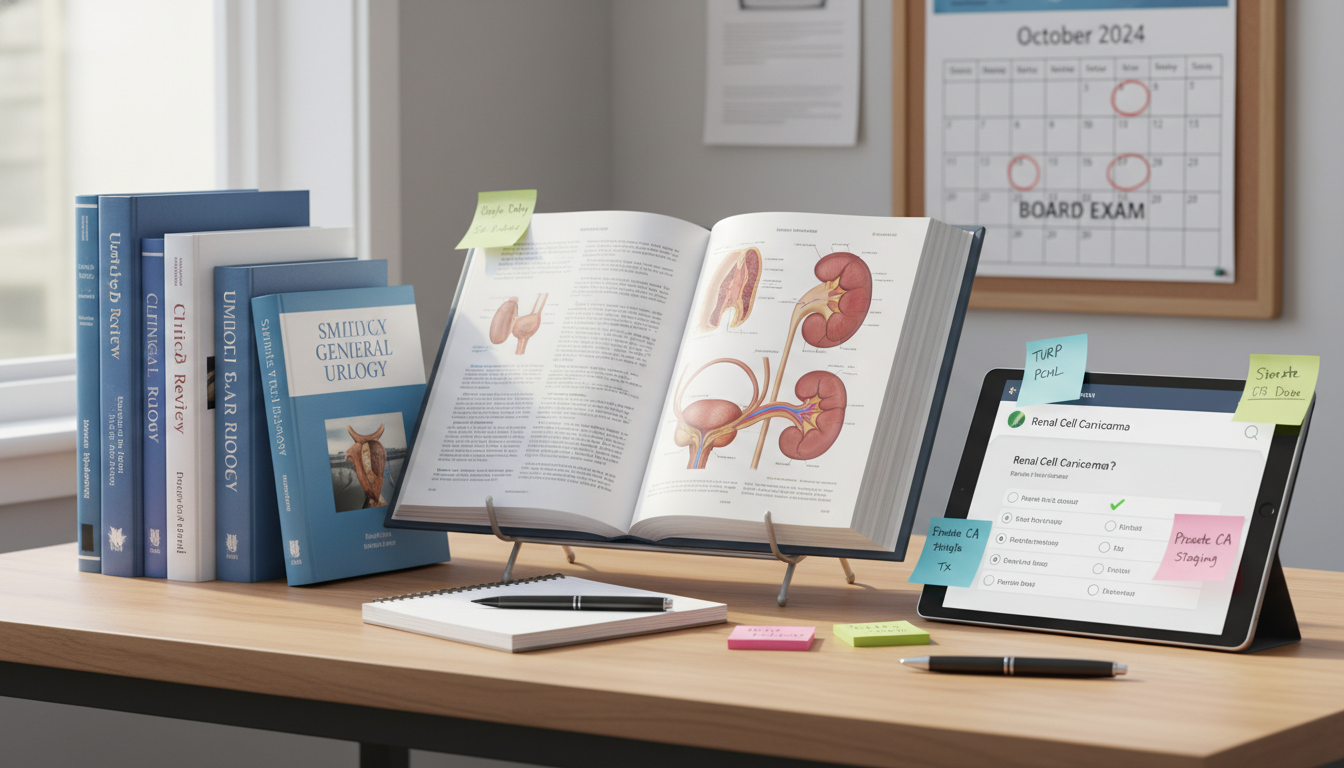
Question Banks and Digital Resources: Your Daily Workhorse
Question-based learning is central to modern board prep. The key is consistency, explanation-focused learning, and feedback loops.
1. Urology-Specific Question Banks
Look for:
- Large question volume (preferably 1,000+ questions).
- Clear explanations with references to major texts or guidelines.
- Mixed-format questions to simulate the exam.
How to use them efficiently
- Early residency (PGY-2–3):
- 10–20 questions/day, untimed, tutor mode.
- Aim: Build foundations and identify weak areas, not speed.
- Pre-board year (PGY-5 or post-graduation):
- 40–60 questions/day, mixed topics, timed blocks.
- Weekly simulation: 100–150 questions in exam-like conditions.
- Review strategy:
- Spend more time on explanations than on answering.
- Focus on:
- Why the right answer is right.
- Why each wrong option is wrong.
- Key “take-home” principle (write 1–2 lines into a notebook or Anki card).
2. UWorld Tips and Translating “USMLE Mindset” into Urology Boards
While UWorld is built for USMLE, the style of learning you cultivate from it is perfectly transferable to urology board preparation.
Key UWorld-inspired strategies:
Concept over fact memorization
- Example: Instead of memorizing “X antibiotic is used for Y,” focus on:
- Pathophysiology of the infection.
- Local resistance patterns.
- Patient comorbidities and renal function.
- This helps when test writers change specifics but preserve underlying principles.
- Example: Instead of memorizing “X antibiotic is used for Y,” focus on:
Pattern recognition
- UWorld teaches you to identify patterns from vignettes (age, risk factors, imaging, lab values).
- Use that on urology Q-banks by:
- Noticing clusters: e.g., elderly man, painless hematuria, smoking history → think urothelial carcinoma until proven otherwise.
- Creating mini-pattern lists in your notes.
Post-question note-making
- Similar to annotating First Aid for USMLE, annotate your urology board review book with insights from question explanations.
3. Harnessing Anki USMLE-Style Spaced Repetition for Urology
Anki is not just for USMLE. Using an Anki USMLE methodology for urology board material can dramatically improve long-term retention.
How to build and use urology Anki decks:
Source of cards:
- Missed or tricky Q-bank questions.
- High-yield points from in-service exams.
- Key tables (TNM staging, risk stratification systems, AUA guideline thresholds).
Card design:
- Favor cloze deletions (“fill in the blank”) rather than long answer fields.
- Example:
- Front: “The most common histologic subtype of testicular cancer overall is {{c1::seminoma}}.”
- Back: Short explanation or rule-out points.
- Example:
- Limit each card to one concept.
- Favor cloze deletions (“fill in the blank”) rather than long answer fields.
Daily routine:
- 30–60 minutes/day of Anki reviews, year-round.
- Create cards only from material you genuinely want to remember 6–12 months later (avoid clutter).
Practical example:
- You miss a question on high-risk non–muscle invasive bladder cancer.
- Create cards:
- Criteria for high-risk NMIBC.
- Standard intravesical therapy options and relative contraindications.
- Surveillance schedule per guidelines.
4. Apps and Digital Study Tools
- Flashcard apps with shared decks
- Some urology residents share curated decks—use these as a supplement, not a substitute for your own cards.
- Clinical guideline apps
- AUA, EAU guideline apps or PDFs can be turned into:
- Quick-review checklists.
- Anki cards (e.g., cutoffs for intervention, surveillance intervals).
- AUA, EAU guideline apps or PDFs can be turned into:
Guidelines, Journals, and Evidence-Based Resources
Modern board exams emphasize guideline-based and evidence-based practice. Questions often hinge on current standards rather than traditional dogma.
1. Urology Guidelines (AUA, EAU, NCCN)
Why they’re high yield
- Reflect what exam committees consider “standard of care.”
- Frequently tested in:
- Cancer staging
- Surveillance strategies
- Screening recommendations
- First- and second-line therapies
How to study them without drowning
- Don’t attempt to memorize entire guideline documents.
- Instead, focus on:
- Executive summaries
- Treatment algorithms and flowcharts
- Tables summarizing risk stratification and recommended follow-up
- Strategy:
- Pick one topic per week (e.g., prostate cancer, stone disease).
- Read the summary and algorithms.
- Translate them into:
- One-page schematic overviews.
- A small set of Anki cards.
Examples of high-yield guideline topics:
- Prostate cancer:
- Screening thresholds and intervals.
- Risk categories and initial treatment pathways.
- Bladder cancer:
- Risk stratification (low, intermediate, high).
- Intravesical therapy algorithms.
- Nephrolithiasis:
- Indications for intervention vs. observation.
- Metabolic evaluation and prevention measures.
- Prostate cancer:
2. Peer-Reviewed Journals and Landmark Trials
For the written exam, you rarely need granular trial details, but you do need the big-picture lessons.
What to target
- Landmark trials that reshaped:
- Prostate cancer screening and management.
- Systemic therapy choices in metastatic urothelial carcinoma.
- Use of neoadjuvant/adjuvant therapies.
- Journals:
- Journal of Urology
- European Urology
- Urology
- Subspecialty journals as needed.
- Landmark trials that reshaped:
How to be efficient
- Read:
- Review articles and guideline updates rather than all original RCTs.
- Focus on:
- The clinical question.
- The bottom-line findings.
- How practice changed (e.g., “Now standard of care is X for patients with Y profile”).
- Read:
3. Board Exam Resources from Professional Societies
- Many urology associations offer:
- Self-assessment modules (SAMs)
- Online question sets
- Video lectures
- These are especially valuable because:
- They’re often aligned with the board committee’s philosophy.
- They may mirror the style and difficulty of questions.

Structuring Your Study Plan Across Training and Beyond
Knowing what to use is just half the equation. How you integrate resources over time is just as important.
1. During Urology Residency (PGY-2 to PGY-4)
Goals:
- Build a robust knowledge foundation.
- Develop efficient study habits.
- Use the in-service exam as low-stakes feedback.
Suggested approach:
- Daily:
- 10–20 board-style questions in tutor mode.
- 30 minutes of Anki reviews.
- Weekly:
- Choose one topic (e.g., BPH, pediatric obstructive uropathy).
- Read the corresponding section in a review book.
- Look up 1–2 key points in Campbell or another major text.
- Annually (before in-service):
- 6–8 weeks of slightly more intense focus:
- 30–40 questions/day.
- Short-topic reviews.
- Post-exam: Analyze performance and adjust your focus areas.
- 6–8 weeks of slightly more intense focus:
2. Pre-Written Board Exam Period (Final Residency Year or PGY-5+)
Timeline: 3–6 months before the exam
Core components:
Content review
- Primary board review book as your roadmap.
- Supplement with Campbell and guidelines for weak spots.
High-volume questions
- 40–80 questions/day depending on your schedule.
- Ensure multiple passes through at least one main urology Q-bank.
- Plan for at least 1–2 full simulated exams (e.g., 200–300 questions in one sitting).
Active recall and spaced repetition
- Continue Anki, focusing on:
- Weak topics.
- Frequently missed material.
- Use your Anki stats and Q-bank analytics to drive what you review.
- Continue Anki, focusing on:
Focused weak-area blocks
- If your analytics show:
- You’re weak in pediatric urology → dedicate 1–2 weeks primarily to that, with:
- Review book chapters.
- Targeted Q-bank sections.
- A guideline overview where applicable.
- You’re weak in pediatric urology → dedicate 1–2 weeks primarily to that, with:
- If your analytics show:
3. Oral Board and MOC Preparation
While this guide is resource-focused, your test prep should also be exam-format aware.
Oral boards:
- Resources:
- Case-based review books.
- Small-group mock orals with faculty.
- Surgical atlases for visualizing procedures and complications.
- Strategy:
- Practice verbalizing your reasoning clearly and succinctly.
- Focus on safety, ethics, and best-practice guidelines.
- Resources:
MOC:
- Resources:
- Self-assessment modules.
- Updated guidelines and online CME courses.
- Brief board review materials focusing on recent changes, not basics you already know.
- Strategy:
- Integrate into your ongoing CME and journal reading.
- Use question-based CME tools to maintain exam readiness.
- Resources:
Practical Tips for Maximizing Your Study Efficiency
1. Match Resource Intensity to Your Stage
- Early residency:
- Prioritize breadth and understanding over detail memorization.
- Late residency / just before the exam:
- Prioritize high-yield details, guideline nuances, and practice questions.
2. Avoid Resource Overload
You don’t need every book and every Q-bank.
- Choose:
- 1 primary comprehensive text (as reference).
- 1 core board review text.
- 1–2 high-quality question banks.
- One spaced repetition tool (e.g., Anki).
Commit to mastering these rather than skimming many.
3. Integrate Studying into Clinical Work
- Use real patients to trigger micro-learning:
- After a complex stone case:
- Read a guideline section on stone management.
- Do 5–10 questions on stone disease.
- After a pediatric clinic day:
- Review a high-yield pediatric topic and make 2–3 Anki cards.
- After a complex stone case:
4. Protect Your Cognitive Bandwidth
- Sleep and caffeine aren’t interchangeable.
- Short, focused study blocks (25–50 minutes) with breaks are more effective than unfocused marathons.
- Minimize distractions:
- Phone on Do Not Disturb.
- Pre-defined study goals for each session (e.g., “20 questions + 15 pages review”).
Frequently Asked Questions (FAQ)
1. When should I start serious board exam prep during my urology residency?
A practical approach is to start lightly from PGY-2, emphasizing steady habits. Your intensive preparation should begin about 6–12 months before the written exam. Throughout residency, use in-service exams and your question bank performance to shape your focus. The earlier you normalize daily questions and Anki-style review, the less “cramming” you’ll need later.
2. Do I need to read Campbell cover-to-cover to pass the urology boards?
No. Campbell is an essential reference, not a required cover-to-cover read for boards. Most successful candidates:
- Use a concise board review book for structured study.
- Turn to Campbell selectively for clarification and depth in problem areas.
- Focus on guideline-driven, high-yield content rather than exhaustive detail.
3. How can I balance studying for the boards with a busy urology residency schedule?
The key is integration and consistency:
- Set realistic daily targets: 10–30 questions and 20–40 minutes of Anki.
- Use clinical encounters as cues to review related topics.
- Block 2–3 protected evenings per week for deeper reading or longer question sets.
- During lighter rotations, increase your volume; during heavier rotations, maintain the core habits even if at lower intensity.
4. Are USMLE-style resources like UWorld and Anki USMLE decks still useful during urology board prep?
They are most useful earlier in your training and for building your approach to studying:
- UWorld teaches clinical reasoning, pattern recognition, and how to learn from explanations.
- Anki USMLE decks show you how to implement spaced repetition. For actual urology board content, you will need urology-specific question banks and decks, but applying UWorld tips and Anki methodology to these specialty resources is extremely effective.
By combining a focused set of high-quality board exam resources—core textbooks, board review books, urology-specific question banks, guidelines, and Anki-style spaced repetition—you can build a sustainable, efficient system that supports you through the written exam, the oral boards, and well into your lifelong learning as a urologist.