



Understanding USMLE Step 1 in the Era of Clinical Informatics
USMLE Step 1 has transformed from a score-reporting exam to pass/fail, but its importance in your trajectory—especially if you’re interested in a future clinical informatics fellowship—remains significant. Program directors still expect solid foundational science knowledge, and many see Step 1 performance (even as pass/fail) as a proxy for discipline, information management, and test-taking strategy.
Clinical informatics as a specialty sits at the intersection of medicine, data, and technology. The same skills that make you effective in health IT training—systems thinking, organized workflows, data-driven decision-making—can dramatically improve your USMLE Step 1 preparation and outcomes.
This guide will walk you through:
- How to approach USMLE Step 1 preparation strategically
- How to build a study plan using informatics-style thinking
- The best ways to use Step 1 resources efficiently
- Digital tools and analytics approaches that mirror clinical informatics practice
- How to “future-proof” your studying for a career in clinical informatics
Step 1 and Clinical Informatics: Why the Connection Matters
Many students think of Step 1 as pure basic science and memorization, far removed from fields like clinical informatics. In reality, the exam, your study approach, and informatics have shared core themes:
1. Systems Thinking
Clinical informatics specialists analyze systems: how EHRs interact with provider workflows, how order sets influence outcomes, how data flows across platforms. Step 1 questions often test similar systems-level thinking:
- How does a pharmacologic intervention cascade through multiple organ systems?
- How does a genetic defect disrupt a metabolic pathway and cause a clinical syndrome?
- How do epidemiologic principles apply to disease spread or screening?
When you study, train yourself to see connections and pathways, not isolated facts. This mindset aligns with both test success and informatics practice.
2. Data Management and Decision Support
Informatics professionals design clinical decision support tools that filter signal from noise in vast amounts of data. Step 1 preparation is your first major test of large-scale information management:
- Thousands of Anki cards (or other flashcards)
- Hundreds of hours of question banks
- Multiple Step 1 resources and textbooks
You must decide what matters, how often to review it, and when to move on. That’s essentially personal decision support.
3. Measurement, Feedback, and Iteration
Health IT training emphasizes continuous quality improvement: collect data, analyze, intervene, reassess. Effective USMLE Step 1 study follows the same loop:
- Quiz yourself (NBME, UWorld blocks)
- Analyze performance
- Adjust study plan
- Reassess with further questions
If you enjoy this kind of structured, iterative learning, you’re already thinking like a future clinical informatician.
Designing a Step 1 Study Strategy Like an Informatics Project
Approach your USMLE Step 1 preparation the way you’d approach a complex clinical informatics implementation: with a clear goal, structured timeline, defined metrics, and flexible workflows.
Step 1: Define Your “Project Scope”
Ask and answer:
- What is my test date?
- How many weeks do I have for dedicated study?
- Am I balancing classes/rotations or focusing full-time?
- What is my current baseline? (e.g., a school-provided CBSE or NBME practice exam)
From there, outline your mission:
“In 10 weeks, I will systematically review all high-yield content, complete 2,000+ quality questions, and pass Step 1 on the first attempt while building durable knowledge for clerkships and eventual clinical informatics fellowship applications.”
Step 2: Map Resources to Objectives
Core Step 1 resources (build your list thoughtfully—don’t overstack):
Question banks
- UWorld (gold standard for Step 1-style questions)
- AMBOSS, Kaplan, or others as secondary if time permits
Content review
- First Aid for the USMLE Step 1 (or equivalent organized review text)
- Pathology resource (e.g., Pathoma or similar)
- Systems-based lecture notes or your school’s curriculum as supplements
Spaced repetition
- Anki decks (e.g., school-specific decks or well-known Step 1 decks)
- Self-made flashcards to personalize weaknesses
Assessment exams
- NBME self-assessments
- UWorld Self Assessments (UWSAs) if available
Tie each resource to its purpose, like components in a clinical decision support system:
- Question bank → application + self-assessment
- Review book → framework & synthesis
- Anki → memory durability
- NBME/UWSA → global performance checks
Avoid redundancy. For example: two full primary question banks for USMLE Step 1 study may offer diminishing returns if you haven’t fully exploited one.
Step 3: Build a Data-Driven Study Schedule
Think in phases, similar to an EHR implementation:
Foundational phase (Pre-dedicated / early months)
- Primary goal: integrate Step 1 preparation with coursework
- Actions:
- Daily low-dose questions (10–20 Qs/day) in “tutor mode” or mixed mode
- Build or review Anki cards from lectures and Step 1 resources
- Align organ systems: when you study cardiology in school, focus your questions and reading there
Systems consolidation phase (6–10 weeks before exam)
- Primary goal: structured, system-based review
- Actions:
- Rotate through organ systems (e.g., 2–3 days each for cardio, endocrine, renal, etc.)
- 40–80 questions per day (depending on schedule) in timed blocks
- Daily Anki to lock in facts
Dedicated phase (4–6 weeks before exam)
- Primary goal: high-yield review and practice under test-like conditions
- Actions:
- 2–3 full blocks per day (40–120 questions)
- Review each question thoroughly
- NBME or UWSA every 1–2 weeks
- Targeted review of weak areas using Step 1 resources and flashcards
Step 4: Use Metrics to Guide Adjustments
In clinical informatics, you wouldn’t redesign a workflow without outcome data. Similarly, don’t drastically change your Step 1 approach without analyzing:
Question bank performance
- Overall percentage correct
- Performance by system (e.g., GI vs. Renal)
- Performance by discipline (e.g., Pharmacology vs. Pathology)
Assessment exam trends
- Are you steadily improving?
- Which content areas repeatedly underperform?
Engagement metrics
- Are you keeping up with your Anki reviews?
- Are you consistently finishing question blocks on time?
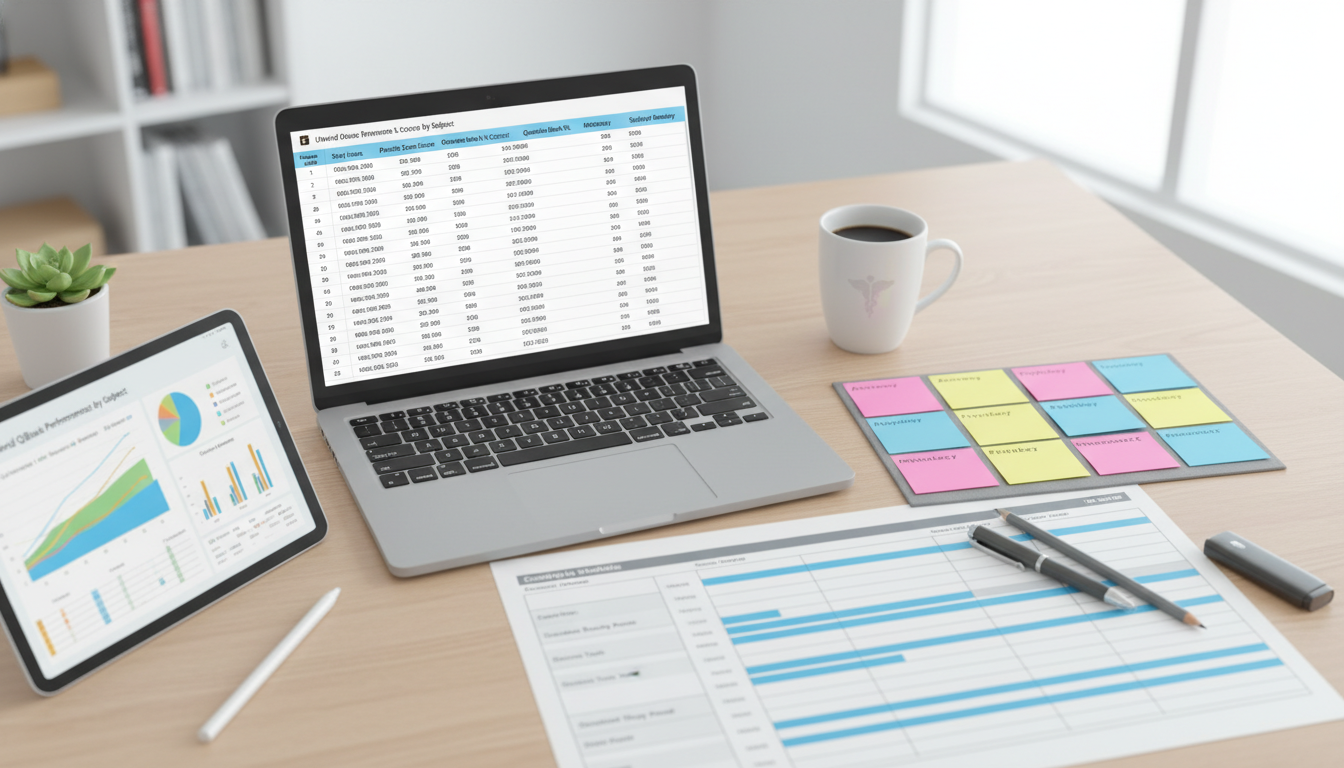
Track data in a simple spreadsheet or app:
| Metric | Baseline | Week 2 | Week 4 | Week 6 |
|---|---|---|---|---|
| Total Qs completed | 0 | 400 | 900 | 1400 |
| Overall QBank % | — | 54% | 63% | 68% |
| Pathology QBank % | — | 58% | 70% | 75% |
| NBME-equivalent | CBSE | NBME | UWSA |
Use this data to adjust:
- Weak in biostatistics? Schedule a half-day “mini-bootcamp” with focused reading + targeted questions.
- Time issues? Build in daily timed blocks to train pacing.
- Plateauing scores? Re-examine how deeply you review questions, not just how many you do.
Daily Study Workflow: Applying Informatics Principles to Your Routine
A well-designed daily workflow is like an optimized EHR interface: it minimizes friction and maximizes meaningful output.
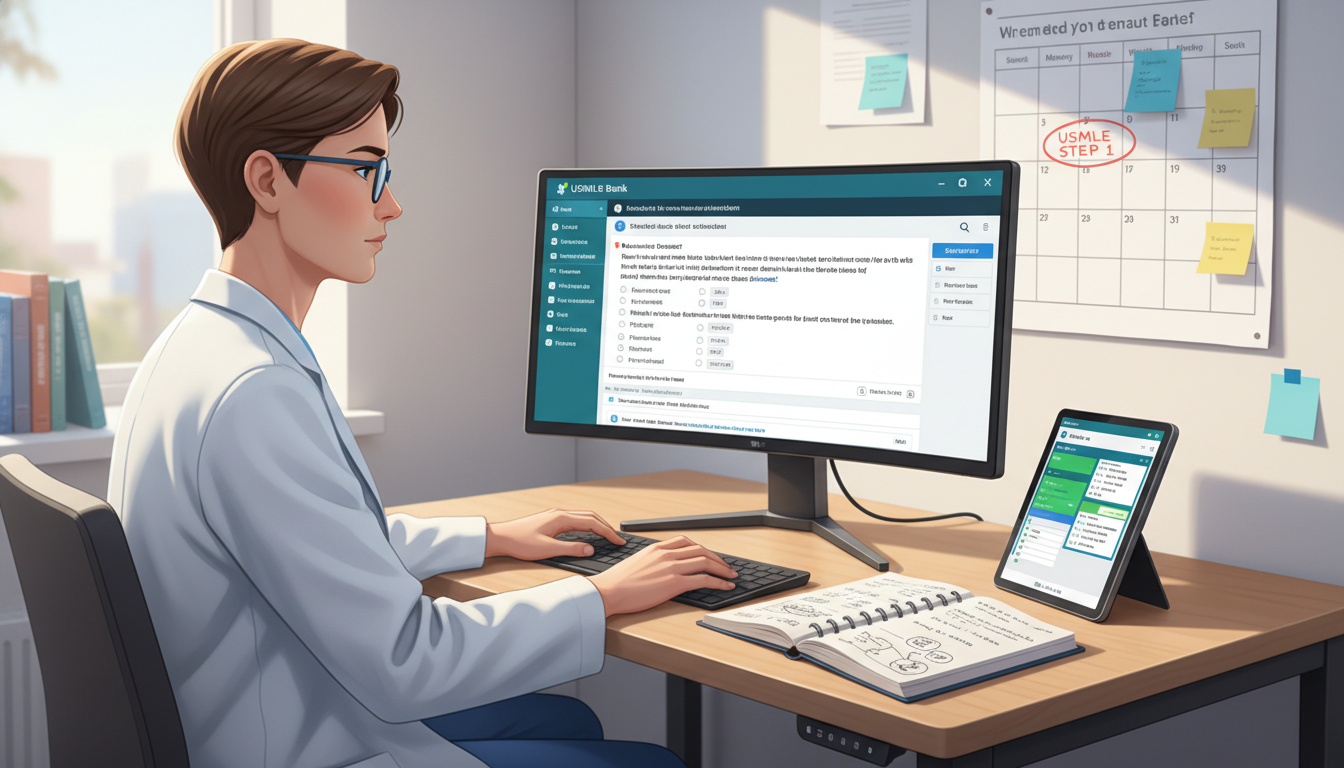
Example Daily Schedule (Full-Time Dedicated, 8–10 Hours)
1. Morning (High-cognition time)
Block 1: Timed Question Set
- 40 questions (mixed or by system), timed mode
- Simulate exam conditions: no pauses, no looking up content mid-block
Review Block 1 (90–120 minutes)
- For each question:
- Identify the core concept
- Ask: “What made the correct option right? What made the others wrong?”
- Add or update Anki cards for concepts you truly did not know
2. Midday (Content Integration)
Focused Review (2 hours)
- Guided by your QBank mistakes and weak systems
- Use:
- First Aid or equivalent for structured reading
- Videos/lectures only for particularly confusing topics
Practice Integration (20–30 minutes)
- Do 5–10 additional questions on the topic you just reviewed
- Confirm that the review improved your accuracy
3. Afternoon (Endurance + Spaced Repetition)
Block 2: Timed Question Set (40 questions)
- Optionally focus on another system or do mixed questions
Review Block 2 (60–90 minutes)
- Slightly faster review than Block 1; focus on patterns and error types
Anki / Spaced Repetition (60–90 minutes)
- Clear new and due cards
- Prioritize cards:
- High-yield facts you keep missing
- Pathways, mechanisms, and differentials that integrate multiple facts
4. Evening (Light Review and Recovery)
- Skim summary tables or diagrams
- Short review of pharm charts or microbiology “bugs and drugs”
- Protect sleep: memory consolidation is critical to USMLE Step 1 study
Error Analysis: Think Like a Root-Cause Analyst
After enough questions, you’ll notice error patterns similar to root causes in quality improvement projects:
- Knowledge deficit – You truly didn’t know the concept
- Recognition deficit – You knew the fact but didn’t recognize it in the vignette
- Misreading – Skimmed key details, misread lab values
- Overthinking/anchoring – Ignored simpler explanations
- Time pressure – Rushed through final questions
Log errors by type. Then prescribe interventions:
- Knowledge deficit → targeted content review + new flashcards
- Recognition deficit → do more questions specifically on that disease/process
- Misreading → practice reading questions more slowly with active annotation
- Time pressure → regular timed blocks; practice spending ~90 seconds per question
Choosing and Using Step 1 Resources Effectively
The quality of your Step 1 resources matters, but your strategy with them matters more. Think like an informatics consultant choosing systems for a hospital: avoid redundancy and ensure each tool serves a clear purpose.
Question Banks: Your Primary Engine
For most students, the central USMLE Step 1 study tool is a high-quality question bank (QBank).
UWorld
- Pros:
- Excellent clinical vignettes mirroring actual exam style
- Outstanding answer explanations and educational objectives
- Integrated tutor/timed modes
- Best use:
- As your primary QBank
- Complete at least 1 full pass; 1.5–2 passes if you start early
AMBOSS / Kaplan / Others
- Pros:
- Additional question variety
- Different explanation styles
- Best use:
- Supplemental if you complete UWorld early
- Targeted practice for weak subjects
Practical tips:
- Treat each question as a learning module, not just a metric.
- Resist the urge to rush through questions for the sake of quantity.
- Avoid “answer key memorization”—always articulate why each option is right or wrong.
Texts, Videos, and Notes: Framework Builders
- Use First Aid for the USMLE Step 1 (or similar) as a map, not a novel.
- Pathology resource (e.g., succinct video/pathology guide):
- Especially useful early in your preparation
- Organize your notes digitally for searchability, as you would clinical documentation in an EHR.
Spaced Repetition: Informatics-Style Memory Management
In clinical informatics, we use algorithms to decide which alert to show and when. In USMLE Step 1 study, spaced repetition algorithms decide which card to show and when for optimal learning.
Anki best practices:
Use it daily; consistency is more important than volume on any single day.
Limit “new cards” if you’re feeling overwhelmed; focus on truly high-yield facts.
Favor cards that test clinical reasoning and relationships, not isolated trivia:
- Instead of: “What is the enzyme deficient in G6PD deficiency?”
- Try: “Patient with hemolysis after sulfa drug exposure, bite cells seen. What enzyme is deficient and what pathway is impaired?”
Create cards from:
- Incorrect QBank questions
- NBME/UWSA errors
- Frequently forgotten tables (e.g., lysosomal storage diseases, pharmacology side effects)
Integrating Clinical Informatics Skills Into Step 1 Prep
If you’re planning on a future clinical informatics fellowship, you can use your Step 1 preparation to cultivate informatics-relevant skills.
Use Simple Analytics on Your Performance Data
- Track your daily and weekly question totals
- Plot your QBank scores alongside your perceived effort and stress levels
- Use color coding in a spreadsheet to quickly spot problem areas (e.g., red for <55% in a system)
Ask informatics-style questions of your own data:
- What interventions changed my performance trajectory?
- Are there specific days/times when I perform best on questions?
- Does my accuracy vary by question source or by system?
Build Personal “Decision Support” Protocols
Examples:
Triage rules:
- If I perform <55% in two consecutive blocks on the same system → trigger a 2-hour focused review + 20 targeted questions.
- If my NBME score plateaus over 2 weeks → review meta-strategy (sleep, schedule, error analysis).
Alert suppression rules:
- If I’ve already seen a point three times and understand it → don’t keep making new cards on it.
This mindset—designing your own rules and triggers—mirrors how clinical decision support rules are built in EHR systems.
Manage Digital Overload Like an Informatics Professional
Just as hospitals struggle with alert fatigue, students struggle with resource fatigue:
- Too many apps, too many dashboards, constant notifications
- Multiple lecture series, dozens of Step 1 resources
Strategies:
- Pick one main QBank, one main review text, and one flashcard tool.
- Turn off non-essential notifications during study blocks.
- Batch email and messages into discrete time windows.
- Use a single digital calendar or task manager to schedule all Step 1-related tasks.
Frequently Asked Questions (FAQ)
1. How far in advance should I start USMLE Step 1 preparation if I’m interested in clinical informatics?
Ideally, begin integrated preparation during your pre-clinical years—at least 6–12 months before your dedicated study period:
- Use each organ-system block as a chance to align:
- Class material
- Step 1 resources
- Low-dose question practice
- If you’re leaning toward a clinical informatics fellowship, also:
- Start experimenting with digital tools (Anki, dashboards, study trackers)
- Consider small projects using your study data (simple performance analytics, visualization)
The dedicated period (4–8 weeks full time) then becomes consolidation and practice, not first exposure.
2. What are the most important Step 1 resources I should use?
At minimum, an efficient USMLE Step 1 study plan typically includes:
- One high-quality QBank (e.g., UWorld)
- A structured review text (e.g., First Aid or similar)
- A spaced repetition tool (Anki or equivalent)
- At least 2–3 assessment exams (NBME/UWSA)
Additional videos, notes, or second QBanks are optional and should only be added if they’ve clearly demonstrated value for you. More resources do not automatically mean better preparation—efficient, focused use of a few core tools wins.
3. How many questions should I complete before taking Step 1?
Volume is less important than engagement, but commonly:
- Aim for at least 2,000 high-quality questions before your exam
- Many students complete all of UWorld (~2,000–3,000 questions)
- Some will supplement with questions from a second QBank if time allows
- Ensure:
- You’ve seen a broad range of topics
- You’ve reviewed each question thoroughly
- You’re comfortable with timed blocks that mirror the real exam
Think in terms of coverage and retention rather than just raw numbers.
4. Does my Step 1 performance matter for a future clinical informatics fellowship?
Step 1 is now pass/fail, but:
- A pass on the first attempt is still important—it signals reliability and baseline competence.
- Knowledge from Step 1:
- Underpins clinical reasoning and communication with clinicians when you’re designing informatics tools.
- Supports your future performance on Step 2 CK, which remains numerically scored and more important for residency selection.
For clinical informatics fellowship applications later on, programs will look more at:
- Residency performance
- Any informatics-related projects, research, or QI work
- Demonstrated interest in health IT training and data-driven care
However, cultivating strong study skills and a systems-level mindset during Step 1 preparation directly contributes to the competencies valued in clinical informatics.
By treating USMLE Step 1 preparation as a personal informatics project—complete with data, workflows, and iterative improvement—you can not only maximize your chances of passing the exam on the first attempt, but also begin building the habits and mindset that will serve you throughout residency and into a career in clinical informatics.




















