Understanding Step 1 in the Context of Vascular Surgery
USMLE Step 1 is now reported as pass/fail, but it remains a critical gatekeeper for an integrated vascular program. Programs may no longer see your three-digit score, yet Step 1 preparation still matters for several reasons:
Licensing and progression
- Passing Step 1 is required to continue training in most U.S. schools.
- Failing Step 1 can delay graduation and reduce your competitiveness for vascular surgery residency.
Screening in an ultra-competitive specialty
- Vascular surgery is a small, competitive field with relatively few spots.
- A failure or multiple attempts on Step 1 is a significant red flag for many program directors, even in an integrated vascular program.
- Strong Step 1 preparation correlates with better performance on Step 2 CK, which remains a key numerical metric for residency selection.
Foundation for vascular surgery knowledge
Step 1 is basic science–focused, but the knowledge base directly supports vascular surgery practice:- Vascular anatomy: arterial branches, collateral circulation, venous systems, and neurovascular relationships.
- Physiology: hemodynamics, shock, endothelial function, coagulation, and microcirculation.
- Pathology: atherosclerosis, vasculitis, aneurysms, thrombosis, embolism.
- Pharmacology: antiplatelet agents, anticoagulants, thrombolytics, lipid-lowering drugs, antihypertensives.
Thinking of Step 1 as your first “vascular surgery rotation on paper” helps align your mindset: you’re not just cramming to pass; you’re building the core concepts you’ll use in the OR, clinic, and ICU.
Building a High-Yield, Vascular-Oriented Step 1 Study Plan
Preparing for Step 1 as a future vascular surgeon doesn’t mean ignoring other systems. Instead, you prioritize cardiovascular and vascular-related domains while still ensuring you cover everything thoroughly.
1. Clarify Your Timeline and Baseline
A. Define your test date and prep window
Typical scenarios:
- Dedicated period: 4–8 weeks of full-time study after preclinical curriculum.
- Longitudinal prep: 6–12+ months of part-time study alongside classes, then 4–6 weeks dedicated.
Choose based on:
- School schedule and curriculum
- Your historical test performance (NBMEs, in-house exams)
- Personal responsibilities and mental health
B. Establish a baseline
Take a practice exam:
- NBME Comprehensive Basic Science Self-Assessment (CBSSA) or
- UWorld self-assessment (if near the exam)
Use results to:
- Identify weak content areas (e.g., cardiovascular physiology, hematology, immunology).
- Set realistic goals (e.g., “I want a comfortable margin above typical passing thresholds to decrease anxiety and support a strong Step 2 CK performance.”)
2. Daily Structure: A Sample Vascular-Oriented Schedule
During an intensive dedicated period (8–10 hours/day):
Morning (4–5 hours) – Question-Driven Learning
- 40–60 timed, random USMLE-style questions (preferably from UWorld).
- Focus on:
- Cardiovascular system
- Hematology/oncology (coagulation, anemia, marrow disorders)
- Renal (volume regulation and blood pressure)
- Endocrine (diabetes, dyslipidemia, obesity—vascular risk factors)
- Review each question in detail:
- Why the right answer is correct
- Why each distractor is wrong
- Link pathophysiology to clinical vascular scenarios (e.g., how nephrotic syndrome can predispose to venous thrombosis).
Afternoon (3–4 hours) – Content Review
- 1–2 chapters or topics from your primary Step 1 resource (e.g., First Aid cardiovascular chapter, pathology of atherosclerosis).
- Integrate with:
- Anatomy: branches of the aorta, peripheral arterial tree, circle of Willis, portal circulation.
- Pathology: aneurysms, dissections, peripheral arterial disease.
- Pharmacology: antiplatelet, anticoagulants, antihypertensives, statins.
Evening (1–2 hours) – Spaced Repetition
- Flashcards (Anki or similar) focusing on:
- Vascular anatomy
- Drug mechanisms and coag cascade
- High-yield vascular path pathology images / gross findings
This structure maintains global Step 1 coverage while anchoring your day to vascular-relevant systems.
Core Content Domains: What Future Vascular Surgeons Must Master
1. Cardiovascular Physiology and Hemodynamics
Vascular surgery is essentially applied hemodynamics. Step 1 physiology questions mirror the logic you will use when planning bypasses, endovascular procedures, or managing shock.
Key topics to master:
- Pressure, flow, resistance
- Poiseuille’s law; how vessel radius changes dramatically affect flow.
- Laminar vs turbulent flow (Reynolds number) and clinical correlations (bruits, stenosis).
- Arterial and venous compliance
- Differences between arteries and veins; why veins are capacitance vessels.
- Position change and venous return concepts (orthostatic hypotension).
- Cardiac output and systemic vascular resistance (SVR)
- How vasodilators and vasoconstrictors change afterload and perfusion.
- Basic shock physiology (hypovolemic, cardiogenic, distributive, obstructive).
Practical link to vascular surgery:
- Understanding why a tight stenosis can cause claudication, why collateral circulation matters, and how blood flow redistributes after bypass or amputation.
2. Vascular Anatomy: From Head to Toe
Strong vascular anatomy is non-negotiable for a vascular surgeon—and Step 1 is an excellent place to build that map.
Must-know regions:
Aorta and major branches
- Thoracic: arch branches, intercostal arteries, spinal cord supply (e.g., artery of Adamkiewicz).
- Abdominal: celiac, SMA, IMA, renal, gonadal, lumbar, common iliacs.
- Aneurysm and dissection questions will often test your ability to localize branches and complications (e.g., renal ischemia, mesenteric ischemia, spinal ischemia).
Head and neck vasculature
- Internal vs external carotid branches (e.g., ophthalmic artery, facial artery).
- Circle of Willis variations and clinical consequences of aneurysm/occlusion.
Upper and lower extremity vessels
- Subclavian → axillary → brachial → radial/ulnar; deep vs superficial palmar arches.
- Aortoiliac → femoral → popliteal → anterior/posterior tibial, peroneal; pedal circulation.
- Step 1 might present limb ischemia cases or trauma scenarios testing your knowledge of collateral flow and regional anatomy.
Study strategies:
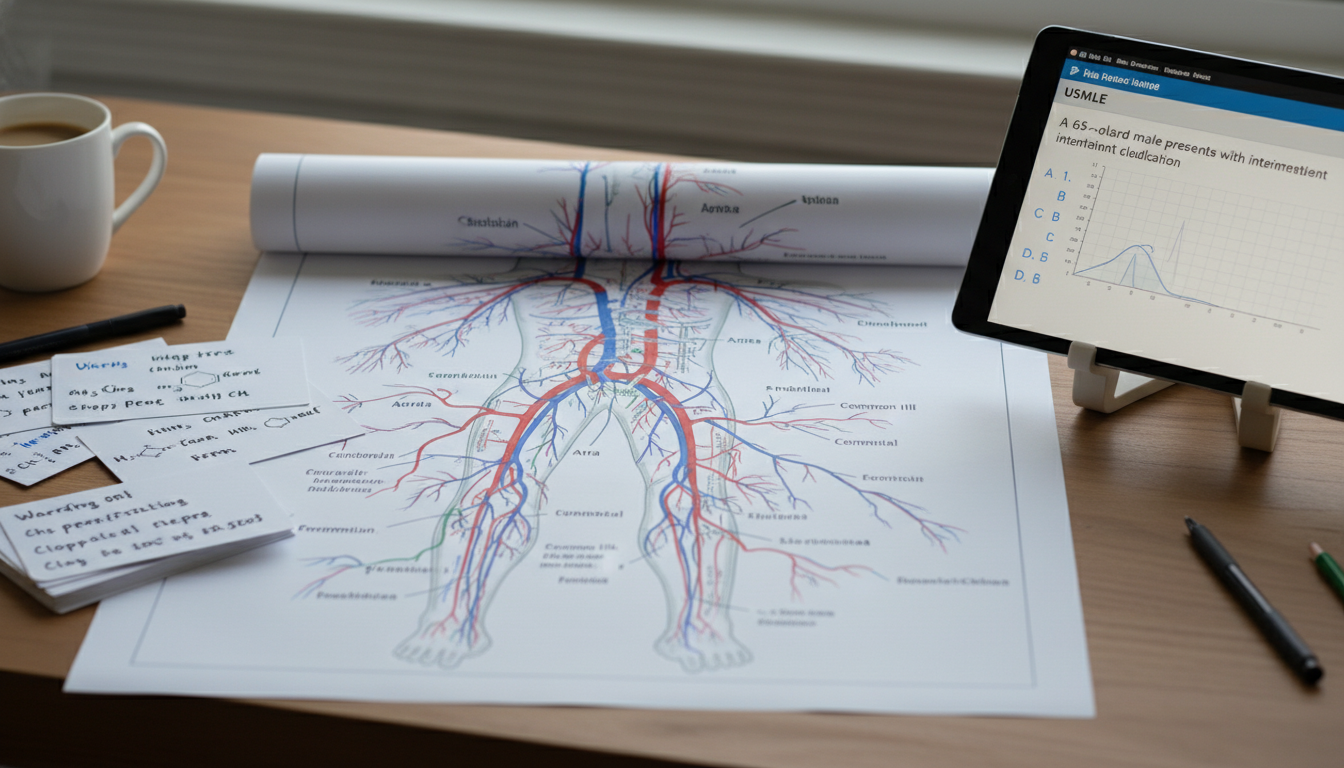
- Redraw key vascular trees from memory every few days.
- Use labeling apps or quizzes that force recall under time pressure.
- Pair each vessel with a clinical scenario: e.g., “SMA occlusion → small bowel ischemia; IMA ligation in surgery and collateral flow via marginal artery of Drummond.”
3. Vascular Pathology and Risk Factors
A future vascular surgeon must understand not only what to fix but why pathology develops.
High-yield vascular pathology:
Atherosclerosis
- Pathogenesis: endothelial dysfunction, lipid deposition, macrophage infiltration, foam cells, fibrous cap.
- Classic sites: abdominal aorta, coronary arteries, popliteal arteries, carotids.
- Complications: MI, stroke, PAD, aneurysm formation.
- Step 1 angle: risk factors (smoking, hypertension, hyperlipidemia, diabetes), histology, and clinical vignettes.
Aneurysms and dissections
- True vs false aneurysm; saccular vs fusiform.
- Risk factors: age, male sex, smoking (AAA), hypertension, connective tissue disorders (Marfan, Ehlers-Danlos).
- Dissection pathophysiology: intimal tear, false lumen, Stanford A vs B.
- Step 1 often emphasizes genetic syndromes, pathologic findings, and complications like tamponade or organ ischemia.
Vasculitis and inflammatory vascular disease
- Large vessel: giant cell arteritis, Takayasu.
- Medium: polyarteritis nodosa, Kawasaki, Buerger.
- Small: granulomatosis with polyangiitis, microscopic polyangiitis, Churg-Strauss.
- For each: know typical patient profile, organ involvement, key labs (ANCA types), biopsy findings.
Thrombosis and embolism
- Virchow’s triad: endothelial injury, hypercoagulability, stasis.
- DVT, PE, paradoxical emboli, fat/air/amniotic embolism.
- Inherited thrombophilias (Factor V Leiden, prothrombin gene mutation, protein C/S deficiency).
Link to your future practice:
- Every vascular patient is a textbook case in risk factor management and thromboembolic disease. Knowing these Step 1 concepts cold will make your future vascular surgery rotations far more intuitive.
4. Coagulation and Pharmacology for the Vascular Surgeon
Step 1 questions may feel abstract, but they map directly onto vascular pharm decisions.
Drugs to know deeply:
Antiplatelet agents
- Aspirin (COX inhibition), clopidogrel/prasugrel/ticagrelor (P2Y12 inhibitors), GP IIb/IIIa inhibitors.
- Indications: coronary stents, PAD, stroke prevention.
- Toxicity: bleeding, GI ulcers, TTP-like syndromes (rare).
Anticoagulants
- Heparin/LMWH: mechanism (antithrombin activation), monitoring, reversal with protamine.
- Direct oral anticoagulants (DOACs): factor Xa inhibitors (rivaroxaban, apixaban) and direct thrombin inhibitor (dabigatran).
- Warfarin: vitamin K antagonist, PT/INR monitoring, bridging, drug interactions, reversing with vitamin K and PCC/FFP.
Thrombolytics
- tPA and others: indications (acute stroke, massive PE in select cases), bleeding risks, contraindications.
Vascular risk factor medications
- Statins: HMG-CoA reductase inhibitors, pleiotropic effects on plaque stabilization.
- Antihypertensives: ACE inhibitors, ARBs, beta-blockers, calcium channel blockers, diuretics.
- Glycemic control agents and their cardiovascular outcome data (high-level understanding).
Step 1 preparation:
- Use visual schemas of the coagulation cascade and annotate drug targets.
- Connect each drug to a prototypical clinical scenario (e.g., “post-op fem-pop bypass with atrial fibrillation: which anticoagulant, what interactions?”).
Strategic Use of Step 1 Resources for a Vascular Surgery Track
You don’t need “vascular surgery–specific” Step 1 resources; you need smart use of standard Step 1 resources with a vascular lens.
1. Core Step 1 Resources
Essential Step 1 resources (use a small, high-yield set; don’t hoard):
Comprehensive review / outline
- First Aid for the USMLE Step 1 or similar condensed text.
- Use as a roadmap, not as your only study material.
Question bank(s)
- UWorld: primary QBank, do as many questions as possible (1x through at minimum, 1.5–2x if time).
- Supplementary (if needed): AMBOSS or Kaplan.
Pathology
- Pathoma or similar video + text resource for solidifying mechanisms and morphologic findings.
- Focus on atherosclerosis, thrombosis, vasculitis, and systemic diseases with vascular manifestations.
Anatomy
- Atlas (Netter, Rohen) plus a clinically-oriented anatomy text or question book.
- For vascular surgery, do not skim vascular anatomy; treat it as a primary subject.
2. Integrating Step 1 Preparation With Vascular Interests
Where you can “tilt” your studying toward vascular surgery without compromising Step 1 breadth:
When reviewing cardiovascular chapters or lectures, pause longer on:
- Peripheral arterial disease
- Aneurysmal disease
- Carotid disease
- Venous insufficiency and DVT
In your USMLE Step 1 study, tag vascular-related questions:
- Create custom question blocks focusing on cardiovascular, renal, and heme/onc topics every few days.
- Note recurring patterns in risk factors, presentations (e.g., claudication vs critical limb ischemia), and management principles.
Build a mini “vascular binder” (digital or paper):
- 1–2 pages per topic: aorta, carotid, peripheral arterial, venous thromboembolism, vasculitis.
- Summarize from Step 1 resources but through a clinical lens.
- This becomes a bridge resource for later vascular surgery rotations and Step 2 CK.
3. Step 1 Resources for Long-Term Vascular Benefit
Some Step 1 resources double as early “vascular surgery textbooks”:
- High-yield cardiovascular physiology texts give you vocabulary and intuition for later hemodynamic decision-making (e.g., understanding Doppler waveforms and pressure gradients).
- Radiologic anatomy resources: understanding CT angiogram images, cross-sectional anatomy of the aorta and peripheral vessels will help on future clerkships and vascular electives, even if only lightly tested on Step 1.

Balancing Step 1 Success With Long-Term Vascular Surgery Goals
1. Protecting Your Application While You Prepare
For an integrated vascular program, your application is a package; Step 1 is one piece. Strong Step 1 preparation supports the rest:
Minimize risk of failure
- Use NBMEs to gauge readiness; don’t test before practice scores are reasonably above typical pass thresholds.
- If performance is borderline, postpone if possible and intensify focused review.
Build Step 2 CK momentum
- Deep understanding in Step 1 basic sciences makes Step 2 CK cardiology, vascular, and ICU questions easier.
- Programs often place heavy weight on Step 2 CK since it’s still numeric.
Create space for vascular exploration
- Efficient Step 1 study leaves time in later years for vascular electives, research, and away rotations.
- Early mastery of fundamentals reduces the cognitive burden when you are on intense surgical services.
2. Preventing Burnout During Intensive Study
Vascular surgery is a demanding specialty; resilience starts now.
Structured breaks
- Pomodoro methods (50 minutes study, 10 minutes break) or similar.
- Short walks, stretching, and hydration breaks to maintain stamina.
Physical health
- Regular exercise (even 20–30 minutes/day) improves focus and stress tolerance.
- Reasonable sleep: 7–8 hours whenever possible; chronic sleep deprivation erodes learning.
Peer and mentor support
- Study groups for challenging subjects (e.g., biochemistry, immunology).
- Seek mentorship from vascular surgery faculty or residents:
- Ask about their Step 1 preparation, what they wished they had done differently.
- Get honest feedback on how Step 1 performance interacts with vascular surgery competitiveness.
3. Example: A 6-Week Dedicated Study Plan With Vascular Emphasis
Weeks 1–2: Foundation and Diagnostic Focus
- 40–50 UWorld questions/day, system-based (start with cardiovascular, renal, heme).
- Pathoma or similar for relevant path chapters.
- 1 NBME at end of week 2; adjust plan based on weak areas.
Weeks 3–4: Broad Coverage With Targeted Reinforcement
- 60–80 questions/day, transition to mixed blocks.
- First Aid cardiovascular, respiratory, renal, and heme/onc sections in-depth.
- Daily vascular anatomy sessions (30–45 minutes).
- NBME at end of week 4.
Week 5: High-Yield Review and Simulation
- Continue 60+ mixed questions/day.
- Rapid First Aid pass, focusing on missed or low-confidence topics.
- 1 full-length simulation (NBME or UWorld SA) under exam conditions.
Week 6: Light Review and Exam Readiness
- Focus on weak topics identified by prior NBMEs.
- Review all high-yield vascular maps, coagulation pathways, and drug charts.
- Taper question volume slightly to prevent fatigue heading into exam week.
- Prioritize sleep, anxiety management, and logistics.
Frequently Asked Questions (FAQ)
1. Does a pass/fail Step 1 still matter for an integrated vascular surgery residency?
Yes. While programs can’t see your exact score, a first-time pass is crucial. A failure raises concern about your ability to handle rigorous surgical training, especially in a complex field like vascular surgery. Moreover, the knowledge and study habits you build for Step 1 significantly influence your Step 2 CK score, which remains a major factor in vascular surgery residency selection.
2. How should I balance vascular-focused studying with the rest of Step 1 content?
You should not neglect any major Step 1 area. The best approach is:
- Maintain comprehensive coverage with standard USMLE Step 1 study.
- Within that, give extra attention to cardiovascular physiology, vascular anatomy, coagulation, and systemic diseases that impact blood vessels.
Think of it as “emphasis,” not “exclusion.” Strong performance across the board is more important than narrow hyper-specialization at this stage.
3. What are the best Step 1 resources if I’m interested in vascular surgery?
Use the same Step 1 resources that top scorers rely on:
- A primary review book (e.g., First Aid)
- A leading question bank (UWorld, plus optionally AMBOSS/Kaplan)
- A solid pathology resource (Pathoma or equivalent)
- A detailed anatomy atlas and/or question book
What sets you apart is how you use them: routinely relate cardiovascular and vascular topics to clinical scenarios you might see in vascular surgery, and ensure you deeply understand coagulation/pharmacology.
4. Will strong Step 1 preparation actually help me once I’m in a vascular surgery residency?
Absolutely. Step 1 preparation lays the groundwork for:
- Understanding complex hemodynamics in aneurysmal, occlusive, and venous disease.
- Making sense of antiplatelet/anticoagulation regimens in perioperative care.
- Interpreting vascular imaging with a solid map of anatomy in your mind.
Residents who arrive with strong basic science foundations often adapt faster to the intensive environment of a vascular surgery residency and ultimately are better prepared for boards and independent practice.
By approaching your USMLE Step 1 preparation with a clear strategy, disciplined use of Step 1 resources, and a vascular-focused lens, you will not only maximize your chances of passing on the first attempt but also set yourself up for long-term success in an integrated vascular program and beyond.