
Preparing for USMLE Step 1 is one of the most consequential phases of your journey toward an internal medicine residency. While Step 1 is now reported as Pass/Fail, program directors in competitive internal medicine residency programs still see it as a key filter: a failed attempt can significantly complicate your IM match prospects, and a strong performance (especially on NBME practice exams) signals readiness for the rigor of internal medicine training.
This guide connects USMLE Step 1 preparation directly to your goal of matching into internal medicine residency. You’ll find strategy, timelines, study plans, and specific tips on choosing Step 1 resources and integrating internal medicine thinking into your USMLE Step 1 study.
Understanding Step 1 in the Era of Pass/Fail—and Why It Still Matters for Internal Medicine
USMLE Step 1 is designed to test whether you can apply essential basic science concepts to clinical practice. For internal medicine–bound students, Step 1 is your first opportunity to show you can think like an internist: integrating physiology, pathology, pharmacology, and biostatistics to solve complex problems.
Step 1’s Role in the Internal Medicine Residency Application
Even as Pass/Fail, Step 1 influences your internal medicine residency path in several ways:
Pass on first attempt is non‑negotiable for most IM programs
- Many categorical IM programs view a first-attempt pass as a basic threshold.
- Repeated failures can trigger automatic filters in the ERAS screening process.
Signals for performance on Step 2 CK
- Step 2 CK (still scored) is a major factor in the IM match.
- A smooth, timely Step 1 pass suggests you’ll be ready to excel on Step 2 CK, which tests internal medicine–heavy clinical knowledge.
Impacts timing of clinical rotations and research
- A delayed or failed Step 1 can postpone core internal medicine clerkships, sub-internships, and research—key elements that enhance your IM application.
Foundation for internal medicine reasoning
- Internal medicine relies heavily on pathophysiology and pharmacology.
- High-yield Step 1 content (e.g., acid–base physiology, cardiovascular and renal path) becomes your day-to-day reasoning toolkit in residency.
Building an Internal Medicine–Oriented Step 1 Foundation
Your USMLE Step 1 study should build a core framework that will carry into clerkships and internal medicine residency. Instead of memorizing disconnected facts, aim for a systems-based understanding.
Focus Systems That Matter Most for Internal Medicine
While you must know all systems, IM is particularly anchored in:
Cardiovascular
- Coronary artery disease, heart failure, valvular disease, arrhythmias
- Pharmacology: beta-blockers, ACE inhibitors, ARBs, diuretics, antiarrhythmics
- Pathophysiology: preload/afterload, pressure-volume loops, murmurs
Pulmonary
- Obstructive vs restrictive lung disease, pulmonary embolism, pneumonia, ARDS
- Ventilation/perfusion relationships, oxygen-hemoglobin dissociation, acid–base
- Radiology patterns: interstitial vs alveolar process (even at basic level)
Renal
- Nephritic vs nephrotic syndromes, acute kidney injury vs chronic kidney disease
- Acid–base disorders, electrolyte physiology (Na, K, Ca, Mg disturbances)
- Diuretics: mechanisms, side effects, clinical indications
Endocrine
- Diabetes types, DKA vs HHS, thyroid disorders, adrenal pathology
- Pharmacology: insulin regimens, oral hypoglycemics, anti-thyroid drugs
Hematology/Oncology
- Anemia workup, leukemias, lymphomas, coagulopathies
- Cancer biology basics relevant to IM oncology
Infectious Disease & Immunology
- Common bacterial, viral, fungal, and opportunistic infections
- Antibiotic classes, mechanisms, resistance patterns
These are frequently tested on Step 1 and central to internal medicine practice.
Internal Medicine Mindset for Step 1 Questions
When practicing questions, deliberately apply an internal medicine problem-solving approach:
Move from symptom → system → mechanism → management
- Example: Dyspnea + bilateral crackles + S3 → think heart failure → review neurohormonal activation, Frank-Starling curves, and drug mechanisms.
Always ask “Why is this happening?”
- Instead of just memorizing “ACE inhibitors reduce mortality in heart failure,” recall:
- They decrease afterload and preload
- They mitigate maladaptive RAAS activation and remodeling
- Instead of just memorizing “ACE inhibitors reduce mortality in heart failure,” recall:
Integrate labs, imaging, and pathophysiology
- Practice interpreting ABGs, CBCs, basic metabolic panels, and EKG-esque descriptions in questions.
- This will directly translate to internal medicine ward and ICU reasoning.

Step 1 Resources: Curating a High-Yield, IM-Relevant Study Arsenal
The number of Step 1 resources can be overwhelming. For an internal medicine–oriented strategy, prioritize depth and integration over sheer volume.
Core “Non-Negotiable” Resources
Comprehensive Review Book
- A “First Aid–style” book (e.g., First Aid for the USMLE Step 1) remains a spine to your study.
- Use it as:
- A high-yield outline, not your only resource.
- A place to consolidate notes from videos, lectures, and question banks.
Question Bank (QBank) – Your Primary Learning Tool
- UWorld Step 1 QBank (or equivalent high-quality bank) is essential.
- Why it matters for internal medicine:
- Questions often mimic early IM reasoning: multi-step, integrating labs, imaging, and pathophysiology.
- Explanations are mini-lessons—especially strong in cardiology, renal, and infectious disease.
- Strategy:
- Aim for 2,000–3,000+ questions completed.
- Do mixed blocks early (not just by system) to build integration skills.
NBME Practice Exams
- NBME forms (and if applicable, UWSAs) help:
- Calibrate your readiness for passing.
- Identify persistent weak systems crucial for IM, like renal or cardio.
- Take at least 3–4 practice exams spread across your dedicated period.
- NBME forms (and if applicable, UWSAs) help:
Supplementary Video & Text Resources
Depending on your learning style:
Video Lecture Series
- Use for conceptual clarity in:
- Cardiovascular physiology and murmurs
- Pulmonary and renal physiology
- Biochemistry and immunology if weak
- Avoid passively watching; annotate your core book and pause to answer your own questions.
- Use for conceptual clarity in:
Pathology Texts/Video Series
- Pathology is the bridge from basic science to internal medicine.
- Consider:
- System-based pathology lectures and notes focused on mechanisms and patterns.
- When to emphasize:
- If you struggle to connect histology and gross pathology to clinical presentations.
Pharmacology Resources
- For internal medicine, prioritize:
- Cardio, renal, endocrine, infectious disease drugs.
- Build quick-reference tables:
- Mechanism, primary use, major adverse effects, contraindications.
- For internal medicine, prioritize:
How to Avoid Resource Overload
- Limit yourself to:
- 1 primary book
- 1–2 QBanks (with one being your main)
- 1 main video/path resource (optional depending on baseline)
- If you find yourself collecting resources more than using them, pause and streamline. For internal medicine residency, consistent, deep engagement with a few resources beats shallow exposure to many.
Strategic Study Planning: Sample Timelines and Daily Structures
A well-structured plan is crucial for efficient USMLE Step 1 preparation, particularly if you aim to enter the IM match competitive and on time.
Longitudinal (Pre‑Dedicated) Phase: M1–M2 with IM in Mind
During preclinical years, use your curriculum as built-in Step 1 preparation:
Align Coursework with Step 1 and IM systems
- When you’re in cardiovascular block:
- Watch step-style videos and do CV questions in your QBank.
- Connect lectures to classic IM pathologies (e.g., MI, heart failure, AFib).
- When you’re in cardiovascular block:
Begin Low-Intensity Question Work
- Start with:
- 10–20 questions/day, 3–4 days/week.
- Focus on the current system, plus occasional mixed blocks.
- Review explanations in depth; annotate your main book.
- Start with:
IM Shadowing and Clinical Preceptorship
- Shadow in internal medicine clinics or wards early.
- Let real patient cases “anchor” your Step 1 concepts (e.g., a patient in DKA helps you remember insulin pharmacology, anion gap acidosis).
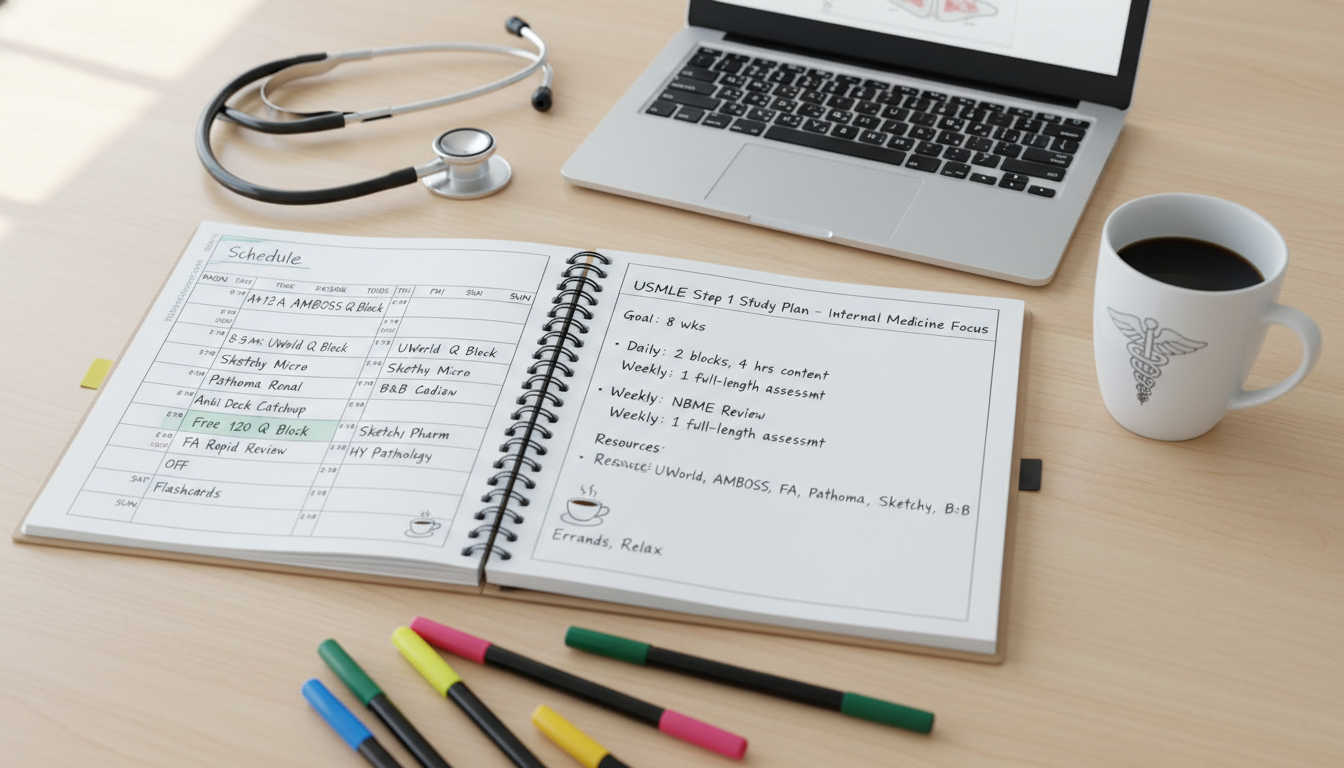
Dedicated Study Phase (6–10 Weeks): A Model for Step 1 Success
Your exact dedicated time depends on school policies and your baseline, but 6–10 weeks is common.
Weekly Structure
QBank Questions
- 40–80 questions/day (2–4 blocks), 5–6 days/week.
- Timed, random/mixed blocks to mimic the exam.
Content Review
- 4–6 hours/day:
- System-based review focusing on weak or IM-central areas.
- Active recall and spaced repetition (e.g., flashcards).
- 4–6 hours/day:
Practice Exams
- Every 1–2 weeks:
- NBME exams (plus institutional practice tests if offered).
- Use results to:
- Prioritize systems: e.g., if Renal < 50%, emphasize that week.
- Every 1–2 weeks:
Sample Daily Schedule (8–10 Hour Day)
- 08:30–10:30 – 1 block (40 Qs), timed, random
- 10:30–12:30 – Review explanations in detail, annotate notes
- 12:30–13:00 – Break/lunch
- 13:00–15:00 – Targeted review (e.g., cardio + renal path/physio)
- 15:00–17:00 – 1 block (40 Qs) + partial review
- 17:00–18:00 – Finish review + 30–45 minutes of flashcards
For shorter days or if balancing research/clinical tasks, adjust question volume but maintain consistency.
High-Yield Strategies for IM-Focused Step 1 Success
To prepare effectively, anchor your USMLE Step 1 preparation in evidence-based study techniques that also build internal medicine skills.
1. Emphasize Active Recall and Spaced Repetition
Passive reading rarely sticks—especially in dense topics like renal physiology.
Flashcards (e.g., Anki)
- Ideal for:
- Acid–base disorders, electrolyte shifts
- Drug mechanisms and adverse effects
- Microbiology and immunology
- Build or use decks that emphasize:
- Clinical vignettes over pure fact recall.
- Reasoning steps (“patient with ascites and low serum sodium—next best test?”)
- Ideal for:
Self-Quizzing
- After reading a section (e.g., RAAS system):
- Close the book.
- Draw the pathway from memory.
- Explain it out loud as if teaching a junior student.
- After reading a section (e.g., RAAS system):
2. Master Differential Diagnosis Thinking Early
Internal medicine is the specialty of differential diagnosis. Begin that mindset now:
When presented with:
- “Shortness of breath + edema”
- Generate a quick mental differential:
- Heart failure, COPD exacerbation, nephrotic syndrome, liver failure, PE, etc.
- Step 1 questions often ask for the next best test or pathophysiologic mechanism; this requires a differential first.
Practice “one-sentence assessment” after each case:
- “This is a 60-year-old male with chronic smoking presenting with progressive dyspnea and productive cough, most consistent with COPD exacerbation.”
This habit will serve you well on Step 1, Step 2 CK, and on IM rotations.
3. Interpreting Data: ABGs, EKG-like Descriptions, and Labs
Step 1 often simulates internal medicine data interpretation:
ABGs and Acid–Base
- Learn a systematic approach:
- Step 1: Determine pH (acidosis vs alkalosis)
- Step 2: Identify primary disorder (metabolic vs respiratory)
- Step 3: Check compensation and anion gap
- Practice with multiple scenarios (DKA, vomiting, COPD, salicylate toxicity).
- Learn a systematic approach:
EKG Descriptions
- Even if you don’t see full tracings, know:
- Features of AFib, AV block, STEMI vs NSTEMI.
- Link these to pharmacologic management (e.g., rate vs rhythm control, anticoagulation).
- Even if you don’t see full tracings, know:
Lab Patterns
- Memorize patterns for:
- Hemolytic anemia vs iron deficiency vs anemia of chronic disease.
- Hepatocellular vs cholestatic liver injury patterns.
- Prerenal vs intrinsic vs postrenal kidney injury.
- Memorize patterns for:
4. Triage Content: Emphasize Internal Medicine–Relevant High Yield
While you must pass all domains, prioritize deeper mastery in areas tightly linked to internal medicine:
- Give extra reps to:
- Cardio, pulmonary, renal, endocrine, GI, ID, heme-onc.
- Maintain baseline competency in:
- Behavioral science, basic anatomy, embryology—don’t neglect them, but don’t sink disproportionate time there if cardio/renal remain weak.
5. Mental and Physical Health During Dedicated
Internal medicine residency is demanding; developing sustainable habits now matters:
- Sleep: Aim for 7 hours/night. Sleep deprivation impairs consolidation and test performance.
- Exercise: 20–30 minutes, 3–5 times/week; even brisk walking helps.
- Burnout checks: If you notice:
- Worsening scores despite more hours
- Constant anxiety or hopelessness
- Consider:
- Scaling back 1–2 hours/day
- Seeking support from mentors, student wellness, or counseling.
Passing Step 1 on the first attempt, with your sanity intact, is more valuable for your IM match than marginal extra study hours that cause burnout.
Positioning Your Step 1 Performance for the Internal Medicine Match
Your IM match story doesn’t end once you take Step 1. How you leverage your Step 1 experience matters.
Timing Step 1 with Internal Medicine Milestones
Ideal Targets
- Step 1 done before:
- Core internal medicine rotation
- Key research blocks
- This allows you to:
- Enter IM rotations with strong basic science underpinnings.
- Focus on building clinical evaluations and letters of recommendation.
- Step 1 done before:
If You Struggle or Need to Delay
- Discuss early with your dean or academic support:
- Adjust schedule to protect time for a solid Step 1 pass.
- For IM applicants:
- A clean, first-attempt pass slightly later is far better than a rushed fail.
- Discuss early with your dean or academic support:
Turning Step 1 Prep into Internal Medicine Strengths
View Step 1 as Foundation, Step 2 CK as Showcase
- Use the integrated pathophysiology you mastered in Step 1 as the scaffold for clinical thinking on Step 2 CK.
- Many internal medicine program directors rely heavily on Step 2 CK scores for ranking once you’ve passed Step 1.
Talk About Step 1 in IM Interviews (When Appropriate)
- If asked about your preparation or challenges:
- Emphasize your systematic approach, resilience, and how you translated basic science into clinical reasoning.
- If you faced difficulty:
- Frame it as:
- “I identified early knowledge gaps in renal and cardio physiology and built a structured remediation plan that later helped me excel on IM rotations.”
- Frame it as:
- If asked about your preparation or challenges:
Use Your Step 1 Knowledge on the Wards
- When presenting a case on internal medicine:
- Add one line connecting findings to pathophysiology:
- “Her orthopnea and paroxysmal nocturnal dyspnea can be explained by increased pulmonary capillary pressures from left-sided heart failure.”
- Add one line connecting findings to pathophysiology:
- This demonstrates that your USMLE Step 1 study did more than help you pass—it shaped you into a thoughtful future internist.
- When presenting a case on internal medicine:
Frequently Asked Questions (FAQ)
1. Does Step 1 still matter for internal medicine residency now that it’s Pass/Fail?
Yes. While programs can no longer compare three-digit scores, internal medicine residency programs still care that you pass Step 1 on the first attempt. A clean pass:
- Avoids getting filtered out by automated systems.
- Suggests you have the foundational knowledge to perform well on Step 2 CK, which remains highly influential.
- Signals reliability and academic readiness for a cognitively intensive specialty like internal medicine.
2. How early should I start USMLE Step 1 preparation if I want to match into internal medicine?
Ideally, start in your first year by:
- Aligning your course studying with Step 1-style resources.
- Doing small sets of QBank questions during each system block. A serious, structured ramp-up usually begins 6–12 months before the exam, with a focused dedicated period (6–10 weeks) closer to test date. The key is gradual integration, not last-minute cramming.
3. Which Step 1 resources are best if I’m aiming for an internal medicine residency?
For most IM-bound students, a strong combination includes:
- One primary review book (e.g., First Aid-type text).
- A high-quality QBank (e.g., UWorld Step 1) as your main learning tool.
- NBME practice exams for readiness assessment. Optionally add:
- A pathology resource and/or video series for difficult topics like cardio/renal physiology and path. Avoid overloading resources; mastering a few deeply is more effective and more relevant for your IM match.
4. How many practice questions should I complete before Step 1?
A common target is 2,000–3,000+ questions, including:
- One full pass through a main QBank.
- Selected additional questions from a secondary bank or incorrects review. For internal medicine–focused preparation, ensure a strong representation of:
- Cardiology, pulmonary, renal, endocrine, GI, infectious disease, and hematology/oncology questions, as they mirror what you’ll see in IM residency.
By approaching USMLE Step 1 preparation as the first step in your internal medicine training—not just an exam—you’ll not only set yourself up for a clean pass and a strong IM match, but also build the clinical reasoning foundation that defines an excellent internist.