Preparing for USMLE Step 1 is a pivotal step in your journey toward a neurology residency. While Step 1 is now reported as pass/fail, its importance for a competitive neurology residency application and a strong neuro match outcome remains high. Neurology is heavily “Step 1–dense”: neuroanatomy, neurophysiology, neuropharmacology, and neuropathology are all central to the exam and to your future clinical practice.
This guide focuses specifically on USMLE Step 1 preparation in neurology—how to study neuro efficiently, which Step 1 resources to prioritize, and how to integrate neuro into your overall USMLE Step 1 study plan so you build a foundation that will serve you on rotations, Step 2, and in residency interviews.
Understanding the Role of Step 1 for Future Neurologists
Even though Step 1 is now pass/fail, program directors still care deeply about how solid your foundational knowledge is—especially if you’re targeting a neurology residency.
Why Step 1 Still Matters for Neurology
Strong neuro underpins everything else
Neurology is built on basic sciences: neuroanatomy, neurophysiology, neuropharmacology, and neuropathology. Step 1 is the one standardized exam that tests this foundation in depth.Signal of discipline and preparedness
A confident pass (especially with strong NBME practice scores) signals that you can handle complex material and large volumes of information—qualities valued in neurology, where diagnostic reasoning is cognitive-heavy.Impact on Step 2 and clerkships
A weak Step 1 foundation often shows up later:- Difficulty on neurology and internal medicine rotations
- Struggles with neuro-heavy shelf exams
- More work to “catch up” for Step 2 CK
Indirect influence on the neuro match
While programs can’t see your numeric Step 1 score, they absolutely can see:- Your Step 2 CK score
- Clinical grades (particularly in neurology, internal medicine, psychiatry)
- Letters of recommendation commenting on your fund of knowledge
A strong USMLE Step 1 preparation plan—especially in neurology—helps all of these downstream metrics.
Core Neurology Content Domains on USMLE Step 1
Before building a study plan, you need a clear map of what “neurology for Step 1” actually includes. For most students, the challenge is not that neurology is impossibly hard—it’s that the content feels fragmented across different disciplines.
1. Neuroanatomy: Structure and Clinical Correlates
Neuroanatomy is often the single most intimidating block, but also the most high-yield for neurology-bound students.
Key areas to master:
CNS gross anatomy
- Lobes and their functions
- Cortical areas (motor, sensory, Broca/Wernicke, frontal eye fields)
- Basal ganglia circuits and their lesions (Parkinson, Huntington, hemiballismus)
- Thalamic nuclei and their roles
Brainstem and cranial nerves
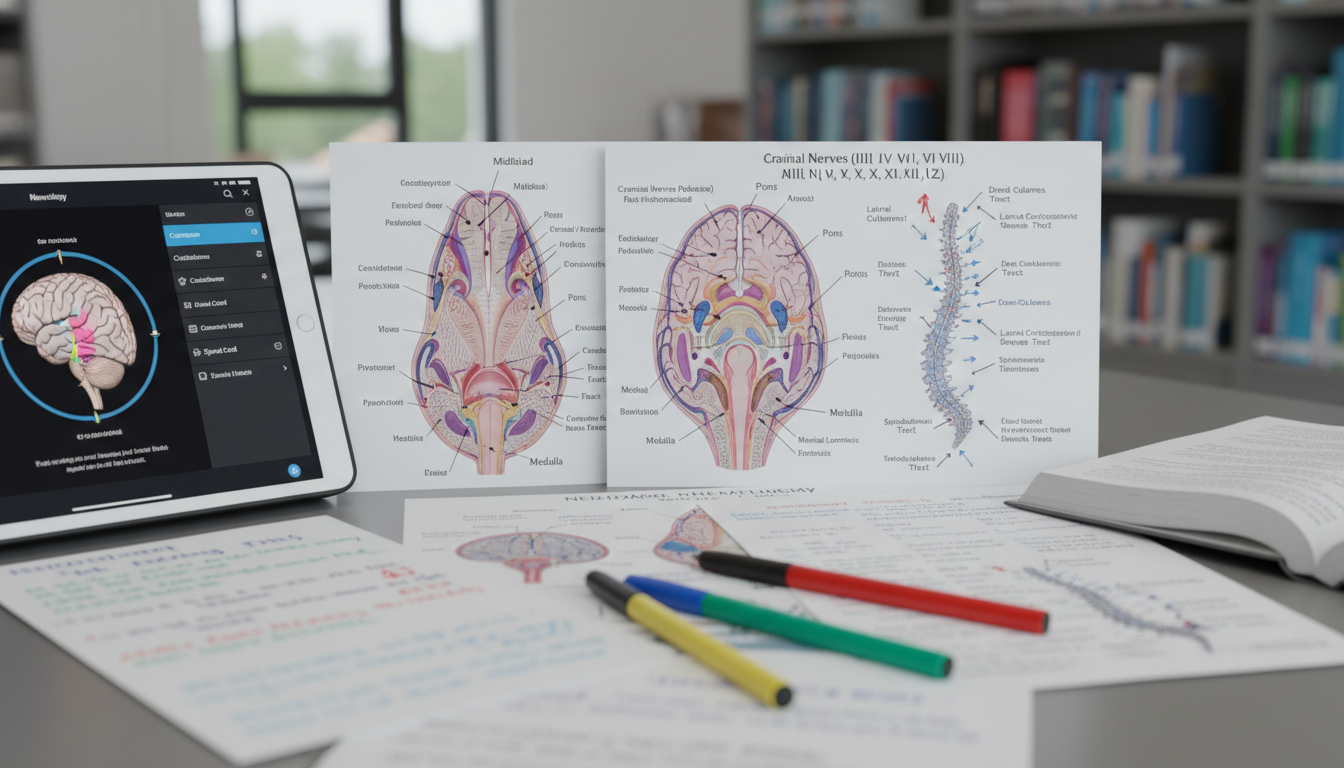
- Brainstem cross-sections (midbrain, pons, medulla)
- Cranial nerve nuclei locations
- Classic brainstem lesion syndromes (Weber, Millard-Gubler, lateral medullary, medial medullary)
Spinal cord
- Cross-sectional anatomy: dorsal column, spinothalamic tract, corticospinal tract
- Common spinal cord lesions (Brown-Séquard, anterior spinal artery infarct, tabes dorsalis, subacute combined degeneration)
Vascular anatomy and strokes
- Anterior vs middle vs posterior cerebral artery territories
- Lacunar strokes and small vessel disease
- Vertebrobasilar system and clinical syndromes
Actionable tip:
For each neuroanatomic structure, always ask:
- What does it do?
- What happens if it’s damaged?
- What are classic USMLE-style presentations?
Create a one-page “Neuroanatomy Lesion Map” summarizing lesions → deficits → common etiologies.
2. Neurophysiology: How the Nervous System Works
Neurophysiology connects the basic patch-clamp concepts you learned in first year to the clinical manifestations you’ll see in neurology residency.
High-yield topics:
- Resting membrane potential and action potentials
- Synaptic transmission: excitatory vs inhibitory
- Neuromuscular junction (particularly for myasthenia gravis, Lambert-Eaton)
- Sensory pathways (fine touch, pain/temperature, proprioception)
- Motor pathways (UMN vs LMN)
- Autonomic nervous system (sympathetic vs parasympathetic pharmacology)
The exam often tests:
- Mechanism-level questions (e.g., ion channels, neurotransmitters)
- Interpretation of pharmacologic interventions on synaptic transmission
- Classic patterns like “UMN lesion” vs “LMN lesion,” or “peripheral vs central vertigo”
3. Neuropathology: Disease Patterns and Pathways
Neuropathology is where everything comes together—and where most neurology-bound students can really differentiate themselves.
Essential conditions:
Vascular
- Ischemic vs hemorrhagic stroke
- Intracranial hemorrhage types (epidural, subdural, subarachnoid, intraparenchymal)
- Berry aneurysms, AV malformations
Degenerative
- Alzheimer, Parkinson, Huntington
- Frontotemporal dementia, Lewy body dementia
- ALS, spinal muscular atrophy
Demyelinating and inflammatory
- Multiple sclerosis
- Guillain–Barré syndrome
- Central pontine myelinolysis
Seizure disorders and epilepsy
- Types of seizures (focal vs generalized)
- Status epilepticus basics
Tumors
- Adult vs pediatric brain tumors
- Typical locations, imaging findings, and paraneoplastic associations
Infections
- Bacterial vs viral meningitis patterns
- Encephalitis (e.g., HSV, West Nile)
- Prion diseases
Pattern to internalize:
For every disease, know:
- Anatomy (where is the lesion?)
- Pathophysiology (what is happening at the cellular level?)
- Clinical triad/cluster
- First-line management (mechanism-based, even if Step 1 is less management-heavy)
4. Neuropharmacology: Drugs That Shape the Brain
Neuropharmacology is where pharmacology, psychiatry, and neurology intersect. For the USMLE Step 1 study, neurology-bound students should go deeper than the bare minimum.
Key drug groups:
- Antiepileptics (phenytoin, carbamazepine, valproate, lamotrigine, levetiracetam, etc.)
- Anti-Parkinson drugs (levodopa/carbidopa, dopamine agonists, MAO-B inhibitors, COMT inhibitors, anticholinergics)
- Muscle relaxants and spasmolytics
- Migraine therapies (triptans, CGRP antagonists, beta-blockers, topiramate)
- CNS stimulants (ADHD) and sedatives
- Anesthetics and neuromuscular blockers (overlap with physiology and pharm)
For each drug, know:
- Mechanism of action
- Primary clinical use
- Most important adverse effects
- Any classic USMLE “buzzword” associations
Example:
Valproic acid → increased Na⁺ channel inactivation, increased GABA → broad-spectrum anticonvulsant → adverse effects: hepatotoxicity, neural tube defects, pancreatitis, weight gain.
Building a Neurology-Focused Step 1 Study Plan
Your goal is not to create a separate “neurology-only” study track, but to integrate neurology into a coherent USMLE Step 1 preparation plan that still covers all organ systems.
Step 1: Establish a Realistic Timeline
Most students prepare over:
- Dedicated study period: 4–8 weeks full time
- Pre-dedicated build-up: integrated with coursework across preclinical years
For neurology-bound students, aim to:
- Reinforce neuro content during your preclinical neuroscience block
- Revisit neuro multiple times before dedicated
- Allocate slightly more time to neuro during dedicated, especially early in the schedule
Example allocation in a 6‑week dedicated plan:
- Week 1: Heavy neuroanatomy and neuropathology review (alongside 1–2 other systems)
- Week 3: Focused neuropharmacology refresh and more practice questions
- Week 5: High-yield neuro “cleanup” (NBMEs + targeted review of weak topics)
Step 2: Choose High-Yield Step 1 Resources for Neuro
You don’t need every resource; you need the right combination used deliberately.
Essential “core” resources:
UWorld (or another high-quality question bank)
- Non-negotiable for USMLE Step 1 study
- Filter and tag neurology questions for spaced review
- Read explanations deeply, especially for missed neuro questions
First Aid for the USMLE Step 1 (or a comparable high-yield text)
- Use as your “neuro skeleton” guide
- Add annotations from your QBank, lectures, and videos
Anatomy/Neuroanatomy supplement
- Options: Neuroanatomy sections in BRS Anatomy, High-Yield Neuroanatomy, or a dedicated neuro text used in your course
- Focus on clinically oriented anatomy (i.e., lesions and symptoms)
Video series (e.g., Boards & Beyond, Osmosis, Sketchy)
- Use for visualizing complex pathways (basal ganglia, cerebellum, auditory/visual systems)
- Watch at 1.25–1.5x speed with active note-taking
Supplemental “if needed” resources:
- Dedicated neuro question banks (e.g., USMLE-Rx, AMBOSS neuro blocks)
- Atlas apps (Netter’s, Complete Anatomy) for 3D visual neuroanatomy
- Pathoma for neuropathology basics (brain tumors, vascular lesions, degenerative diseases)
The most powerful combination for most students:
UWorld + First Aid + high-yield neuro videos + one good neuroanatomy text.
Step 3: Use Active Learning, Not Passive Review
Passive rereading neuro notes rarely sticks. Instead:
Draw pathways and tracts from memory
- Corticospinal, spinothalamic, dorsal columns
- Visual pathway, auditory pathway
- Basal ganglia direct/indirect pathways
Teach neuro concepts to a peer (or to yourself out loud)
- Explain the differences between UMN vs LMN lesions
- Walk through an approach to a patient with unilateral weakness or ataxia
Create “If lesion is here → deficit is this” flashcards
- Example: “Lesion in right MCA superior division → contralateral face/arm weakness, Broca aphasia (if dominant hemisphere)”
Use spaced repetition tools (e.g., Anki)
- Make cards for cranial nerve functions and lesion patterns
- Add image occlusion cards for neuroanatomy diagrams
Step 4: Integrate Neuro Into Daily Question Practice
Neuro should be part of your daily QBank practice, not restricted to a single isolated week.
Sample daily schedule (during dedicated):
- 40 questions in timed, mixed mode (all organ systems)
- Identify neuro questions (e.g., 8–10 per block)
- For each neuro miss:
- Identify content gap (e.g., “didn’t know lateral medullary syndrome features”)
- Annotate First Aid or your neuro summary
- If pattern repeats, schedule a focused 30–45 minute neuro review block the next day
As a neurology-leaning student, aim to overperform on neuro questions in QBank and NBME practice exams. This both builds confidence and strengthens your application narrative later when you can point to strong exam performances in neuro-heavy areas.
Advanced Strategies to Master Neurology for Step 1
Once you’ve built a foundation, there are specific strategies that help you move from “I kind of recognize this lesion” to “I can confidently localize and reason through any neuro question.”
Diagnostic Reasoning: Think Like a Future Neurologist
Step 1 often tests neuroanatomic localization, even in basic science questions.
Build a mental “localization algorithm”:
Central vs peripheral
- CNS: brain, brainstem, spinal cord
- PNS: nerve roots, plexus, peripheral nerves, neuromuscular junction, muscle
Pattern of involvement
- Symmetric vs asymmetric
- Motor vs sensory vs mixed
- UMN vs LMN signs
Time course
- Acute (minutes–hours): think vascular, trauma
- Subacute (days–weeks): infection, inflammation, tumor
- Chronic (months–years): degenerative, hereditary, slow-growing tumors
In practice questions, read the vignette and ask yourself:
- “Where is the lesion?” before you look at the answer choices.
This habit turns passive reading into active clinical reasoning and sets you up well for a future neurology residency.
Visual Mnemonics and Mapping
Neurology is visual. Leverage that:
Create a one-page brainstem cross-section map with:
- Cranial nerve nuclei
- Long tracts
- Key vascular territories
For each classic syndrome (e.g., lateral medullary), shade the involved areas on the cross-section and list:
- Tracts affected
- Corresponding deficits
- Likely vascular lesion
Use color-coded notes:
- Red for motor, blue for sensory, green for autonomic, orange for cranial nerves
When you see a question stem describing “loss of pain and temperature on the contralateral body and ipsilateral face with dysphagia and hoarseness,” your visual map should light up “lateral medullary (PICA) lesion.”
Integrating Step 1 Neuro With Future Neurology Residency Goals
Your Step 1 preparation can also subtly support your long-term neurology interests.
Keep a “neuro curiosity list” while studying:
- Anytime a disease fascinates you (e.g., ALS, MS, myasthenia), jot it down.
- Later, explore it more deeply through review articles or case reports.
Build a small neuro portfolio of strengths:
- Example: “I’m exceptionally strong in neuromuscular junction disorders and demyelinating diseases.”
- This can guide elective choices, research projects, or future residency interview talking points.
Connect with neurologists early:
- Ask your neurology faculty for recommended reading that complements Step 1 basics.
- Mention that you’re focusing on USMLE Step 1 study with an eye toward neurology; they may share cases or pearls that make abstract content feel real.
This way, your Step 1 work does double duty: exam prep and early professional identity formation as a future neurologist.
Common Pitfalls in Neuro-Focused Step 1 Prep—and How to Avoid Them
Even strong students fall into predictable traps in neurology.
Pitfall 1: Memorizing Without Understanding
Pure memorization works for some pharm tables; it fails miserably for lesion localization.
Fix:
Always ask “why?” If you memorize “right MCA stroke → left hemineglect,” also understand:
- Right parietal lobe function in spatial attention
- Why non-dominant parietal lesions produce neglect
Understanding transforms isolated facts into a network of concepts.
Pitfall 2: Ignoring Weaknesses Because Neuro Is Intimidating
Some students postpone neuro until late in dedicated because it feels hard—then run out of time just when they need it most.
Fix:
- Tackle neuro early and repeatedly
- Schedule “neuro-only” review blocks in Week 1–2 of dedicated
- Use easy wins (cranial nerves, basic tracts) to build confidence before heavy lesion syndromes
Pitfall 3: Overloading With Too Many Step 1 Resources
Buying multiple neuro textbooks, video series, and QBanks can dilute your focus.
Fix:
- Limit yourself to 1–2 primary neuro references plus 1 main QBank.
- Depth > breadth. Master one explanation instead of skimming five.
Pitfall 4: Separating Neuro From the Rest of the Exam
Some students think, “I’m going into neurology; I can be weaker in other systems.” That mindset hurts both Step 1 and your eventual neuro match.
Fix:
Remember, neurologists are internists of the nervous system. You still need:
- Cardio for stroke risk and management
- Endocrine for diabetic neuropathy
- Rheumatology/infectious disease for neuro complications (e.g., vasculitis, HIV, TB meningitis)
Your neurology residency colleagues and attendings will expect you to manage comorbidities, not just localize lesions.
Bringing It All Together: A Sample Neuro-Focused Step 1 Plan
Here’s a concrete example of how a neurology-oriented student might structure their USMLE Step 1 preparation during a 6‑week dedicated period.
Weeks 1–2: Foundation and Structure
- Daily:
- 40 mixed QBank questions (timed)
- 1–2 hours of neuro review (anatomy + physiology + basics of neuropathology)
- Goals:
- Master spinal cord and brainstem anatomy
- Create lesion–deficit maps
- Watch core neuroanatomy videos and annotate First Aid
Weeks 3–4: Integration and Advanced Pathology
- Daily:
- 40–60 mixed QBank questions
- 1 hour focused neuropathology (stroke, dementia, demyelination, tumors)
- 30 minutes of neuropharmacology review
- Add:
- 1 NBME per week; carefully review all neuro questions
- Goals:
- Confident lesion localization in >80% of neuro questions
- Solid command of major CNS diseases and first-line drugs
Weeks 5–6: Refinement and Exam Readiness
- Daily:
- 60–80 mixed QBank questions
- Rapid review of high-yield neuro topics and weak spots
- Every 4–5 days:
- Full-length NBME or practice exam
- Specific neuro focus:
- Revisit any neuro topics consistently missed on NBMEs
- Drill cranial nerve lesions, classic syndromes, and high-yield pharm
By the end of this schedule, you should:
- Feel at ease when you see neuro-heavy vignettes
- Be able to reason through unfamiliar scenarios using solid neuroanatomy and physiology
- Have a strong basic science platform for future neurology rotations and Step 2 CK
FAQs: USMLE Step 1 Preparation in Neurology
1. If Step 1 is pass/fail, should I still spend extra time on neurology for a neurology residency?
Yes. While programs won’t see your numeric Step 1 score, neurology is a specialty that relies heavily on Step 1 content. Strong neuro preparation:
- Improves your performance on neurology rotations and shelves
- Sets you up for a higher Step 2 CK score, which programs do see
- Builds the knowledge base you’ll draw from every day in residency
Aiming for excellence in neuro for Step 1 is still a smart strategy for a competitive neuro match.
2. What are the most high-yield Step 1 resources specifically for neurology?
For most students, the top Step 1 resources for neurology are:
- UWorld (or equivalent QBank) with careful review of neuro questions
- First Aid (or similar high-yield text) for a neuro overview
- A reliable neuroanatomy reference (BRS Anatomy neuro chapters, High-Yield Neuroanatomy, or your school’s recommended text)
- A quality video series for neuroanatomy, neurology, and neuropharmacology
Adding a smaller neuro-focused QBank or atlas can help, but only after you’ve maximized your primary resources.
3. I struggle with neuroanatomy. How can I improve efficiently?
Focus on:
- Visual learning: use atlases, cross-sections, and 3D apps
- Repeated drawing: sketch spinal cord tracts, brainstem sections, and cranial nerve nuclei multiple times from memory
- Clinical correlation: always link a structure to a specific deficit and a sample vignette
- Small, frequent sessions: 20–30 minutes of neuroanatomy 4–5 times per week is better than one 3‑hour cram session
Practice questions that emphasize lesion localization are critical; review each one with an atlas open.
4. How does strong Step 1 neuro preparation help my overall neurology residency application?
Indirectly but powerfully. Solid neuro basics translate into:
- Better clinical performance and evaluations on neurology rotations
- Higher neurology shelf and Step 2 CK scores
- More sophisticated conversations with neurologist mentors, which can lead to stronger letters
- Confidence when discussing cases and neuro topics during residency interviews
Your USMLE Step 1 preparation in neurology is the first layer of a knowledge base you’ll build on throughout your career—and programs can quickly sense who has that foundation.
A thoughtful, neuro-focused Step 1 strategy doesn’t just help you pass an exam; it helps you start thinking like the neurologist you want to become. By combining targeted content review, active learning, and strategic use of Step 1 resources, you’ll be well-positioned for both the exam and a successful path to neurology residency.