
Why USMLE Step 1 Matters So Much for Neurosurgery
For neurosurgery residency applicants, USMLE Step 1 remains one of the most scrutinized components of the application—even after the transition to pass/fail scoring. While programs no longer see a three-digit score, a pass on the first attempt is assumed for serious applicants to a brain surgery residency. Conversely, a fail (or multiple attempts) can be a major red flag.
Neurosurgery is one of the most competitive specialties. Program directors are flooded with applicants who have:
- Stellar clerkship evaluations
- Strong letters from neurosurgeons
- Research publications in neurosurgery or neuroscience
- Honors in pre-clinical and clinical courses
In this context, a clean Step 1 record (pass on the first attempt, taken on time) functions as:
- A screening tool – Many neurosurgery residency programs will filter out applicants with Step 1 failures before reading the rest of the file.
- A signal of discipline – The exam emphasizes detail-heavy, high-yield basic science content; thriving here suggests you can handle the intensity of neurosurgery training.
- A foundation for Step 2 CK – Step 2 CK still has a numerical score and is increasingly used as the primary standardized metric; strong Step 1 preparation directly supports a high Step 2 CK.
For aspiring neurosurgeons, USMLE Step 1 preparation is not just about “passing a test.” It is about:
- Mastering neuroanatomy, neuropathology, and neurophysiology
- Developing the study systems you’ll later apply to Step 2 CK, in-service exams, and board exams
- Demonstrating that you can execute a long-term plan under pressure
The rest of this guide will walk you through how to build an efficient, neurosurgery-focused USMLE Step 1 study strategy.
Core Principles of High-Yield Step 1 Preparation
Before diving into resources and day-by-day schedules, you need to understand a few core principles that define effective USMLE Step 1 study.
1. Active Learning Over Passive Review
Neurosurgery applicants tend to be high achievers who can memorize enormous amounts of information—but how you get the information into your head is critical.
High-yield strategies:
Question-based learning
- Use a dedicated USMLE Step 1 QBank early and consistently
- Treat questions as learning tools, not just assessment
- Carefully review every question (right or wrong): why each answer is correct or incorrect
Spaced repetition flashcards
- Use Anki or a similar system daily
- Rely on well-curated decks that cover first-order facts (e.g., drug mechanisms, lesions, clinical presentations)
Lower-yield strategies:
- Re-reading entire textbooks
- Passive highlighting
- Watching long video series without note-taking or practice questions
The students who perform best on Step 1 (and later on Step 2 CK and neurosurgery board exams) build their study around questions and active recall, not around passive consumption.
2. Early and Continuous Integration of Neuro Content
For a neurosurgery residency, you don’t just want to “get by” in neuro; you want to excel. Use Step 1 as your chance to build a rock-solid foundation.
Start early in medical school by:
- Treating neuroanatomy and neuropathology blocks as your priority content
- Creating or tagging Anki cards specifically labeled “NEURO”
- Doing neuro-focused questions even during MS1 when you’re in relevant blocks
This early focus makes your dedicated Step 1 period far more efficient and lays groundwork for later performance on neurology, neurosurgery sub-internships, and the neurosurgery in-training exam.
3. Integration With Neurosurgery Career Planning
Your Step 1 prep should be aligned with your long-term neurosurgery goals:
- Time your exam so that you can start or continue neurosurgery research afterward with fewer distractions.
- Use Step 1 neuro studying to identify areas of deeper interest (e.g., neuro-oncology, cerebrovascular disease, spinal cord injury).
- Build relationships with neuroanatomy and neuropathology faculty—these can later become mentors and letter writers.
Building Your Step 1 Study Plan as a Future Neurosurgeon
A strong Step 1 study plan is structured but flexible. Below is a framework you can adapt depending on your school’s curriculum and your timeline.
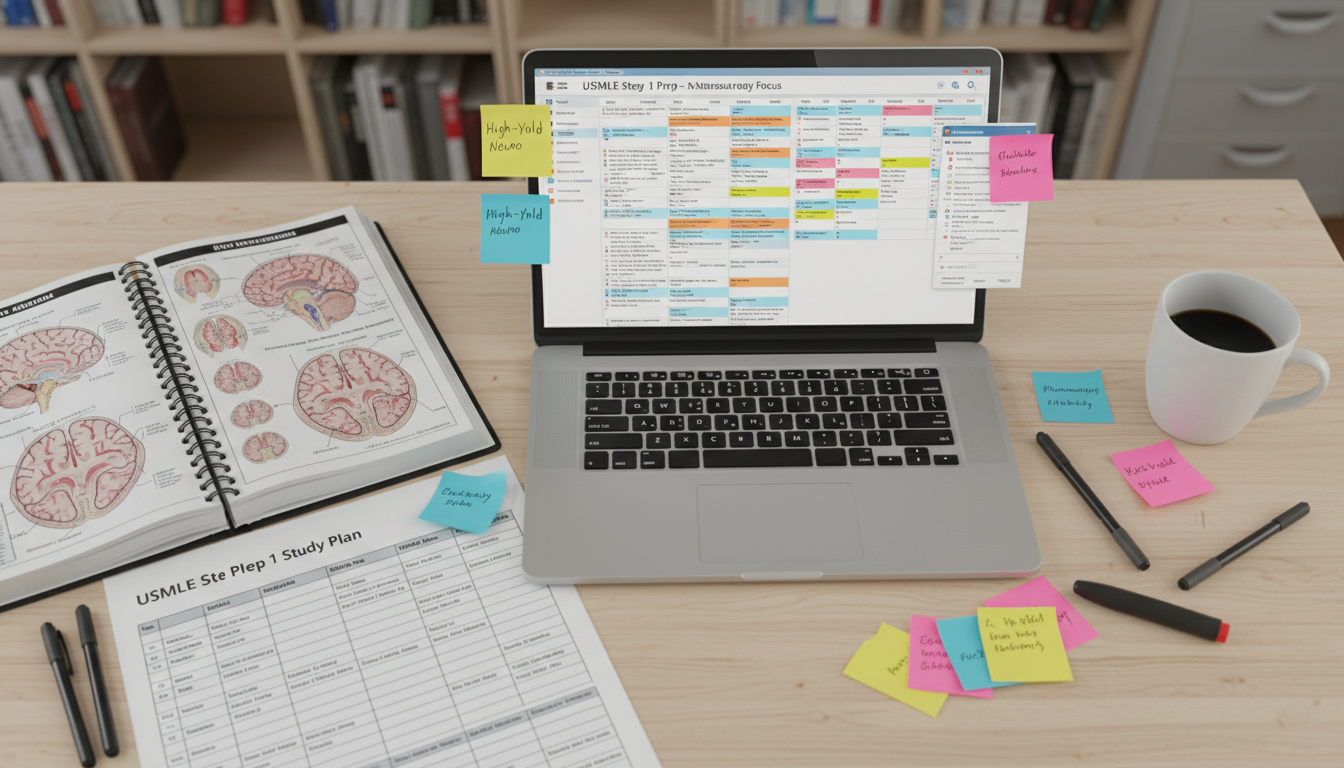
Phase 1: Foundations (MS1–Early MS2)
Primary goal: Learn your coursework well and tag it in a Step 1 mindset.
Key actions:
Master your school’s neuroanatomy and physiology
- Treat neuro-heavy blocks as if they are Step 1 prep.
- Use a neuro-focused atlas and integrate it with your lecture material.
Start Step 1 resources early—but in moderation
- Begin selective use of a board-style QBank for topics you’ve already studied (e.g., do neurophysiology questions after finishing that block in school).
- Start or join an Anki deck aligned with your curriculum, adding or tagging neuro cards.
Identify weak systems early
- Many neurosurgery-bound students over-focus on neuro at the expense of other subjects. Track your performance in cardiology, renal, endocrine, etc. You still must pass Step 1 comprehensively.
A sample weekly structure during MS1 neuro block:
- 5 days/week:
- 2–3 hours lecture + review
- 30–45 minutes Anki (with many neuro cards)
- 2–3 days/week:
- 10–15 neuro Step 1 questions with full review
Phase 2: Pre-Dedicated (Late MS2, 2–4 Months Before Exam)
Primary goal: Transition from coursework-focused study to USMLE Step 1 study.
Key actions:
Consolidate your Step 1 resources (no more than 3–4 core tools):
- One comprehensive reference (e.g., First Aid for the USMLE Step 1 or similar)
- One major QBank (e.g., UWorld or equivalent)
- Anki deck (e.g., a well-known Step 1 deck)
- A video series only if you have major conceptual gaps
Start systematic QBank use
- Aim for 10–20 questions per day, untimed and subject-based if your school is still teaching systems.
- Spend as much time reviewing questions as you do answering them.
Neuro emphasis without neglecting other systems
- For a future brain surgery residency, don’t only do neuro questions; but when you do them, go deeper:
- Cross-check neuroanatomy lesions with a neuroanatomy text
- Look up imaging correlates (CT/MRI) when relevant
- For a future brain surgery residency, don’t only do neuro questions; but when you do them, go deeper:
Map out your dedicated period
- Decide on your exam date in coordination with your school.
- Draft a 4–8-week dedicated schedule (see below) with daily question and Anki targets.
Phase 3: Dedicated Study (4–8 Weeks Before Step 1)
Primary goal: Achieve consistency, full content coverage, and exam-ready performance.
A typical day during dedicated:
Morning
- 40–60 timed, random QBank questions in exam mode
- Immediate review of all questions (2–3 hours), taking notes or tagging concepts/cards
Afternoon
- Targeted review of weakest systems or subjects (e.g., renal, biochem, immunology)
- High-yield reading or video segments for trouble spots
- Neuro emphasis: 30–60 minutes specifically on neuroanatomy/neuropath questions or review
Evening
- 1–1.5 hours of Anki/spaced repetition
- Brief review of summary tables (e.g., pharmacology, microbiology, tumor types)
Total daily study time: ~8–10 focused hours, with breaks.
Neurosurgery-focused adaptations:
Ensure neuroanatomy, neuropathology, neuropharmacology and brain tumors are never neglected:
- Brainstem cross-sections
- Spinal cord lesions
- Movement disorders circuitry
- CNS tumors and associated syndromes
- Cerebrovascular territories and stroke patterns
Practice reading basic CNS imaging where possible:
- Even though Step 1 is more limited in advanced imaging, being comfortable with CT/MRI neuro images helps your pattern recognition and prepares you for future neurosurgery work.
Phase 4: Final 7–10 Days
Primary goal: Consolidation, not new learning.
Shift your emphasis to:
- Reviewing marked questions and incorrects from your QBank
- Rapid-fire review of high-yield tables and charts
- Intensive Anki of weak areas (including neuro)
Take 1–2 full-length practice exams (if available) early in this window; do not schedule a full-length exam the day before the real test.
The last 1–2 days should be lighter, focusing on sleep, stress control, and brief review—not marathon cramming.
Best USMLE Step 1 Resources for Neurosurgery-Bound Students
Choosing the right Step 1 resources is crucial. Neurosurgery applicants often lean toward “more is better,” but overloading yourself can backfire. Aim for depth of use, not breadth of resources.
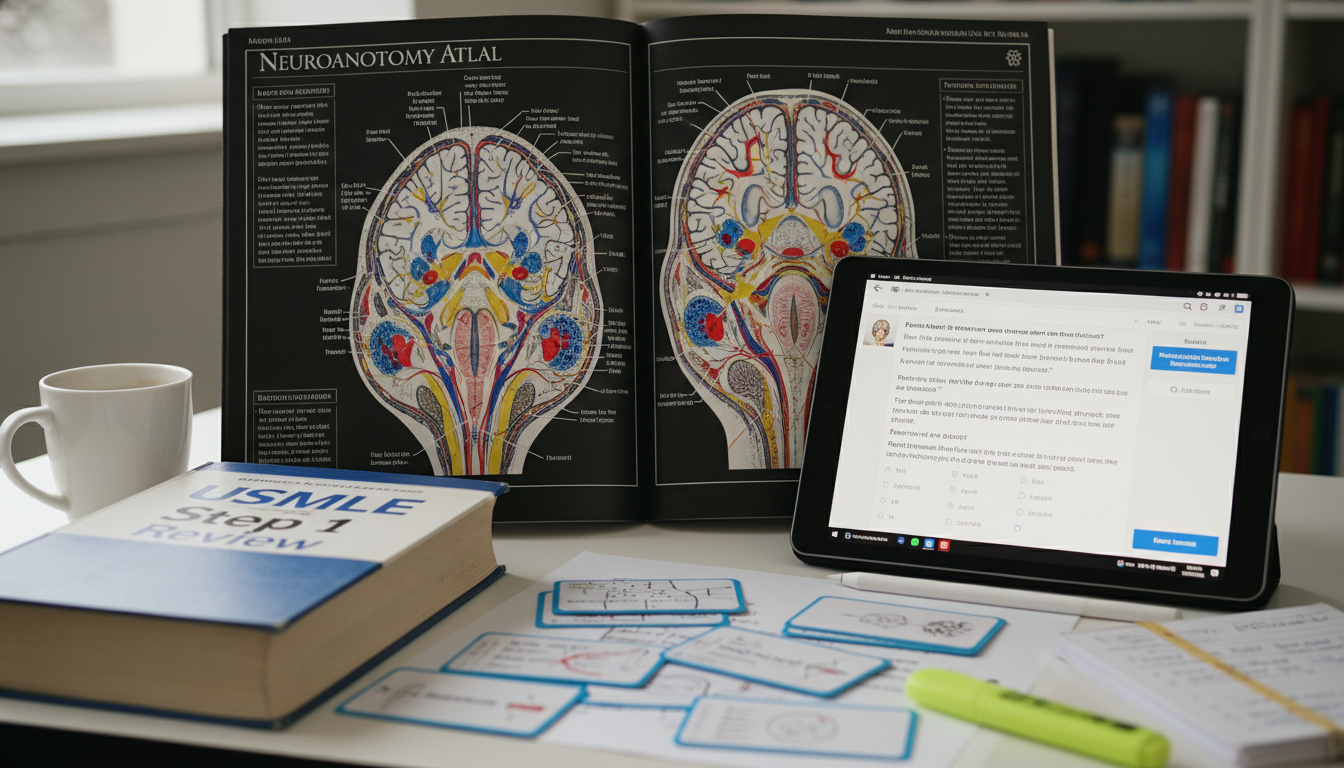
1. Question Banks (QBank): Your Primary Engine
For USMLE Step 1 preparation, high-quality QBank questions are non-negotiable.
Look for:
- Large number of questions covering all basic science disciplines
- Strong explanations with clear rationales
- High-yield neuroanatomy and neuropathology coverage
How to use a QBank effectively:
- Do questions in timed mode regularly to simulate exam pressure.
- Use random blocks once you’re close to your exam date.
- Create brief notes or Anki cards from your mistakes and difficult concepts.
Neurosurgery-specific tip:
- Flag neuroanatomy and neuropath questions for second pass review if time allows; these areas are highly relevant both for Step 1 and for your eventual brain surgery residency.
2. Comprehensive Review Text / Summary Book
Most students use a single, widely known Step 1 review book as their “spine” for content.
Best practices:
- Do not try to memorize the entire book line-by-line.
- Instead, pair it with your QBank: when you miss a question, read the relevant summary section.
- Mark or highlight neuro chapters for repeated review: cranial nerves, neurocutaneous disorders, demyelinating diseases, CNS tumors, spinal cord lesions, vascular territories.
3. Anki and Spaced Repetition
Anki (or a similar platform) is extremely powerful for:
- Memorizing pathways, drug mechanisms, lesion-deficit patterns
- Retaining large volumes of small facts over months
To optimize Anki:
- Use a high-quality Step 1 deck; avoid building everything from scratch.
- Suspend cards unrelated to your curriculum phase, then unsuspend as you reach those topics.
- Tag or filter neuro-related cards so you can review them more frequently.
Neurosurgery emphasis:
- Create extra custom cards for:
- Named spinal cord tracts and their functions
- Typical presentations and imaging clues for CNS tumors
- Classic neurosurgical emergencies (epidural vs subdural hematomas, herniation syndromes)
4. Video Resources
Video resources can be beneficial for visual learners and for particularly challenging topics (e.g., biochemistry, immunology, neuroanatomy). However:
- They are high time-cost, so pick selectively.
- Use increased playback speed and take active notes.
- Connect video viewing with questions on the same topic the same day.
Ideal uses for neurosurgery-bound students:
- Detailed neuroanatomy lectures with 3D models
- Neurophysiology (e.g., basal ganglia circuits, visual pathways)
- Neuropathology image-heavy reviews
5. Supplemental Neuroanatomy and Neuropathology
Given your specialty interest, you may go a bit beyond what is strictly necessary to pass Step 1. Consider:
- A concise neuroanatomy atlas or text (especially one with cross-sectional imaging)
- Brief neuropathology resources that review tumors, demyelinating disease, infections, and degenerative disorders with images
Use them sparingly—your Step 1 study should not morph into a full neurosurgery board prep, but these supplements can deepen understanding of concepts tested on Step 1.
Step 1 Content Areas Critical for Future Neurosurgeons
While all tested material is important, certain domains are disproportionately relevant for someone aiming for a neurosurgery residency.
1. Neuroanatomy and Lesion Localization
Core skills to develop:
- Understanding major CNS tracts (corticospinal, spinothalamic, dorsal columns)
- Localizing lesions based on clinical signs:
- Hemisection of the spinal cord (Brown-Séquard)
- Central cord vs anterior cord syndromes
- Brainstem lesions affecting cranial nerves and long tracts
- Recognizing vascular territories of major cerebral arteries and associated stroke syndromes
Effective strategies:
- Draw and redraw pathways from memory.
- Use cross-sectional diagrams and correlate with CT/MRI images.
- Practice neuroanatomy questions until patterns feel automatic.
2. Neuropathology and CNS Tumors
For a brain surgery residency, understanding CNS tumors at a Step 1 level is foundational.
Focus on:
- High-yield adult and pediatric brain tumors:
- Glioblastoma, oligodendroglioma, meningioma, pituitary adenoma
- Medulloblastoma, ependymoma, craniopharyngioma, pilocytic astrocytoma
- Tumor locations and associated symptoms (e.g., cerebellar vs suprasellar masses)
- Basic histologic features highlighted in Step 1-style questions
Approach:
- Build tables comparing tumors by: age, location, imaging, histology, paraneoplastic phenomena.
- Tie each tumor to the typical “stem” of a clinical vignette.
3. Neuropharmacology
Key domains:
- Antiepileptic drugs: mechanisms, indications, major side effects
- Agents affecting intracranial pressure, sedation, analgesia (important for understanding perioperative care later)
- Drugs for Parkinson disease, Alzheimer disease, multiple sclerosis, migraine
Many future neurosurgeons also develop a strong interest in neurocritical care; robust neuropharmacology knowledge will help in that domain as well.
4. Vascular and Stroke-Related Material
Even though stroke is more heavily emphasized on Step 2 CK and in neurology, Step 1 still tests key concepts:
- Circle of Willis and major branch territories
- Ischemic vs hemorrhagic stroke basics
- Common aneurysms (e.g., berry aneurysm) and associated conditions
- Subarachnoid hemorrhage pathophysiology and presentation
These topics are central to many neurosurgical cases (aneurysm clipping, AVM treatment, decompressive craniectomy), so take them seriously.
Integrating Step 1 Prep With Long-Term Neurosurgery Goals
Your Step 1 preparation is just one piece of your overall neurosurgery application strategy. You can use this period to strengthen your long-term competitiveness.
1. Building Systems You’ll Use Throughout Training
The habits you build for USMLE Step 1 preparation will carry forward:
- Question-based learning → In-service exam and board prep
- Spaced repetition → Retention of surgical oncology, vascular, spine knowledge
- Efficient scheduling and burnout prevention → Surviving residency’s workload
View Step 1 as part of your professional identity formation—you are training yourself to think like a physician who will repeatedly absorb and apply complex data under pressure.
2. Coordinating With Research and Mentorship
Strategic timing:
- Many future neurosurgeons pursue research years or longitudinal research projects. Use your pre-dedicated and dedicated periods primarily for Step 1; plan major research pushes for after your exam.
Mentorship:
- Discuss your Step 1 study plan with neurosurgery mentors or residents; they can often share how they balanced Step 1 prep with early research.
- Share your Step 1 results (once available) with mentors; they can help you contextualize them in your overall neurosurgery application strategy.
3. Protecting Your Mental and Physical Health
Neurosurgery and USMLE Step 1 both demand sustained intensity. Burnout during Step 1 prep can foreshadow problems later.
Non-negotiables:
- Sleep: Aim for 7–8 hours most nights; sleep is critical for memory consolidation.
- Short daily movement: Even 20–30 minutes of walking, stretching, or light exercise boosts concentration.
- Scheduled downtime: Build at least one half-day per week of reduced intensity to reset.
If anxiety, depression, or burnout symptoms emerge, address them early through counseling, student health services, or other supports. Neurosurgery residency programs value resilience and insight—addressing your health is part of professional responsibility.
Frequently Asked Questions (FAQ)
1. Since Step 1 is now pass/fail, how important is it for neurosurgery residency?
For neurosurgery residency, Step 1 remains very important—just in a different way. Program directors no longer see your numeric score, but they will see whether you passed on the first attempt and when you took the exam. A first-attempt pass is essentially mandatory for a competitive brain surgery residency application. A fail or delayed exam can significantly hinder your ability to match, especially in neurosurgery where the applicant pool is small and highly competitive.
2. How early should I start USMLE Step 1 preparation if I want neurosurgery?
You should adopt a Step 1 mindset from early MS1, especially in neuro-heavy courses. That doesn’t mean doing full-time USMLE Step 1 study from day one, but it does mean:
- Using Anki or another spaced repetition tool from early on
- Integrating board-style questions into your neuro, physiology, and pathology blocks
- Treating neuroanatomy as a major priority
Formal, dedicated USMLE Step 1 study for most students is around 4–8 weeks, but your foundation is built over 1.5–2 years.
3. Do I need extra neurosurgery-specific resources for Step 1?
In most cases, no. High-quality general Step 1 resources are sufficient to pass and to build the core knowledge required for neurosurgery. However, because of your interest, adding a concise neuroanatomy atlas or a short neuropathology review can deepen your understanding and make neuro questions feel easier. Just be careful not to sacrifice global Step 1 coverage for subspecialty depth.
4. How does Step 1 preparation help me with Step 2 CK and my neurosurgery application?
Strong USMLE Step 1 study habits translate directly to Step 2 CK success, where your numerical score will be heavily weighed in neurosurgery residency selection. The neuroanatomy, neuropath, and neuropharmacology you master now will:
- Make neurology and neurosurgery clerkships easier
- Help you shine on neurology-related portions of Step 2 CK
- Provide a base for neurosurgery sub-internships, where you’ll be expected to understand lesions, imaging, and perioperative management
In short, thoughtful, disciplined Step 1 preparation is a cornerstone of a strong neurosurgery residency application and a durable investment in your future as a neurosurgeon.