
USMLE Step 1 is often your first major gateway to a competitive OB GYN residency. Even in the pass/fail era, your Step 1 preparation still matters—for building core knowledge, performing well on clerkships and shelves, and setting yourself up for a strong performance on Step 2 CK, which is heavily weighted in the obstetrics match. This guide will walk you through how to prepare strategically for Step 1 with a particular focus on obstetrics & gynecology.
Understanding USMLE Step 1 in the OB GYN Context
Although USMLE Step 1 is not a specialty exam, its content deeply overlaps with what you’ll need for a career in obstetrics & gynecology. Thinking about OB GYN while you plan your USMLE Step 1 study can help you prioritize concepts and build a foundation you’ll re-use throughout third year and beyond.
How Step 1 Fits into the OB GYN Residency Application
Even with Step 1 reported as pass/fail, OB GYN program directors still consider it in several ways:
- Pass vs. fail as a threshold: A pass is required; a fail can delay graduation and complicate your obstetrics match timeline.
- Signal of knowledge base: Solid Step 1 preparation usually translates into better clerkship performance, particularly on OB GYN rotations.
- Foundation for Step 2 CK: OB GYN is one of the more competitive fields, and Step 2 CK (still scored) now carries even more weight. Strong Step 1 knowledge makes your Step 2 CK prep smoother and more efficient.
Programs also pay close attention to:
- Clinical grades, especially in OB GYN and Surgery
- Shelf exam scores
- Letters of recommendation from OB GYN faculty
- Research and involvement in women’s health
Robust Step 1 preparation supports all of these by making you more confident and clinically fluent once you hit the wards.
What OB GYN-Relevant Content Appears on Step 1?
While Step 1 is primarily basic science, OB GYN themes are woven through:
- Reproductive anatomy and embryology
- Development of the Müllerian and Wolffian ducts
- Congenital anomalies (e.g., uterine septum, bicornuate uterus, ambiguous genitalia)
- Pelvic anatomy (uterus, ovaries, pelvic floor, blood supply)
- Reproductive endocrinology
- Hypothalamic-pituitary-gonadal axis
- Menstrual cycle regulation
- Hormonal contraceptives and their mechanisms
- Pregnancy hormones (hCG, progesterone, estrogen, human placental lactogen)
- Reproductive physiology
- Fertilization, implantation, placental function
- Puberty, menopause, and related hormonal changes
- Reproductive pathology
- Ectopic pregnancy, molar pregnancy, gestational trophoblastic disease
- Ovarian tumors, uterine fibroids, endometrial cancer
- Cervical dysplasia and carcinoma (HPV-associated changes)
- Endometriosis, adenomyosis, polycystic ovary syndrome (PCOS)
- Genetics and teratology
- Chromosomal abnormalities (e.g., Turner, Klinefelter)
- Teratogenic drugs and infections affecting pregnancy
- Pharmacology
- Hormone therapies (OCPs, HRT, SERMs, aromatase inhibitors)
- Tocolytics and uterotonics (though more heavily tested on Step 2, basic mechanisms appear on Step 1)
- Antibiotics and drugs contraindicated in pregnancy
Understanding that these domains link directly to your future practice can make your USMLE Step 1 study feel more meaningful and focused.
Building a High-Yield Step 1 Study Plan with an OB GYN Lens
Effective USMLE Step 1 preparation requires structure. A generic plan is helpful, but intentionally weaving in OB GYN content can give you a head start for your core OB GYN clerkship and residency ambitions.
Step 1 Study Phases
Think of your preparation in three phases:
Pre-dedicated (Systems Courses + Early Boards Mindset)
- Purpose: Build conceptual understanding while you go through organ systems.
- OB GYN focus:
- Take reproductive and endocrine blocks seriously; they are central for OB GYN.
- Start light exposure to Step 1 resources (e.g., Anki, question banks) early in these blocks.
Dedicated Study Period (4–10 weeks)
- Purpose: Consolidate and integrate; push toward exam readiness.
- OB GYN focus:
- Ensure full mastery of reproductive, endocrine, and embryology content.
- Integrate OB GYN-relevant questions regularly, not just at the end.
Preclinical → Clinical Bridge
- Purpose: Turn Step 1 knowledge into clinically usable skills.
- OB GYN focus:
- After Step 1, do a quick “OB GYN bridge review” (2–5 days) to transform basic science into clinical reasoning before or early in your OB GYN rotation.
Core Components of a Strong Step 1 Study Plan
Daily Question Practice
- Use a major USMLE question bank (UWorld, Amboss, etc.).
- During dedicated, aim for 60–80 questions per day, adjusting to your schedule and stamina.
- Tag or note OB GYN-related items (e.g., reproductive path, pregnancy physiology) for quick reviews.
Core Resources
- One primary content resource (e.g., First Aid, Boards & Beyond, or equivalent).
- A reliable USMLE Step 1 study video resource for deeper clarification when needed.
- An active recall system (Anki or your own flashcards).
Scheduled Review Blocks
- Weekly dedicated time to review:
- Reproductive anatomy & physiology
- Endocrine–reproductive system integration
- Embryology with OB GYN relevance
- Weekly dedicated time to review:
NBME and Self-Assessment Exams
- Use NBME practice tests or similar self-assessments at regular intervals.
- Analyze OB GYN-relevant misses carefully; they often highlight conceptual gaps in endocrine and reproductive physiology.
Sample 6-Week Dedicated Study Template (OB GYN-Enhanced)
Weeks 1–2: Foundations + Systems Review
- Focus: Biochemistry, physiology, immunology, pathology basics
- OB GYN overlay:
- Include daily 60–90 minute blocks of reproductive & endocrine review.
- Use at least 10–15 questions per day specifically from endocrine/reproductive blocks in your question bank.
Weeks 3–4: Integrated System Review
- Focus: Cardiovascular, renal, respiratory, GI, neuro, MSK/skin
- OB GYN overlay:
- Revisit pregnancy physiology as you cover cardiovascular and renal adaptations.
- Attach OB GYN pathology where relevant (e.g., hypercoagulability in pregnancy; DIC in obstetric emergencies, even if Step 2 leans heavier on this).
Weeks 5–6: High-Yield + Weakness Focus
- Focus: Reinforce weak systems, memorization-heavy content (micro, pharm).
- OB GYN overlay:
- One full day for reproductive pathophysiology review.
- One half-day each week for embryology and teratology.
- Practice integrating OB GYN-relevant pharmacology (e.g., hormonal contraception, anti-estrogens, teratogenic drugs like isotretinoin, ACE inhibitors).
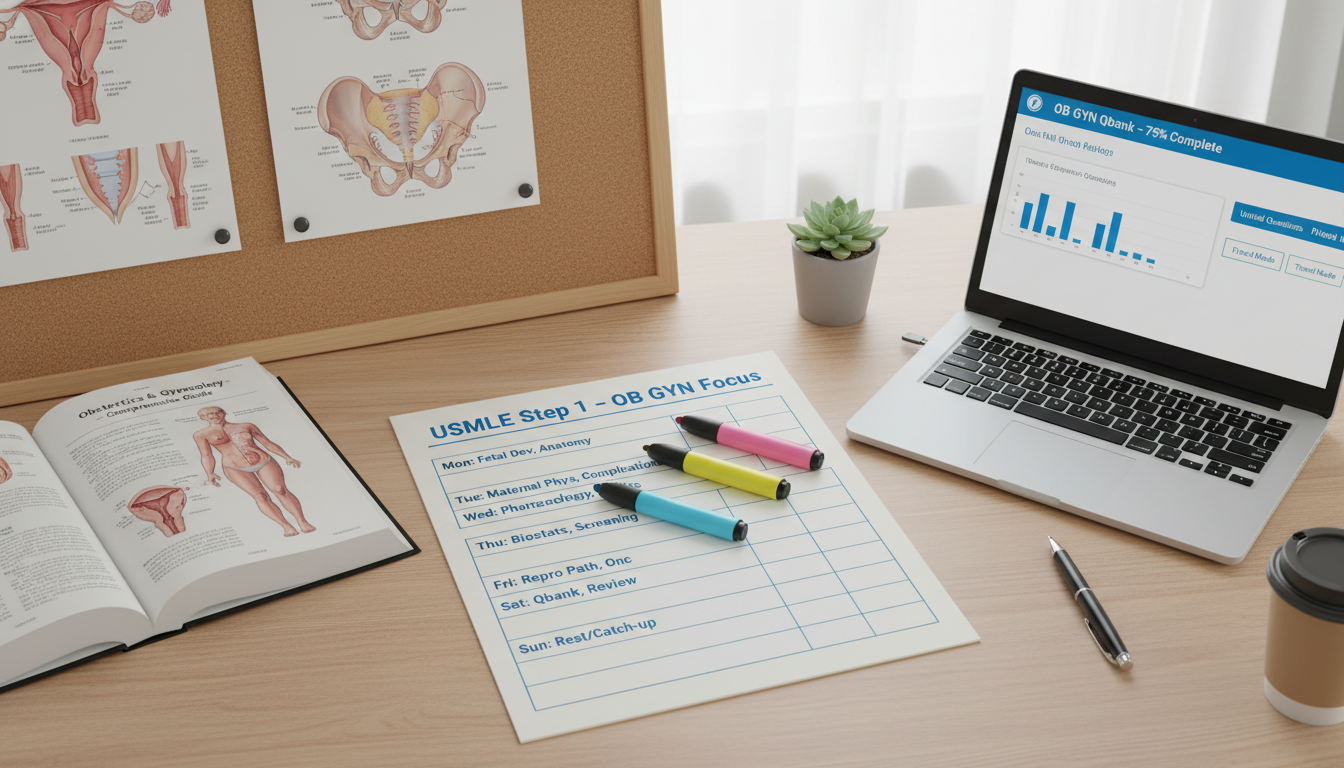
High-Yield Step 1 Resources and How to Use Them for OB GYN
Many students drown in Step 1 resources and lose time. For an OB GYN-focused approach, it is better to use a few resources deeply and adapt them to your specialty interest.
Core “Must-Have” Resources
Question Bank (UWorld, Amboss, or similar)
- How to use:
- Do questions in timed, random mode once you have covered most content.
- During systems blocks in preclinical, do questions by system (e.g., reproductive, endocrine).
- Actively annotate key OB GYN concepts into your primary content resource or flashcards.
- OB GYN angle:
- Flag questions related to pregnancy, contraception, reproductive tumors, and endocrine conditions that commonly present in women of reproductive age.
- Build mini-decks of tricky OB GYN-related questions to re-do later.
- How to use:
First Aid (or Equivalent Board Review Text)
- How to use:
- Treat it as a roadmap and checklist rather than your only learning source.
- Annotate high-yield nuggets from questions and videos, especially around reproductive and endocrine.
- OB GYN angle:
- Pay particular attention to:
- Reproductive anatomy/embryology tables
- Menstrual cycle hormone graphs
- Tumor markers and ovarian tumor summaries
- Pregnancy-related conditions and teratogens
- Pay particular attention to:
- How to use:
Comprehensive Video Series (e.g., Boards & Beyond, Pathoma, Sketchy)
- Pathoma:
- Master gynecologic pathology sections—uterine, ovarian, cervical cancers, molar pregnancy.
- Boards & Beyond (or similar):
- Use reproductive & endocrine modules intensively.
- Sketchy (if you use it):
- Focus on micro and pharm relevant to pregnancy and women’s health (e.g., TORCH infections, antibiotics and teratogens).
- Pathoma:
Specialty-Focused Supplements (Optional but Helpful)
OB GYN Shelf-Oriented Books or Notes
- These are not mandatory for Step 1, but a short OB GYN notes resource can:
- Help you translate basic science into clinical presentations (abnormal uterine bleeding patterns, ectopic pregnancy, miscarriage).
- Serve as your early bridge to the OB GYN clerkship.
- These are not mandatory for Step 1, but a short OB GYN notes resource can:
Embryology Atlases or Condensed Guides
- A short, high-yield embryology summary can clarify:
- Reproductive tract anomalies
- Placental development and its implications
- This content is tested on Step 1 and later becomes crucial for counseling pregnant patients.
- A short, high-yield embryology summary can clarify:
Integrating OB GYN Knowledge into Your Step 1 Prep
Even if Step 1 is basic science, you will retain more—and be better positioned for an OB GYN residency—if you think clinically and longitudinally.
Connecting Basic Science to OB GYN Clinical Scenarios
When you study a basic science concept, ask “How might this show up in OB GYN practice?” For example:
Endocrine – Hypothalamic-Pituitary-Ovarian Axis
- Step 1 level:
- GnRH → FSH, LH → estrogen, progesterone
- Feedback loops, receptor types, second messenger systems
- OB GYN translation:
- Infertility workup: understanding FSH/LH levels and ovulation induction
- Polycystic ovary syndrome (PCOS): hyperandrogenism, anovulation, metabolic aspects
- Step 1 level:
Pharmacology – SERMs (e.g., Tamoxifen, Raloxifene)
- Step 1 level:
- Partial agonist/antagonist behavior on estrogen receptors in various tissues
- OB GYN translation:
- Breast cancer treatment and prophylaxis
- Risks of endometrial hyperplasia/cancer with certain SERMs
- Step 1 level:
Embryology – Müllerian Duct Development
- Step 1 level:
- Differentiation into fallopian tubes, uterus, upper vagina
- OB GYN translation:
- Congenital uterine anomalies and their impact on fertility and pregnancy outcomes
- Step 1 level:
This style of thinking not only makes Step 1 content stick but also builds clinical reasoning that OB GYN attendings will notice on your rotation.
Common High-Yield OB GYN-Related Step 1 Topics
Focus on mastering these categories:
Menstrual Cycle Hormones
- Understand the sequence and feedback:
- Follicular vs. luteal phase
- LH surge and ovulation
- Recognize graphs and apply them to questions about fertility and contraception.
- Understand the sequence and feedback:
Pregnancy Physiology
- Cardiovascular:
- Increased plasma volume, decreased systemic vascular resistance
- Renal:
- Increased GFR and implications for drug dosing
- Endocrine:
- hCG production and uses as a marker (e.g., ectopic pregnancy, molar pregnancy)
- Application:
- Why certain blood pressures are “normal” in pregnancy
- How pregnancy affects lab values (e.g., mild physiologic anemia)
- Cardiovascular:
Gynecologic Tumors
- Ovarian tumors:
- Distinguish epithelial, germ cell, and sex cord-stromal tumors
- Know key tumor markers (e.g., CA-125, AFP, hCG)
- Uterine pathology:
- Leiomyomas vs. leiomyosarcomas
- Endometrial carcinoma risk factors
- Cervical neoplasia:
- HPV types, transformation zone, CIN progression
- Ovarian tumors:
Teratogens and TORCH Infections
- Drugs:
- Isotretinoin, warfarin, ACE inhibitors, valproate, thalidomide
- Infections:
- Toxoplasmosis, Rubella, CMV, HSV, HIV, Syphilis
- Application:
- Counseling pregnant patients (later in training) and recognizing classic congenital syndromes.
- Drugs:
Reproductive Genetics
- Turner syndrome (45,XO), Klinefelter (47,XXY)
- Trisomies and associated maternal age risk
- Disorders of sexual development (e.g., androgen insensitivity)
If you solidly learn these topics for Step 1, you will be significantly ahead of the curve on your OB GYN clerkship and shelf exam.
Balancing Step 1 Preparation with Long-Term OB GYN Career Goals
Pursuing OB GYN means balancing your exam performance with meaningful specialty exposure and experiences that will strengthen your future residency application.
How Much Should You “Specialize” During Step 1 Prep?
During USMLE Step 1 preparation, your primary target is still a strong overall performance and a comfortable pass on this exam. However, you can:
- Emphasize:
- Reproductive and endocrine systems
- Embryology and genetics related to fetal development and congenital anomalies
- Without neglecting:
- High-yield systems like cardio, renal, respiratory, neuro, and micro—crucial for both Step 1 and general clinical competence.
Think of OB GYN as a lens, not a tunnel. Use it to make content more meaningful and interconnected, not to ignore other systems.
Using Step 1 Prep to Prepare for OB GYN Clerkship
As you near the exam, consider:
- Creating a one-page summary of:
- Menstrual cycle hormone changes
- Pregnancy physiologic changes
- High-yield reproductive pathologies
- After you finish Step 1:
- Spend 2–5 days reviewing OB GYN-specific notes and a few OB GYN-focused question sets.
- This will help you hit the ground running on your OB GYN rotation.
Maintaining Well-Being and Resilience
OB GYN is a high-intensity field with long hours and emotionally heavy cases. Use Step 1 prep as an early opportunity to build sustainable habits:
- Sleep: 7–8 hours whenever possible; cognition plummets with chronic sleep debt.
- Exercise: Short, consistent workouts (20–30 minutes) to manage stress.
- Boundaries: Protect at least a half-day per week free from heavy studying to avoid burnout.
These skills will serve you on call nights, during residency, and throughout your career.
Practical Study Strategies and Common Pitfalls
Evidence-Informed Study Techniques
Active Recall over Passive Review
- Use flashcards, closed-book recitation, and practice questions to pull information out of memory.
- Example: After watching a reproductive endocrinology video, write down the hormone curves for the menstrual cycle from memory.
Spaced Repetition
- Use Anki or another spaced repetition tool for details:
- Hormones, tumor markers, teratogens, genetic conditions.
- Schedule brief daily review sessions rather than long cramming blocks.
- Use Anki or another spaced repetition tool for details:
Interleaving
- Mix OB GYN-relevant content with other systems:
- E.g., a block of questions that includes reproductive, endocrine, and cardiovascular.
- This mirrors the integrated nature of the real exam.
- Mix OB GYN-relevant content with other systems:
Error Analysis
- Keep an error log:
- For every missed question, note:
- Topic (e.g., “ovarian germ cell tumor”)
- Why you missed it (knowledge gap, misread, time pressure)
- One key takeaway
- For every missed question, note:
- Revisit OB GYN-related errors weekly; they tend to have recurring patterns (e.g., confusing tumor types or hormone actions).
- Keep an error log:
Common Pitfalls for OB GYN-Interested Students
Over-Indexing on OB GYN at the Expense of Other Systems
- Remember: Cardio, renal, neuro, and micro are still heavily tested and crucial for your future OB GYN patients, who will have comorbid conditions.
Neglecting Basic Science Foundations
- It’s tempting to jump straight to clinical OB GYN details, but Step 1 requires basic science mastery:
- Receptor signaling pathways
- Molecular genetics
- Biostatistics and ethics (including reproductive ethics)
- It’s tempting to jump straight to clinical OB GYN details, but Step 1 requires basic science mastery:
Over-Reliance on Passive Resources
- Watching videos at 2x speed without practice questions often creates a false sense of security.
- Always pair videos or reading with questions or flashcards.
Insufficient Integration of Step 1 and Step 2 CK Strategy
- OB GYN aspirants especially need to think long-term:
- Strong Step 1 foundations → smoother Step 2 CK prep → stronger residency application.
- OB GYN aspirants especially need to think long-term:
FAQs: USMLE Step 1 Preparation for Future OB GYN Residents
1. Does Step 1 still matter for OB GYN now that it’s pass/fail?
Yes. While the numeric score is no longer reported, OB GYN programs expect you to pass Step 1 on the first attempt. More importantly, strong Step 1 preparation builds the knowledge base you need to excel on Step 2 CK, OB GYN and Surgery clerkships, shelf exams, and eventually your in-training exams during residency. Think of Step 1 as your foundation, not the finish line.
2. How should I prioritize OB GYN topics during my Step 1 preparation?
Prioritize reproductive and endocrine systems, embryology, and any pathology or pharmacology that relates to pregnancy, fertility, or female reproductive cancers. Make sure you understand the menstrual cycle, pregnancy physiology, gynecologic tumors, teratogens, and key genetic syndromes. However, do this within a balanced study plan that still gives ample time to other high-yield systems like cardiology and nephrology.
3. What are the best Step 1 resources specifically for OB GYN-related content?
Use a solid question bank (UWorld, Amboss) as your core, then layer on:
- A primary review text like First Aid for structure and checklists.
- A video resource (e.g., Boards & Beyond) for reproductive/endocrine and embryology.
- Pathoma for gynecologic pathology. You don’t need OB GYN-specific books for Step 1 alone, but a concise OB GYN shelf resource can be useful later as you bridge to clinical rotations.
4. How can I use Step 1 preparation to help with the obstetrics match and my future OB GYN residency application?
Leverage Step 1 preparation to:
- Build a robust knowledge base that will make you stand out on your OB GYN rotation.
- Set yourself up for an excellent Step 2 CK performance, which is highly valued in the obstetrics match.
- Develop strong, sustainable study habits and resilience that will carry into clerkships and residency. Combined with good clinical evaluations, strong OB GYN letters, and genuine involvement in women’s health (research, interest groups, advocacy), your Step 1 foundations will support a compelling application to OB GYN residency.
Focusing your USMLE Step 1 preparation through an OB GYN lens lets you master the exam while laying the groundwork for the specialty you’re passionate about. By using high-yield Step 1 resources, strategically emphasizing reproductive and endocrine systems, and connecting basic science to real OB GYN scenarios, you’ll be better prepared not only to pass Step 1 but to excel on the path to an obstetrics & gynecology residency.