Understanding the Role of Step 1 in Your Residency Journey
USMLE Step 1 preparation is no longer just about a three-digit score, but it remains a high‑stakes milestone that profoundly shapes your residency application strategy.
Step 1 in the Pass/Fail Era
Since Step 1 transitioned to pass/fail, its role has changed—but it has not become “unimportant.” Programs now:
- Use Step 1 as a screen for basic competence
- Place more weight on:
- Step 2 CK scores
- Clerkship grades and MSPE
- Letters of recommendation
- Research productivity
- Personal statement and experiences
However, failing Step 1:
- Can delay graduation or clinical rotations
- May limit the number of programs willing to interview you
- Forces you to explain the failure in ERAS and interviews
A strong foundation built during your USMLE Step 1 study directly improves:
- Your Step 2 CK performance
- Your core clerkship performance and shelf exams
- Your confidence in clinical reasoning
Your Step 1 preparation is therefore best viewed as the academic backbone of your residency application, especially for competitive specialties (dermatology, orthopedics, neurosurgery, plastics, ENT, etc.), where consistent excellence across metrics matters.
When to Start Thinking About Step 1 Preparation
For most U.S. medical students, Step 1 is taken:
- Late second year (M2) or early M3
- After completing core preclinical systems and foundational sciences
International medical graduates (IMGs) often:
- Start serious USMLE Step 1 study 6–12 months in advance
- Balance prep with clinical responsibilities or internships
General guidance:
- Early M1: Gentle exposure (focus on class; integrate Step-style questions periodically)
- Late M1–M2: Begin structured review with select Step 1 resources
- Dedicated period (4–10 weeks): Full-time USMLE Step 1 study
The key is not just the calendar date, but when:
- You’ve mastered most preclinical content
- You can devote consistent, protected time to preparation
Building Your Step 1 Study Framework
Before diving into question banks and books, you need a clear structure: timeline, baseline assessment, and realistic goals.
Step 1 Preparation Timeline: How Long Is Enough?
How long you need for Step 1 preparation depends on your baseline and obligations.
Typical U.S. MD/DO students:
- Pre-dedicated phase: Light integration over 6–12 months
- Dedicated period: 4–8 weeks of full-time study (6–10+ hours/day)
Typical IMGs:
- Often require 6–12 months of part-time Step 1 preparation
- Many add a 2–3 month “pseudo-dedicated” or fully dedicated period toward the end
Factors that modify your timeline:
- Strength of your basic science background
- Prior exposure to NBME-style questions
- English language comfort (for non-native speakers)
- Competing responsibilities (clinical work, family, research)
Establishing Your Baseline
Before finalizing a USMLE Step 1 study plan, you need a realistic snapshot of where you stand.
Common options:
- NBME Comprehensive Basic Science Self-Assessments (CBSSA):
- Best mimic actual Step 1 question style
- Provide performance profile by discipline and system
- Free 120 (USMLE Sample Questions):
- Useful later as an “exam readiness” gauge
- Question bank (Qbank) diagnostic tests (less predictive but helpful for rough baseline)
Actionable approach:
- Finish most preclinical systems first.
- Take a baseline NBME under exam conditions (timed, closed book, quiet environment).
- Use results to:
- Identify weak systems (e.g., renal, neuro)
- Identify weak disciplines (e.g., biostatistics, pharmacology)
- Decide whether you need a longer preparation timeline
Given the pass/fail nature:
- Most schools recommend starting dedicated once your practice performance suggests clear readiness to pass with some buffer.
- Your goal: NBME performance consistently above the passing threshold (ideally by several percentage points) before your test date.
Setting Realistic Goals in a Pass/Fail World
Although Step 1 doesn’t generate a numeric score for residency programs:
You should set:
- A content goal: “Master core mechanisms and high-yield facts so I can explain diseases, not just name them.”
- A performance goal:
- Aim for practice NBMEs that show solid passing performance across most systems.
- Avoid relying on borderline performance in multiple weaker areas.
Your mindset should be:
“I’m not just trying to pass Step 1; I’m building a foundation to excel on Step 2 CK and in residency.”
Crafting an Effective Step 1 Study Schedule
A strong Step 1 preparation plan combines structure and flexibility. You need a daily rhythm, weekly checkpoints, and enough adaptability to respond to your performance data.
Principles of a High-Yield Step 1 Study Schedule
Questions first, not last
Build your schedule around doing and reviewing USMLE-style questions, not just reading.Active learning over passive reading
- Flashcards (especially spaced repetition like Anki)
- Teaching concepts aloud
- Drawing pathways, cycles, and mechanisms
Spiral review
- Revisit subjects multiple times instead of trying to “finish” them in one pass.
Regular self-assessment
- Use practice tests every 2–3 weeks during dedicated.
- Adjust your schedule based on performance.
Daily variety
- Mix systems/subjects to mimic the real exam’s randomization.
- Prevent burnout by not spending an entire day on one micro-topic.
Sample Dedicated Study Day (8–10 Hours)
Morning (Approx. 4 hours): Question-Intensive Block
- 40–80 timed, random Qbank questions (NBME style, one-hour blocks)
- Immediately review:
- Every question (right or wrong)
- Why the correct option is correct
- Why the distractors are wrong
- Annotate First Aid / core resource or update Anki cards
Early Afternoon (Approx. 3 hours): Targeted Content Review
- Focus on 1–2 weak systems (e.g., renal + immunology)
- Use a mix of:
- Step 1 resources (First Aid, Pathoma, boards-style videos)
- Sketchy for micro/pharm if you use it
- Condensed notes from class or earlier study
Late Afternoon or Evening (Approx. 2–3 hours): Consolidation
- Anki/spaced repetition review
- Light reading or watching short review videos
- Quick formula or high-yield concept review (biostats, ethics, genetic patterns)
Always reserve:
- At least 30–60 minutes/day for Anki or flashcards
- Breaks every 60–90 minutes to avoid fatigue and maintain quality
Weekly Structure and Rest Days
For a 6-week dedicated period, a sample pattern:
- Days 1–5: Full study days (8–10 hours)
- Day 6: Lighter day (5–6 hours, focus on review and consolidation)
- Day 7: Half-day or full rest (non-negotiable for most; burnout kills efficiency)
Each week:
- Assign 2–3 systems for focused review (e.g., “Week 2: renal, cardio, heme/onc”).
- Ensure coverage of cross-cutting topics (biostats, ethics, genetics, immunology).
- Plan one major self-assessment every 2 weeks (NBME or full-length simulation).
How Many Questions Should You Do?
For strong USMLE Step 1 preparation, a rough target:
- UWorld or primary Qbank: Aim to finish 100% of the questions, ideally with:
- Most of them in timed mode
- A mix of system-based (early) then random (later)
- Total questions during a typical dedicated period:
- 2,000–3,000+ questions (including reviewed and reset blocks)
Doing questions is only half the battle; how you review them matters more than the raw number.
Choosing and Using Step 1 Resources Wisely
The Step 1 resources market is crowded. The most successful students intentionally keep their core list short and use each tool for a specific purpose.
Core Step 1 Resources (The Essentials)
Question Bank (Qbank) – UWorld (or equivalent)
- The single most important Step 1 preparation tool
- Use it as:
- A learning tool, not just an assessment
- A way to train your brain in USMLE logic
- Tips:
- Start in tutor mode + system-based early
- Transition to timed + random as test nears
- Review all explanations, even for correct answers
First Aid for the USMLE Step 1
- Considered the “master outline” or content spine for Step 1
- Best used to:
- Tie together high-yield facts
- Anchor your annotations from Qbank and other resources
- Avoid trying to memorize it cover-to-cover in one pass; instead, cycle through it multiple times.
Pathoma (for pathology)
- Excellent for pathophysiological understanding
- Best for:
- Organ system pathology
- Integrating mechanisms with clinical presentations
- Watch videos, then review the corresponding text.
Anki (or another spaced repetition system)
- Critical for long-term retention
- Many students use:
- Pre-made decks (e.g., AnKing) aligned to First Aid/UWorld
- Personal cards based on missed questions
When people ask, “What are the best Step 1 resources?” — this core combination (Qbank + First Aid + Pathoma + Anki) covers the essentials for most students.
Supplementary Step 1 Resources (Use Selectively)
Depending on your learning style and weaknesses, consider:
Sketchy Medical (Micro + Pharm + Path)
- Highly effective for visual learners
- Great for microbiology and pharmacology mnemonics
- Time-intensive; prioritize pieces you truly need
Boards & Beyond / OnlineMedEd / similar board review videos
- Good for foundational re-teaching if your preclinical courses were weak
- Use strategically—not as background noise
- Watch at increased speed, pausing to take structured notes
BRS/High-Yield books (e.g., BRS Physiology, BRS Behavioral)
- Useful for targeted weak-area repair
- Physiology books are especially useful if you struggled with core concepts
USMLE-style question add-ons (AMBOSS, Kaplan, etc.)
- Helpful if:
- You finish your primary Qbank early
- You want more exposure to clinical scenarios
- Don’t substitute them entirely for UWorld; use them as supplement, not replacement.
- Helpful if:
Avoiding the “Too Many Step 1 Resources” Trap
A common Step 1 preparation mistake is collecting resources without a plan.
Red flags:
- You are trying to watch all major video series.
- You haven’t finished even one Qbank but are subscribed to two or three.
- You feel perpetually behind and never complete any resource thoroughly.
A practical strategy:
- Pick 1 primary Qbank, 1 pathology resource, 1 master outline (First Aid), and 1 flashcard system.
- Limit yourself to 1–2 supplementary resources that directly address your weaknesses or learning style.
- Commit to finishing what you choose.
Mastering Exam Technique and Test-Day Readiness
Success on Step 1 is not just about knowledge; it’s also about exam strategy, endurance, and cognitive control under stress.
Question Strategy: How to Think Like the USMLE
When doing USMLE Step 1 study questions:
Read the last line first
- Understand what is being asked before reading the stem.
- This primes your brain to filter key details.
Identify the “testing concept”
- Is it about:
- Mechanism of a drug?
- Side effect/toxicity?
- Pathophysiology?
- Biostatistical concept (e.g., sensitivity, odds ratio)?
- Label it mentally; it helps narrow choices.
- Is it about:
Summarize the case in 1–2 sentences
- E.g., “Young woman with photosensitivity, malar rash, joint pain, and anti-dsDNA antibodies → systemic lupus erythematosus.”
Eliminate obviously wrong answers
- Use pattern recognition and first principles.
- Often you can get to a 50/50 choice by removing clearly unrelated options.
When stuck, choose the answer that best matches the “core mechanism”
- Even if you don’t remember the exact fact, you may know:
- The relevant pathway
- The category of drug or bug
- The physiological direction (e.g., increases vs. decreases)
- Even if you don’t remember the exact fact, you may know:
Don’t overthink zebras
- Many questions test common pathologies or high-yield associations, not the rarest entity.
Reviewing Incorrect and Correct Answers
High-yield Step 1 preparation means transforming each question into a mini-lesson:
- For each incorrect question:
- Ask: “What exactly did I miss—content, reading the question carefully, or reasoning?”
- Note whether this is:
- A recall error (didn’t know the fact)
- A processing error (misread or rushed)
- A conceptual gap (didn’t understand the pathophysiology)
- For correct questions:
- Still read the explanation.
- Ensure your logic was sound (not just a lucky guess).
- Learn why other answer choices are wrong.
Add newly discovered insights into:
- Your Anki deck (one card per core concept)
- Annotations in First Aid or your primary notes
Simulating the Real Exam
Closer to your test date (2–3 weeks out), begin full-day simulations:
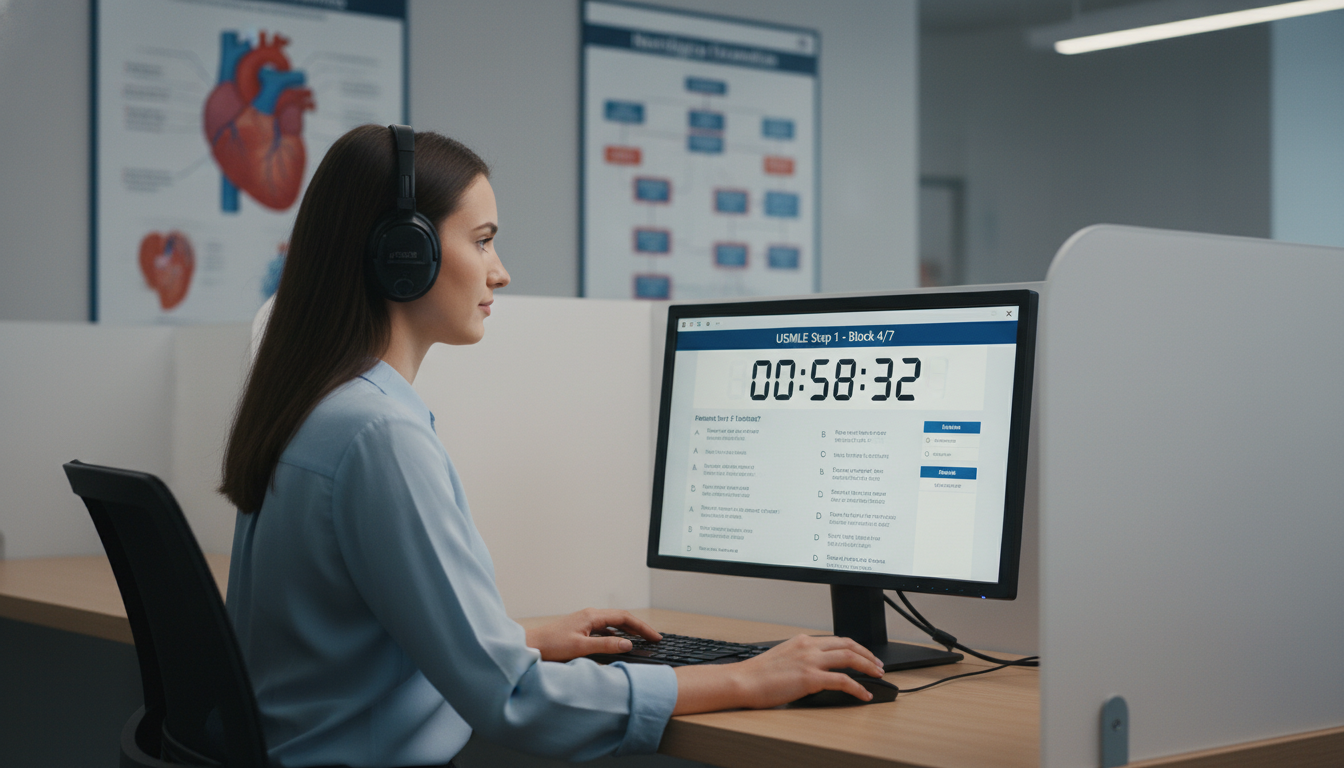
- Take at least one full-length practice exam (6–7 blocks) under test-like conditions:
- Timed
- Minimal breaks
- No notes, no phone
- Quiet environment
Goals:
- Test stamina and concentration
- Practice nutrition and hydration strategy
- Identify when you tend to lose focus (often around blocks 4–5)
Afterwards:
- Review each block in detail over 1–2 days.
- Note patterns:
- Are you missing more questions later in the day?
- Are certain systems consistently weak?
- Are there reading-comprehension or time-management issues?
Test-Day Logistics and Mental Game
One week before:
- Confirm:
- Test center location
- Required IDs
- Transportation and timing
- Adjust sleep schedule to match exam day.
Night before:
- Light review only.
- No new resources.
- Prepare:
- Clothes (comfortable, layered)
- Snacks and drinks (easy to digest)
- Allowed items (check USMLE rules)
During the exam:
- Begin each block with a deep breath.
- Use your practiced strategy (e.g., last line first, timed pacing).
- Take scheduled breaks:
- Use bathroom
- Eat and hydrate
- Reset mentally (short breathing exercises)
If you hit a string of difficult questions:
- Remind yourself: “The test feels hard for everyone.”
- Don’t dwell on past blocks—each new block is a fresh start.
Common Pitfalls in Step 1 Preparation and How to Avoid Them
Even strong students can sabotage their results with unforced errors. Recognizing these early can protect your progress and, ultimately, your residency trajectory.
Pitfall 1: Passive Overconsumption of Content
Signs:
- Watching hours of videos daily with little active recall.
- “Finishing” entire series but forgetting most details.
- Feeling productive but scoring poorly on questions.
Fix:
- For each hour of video, do at least 1 hour of questions or active recall.
- Summarize segments in your own words.
- Convert concepts into Anki cards the same day.
Pitfall 2: Ignoring Weaknesses
Signs:
- Avoiding certain systems (e.g., neuro, renal) because they’re “too hard.”
- Consistently low performance in biostats/ethics but never dedicating targeted review time.
Fix:
- Use NBME and Qbank analytics to identify weak systems and disciplines.
- Dedicate specific blocks each week to those areas.
- For biostats and ethics:
- Memorize key formulas.
- Practice systematically with dedicated question sets.
Pitfall 3: Over-Reliance on Memorization Without Understanding
Memorization alone fails on mechanism-based questions. For example:
- Knowing “ACE inhibitors ↓ angiotensin II” is not enough.
- You need to reason through:
- Effects on efferent arterioles
- GFR and filtration fraction changes
- Resulting lab findings
Fix:
- Regularly ask “why” and “how” questions in your review.
- Teach difficult topics aloud (to yourself, a peer, or even a wall).
- Use physiology and pathology resources (BRS, Pathoma) to reinforce mechanisms.
Pitfall 4: Burnout and Mental Health Neglect
Signs:
- Chronic exhaustion, irritability, or emotional numbness.
- Declining productivity despite long hours.
- Loss of sleep hygiene.
Fix:
- Protect sleep (7–8 hours/night) as a non-negotiable.
- Schedule rest days and short daily breaks.
- Use physical activity (even 15–20 minutes/day) as a reset.
- Reach out to:
- School wellness resources
- Peers, family, mentors
- Mental health professionals if needed
Burnout doesn’t just hurt Step 1 performance; it can derail your entire residency application timeline and well-being.
Step 1 Preparation in the Context of Residency Applications
Because you’re preparing for Step 1 as a future residency applicant, your strategy should reinforce the rest of your application portfolio.
Balancing Step 1 With Other Priorities
During preclinical years, your priorities should include:
- Strong class performance
- Early exposure to research, if possible (especially for competitive specialties)
- Building mentoring relationships with faculty
- Participating in meaningful extracurriculars that you can sustain
When you enter your dedicated Step 1 study period:
- It’s acceptable (and often necessary) to scale back on:
- Non-essential extracurriculars
- Research that isn’t time-sensitive
- Communicate proactively with:
- Research mentors about realistic timelines
- Student groups about temporary role reduction
How Strong Step 1 Preparation Helps With Step 2 CK
Because Step 2 CK is now even more heavily weighted in residency applications, your Step 1 study can be viewed as an investment in Step 2 CK success:
- You’ll already understand:
- Pathophysiology
- Mechanisms of action
- Core pharmacology
- Step 2 CK will then layer:
- Clinical decision-making
- Guidelines and management strategies
- More complex vignettes
Residents and program directors often look for a trajectory of improvement and consistency. A solid Step 1 foundation makes it far more realistic to achieve a competitive Step 2 CK score, which directly influences:
- Specialty options
- Program tier accessibility
- Interview volume
FAQs: USMLE Step 1 Preparation and Residency Applications
1. How many hours per day should I study during dedicated Step 1 preparation?
Most students study 8–10 hours per day during dedicated, including:
- 2–4 hours of Qbank questions and review
- 3–4 hours of content review for weak topics
- 1–2 hours of Anki/flashcards and consolidation
Quality of focus is more important than raw hours. If your concentration falls sharply after 8 hours, forcing 12+ hours daily is usually counterproductive.
2. Do residency programs still care about Step 1 now that it’s pass/fail?
Yes, but differently:
- Programs use Step 1 as a competence screen rather than a ranking metric.
- A pass on first attempt is expected.
- A failure can:
- Trigger application filters
- Require explanation in your application and interviews
- Strong Step 1 preparation still improves Step 2 CK performance, which is now a major numerical screening tool.
3. Is UWorld enough for Step 1, or do I need multiple question banks?
For most students, one high-quality Qbank (usually UWorld), used thoroughly and thoughtfully, is sufficient, especially when paired with:
- First Aid
- Pathoma (or an equivalent pathology resource)
- Anki/spaced repetition
A second Qbank (like AMBOSS) can be useful if you:
- Finish your primary bank early
- Want more exposure to questions after identifying specific weaknesses
But it’s better to master one bank than to half-complete several.
4. When should I postpone my Step 1 exam?
Consider postponing if:
- Multiple NBMEs taken within 2–3 weeks of your planned date show borderline or below-passing performance.
- Your performance is highly unstable across practice tests.
- You’ve had a significant disruption (illness, family emergency) that derailed your preparation.
Postponement should be strategic, not reflexive. Discuss with:
- Your academic advisor
- Your dean’s office
- A trusted mentor who understands USMLE and residency timelines
Bottom line: Strategic, focused USMLE Step 1 preparation—built around high-yield Step 1 resources, a realistic study schedule, and deliberate practice with questions—will not only help you pass Step 1 confidently, but will also lay the groundwork for a strong Step 2 CK score and a competitive residency application.