Preparing for USMLE Step 2 CK as an aspiring Emergency Medicine–Internal Medicine (EM IM) resident demands more than just memorizing guidelines and algorithms. You’re preparing to be the type of physician who can handle a crashing septic patient in the ED and fine-tune their long-term heart failure regimen on the inpatient ward. Your Step 2 CK preparation should reflect that dual identity.
This guide walks you through a structured, high-yield approach to Step 2 CK preparation with a particular lens on the EM IM combined pathway. We’ll focus on clinical reasoning, test-taking strategy, and targeted practice that will both boost your Step 2 CK score and build a foundation for EM IM training.
Understanding Step 2 CK in the Context of EM IM Combined Programs
Step 2 CK has grown in importance since Step 1 transitioned to pass/fail. For dual-boarding pathways like emergency medicine internal medicine (EM IM combined) programs, your Step 2 CK score is often one of the most robust objective metrics on your application.
Why Step 2 CK Matters So Much for EM IM
EM IM combined programs value candidates who demonstrate:
- Clinical reasoning across care settings – ED resuscitation, ICU-level patients, and ward-based chronic disease management
- Comfort with breadth and acuity – from undifferentiated abdominal pain to complex multi-morbidity
- Evidence-based decision making – guideline-directed therapy for chronic disease and time-sensitive interventions in emergencies
Step 2 CK is designed to assess precisely these capabilities. High performance signals that you can:
- Rapidly interpret clinical data and prioritize next steps
- Apply internal medicine guidelines in realistic, variable scenarios
- Recognize and stabilize life-threatening emergencies—core to emergency medicine internal medicine practice
How EM IM Programs Read Your Step 2 CK Score
While each program differs, many EM IM combined programs tend to look for:
- Strong but not necessarily “perfect” scores – Often in line with categorical EM or IM expectations, sometimes slightly higher because of the dual-training rigor
- Evidence of upward trajectory – Particularly if your Step 1 was average or lower, a strong Step 2 CK score demonstrates growth
- Alignment with your clinical performance – Great evaluations on EM and IM rotations plus a strong Step 2 CK suggests consistency
Your goal is not just to “pass,” but to achieve a Step 2 CK score that reflects your ability to practice at the level expected of a future EM IM resident. Think in terms of mastery rather than minimums.
Building a Step 2 CK Study Strategy with an EM IM Mindset
To optimize USMLE Step 2 study, you need both a macro-level plan (months) and micro-level tactics (daily). Tailor your approach to the dual perspective of emergency medicine internal medicine: broad knowledge, sharp pattern recognition, and confident decision-making.
Step 1: Establish Your Timeline and Phases
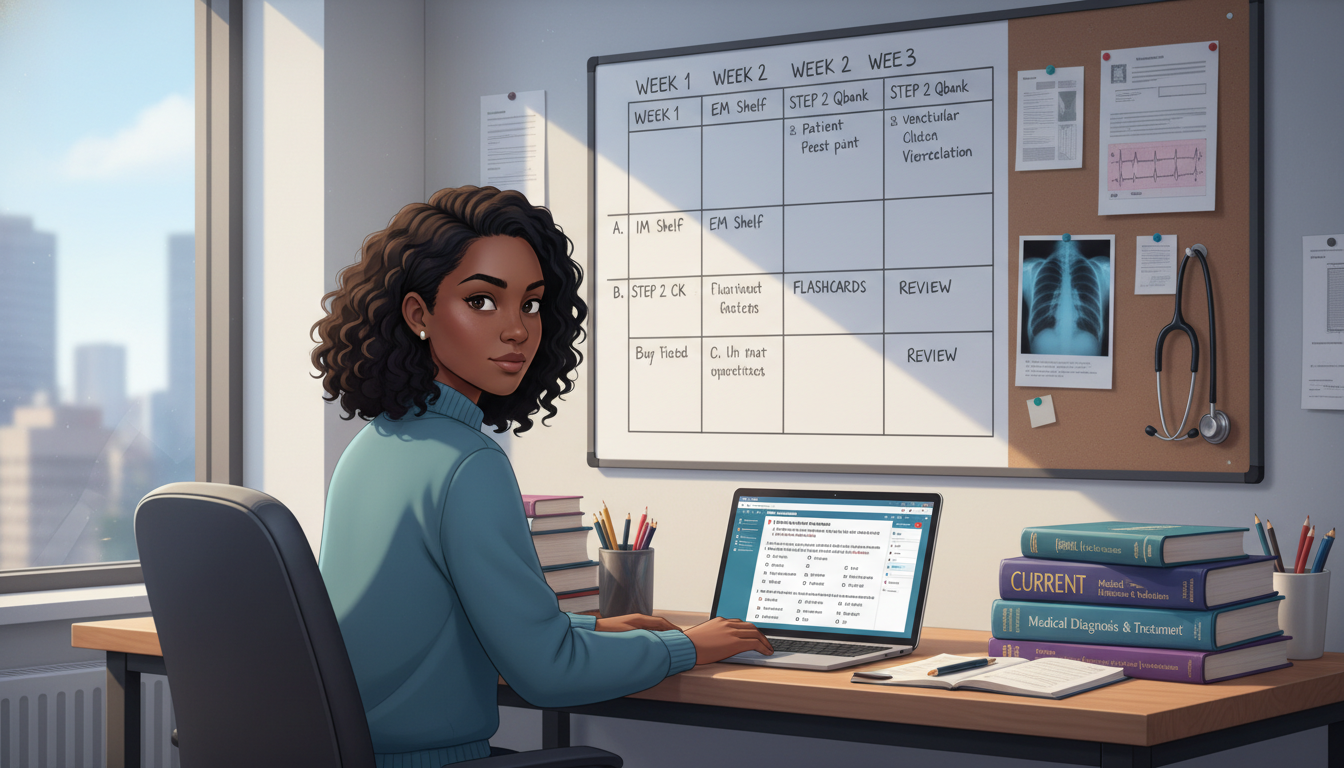
For most students, a solid Step 2 CK preparation window is 8–12 weeks of focused studying, often overlapping with or following core clinical rotations.
Consider this phased approach:
Foundation Phase (3–4 weeks)
- Main focus: UWorld (or equivalent) questions + concept review
- Goal: Re-expose yourself to all major content areas, solidify weak spots from clerkships
- Strategy: System-based or mixed blocks, depending on your learning style
Integration Phase (3–4 weeks)
- Main focus: Full-length practice exams (NBME, UWSA) + intensive review of incorrects
- Goal: Build stamina; refine test-taking; close remaining knowledge gaps
- Strategy: Switch heavily to mixed-question blocks to mimic exam conditions
Final Stretch (1–2 weeks)
- Main focus: Rapid review of high-yield topics, especially EM IM-relevant content
- Goal: Maximize recall, solidify algorithms, refine timing and mental endurance
- Strategy: Short mixed blocks, focused review notes, and summary resources
Align this with your schedule. If you’re planning EM or IM sub-internships (Sub-Is), try to protect at least 3–4 weeks of mostly dedicated study near your test date.
Step 2: Balance Question Banks and Content Review
For EM IM–oriented Step 2 CK preparation, prioritize:
- Primary QBank: UWorld for Step 2 CK – non-negotiable, aim to complete ~80–100%
- Practice Exams: NBME CCSSAs, UWSA 1 & 2, and possibly an institutional practice exam
- Content Reference: An integrated text or video resource (e.g., OnlineMedEd, Boards & Beyond, or similar) as needed for weak areas
Use a questions-first approach:
- Do 40–80 questions per day during core phases
- Prioritize timed, mixed blocks after first 2–3 weeks to simulate real testing
- Spend more time reviewing question explanations than doing new questions when necessary
Step 3: Lean into EM IM-Relevant Question Types
As an aspiring EM IM combined resident, pay particular attention to:
- Undifferentiated acute complaints (chest pain, dyspnea, syncope, abdominal pain, altered mental status)
- High-acuity management (shock, respiratory failure, status epilepticus, STEMI/NSTEMI, trauma)
- Chronic disease optimization and transitions of care (HF, COPD, diabetes, CKD, cirrhosis, anticoagulation)
Whenever you see a question that clearly mirrors EM or IM scenarios you’ll often face in residency, label it mentally:
“This isn’t just for Step 2; this is for my future practice.”
That mindset naturally drives deeper learning and better retention.

High-Yield Content Domains for EM IM-Oriented Step 2 CK Prep
Though Step 2 CK is broad, you can tilt your prep toward topics that are both high-yield on test day and high-value for EM IM combined training.
1. Acute Care and Resuscitation
Emergency medicine internal medicine physicians must excel at initial stabilization and serial management of acute conditions. For Step 2 CK:
Focus on:
- Airway and breathing
- Indications for intubation (e.g., GCS ≤8, impending obstruction, respiratory failure)
- Non-invasive ventilation vs. invasive ventilation choices
- Shock and hemodynamics
- Types: hypovolemic, cardiogenic, distributive, obstructive
- First-line management (fluids, vasopressors, inotropes)
- Recognizing subtle septic shock, obstructive shock (PE, tamponade, tension pneumothorax)
- Cardiac emergencies
- STEMI vs. NSTEMI vs. unstable angina – indications for PCI, thrombolytics, heparin
- Arrhythmias: unstable vs. stable; ACLS-based management
- Neurologic emergencies
- Stroke (ischemic vs. hemorrhagic), TIA, status epilepticus, increased ICP
On questions, you’ll often be asked to identify the “best next step in management” in a time-sensitive scenario. Train yourself to mentally think through ABCs first, then key diagnostics.
Example:
A patient arrives with acute chest pain, hypotension, and JVD, clear lungs, and electrical alternans on ECG.
- High-yield Step 2 CK thought process: This is likely cardiac tamponade; best next step is urgent pericardiocentesis, not further imaging.
This is exactly the kind of rapid decision-making both Step 2 CK and EM IM combined programs want to see you internalize.
2. Core Internal Medicine: Chronic Disease and Inpatient Management
EM IM physicians often shepherd a patient from ED resuscitation to ward or ICU management. Step 2 CK loves this continuum.
Prioritize:
- Cardiology: HF management (acute vs. chronic), valvular disease, arrhythmia work-up, anticoagulation
- Pulmonology: COPD/asthma exacerbation vs. chronic management, PE diagnosis and risk stratification, pneumonia (CAP, HAP, VAP)
- Endocrinology: DKA/HHS management, outpatient diabetes regimens, adrenal pathology, thyroid emergencies
- Nephrology: AKI vs. CKD, electrolyte disorders (esp. sodium, potassium, calcium), dialysis indications
- GI and Hepatology: Upper vs. lower GI bleed management, cirrhosis complications, pancreatitis, cholangitis vs. cholecystitis
- Infectious Diseases: Sepsis, HIV-related infections, opportunistic infections, empiric antibiotic selection
Study these not just as isolated topics, but as longitudinal problems: from ED presentation through stabilization, admission, and discharge planning.
Clinical integration example:
- ED: Patient with COPD and pneumonia in respiratory distress – NIPPV, IV antibiotics, steroids
- IM ward/ICU: Titrate O2, monitor ABGs, de-escalate antibiotics, adjust chronic inhaler regimen, plan follow-up
Step 2 CK will weave these stages into vignettes; embrace that continuity.
3. Diagnostics and Clinical Reasoning
Step 2 CK increasingly emphasizes clinical reasoning:
- Interpreting ECGs, imaging, and basic labs in context
- Choosing the single best test vs. the “nice-to-have” test
- Understanding pre-test probability and next-step testing (D-dimer vs. CT-PA, stress test vs. cath)
For an EM IM combined mindset, focus on:
- When to order CT head vs. MRI vs. no imaging
- When to get CT abdomen vs. ultrasound vs. plain films
- Rational use of D-dimer, troponins, BNP, ABGs, lactate, blood cultures
Practicing with question banks and intentionally pausing to reflect on “Why is this the single best next test?” builds a diagnostic reflex that both Step 2 CK and EM IM training rely on.
4. Ethics, Systems-Based Practice, and Communication
Dual training in EM and IM requires facility with systems-based care:
- ED boarding, ICU triage, outpatient follow-up planning
- Goals-of-care discussions, capacity assessment, end-of-life decisions
Step 2 CK frequently asks about:
- Autonomy vs. beneficence vs. nonmaleficence vs. justice
- Surrogate decision makers and advance directives
- Handling medical errors and disclosure
- Resident supervision and duty-hour issues
Don’t neglect these topics—they’re often low-effort, high-yield points if you’ve reviewed them once or twice.

Day-to-Day USMLE Step 2 Study Tactics for EM IM-Bound Students
Beyond what you study, how you study will largely determine your Step 2 CK score.
Create a Structured Daily Study Template
A balanced daily plan for 8–10 hours of focused work might include:
Morning: Timed QBank Blocks
- 1–2 blocks of 40 questions (mixed, timed)
- Simulate test conditions (no phone, minimal breaks)
Midday: Deep Review
- Thoroughly analyze missed and marked questions
- Ask: “What did I miss clinically?” not just “What fact did I not know?”
- Connect each question to EM or IM relevance when possible
Afternoon: Targeted Content Review
- Watch videos or read chapters for your weakest systems
- Create concise notes or Anki cards for recurring themes
Evening: Short Refreshers
- 10–20 quick questions or flashcards
- Brief skim of high-yield tables (e.g., antibiotic regimens, heart murmurs, shock types)
Use “EM IM Lenses” to Process Questions
While doing questions, consciously ask:
- “If this patient walked into the ED, what would I do right now?”
- “If I admitted this patient to my IM service, what would my 24–48 hour plan be?”
This dual perspective helps:
- Anchor high-yield Step 2 CK facts in real practice
- Transition smoothly between ED stabilization decisions and ward-level management
Track Patterns and Weaknesses
Keep a simple tracking list (spreadsheet or notebook) of:
- Systems you miss most frequently (e.g., neuro, ID, endocrine)
- Recurrent concepts (e.g., anticoagulation indications, ARDS criteria, cirrhosis complications)
- “Always forget” facts (e.g., specific contraindications, staging criteria)
Review this list weekly and in the final 5–7 days before your exam.
Simulate Test Day—Especially for Stamina
The real exam is long (8 blocks). For EM IM candidates who will eventually work long shifts and manage complex patients, this is your first endurance test.
In the last 3–4 weeks:
- Take at least 2–3 full-length practice exams
- Simulate real testing conditions (break schedule, meals, noise level)
- Review not only content but your performance patterns:
- Are you fading in attention in later blocks?
- Are you rushing early questions and second-guessing later?
Develop a break strategy (e.g., short breaks every 2 blocks) and a mental reset routine (deep breaths, quick posture reset) that you’ll deploy on test day.
Bridging Step 2 CK Prep with EM IM Residency Applications
Preparing for Step 2 CK is not separate from preparing for EM IM combined training and applications—it’s part of the same continuum.
Timing Your Exam Strategically
For residency applications, consider:
- Take Step 2 CK early enough to have your score ready by ERAS submission, ideally by August if you’re targeting the regular application timeline.
- If your Step 1 was weaker or borderline, aim to demonstrate clear improvement on Step 2 CK by taking it a bit earlier and giving yourself enough dedicated prep time.
Coordinate with:
- Your EM and IM clerkships/sub-internships
- Away rotations in EM IM or related sites (if you’re doing them)
You don’t want to be taking Step 2 CK in the middle of a demanding ICU month if that’s avoidable.
Using EM and IM Rotations to Boost Step 2 CK Prep
Your core clinical rotations and sub-Is are an important part of USMLE Step 2 study:
On ED shifts:
- Practice rapidly forming differential diagnoses for undifferentiated complaints
- Ask attendings to walk you through “best next steps” for nuanced cases
- Translate each case you see into a Step 2 CK–style question in your head
On IM wards:
- Write meticulous assessment-and-plans that include guideline-based care
- Think longitudinally: admission, in-hospital course, discharge planning
- Reflect on “What question would the USMLE ask about this case?”
Capturing 1–3 “mini learning points” from each shift and reviewing them later reinforces material far more effectively than passive reading.
Storytelling in Your Application: Link Step 2 CK and EM IM
A strong Step 2 CK score, combined with:
- Strong EM and IM evaluations
- Letters of recommendation from both EM and IM faculty
- Clinical experiences that bridge ED and inpatient care
…tells a consistent story: you’re well-prepared for the intellectual and clinical demands of EM IM combined training.
If you perform significantly better on Step 2 CK than Step 1, you can also briefly highlight this as evidence of growth and adaptation in your personal statement or interviews—especially if you’ve aligned your studying with real-world EM IM care.
Frequently Asked Questions (FAQ)
1. How high does my Step 2 CK score need to be for EM IM combined programs?
There is no single cutoff score, and programs consider your entire application. However, because EM IM combined training is demanding, aim for a Step 2 CK score that is at least in the range of competitive categorical EM or IM applicants, with upward trajectory from Step 1 if possible. Think of your score as part of a package that should align with strong clinical evaluations and compelling EM IM–relevant experiences.
2. Should I focus my studying more on emergency medicine or internal medicine topics?
You shouldn’t choose one over the other. Step 2 CK tests a broad clinical foundation. For EM IM aspirants, your goal is integration:
- ED-style stabilization, triage, and early decision-making
- IM-style diagnostic depth, guideline-based chronic disease management, and discharge planning
When in doubt, ask: “How would an EM IM physician handle this from door-to-discharge?” That mindset ensures you cover both domains.
3. How many practice NBMEs or practice exams should I take?
Most students aiming for EM IM should take at least:
- 2–3 NBME practice exams
- 1–2 UWorld self-assessments (UWSAs)
Space them over the last 4–6 weeks of preparation. Use them to:
- Estimate your performance range
- Identify remaining weaknesses
- Build test-day stamina
Reviewing incorrect and borderline questions carefully is often as valuable as the score itself.
4. What if my Step 1 was pass but not strong—can Step 2 CK still help me match EM IM?
Yes. Since Step 1 is now pass/fail or may not be highly differentiating, a strong Step 2 CK score is one of the best ways to demonstrate academic readiness. Paired with:
- Solid clinical grades
- Strong letters from EM and IM faculty
- Thoughtful articulation of why EM IM combined fits your goals
…a strong Step 2 CK can significantly strengthen your competitiveness for EM IM combined programs.
By approaching your USMLE Step 2 study with an EM IM combined lens—focusing on both resuscitation and longitudinal care, acute decisions and chronic management—you’re not only preparing for a high Step 2 CK score, but also building the cognitive framework you’ll use daily as a dual-boarded emergency medicine internal medicine physician.