
Understanding Step 2 CK in the Context of Family Medicine
USMLE Step 2 CK increasingly carries as much—sometimes more—weight than Step 1, especially since Step 1 became Pass/Fail. For applicants targeting a family medicine residency, a strong Step 2 CK score can:
- Demonstrate clinical readiness for internship
- Compensate, to some degree, for a marginal Step 1 outcome
- Strengthen your FM match application at both community and academic programs
- Signal that you can handle the knowledge breadth required in primary care
Family medicine residency programs care deeply about real-world clinical judgment and outpatient competence. Step 2 CK is the exam that most closely reflects this, so your USMLE Step 2 study plan should be tailored with primary care in mind.
Why Step 2 CK Matters So Much for Family Medicine
Breadth over depth
Family medicine demands comfort across adult medicine, pediatrics, OB/Gyn, psychiatry, geriatrics, and minor procedures. Step 2 CK heavily tests exactly this broad primary care spectrum.Focus on ambulatory care
While the exam includes inpatient scenarios, a substantial portion of questions are outpatient, prevention-focused, and continuity-of-care oriented—core elements of a family medicine residency.Timing with applications
Many programs will review your Step 2 CK score during the FM match selection process. A strong score available early in ERAS season can:- Push you into the interview pool at more competitive programs
- Offset weaker areas in your application (e.g., slightly lower GPA, fewer research activities)
Board exam predictor
Program directors view Step 2 CK performance as a predictor for:- ABFM board pass rates
- In-training exam performance
- Ability to synthesize and apply clinical information quickly
Target score guidance for family medicine:
These are not strict cutoffs, but rough ranges in recent match cycles:
- 230–240+ Step 2 CK score: Very competitive for most family medicine residency programs, including many academic centers.
- 220–230: Solid, comfortably within range for the majority of FM programs.
- 210–220: Still viable for FM match, especially with strong clinical evaluations, letters, and personal statement.
- Below ~210: You still have a realistic shot in family medicine, but you must strengthen every other part of your application and apply broadly.
Your Step 2 CK preparation should aim above the minimum you think you “need.” It’s easier to maintain momentum once you build it than to scramble to “rescue” your score later.
Blueprint-Driven Study: What Step 2 CK Actually Tests (With a Family Medicine Lens)
Before choosing resources or building a schedule, align your USMLE Step 2 study with the exam blueprint. For family medicine residency applicants, this alignment naturally favors:
- Outpatient, chronic disease management
- Preventive medicine and screening
- Women’s health and prenatal/postpartum care
- Pediatric development, immunizations, and common conditions
- Behavioral health and substance use
High-Yield Content Areas Overlapping with Family Medicine
Below are key domains you should emphasize, with examples of how they appear both on Step 2 CK and in a family medicine residency:
1. Preventive Medicine & Health Maintenance
Expect frequent questions on:
- Screening guidelines:
- CRC screening: start ages, intervals, test types
- Breast, cervical, and lung cancer screening
- AAA screening in smokers
- Immunizations:
- Adult catch-up vaccines (Tdap, shingles, pneumonia)
- Pediatric schedule and special populations (asplenia, immunosuppression)
- Lifestyle counseling:
- Smoking cessation, obesity management, exercise prescriptions
In family medicine residency, you’ll do these tasks daily. Build a concise summary sheet (“preventive medicine at a glance”) early in your Step 2 CK preparation and keep revisiting it.
2. Chronic Disease Management
High-yield chronic conditions:
- Diabetes: diagnostic thresholds, treatment intensification, complication screening
- Hypertension: treatment thresholds, medication selection for comorbidities
- Hyperlipidemia: risk calculators, statin indications
- COPD and asthma long-term management
- Chronic kidney disease staging and follow-up
- Heart failure, CAD, atrial fibrillation in the outpatient setting
Step 2 CK loves questions where the “best next step” is optimizing chronic disease control rather than dramatic interventions. Think like a continuity clinic physician, not an ICU fellow.
3. Acute Complaints in the Outpatient and ED Settings
Common Step 2 CK scenarios that mirror urgent-care-type visits:
- Chest pain: risk stratification, initial workup, ruling out emergencies
- Abdominal pain: distinguishing surgical from nonsurgical etiologies
- Back pain: red flags vs benign mechanical
- Headache: when to image, when to reassure
- URI, otitis media, sinusitis, and pharyngitis: appropriate antibiotic use
These align closely with family medicine residency continuity and urgent care clinics. As you study, constantly ask: “What would I do as the patient’s primary care physician?”
4. Women’s Health and OB in the FM Context
Even if you won’t do an OB-heavy family medicine residency, Step 2 CK expects:
- Prenatal care schedules and screening
- Management of gestational diabetes, HTN disorders, and Rh incompatibility
- Contraception counseling and selection
- Common gynecologic issues: abnormal uterine bleeding, fibroids, endometriosis, PID
- Postpartum follow-up and breastfeeding issues
Family physicians often serve as primary prenatal providers, especially in rural or full-scope practices. OB/Gyn is a major testing domain and a clear Step 2 CK score booster if you get comfortable with algorithms.
5. Pediatrics in Family Medicine
Step 2 CK pediatric questions often center around:
- Developmental milestones and screening
- Pediatric immunization schedule and catch-up plans
- Common pediatric infections (otitis, bronchiolitis, croup, pneumonia)
- Failure to thrive, childhood obesity, and adolescent medicine
- Pediatric rash + fever differentials
In many family medicine residencies, you’ll follow kids from birth to adolescence. Use your Step 2 CK prep to master the pediatric well-child visit structure.
6. Psychiatry and Behavioral Health
Critical not only for the exam but for daily family medicine practice:
- Major depressive disorder, GAD, panic, PTSD
- Substance use disorders and motivational interviewing
- Suicide risk assessment and emergency management
- ADHD and behavioral concerns in children
- Managing psychotropic medications and side effects in the primary care setting
Many FM programs directly assess comfort with outpatient psychiatry. Use Step 2 CK questions as practice for nuanced, real-world decision-making in these areas.
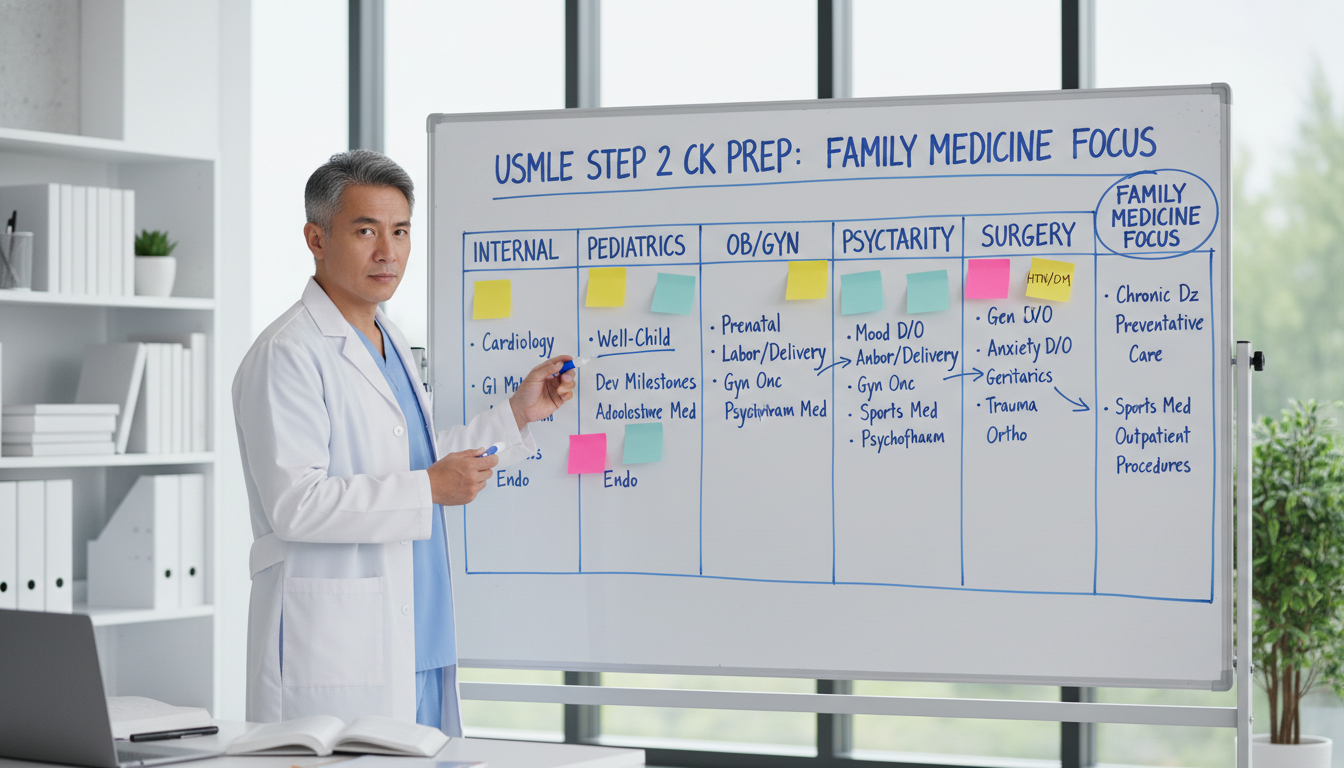
Building a High-Yield Step 2 CK Study Plan Tailored to Family Medicine
Your Step 2 CK preparation timeline will depend on when you take the exam relative to your clinical rotations and FM match timeline. Below are structures for two common situations.
Scenario 1: Dedicated Study Period (6–8 Weeks)
Best for: Students taking Step 2 CK after core clerkships, before or early in application season.
Core elements:
- 6–8 hours/day of focused USMLE Step 2 study
- Question bank–centered approach
- Systematic review of weaker clerkships or topics
Sample 7-week plan (adapt as needed):
Weeks 1–2: Foundation + Internal Medicine Emphasis
- Daily:
- 60–80 UWorld questions (or similar) in timed, random blocks
- Review all explanations, making short, structured notes
- Content:
- Focus on internal medicine, EKGs, common labs, and high-yield inpatient scenarios
- Start a “core family medicine” notebook: chronic disease algorithms, preventive care charts
- Integration:
- Identify patterns where primary care management differs from inpatient algorithms
Weeks 3–4: OB/Gyn + Pediatrics + Psychiatry
- 80+ questions/day, weighted toward OB, peds, and psych
- Dedicate specific days:
- 2 days/week OB/Gyn
- 2 days/week Peds
- 1 day/week Psych/Neuro
- Remaining days: mixed review
- Build concise summary tables:
- Prenatal care timeline
- Vaccine schedules (kids + adults)
- Screening guidelines
Week 5: Full-Scale Mixed Review
- 2 blocks (40–80 questions) timed, random, daily
- One day each week: simulated test day (4–6 blocks back-to-back)
- Start working through at least one NBME practice exam
Week 6: Targeted Weakness Fixing
- Use performance analytics from UWorld/NBME:
- Identify bottom 3–4 categories and allocate 60–70% of time to them
- Revisit tricky topics from a family-medicine angle:
- Preventive care
- Chronic disease long-term plans
- Ambulatory complaints
Week 7: Taper + Exam Readiness
- 40–60 questions/day, mainly mixed, to keep stamina and rhythm
- 1–2 more practice NBMEs or UWSA
- Light content review of core charts, especially preventive care, OB timelines, and pediatric milestones
Scenario 2: Studying During Clinical Rotations (Integrating with Family Medicine)
Best for: Students taking Step 2 CK late in third year or during sub-internships, or those on a family medicine rotation.
Strategy:
- 20–40 questions/day on busy rotation days
- 40–60 questions/day on lighter days/weekends
- Focus questions on your current rotation:
- On an FM rotation: heavy outpatient, IM, peds, psych, and OB topics
- Weekly system:
- Pick 2–3 high-yield topics each week to deep dive (e.g., diabetes, HTN, prenatal care)
Leverage your FM rotation for Step 2 CK:
- After clinic sessions, quickly review:
- One topic from each interesting patient
- The USMLE-style management algorithm for that condition
- Ask attending physicians:
- “How would this condition appear on Step 2 CK?”
- “What’s the most critical decision point in this patient’s care?”
This approach improves both your test performance and your value as a future family medicine resident.
Choosing Resources and Using Them Strategically
The number of possible resources can be paralyzing. For family medicine–oriented Step 2 CK preparation, depth is less important than mastery of a few high-yield tools.
Essential Resources
Primary Question Bank (QBank) – Non-negotiable
- Examples: UWorld, AMBOSS
- Why it matters:
- Closest thing to the real exam format
- Best single indicator of readiness
- Strategy:
- Aim to complete at least 75–100% of a single QBank
- Do blocks in timed mode to simulate exam conditions
- Review explanations thoroughly—this is where your learning truly happens
NBME Practice Exams & UWSAs
- Use them to:
- Gauge readiness
- Adjust your Step 2 CK study focus
- Timing:
- First NBME 4–5 weeks before the exam
- Another 2–3 weeks before
- Consider a UWorld Self-Assessment 1–2 weeks before
- Use them to:
Concise Review Resource
- For example: high-yield Step 2 lecture series or notes that summarize:
- Core internal medicine
- OB/Gyn
- Peds
- Psych
- Use these to:
- Reinforce QBank learning
- Fill small knowledge gaps quickly
- For example: high-yield Step 2 lecture series or notes that summarize:
Supplemental, Family-Medicine-Focused Resources (Optional but Helpful)
Outpatient/Primary Care Guides
- Some schools have in-house family medicine handbooks
- FM board review question sets can help your outpatient decision-making mirrors Step 2 CK logic
Guideline Summaries
- Up-to-date recommendations for:
- Diabetes
- HTN
- Hyperlipidemia
- Preventive screening
- You don’t need full guidelines; use short, exam-focused summaries.
- Up-to-date recommendations for:
How Many Resources Are Too Many?
If using a resource prevents you from completing your main QBank, it’s too much. Mastering one strong QBank + a concise review source typically produces a better Step 2 CK score than dabbling in four or five resources.

High-Yield Strategies: From Study Tactics to Exam-Day Execution
Make Your QBank Work for You
Timed, not tutor mode (most of the time)
Family physicians often make decisions under time pressure. Replicate that:- Do most question blocks timed and mixed.
- Reserve tutor mode for:
- Initial learning in a very weak area
- Post-block review of particularly confusing questions
Systematic Review of Explanations When reviewing a question, ask:
- Why is the correct answer right?
- Why is each wrong answer wrong?
- Could I have answered correctly faster?
- Is there a guideline or algorithm I should write down?
Keep notes short and focused:
- One or two lines per concept
- Few high-yield tables/charts (not long paragraphs)
Track Patterns, Not Just Facts Look for Step 2 CK patterns that you will also use daily in family medicine:
- When to treat vs watchful waiting
- When to screen and how often
- First-line vs second-line treatments
- How a condition’s management differs inpatient vs outpatient
Balancing Breadth and Depth
Because Step 2 CK shares FM’s “cover everything” philosophy, you must:
- Go broad with QBank exposure: see as many different vignettes as possible
- Go deep only on:
- High-frequency topics
- Personally weak or unfamiliar concepts
For example:
- Deep dive: diabetes algorithms, prenatal care, chest pain evaluation
- Quick pass: rare vasculitides, esoteric genetic syndromes
Integrating Clinical Experience into Your Step 2 CK Prep
Use MCQs to reinforce what you see on rotations:
- After a busy family medicine clinic:
- Do 10–15 questions on topics seen that day (HTN, DM, depression, URIs).
- Before a day on OB or Peds service:
- Warm-up with a short block on the relevant subject.
Treat every patient encounter as potential exam content. Then cement it with a USMLE Step 2 study session soon afterward.
Exam-Day Strategy and Mindset
Time Management
- Aim for:
- ~1 minute 15 seconds per question
- If stuck:
- Eliminate obviously wrong answers
- Make your best guess based on most likely patient scenario
- Mark and move on—don’t sink 3 minutes into a single stem
- Aim for:
Think Like a Family Physician On ambiguous questions, ask:
- What is the safest, most evidence-based next step?
- Does the patient need:
- Emergency intervention?
- Urgent workup?
- Outpatient follow-up or lifestyle changes?
- Reassurance only?
Common Pitfalls to Avoid
- Ordering exhaustive imaging when watchful waiting is safer
- Overusing antibiotics for viral illnesses
- Ignoring clear red flags needing immediate escalation
- Forgetting age-appropriate screening or immunizations
Mental and Physical Preparation
- Maintain a regular sleep schedule for at least a week before
- Practice 1–2 full-length test days to build stamina
- Plan logistics:
- Route to test center
- Meals and snacks
- Break schedule strategy (short breaks between blocks, one longer break midway)
Aligning Your Step 2 CK Performance With Your Family Medicine Residency Goals
Your Step 2 CK preparation doesn’t exist in a vacuum. It’s a bridge between third-year clerkships and your future family medicine residency.
Using Step 2 CK to Strengthen Your FM Match Application
Signaling Primary Care Strength A solid Step 2 CK score, especially with strong performance in IM, OB, Peds, and Psych, signals to programs:
- You are well prepared for the wide scope of family medicine
- You can manage continuity and preventive care responsibilities
Timing the Exam with ERAS
- If possible, take Step 2 CK early enough that your score is available when applications are reviewed (often by October).
- If you had a weaker Step 1:
- A significantly higher Step 2 CK score can help reassure programs.
Discussing Step 2 CK in Your Application You generally don’t need to explicitly discuss your Step 2 CK score unless:
- It represents a strong upward trend you want to highlight (e.g., Step 1 near pass/fail line but Step 2 CK >230).
- You had an unexpectedly low score and want to contextualize (e.g., major illness), though this should be done carefully and briefly.
Translating Your Study Habits Into Residency Success
The habits you build for Step 2 CK preparation mirror those needed for a successful family medicine residency:
- Efficient information synthesis
- Prioritizing among multiple problems in a 15–20 minute visit
- Staying current with guidelines
- Managing time and cognitive load under pressure
Treat your Step 2 CK prep not just as exam cramming, but as early training for being a competent, confident family physician.
FAQs: Step 2 CK and Family Medicine Residency Applications
1. What Step 2 CK score do I need for family medicine residency?
Most applicants who successfully match into family medicine residency programs score somewhere in the 210–230 range. A Step 2 CK score ≥230 will make you competitive at a broad range of programs, including many academic centers. However, family medicine evaluates the entire application holistically—clinical evaluations, letters, personal statement, and evidence of commitment to primary care can offset a somewhat lower score.
2. If my Step 1 was low, can Step 2 CK rescue my FM match chances?
A significantly higher Step 2 CK score can absolutely help, especially since family medicine values clinical performance and growth. For example:
- Step 1 near pass threshold, Step 2 CK in the 220s or 230s shows clear improvement.
- Programs may focus more on your clinical clerkship performance and Step 2 CK than on Step 1.
You’ll still want to apply broadly and strengthen other components of your application (FM letters, continuity clinic experiences, community involvement), but a strong Step 2 CK can substantially improve your trajectory.
3. How should I balance Step 2 CK study with a busy family medicine rotation?
Prioritize consistency over volume:
- Aim for 20–40 questions/day on rotation days.
- Use weekends to do longer blocks and more thorough review.
- Align your questions with what you’re seeing in clinic:
- If your day was heavy in diabetes and HTN, do a focused internal medicine/outpatient block afterward.
- Use brief down-time in clinic to review flashcards or short guideline summaries related to preventive care and chronic disease.
This approach reinforces both your clerkship performance and your USMLE Step 2 study simultaneously.
4. Is it worth delaying my exam to get a higher Step 2 CK score for FM applications?
It depends on:
- How far you are from your target score (based on practice NBMEs/UWSAs)
- How much additional dedicated time you can realistically get
- Application timelines (ERAS, FM match deadlines)
Consider delaying if:
- Your practice scores are significantly below your goal range (e.g., <200 when aiming for ≥220).
- You can secure at least 3–4 additional weeks of focused study.
- The delay still allows your official score to be reported before most programs make interview decisions (usually by October–November).
Discuss timing with your dean’s office or a trusted advisor; different schools and programs may have specific recommendations.
By approaching your Step 2 CK preparation through a family medicine lens—prioritizing outpatient care, prevention, and broad clinical competence—you not only position yourself for a stronger Step 2 CK score, but also build the very skills you’ll rely on daily as a future family physician.