
Understanding Step 2 CK as a Caribbean IMG Aiming for Psychiatry
For a Caribbean IMG targeting psychiatry residency, USMLE Step 2 CK is more than just another hurdle—it’s your single strongest opportunity to prove you can excel in U.S. clinical medicine. With Step 1 now pass/fail, program directors, especially in psychiatry, lean heavily on your Step 2 CK score, clinical evaluations, and letters to gauge your readiness.
Because the phrase “Caribbean medical school residency” still triggers concerns about educational variability, a strong Step 2 CK performance can reassure programs that you have the knowledge, discipline, and clinical reasoning to succeed. This is especially true for competitive programs and for those who want to highlight a strong SGU residency match or similar outcomes from other Caribbean schools.
For psychiatry, Step 2 CK matters in three specific ways:
Screening and Interview Offers
- Many psychiatry programs now use Step 2 CK score thresholds to decide who gets an interview.
- A high score can offset a less competitive Step 1 or medical school pedigree.
Evidence of Clinical Reasoning in Behavioral Health
- Step 2 CK tests applied clinical knowledge; psychiatry content is integrated into medicine, neurology, pediatrics, OB/GYN, and emergency care.
- Solid performance in psych-heavy items demonstrates the kind of reasoning psychiatry programs value.
Timing Relative to ERAS and the Psych Match
- Having your Step 2 CK result ready before ERAS submission strengthens your application and can influence initial interview offers.
- For Caribbean IMGs, late scores may delay or reduce interview opportunities in an already competitive psych match.
Target Score Ranges for Psychiatry Applicants
While every situation is unique, realistic Step 2 CK targets for psychiatry are:
- “Safe and solid” target: 235–245
- Competitive for many academic/community programs: 245–255
- Helpful for strong university or coastal programs: 255+
If your Step 1 was low or borderline, aiming toward the higher end of these ranges is wise. If you did well on Step 1, Step 2 CK is your chance to confirm that performance.
Step 2 CK Content Emphasis for Psychiatry-Bound Caribbean IMGs
Step 2 CK is not a psychiatry exam, but psychiatry topics appear everywhere: primary care, ED, neurology, OB, pediatrics, and ethics. As a psychiatry-focused Caribbean IMG, you must master both:
- Core high-yield medicine that all residencies expect
- Psychiatry-specific clinical scenarios, including emergency and consult-liaison situations
High-Yield Content Domains (With Psychiatry Relevance)
Internal Medicine & Neurology (Largest Portion of the Exam)
- Delirium vs dementia vs primary psychosis
- Neurocognitive disorders: Alzheimer disease, vascular dementia, Lewy body dementia, frontotemporal dementia
- Neurologic disease with psychiatric overlap: epilepsy, brain tumors, MS, Parkinson disease, Wilson disease, Huntington disease
- Metabolic and endocrine causes of psychiatric symptoms (thyroid disease, Cushing, Addison, B12 deficiency, porphyria)
Psychiatry & Behavioral Sciences
- Mood disorders: MDD, bipolar I/II, cyclothymia, dysthymia
- Anxiety disorders, OCD, PTSD, acute stress disorder, phobias, panic disorder
- Schizophrenia spectrum and other psychotic disorders
- Personality disorders: borderline, antisocial, narcissistic, avoidant, dependent, OCPD, schizoid/schizotypal
- Substance use disorders, intoxication/withdrawal syndromes, medication-assisted treatment (methadone, buprenorphine, naltrexone)
- Somatic symptom disorders, factitious disorder, malingering
- Child & adolescent psych: ADHD, autism spectrum, conduct disorder, oppositional defiant disorder, Tourette
- Peripartum psychiatric conditions: baby blues, postpartum depression, postpartum psychosis
- Sleep disorders, especially those with psychiatric relevance
Pharmacology with Psychiatric Emphasis
- SSRIs, SNRIs, TCAs, MAOIs, atypical antidepressants (bupropion, mirtazapine, trazodone)
- Typical and atypical antipsychotics, side effects, monitoring (EPS, NMS, metabolic syndrome, QT prolongation)
- Mood stabilizers: lithium (toxicity, monitoring), valproate, carbamazepine, lamotrigine
- Benzodiazepines, Z-drugs, buspirone
- Drug–drug interactions (e.g., serotonin syndrome, CYP450 interactions)
Ethics, Communication, and Professionalism
Psychiatry programs watch these closely. On Step 2 CK, expect scenarios involving:- Capacity assessments and informed consent
- Suicide risk assessment and involuntary hospitalization criteria
- Confidentiality vs duty to warn/protect (Tarasoff-type situations)
- Managing difficult patient interactions, non-adherence, and boundary issues
- Reporting requirements for child abuse, elder abuse, and impaired colleagues
Emergency and Consult-Liaison Situations
- Agitation management: verbal de-escalation, medication choices (e.g., IM haloperidol + lorazepam), physical restraints
- Acute intoxication and withdrawal (alcohol, benzodiazepines, opioids, stimulants)
- Medical clearance vs psych admission
- Psych conditions in medically ill patients (e.g., depression in cancer, delirium on surgical floors)
How This Shapes Your Study Strategy
As a Caribbean IMG, your clinical exposure may be fragmented across multiple sites and health systems, so you must use Step 2 CK preparation to:
- Standardize your clinical reasoning to U.S. exam expectations
- Fill gaps in psych-adjacent medicine (endocrinology, neurology, geriatrics, OB)
- Learn U.S.-specific guidelines (suicide risk protocols, involuntary admission rules, controlled substance prescribing norms)

Building a Step 2 CK Study Plan (3–6 Months) for Psychiatry-Focused Caribbean IMGs
Your plan should reflect three realities of Caribbean medical education:
- Clinical rotations may be geographically scattered and academically inconsistent.
- Many peers are also preparing for the psych match, so you’re competing within a strong IMG cohort.
- You often need to balance Step 2 CK preparation with electives, research, or home responsibilities.
Below is a structured framework you can adapt.
Step 1: Establish Your Timeline and Anchor Dates
Key dates to consider:
- Desired ERAS submission year (for the psychiatry residency application cycle)
- Target Step 2 CK exam date (ideally 1–3 months before ERAS opens)
- Score report timing (results typically in ~2–4 weeks)
For example, if you aim to apply for the September psych match cycle:
- Take Step 2 CK by end of June or early July
- Begin dedicated study 3–4 months prior (March–April)
Step 2: Baseline Self-Assessment
Within the first 1–2 weeks:
- Do 1–2 timed blocks (40 questions each) of your chosen QBank (e.g., UWorld)
- Take a baseline NBME (or practice exam from another reputable source) if possible
Use these results to:
- Identify weak systems: e.g., internal medicine, neurology, OB/GYN
- Identify weak psych areas: neurocognitive, substance use, emergency psych, ethics
- Decide if you need a longer runway (e.g., 5–6 months instead of 3–4)
Step 3: Core Resources for Step 2 CK Preparation
Recommended for most Caribbean IMGs:
Primary QBank (non-negotiable)
- UWorld is the standard for USMLE Step 2 study. Treat it as a learning resource, not a test.
- Aim to complete 100% of the questions, ideally with review of incorrects.
Comprehensive Review Book or Online Resource
- An integrated Step 2 CK book (e.g., Master the Boards, Step Up to Medicine plus a dedicated psych review, or an all-in-one online resource)
- Ensure it has strong sections on psychiatry, neurology, and ethics.
Psychiatry-Specific Supplement
- A focused psychiatry review (e.g., a concise shelf review book or a psych video series) can solidify psychiatric diagnoses, pharmacology, and emergency management.
Self-Assessment Exams
- NBME practice tests (and/or UWorld self-assessments) at regular intervals.
Avoid spreading yourself too thin with many resources. For a Caribbean IMG in psychiatry, depth with one primary QBank plus a few high-yield references beats sampling everything.
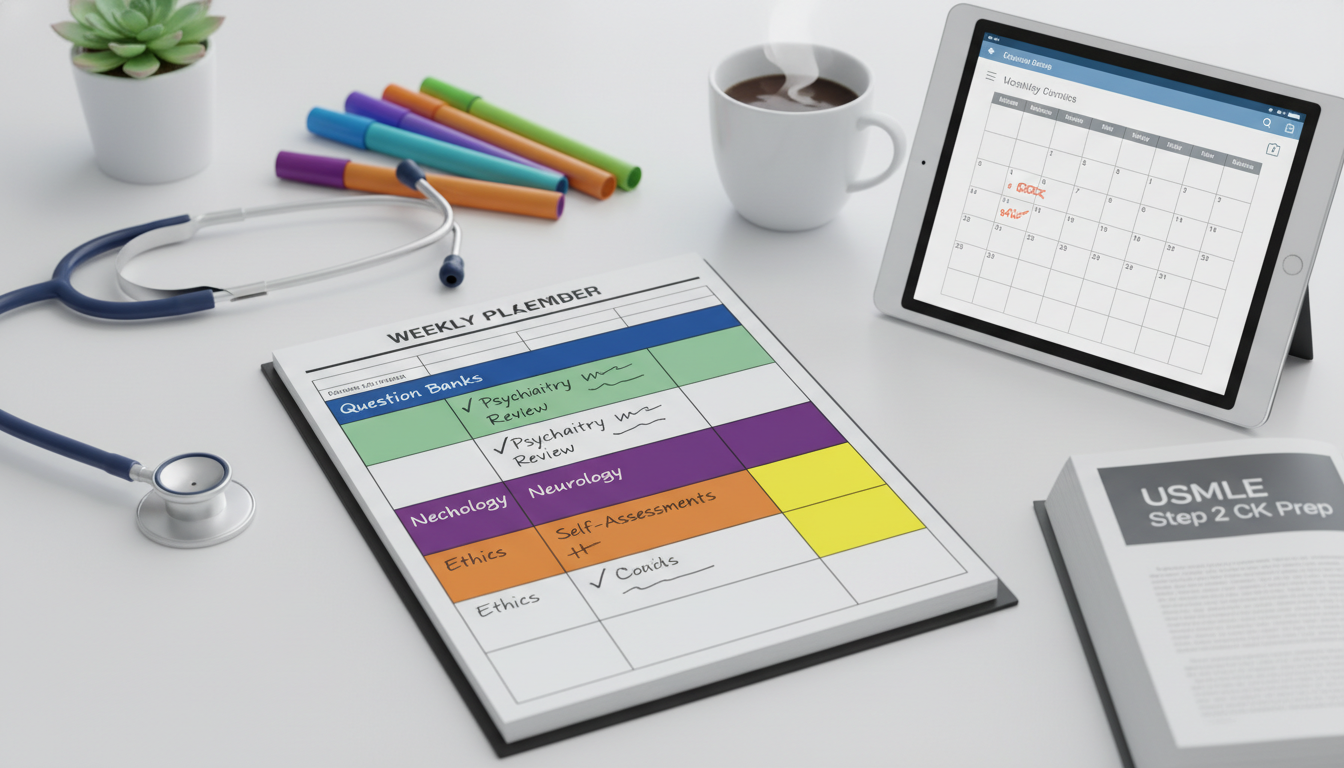
Step 4: Structured Weekly Study Template
For a 12–16 week dedicated period (adjust based on your schedule):
Weekly Goals:
- 200–280 QBank questions (about 5–7 blocks of 40 questions)
- 1–2 systems or topics reviewed in depth
- 1 half-day (or evening) focused on psychiatry-specific topics
- 1–2 hours on ethics and biostatistics
Sample Weekly Schedule (If Not on a Heavy Rotation)
Monday–Friday
- Morning: 1 timed block (40 questions), mixed or system-based (tutor mode only in early phase if needed, then switch to timed).
- Afternoon: Review explanations thoroughly (2–3 hours). Annotate a concise resource or digital notes.
- Late afternoon/evening: Targeted content review (videos or textbook) for your weakest systems.
Saturday
- Long review session for psychiatry, neurology, and ethics:
- Practice diagnostic differentials (e.g., MDD vs bipolar II vs cyclothymia)
- Review medication side effects, black box warnings, and drug interactions
- Ethics and communication questions
- Long review session for psychiatry, neurology, and ethics:
Sunday
- Lighter review / catch-up or half day off to prevent burnout.
If You’re on Core or Elective Rotations
- Reduce question load to 20–40 questions per day during busy weeks.
- Use short time blocks: 10–15 questions during breaks, commute (if possible), or between patients.
- Use weekends for 2 full blocks plus a longer review session.
Step 5: Integrating Psychiatry Into Your Rotation Schedule
As a Caribbean IMG, your psychiatry rotation (if well-organized) can double as real-time Step 2 CK preparation:
On psych rotations:
- Read one topic per day that relates to a patient you saw (e.g., schizophrenia, bipolar disorder, anorexia nervosa).
- Look up USMLE-style management algorithms after each clinic or ward day.
- Practice mini self-quizzes:
- “What diagnoses must I rule out first?”
- “What is the safest initial medication?”
- “How would this present as a Step 2 vignette?”
On internal medicine, neurology, or emergency rotations:
- Focus on psych–med overlap: delirium, substance misuse, suicide risk, dementia workup, withdrawal protocols.
Your goal is to think like a psychiatrist in every rotation while still mastering the core medicine Step 2 CK expects.
Using Question Banks, NBMEs, and Step 2 CK Scores Strategically
QBank Strategy for Caribbean IMGs
To impress psychiatry program directors and strengthen your Caribbean medical school residency chances, your QBank strategy should be deliberate:
First Pass: Learning Phase
- Mixed or system-based blocks (either is fine; some prefer system-based early, mixed later).
- Start with tutor mode if your baseline is weak, then transition to timed to simulate the exam.
- Focus on understanding why each option is right or wrong, especially with psych-related items:
- E.g., why lamotrigine is preferred for bipolar depression vs valproate for acute mania.
Tag and Review Psychiatry and Ethics Questions
- Create custom QBank tags for psychiatry, neurology, ethics, and communication.
- Re-do these before the exam to ensure high yield retention in your target specialty.
Second Pass or Incorrects Review
- 4–6 weeks before the exam, start a second pass of incorrect and marked questions.
- Focus on repeated error patterns: misreading questions, missing key buzzwords (e.g., postpartum timeline), or consistently missing certain diagnoses.
Self-Assessments and Readiness Checks
Plan 3–4 self-assessments:
- First NBME: 8–10 weeks before your exam
- Second NBME or UWSA: 4–6 weeks before
- Final 1–2 Self-Assessments: 1–3 weeks prior
Use them to:
- Adjust timing: If scores are not in your target Step 2 CK score range, consider delaying the exam.
- Refine your study list: Focus on the areas you consistently miss (e.g., specific endocrine diseases masquerading as depression).
- Develop test stamina: Take at least a couple of practice exams in one sitting to mimic exam day.
Many psychiatry residency programs will not openly state a hard cutoff, but a consistent pattern of NBME/UWSA scores near or above your target is strong evidence you’re ready and can achieve a psych-competitive outcome.
Exam-Day Strategy and Psychiatry-Specific Pitfalls
Structuring Your Exam Day
Step 2 CK is 9 hours long (eight 60-minute blocks). To avoid cognitive fatigue:
- Plan short breaks between blocks, and one longer break for food and hydration.
- Avoid over-caffeinating early in the day; you need sustained focus through the last block.
- Practice your break strategy during full-length practice exams.
Approach to Questions With Psychiatric Content
Clarify Whether the Presentation Is Primary Psychiatric vs Secondary to Medical Illness
- Consider “red flags” for medical causes: acute onset, fluctuating course, autonomic instability, abnormal vitals, focal neuro deficits, recent medication changes or substance use.
Use Time Anchors
- MDD: ≥ 2 weeks
- Schizophrenia: ≥ 6 months
- Schizophreniform: 1–6 months
- Brief psychotic disorder: < 1 month
- Baby blues vs postpartum depression vs postpartum psychosis based on timing and severity.
Prioritize Safety in Management
- In suicidal patients, address immediate safety first (involuntary hospitalization, constant observation).
- In acute agitation, choose the fastest and safest pharmacologic and environmental interventions.
Ethics and Communication
- Ask: “What is the most patient-centered and legally sound step?”
- Avoid being swayed by what you’d do in a rushed clinical environment; choose the textbook-standard answer.
Common Mistakes for Caribbean IMGs on Step 2 CK
- Underestimating internal medicine and neurology, thinking psych interest alone will carry you.
- Neglecting biostatistics and epidemiology, which can be a surprisingly large question block.
- Delayed scheduling, leading to scores coming back too late to influence the psych match.
- Over-using multiple QBanks without fully digesting explanations from any of them.
Connecting Strong Step 2 CK Preparation to a Successful Psychiatry Match
A solid Step 2 CK score is one of your most powerful tools to offset biases tied to being a Caribbean IMG. It directly supports your goal of an eventual psychiatry residency and contributes to stronger outcomes like an SGU residency match or similar pathways from other islands.
Here’s how Step 2 CK preparation supports your psych match:
Score as an Objective Marker
- A competitive Step 2 CK score reassures programs that you can handle complex psychopharmacology, comorbid medical conditions, and high-volume clinical learning.
Interview Talking Point
- You can reference your Step 2 CK performance during interviews:
- “I focused heavily on understanding the medical–psychiatric interface, especially delirium, dementia, and substance use disorders, which showed in my Step 2 CK performance.”
- You can reference your Step 2 CK performance during interviews:
Consistency With Clinical Evaluations
- Strong Step 2 CK performance, especially in psychiatry-related domains, should align with strong clinical comments from your psych and internal medicine rotations.
Backup Specialty Flexibility
- If circumstances change and you consider internal medicine, family medicine, or neurology, a strong Step 2 CK score still serves you well.
FAQs: Step 2 CK Preparation for Caribbean IMGs Targeting Psychiatry
1. What Step 2 CK score should a Caribbean IMG aim for to be competitive for psychiatry residency?
For a psychiatry residency, many Caribbean IMGs should aim for at least 235–245 as a solid baseline. To be competitive at a wider range of university-affiliated or coastal programs, target 245–255+. If your Step 1 was weaker or you have academic concerns on your transcript, pushing toward the higher end of this range can significantly help your psych match prospects.
2. How early should I take Step 2 CK before applying to psychiatry residency?
Ideally, schedule Step 2 CK so that your score is available before ERAS opens—often by late June or early July of your application year. This allows programs to see your Step 2 CK score during initial screening, which is especially important for Caribbean IMGs. If life events or rotations interfere, communicate carefully in your application and consider whether a slight delay in your psych match timeline could ultimately improve your overall competitiveness.
3. Do I need special psychiatry resources beyond the usual Step 2 CK materials?
Most students can do well using a strong QBank plus a comprehensive Step 2 CK review resource. However, as a psychiatry-focused Caribbean IMG, a concise psychiatry shelf review book or a short psych video course is a valuable supplement. It strengthens diagnostic clarity, psychopharmacology, and ethics—areas psychiatry programs will expect you to understand deeply.
4. How can Step 2 CK preparation help me overcome bias as a Caribbean IMG?
Program directors are aware that Caribbean training is variable, so they rely heavily on objective metrics. A strong Step 2 CK score demonstrates that you can perform on par with, or better than, U.S. graduates. When coupled with strong letters from U.S. psychiatry rotations and a cohesive narrative about your interest in mental health, your Step 2 CK preparation becomes central to building a convincing, competitive application for psychiatry residency—even in the tight psych match environment.
By approaching Step 2 CK preparation with a focused, psychiatry-informed strategy, you transform the exam from a barrier into a major asset for your goal of matching into psychiatry as a Caribbean IMG.