
Understanding Why Step 2 CK Matters So Much for Caribbean IMGs Targeting Radiation Oncology
If you’re a Caribbean IMG aiming for a radiation oncology residency in the United States, USMLE Step 2 CK is not just another exam—it’s one of your most powerful tools to stand out.
Radiation oncology is a small, competitive specialty. Program directors see relatively few spots, many strong applicants, and a limited number of ways to compare them. As a Caribbean medical school graduate, you may already be aware that some programs are cautious about international and offshore graduates. This is exactly why your Step 2 CK score and overall USMLE Step 2 study strategy are critical.
Why Step 2 CK is especially important for Caribbean IMGs
Objective, standardized metric
In the current era, Step 1 is pass/fail. Step 2 CK remains one of the few standardized, numeric comparisons across all applicants. For a Caribbean medical school residency applicant in radiation oncology, an excellent Step 2 CK score can:- Offset bias about school pedigree
- Counterbalance an average Step 1 performance
- Support your narrative that you can perform at or above the level of U.S. graduates
Clinical competence signal
Step 2 CK focuses heavily on clinical reasoning and management. Radiation oncology is deeply multidisciplinary—requiring collaboration with medical oncology, surgery, palliative care, and primary care. A strong Step 2 CK score suggests:- You have solid foundational clinical judgment
- You can handle advanced oncologic decision-making later in residency
Timing relative to rad onc match applications
Most radiation oncology applicants apply in their 4th year (or equivalent), and program directors will often have your Step 2 CK score in hand:- A strong Step 2 CK can improve your chances of getting interviews
- If you’re applying from a Caribbean medical school, a clear upward trend (e.g., average Step 1, strong Step 2) is reassuring to programs
- Some programs require Step 2 CK for interview consideration, especially for IMGs
SGU residency match and other Caribbean schools
Data from schools like St. George’s University (SGU) and other Caribbean institutions consistently show:- Higher Step 2 CK scores correlate with stronger match outcomes across specialties
- For competitive fields like radiation oncology, successful Caribbean IMG matches almost always report very strong scores and robust clinical records
Target to aim for (general guidance, not a guarantee):
- For a Caribbean IMG hoping to be seriously competitive in radiation oncology, many advisors recommend targeting a Step 2 CK score well above the national mean—ideally in the upper quartile. While there is no fixed cutoff, aiming for a high 240s–250s+ range significantly strengthens your application.
Building a Strategic Step 2 CK Study Plan as a Caribbean IMG
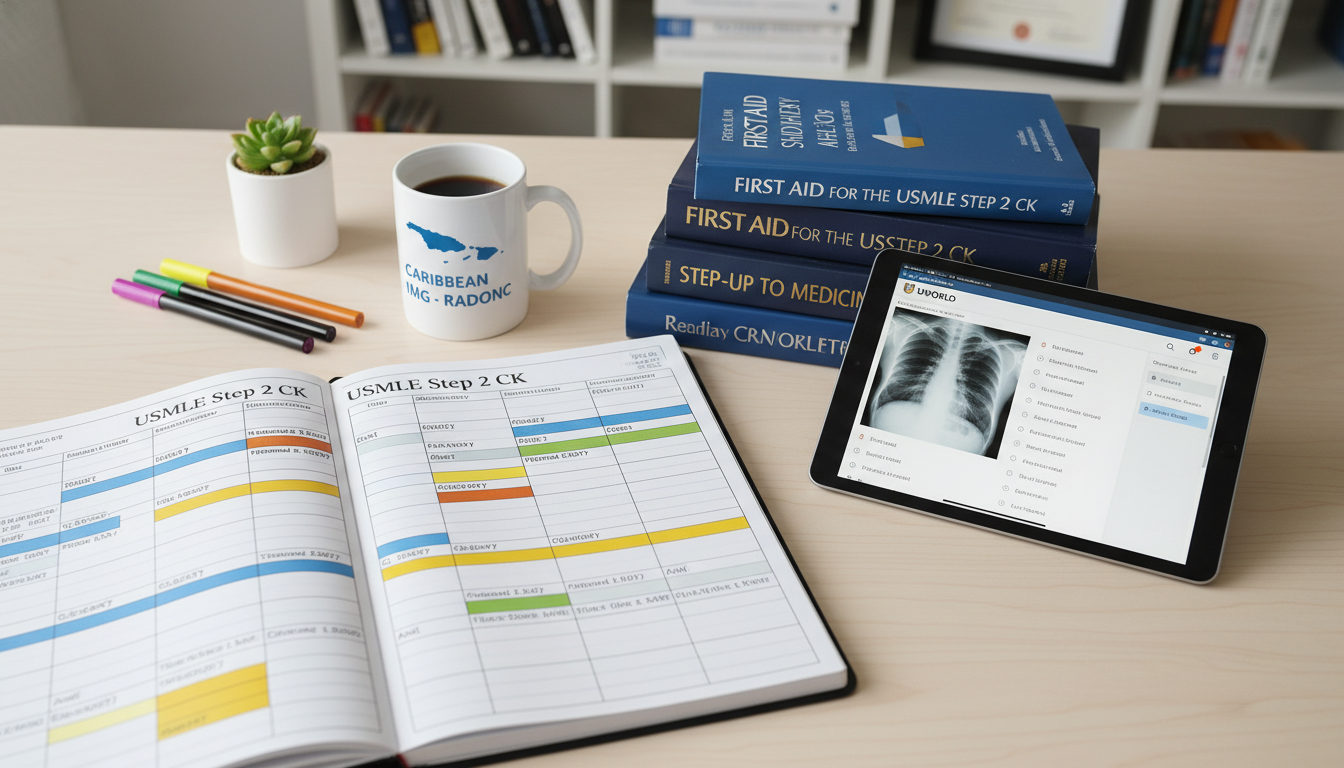
Step 1: Clarify your timeline and constraints
As a Caribbean IMG, your schedule may be more fragmented than that of a typical U.S. MD student. You might be:
- Rotating at multiple U.S. hospitals (often as a visiting student)
- Balancing visa-related concerns or travel
- Managing time zone differences during online teaching or exams
Before you plan your USMLE Step 2 study period, define:
Exam date window
- Ideally: Take Step 2 CK about 3–6 months before ERAS application opens, so your score is available early in the cycle.
- For radiation oncology, where programs are extra selective with Caribbean medical school residency applicants, earlier high scores can improve your initial screen.
Dedicated vs. non-dedicated time
- Dedicated study: 4–8 weeks with minimal clinical duties
- Non-dedicated: Studying in parallel with rotations for 3–6+ months
Personal factors
- Family responsibilities
- Financial constraints (limiting ability to extend rotations or purchase resources)
- Health and mental well-being
Step 2: Choose a core set of high-yield resources
A common pitfall is spreading your energy across too many materials. Especially for a busy Caribbean IMG, less is more but used deeply.
Core resources for Step 2 CK preparation:
Primary Question Bank (QBank)
- UWorld Step 2 CK is widely regarded as the gold standard.
- Strategy:
- Aim to complete 100% of the questions, ideally with 1 full pass and a partial second pass if time allows.
- Use tutor mode early on, then transition to timed blocks as your test date approaches.
- Track performance by system and discipline to identify weak areas.
Secondary QBank (Optional)
- If you finish UWorld early or prefer additional practice, consider adding a secondary QBank (e.g., Amboss).
- Priority should remain depth of learning from UWorld, not just question count.
Clinical Knowledge Text / Review Book
Common options:- “Master the Boards” Step 2 CK
- “Step-Up to Medicine” (especially for Internal Medicine-heavy topics)
Use these as references, not primary vehicles. The bulk of your USMLE Step 2 study should be QBank-driven.
NBME and Official Practice Exams
- Use NBME Step 2 CK practice exams and the UWSA (UWorld Self-Assessment) forms to:
- Benchmark progress
- Calibrate your expected Step 2 CK score
- Identify remaining knowledge gaps
- Use NBME Step 2 CK practice exams and the UWSA (UWorld Self-Assessment) forms to:
Step 3: Build a realistic study schedule
For a Caribbean IMG splitting time between rotations and Step 2 CK preparation, consider these structured approaches:
Example 3-month non-dedicated schedule (during clinical rotations):
- Weekdays:
- 1–2 blocks of 40 questions/day (timed)
- 1–1.5 hours daily reviewing explanations and annotating notes
- Weekends:
- 2–3 question blocks/day
- Consolidated review of weak topics from the week
- Short focused reading from high-yield notes
Example 6–8 week dedicated schedule:
- 6 days/week, 1 lighter day:
- 2–3 QBank blocks (80–120 questions/day)
- 3–4 hours of explanation review + targeted reading
- 30–60 minutes for flashcards or spaced repetition
- Weekly:
- 1 practice exam (especially in the final 4 weeks)
- Adjust next week’s plan according to your weakest systems
Step 4: Integrate your clinical rotations into Step 2 CK study
Many Caribbean medical schools place students in U.S.-based core rotations; use them to your advantage:
Internal Medicine rotations
- Prime time for cardiovascular, pulmonary, renal, endocrine, and infectious disease questions.
- Example: After seeing a patient with DVT, review UWorld questions on venous thromboembolism that evening.
Surgery and OB/GYN
- Systematically tie your cases to UWorld blocks in those disciplines.
- For instance, a cholecystitis patient is an opportunity to review all acute abdomen algorithms in your QBank.
Pediatrics and Psychiatry
- These are frequently underemphasized by IMG students but heavily tested.
- Allocate dedicated mini-blocks (e.g., 10–20 questions daily) for these specialties during relevant rotations.
Prioritizing Content Areas for Future Radiation Oncologists

Radiation oncology is cancer-focused, but Step 2 CK is broadly clinical. Still, you can align your preparation with the clinical foundations of oncology.
Core Step 2 CK topics with high relevance to radiation oncology
General Internal Medicine and Oncology-Related Care
- Cancer presentations: unintentional weight loss, lymphadenopathy, anemia, paraneoplastic syndromes
- Oncologic emergencies: spinal cord compression, hypercalcemia of malignancy, tumor lysis syndrome, SVC syndrome
- Principles of staging and prognosis, treatment-related complications (e.g., neutropenic fever)
Radiology and Imaging Interpretation
- Step 2 CK does not deeply test radiotherapy physics, but it frequently involves reading:
- Chest X-rays
- CT/MRI cross-sectional images
- As a future rad onc resident, showing strength here helps:
- Recognize lung nodules, bone lesions, brain masses
- Differentiate obstructive vs. restrictive patterns and basic chest CT pathologies
- Step 2 CK does not deeply test radiotherapy physics, but it frequently involves reading:
Neurology and Neuro-oncology Basics
- Headaches, seizures, focal neurologic deficits
- Differentiation between primary brain tumors and metastatic disease
- Spinal cord lesions, including compression and cauda equina syndrome
Palliative Care and Symptom Management
- Pain control: WHO analgesic ladder, opioid rotations, neuropathic pain agents
- Goals-of-care discussions, advanced directives, hospice vs. palliative care
- Management of common symptoms in advanced cancer: nausea, dyspnea, fatigue, delirium
Evidence-Based Medicine and Ethics
- Study designs, interpreting sensitivity/specificity, NNT, etc.
- Ethical principles in oncology: capacity, informed consent, breaking bad news
- Many rad onc programs value applicants who can reason through complex ethical scenarios
Balancing your focus areas
While it’s tempting to overemphasize oncology topics because of your career goals, you must remember: Step 2 CK is a general exam. Weakness in:
- OB hemorrhage
- Pediatric meningitis
- Hypertensive emergencies
will hurt your score, even if your oncology knowledge is stellar.
An effective approach:
- Ensure solid competency across all systems first, then:
- Add extra emphasis on oncology-adjacent areas (IM, neuro, palliative care)
- Integrate oncology-focused questions and cases as “bonus” learning, not as a replacement for core content
Study Techniques and Test-Taking Strategies for a Top Step 2 CK Score
Active learning: how to get more out of every question
Deep-dive explanations
For each missed question (and even for correct ones), ask:- Why is the correct answer correct?
- Why are the incorrect answers wrong?
- What is the key takeaway I could see tested in a different way?
Error logging
- Maintain a spreadsheet or notebook with:
- Topic
- Type of error (knowledge gap, misread question, time, second-guessing)
- Correct concept summary
- Review this error log weekly. Patterns in your mistakes will guide targeted review.
- Maintain a spreadsheet or notebook with:
Spaced repetition (e.g., Anki)
- Build or borrow Step 2 decks focusing on your personal weak areas.
- Short, frequent daily review (20–40 minutes) is more effective than occasional cram.
Exam-day strategies: maximizing your rad onc match potential
Even with great preparation, exam-day performance matters significantly in determining your final Step 2 CK score.
Time management
- Practice doing full 40-question timed blocks under test conditions.
- Target finishing each block with at least 5–10 minutes to review flagged questions.
- If you’re stuck, mark and move rather than overthinking one question.
Clinical reasoning approach
- Translate questions into:
- What is the clinical syndrome?
- What’s the next best step: diagnosis or management?
- Is the patient stable or unstable?
- Prioritize life-threatening issues first—a key principle both for Step 2 CK and later in radiation oncology practice.
- Translate questions into:
Handling uncertainty
- When between two options:
- Eliminate choices that contradict established guidelines or the patient’s stability.
- Lean toward answers that actively change management rather than repeating prior tests.
- When between two options:
Stress and cognitive stamina
- Step 2 CK is long (8 blocks). In the weeks before your exam:
- Do at least 2 full “mock exam days” with 6–8 blocks.
- Practice nutrition and hydration strategies, including what you plan to eat and drink on exam day.
- As a future radiation oncologist, your ability to maintain focus over long planning sessions and contouring tasks will parallel this stamina.
- Step 2 CK is long (8 blocks). In the weeks before your exam:
Connecting Step 2 CK Success to a Future Radiation Oncology Match
How programs view Step 2 CK for Caribbean IMGs
Radiation oncology programs, especially university-based ones, know that Caribbean IMGs can be outstanding residents—but they often have limited information to differentiate applicants.
Strong Step 2 CK performance helps with:
Initial application screen
- Many programs use unofficial “filters” that combine:
- USMLE scores
- Medical school type
- Visa status
- A high Step 2 CK score can push your file into the “review carefully” pile rather than “auto-reject” or “low priority.”
- Many programs use unofficial “filters” that combine:
Signal of readiness for oncology-focused research and clinical work
- Complex oncologic care requires strong internal medicine and diagnostic reasoning foundations.
- Faculty scanning your application will see your Step 2 CK score as evidence that you can handle multidisciplinary case conferences, tumor boards, and high-acuity cancer patients.
Compensating for other weaknesses
- If your Step 1 was borderline, a strong Step 2 CK can show clear academic progression.
- Caribbean medical school residency advisors often highlight students who show an upward trajectory across exams.
Tying Step 2 CK preparation to your broader rad onc application
To maximize your rad onc match prospects as a Caribbean IMG, integrate Step 2 CK with the rest of your career-building efforts:
Use oncology rotations to reinforce Step 2 concepts
- When you see a case of spinal metastasis, review Step 2 CK content on back pain, red flag symptoms, and imaging indications.
- Manage oncology inpatients? Revisit thrombocytopenia, chemotoxicities, and infection algorithms.
Leverage your study discipline in your personal statement
- You might describe how your focused preparation for Step 2 CK:
- Improved your clinical reasoning
- Reinforced your interest in cancer care
- Prepared you for multidisciplinary collaboration in radiation oncology
- You might describe how your focused preparation for Step 2 CK:
Exposure to radiation oncology before applying
- Arrange electives or observerships in radiation oncology at U.S. academic centers.
- During those rotations:
- Demonstrate clinical excellence grounded in the very Step 2 CK principles you mastered.
- Ask intelligent, Step 2-informed questions about management decisions (e.g., why stereotactic radiosurgery vs. whole brain radiation in a given scenario).
Evidence of dedication despite structural barriers
- Being a Caribbean IMG often means extra steps to secure strong rotations, research, and mentorship.
- A top-tier Step 2 CK score shows that, regardless of institutional limitations, you can perform at the highest academic level.
FAQs: USMLE Step 2 CK Preparation for Caribbean IMGs in Radiation Oncology
1. What Step 2 CK score should a Caribbean IMG aim for to be competitive in radiation oncology?
There is no official cutoff, but given the competitiveness of radiation oncology and the additional scrutiny for Caribbean medical school residency applicants, many advisors suggest aiming for a Step 2 CK score well above the national mean, ideally high 240s or above. Some successful Caribbean IMG rad onc applicants have scores in the 250s+, but a holistic application (research, strong clinical performance, letters, and oncology exposure) is also crucial.
2. How early should I take Step 2 CK if I want to apply in the upcoming rad onc match cycle?
Ideally, schedule Step 2 CK so that your score is available before ERAS submission, which usually means taking the exam at least 2–3 months before applications open. This allows:
- Enough time for score reporting
- The chance for program directors to see your score during initial screening
For many Caribbean IMGs, this aligns with the end of core clinical rotations or early advanced electives.
3. How can I balance clinical rotations in the U.S. with Step 2 CK preparation?
Use a non-dedicated, integrated approach:
- During weekdays on rotation, aim for 1–2 QBank blocks and brief review sessions.
- Use weekends for more intensive studying (2–3 blocks/day and deeper review).
- Tie your patient cases directly to Step 2 CK topics—this not only saves time but also reinforces recall and clinical reasoning in a context that will help in residency.
4. Do I need specific oncology resources for Step 2 CK, given my interest in radiation oncology?
Dedicated oncology textbooks or rad onc references are not necessary for a high Step 2 CK score. The exam focuses on broad clinical management, with oncology representing only a portion of that. Prioritize:
- UWorld Step 2 CK
- NBME/UWSA practice exams
- High-yield internal medicine and general clinical review
If you have extra time and interest, reading about basic oncology principles and palliative care can enrich your understanding, but it should not come at the expense of mastering core Step 2 CK content across all specialties.
By structuring your USMLE Step 2 study around high-yield resources, clinical integration, and consistent practice, you can turn Step 2 CK into a major strength of your application. For a Caribbean IMG targeting radiation oncology, your Step 2 CK score can be one of the clearest, most powerful signals that you are ready to thrive in an advanced, oncology-focused residency program.