Understanding Step 2 CK in the Context of Diagnostic Radiology
For a Caribbean medical school residency candidate aiming at diagnostic radiology in the U.S., USMLE Step 2 CK is now one of the most critical parts of your application. With Step 1 now pass/fail, Program Directors often turn to Step 2 CK scores as an objective metric. This is especially true for competitive fields like diagnostic radiology and for International Medical Graduates (IMGs), including graduates of Caribbean medical schools.
If you’re coming from a Caribbean medical school residency pathway, your Step 2 CK score can:
- Offset concerns about institutional bias toward Caribbean IMGs
- Compensate for a non-ideal Step 1 result or an average school reputation
- Demonstrate clinical reasoning and readiness for a high-cognitive specialty like radiology
- Strengthen your odds in the diagnostic radiology match and help you stand out from other applicants
Radiology is not just about image interpretation; it’s about integrating clinical information, differential diagnosis, and management decisions. Step 2 CK tests exactly these skills. A strong Step 2 CK score is one of the clearest signals to PDs that you can handle the cognitive load of residency.
Why Step 2 CK Matters So Much for Diagnostic Radiology
Diagnostic radiology is highly competitive. Programs typically look for:
- Strong standardized test performance
- Solid clinical acumen and decision-making
- Evidence of disciplined, independent study habits
Program Directors also know that residents with strong Step 2 CK performance tend to:
- Do better on ACR in-training exams
- Have higher pass rates on the ABR Core Exam
- Transition faster into efficient, accurate clinical decision-makers
For a Caribbean medical school residency applicant, your Step 2 CK can be your most powerful measurable asset. If you want to be taken seriously in the diagnostic radiology match, you should target a score above the national mean, and ideally well above average (many successful IMG radiology applicants aim for 250+, though strong matches also happen with scores in the 240s with a balanced application).
Step 2 CK Content and Blueprint: What Matters Most for a Radiology-Bound IMG
A focused plan starts with understanding what you’re being tested on and how that translates to radiology.
Step 2 CK Basics
- Format: One-day exam, ~8 hours
- Question blocks: 8 blocks, up to 40 questions each
- Total questions: Up to 318
- Emphasis: Clinical reasoning, diagnosis, management, and prognosis across all major specialties
While Step 2 CK is a general clinical exam, several areas map directly to skills you’ll need in radiology:
Internal Medicine (including subspecialties)
- High yield for radiology because so many imaging decisions and interpretations are medicine-based (e.g., pulmonary embolism, stroke workups, malignancy staging).
Emergency Medicine & Critical Care
- Aligns with radiology’s acute imaging environment: trauma, stroke codes, aortic dissection, sepsis workup, etc.
Surgery & Orthopedics
- Trauma imaging, acute abdomen, pre- and post-op complications—frequent consult scenarios for radiologists.
Obstetrics & Gynecology
- First-trimester bleeding, ectopic pregnancies, fetal anomalies, pelvic pathology—frequent ultrasound imaging indications.
Pediatrics
- Imaging of congenital conditions, pediatric emergencies, non-accidental trauma, and oncologic workups.
Neurology & Psychiatry
- Neuroimaging in stroke, seizures, demyelinating disease, and psych emergencies with organic causes.
Preventive Medicine, Ethics, and Biostatistics
- Important for understanding screening programs, diagnostic test performance, and research literature—fundamental to radiology practice.
Radiology-Relevant Concepts Within Step 2 CK
Although Step 2 CK is not a radiology exam, radiology-relevant thinking appears everywhere:
- Diagnostic pathways: When to order CT vs MRI vs ultrasound vs plain film
- Risk–benefit analysis: When imaging is unnecessary or harmful (e.g., radiation in pregnancy)
- Interpreting imaging descriptions: Recognizing typical language (e.g., “ground-glass opacities,” “ring-enhancing lesion,” “dilated non-compressible tubular structure in RLQ”)
- Test characteristics: Sensitivity, specificity, PPV, NPV—vital for a radiologist
Use this alignment to keep yourself engaged: each Step 2 CK case is practice for the clinical reasoning you’ll use when interpreting images in residency.
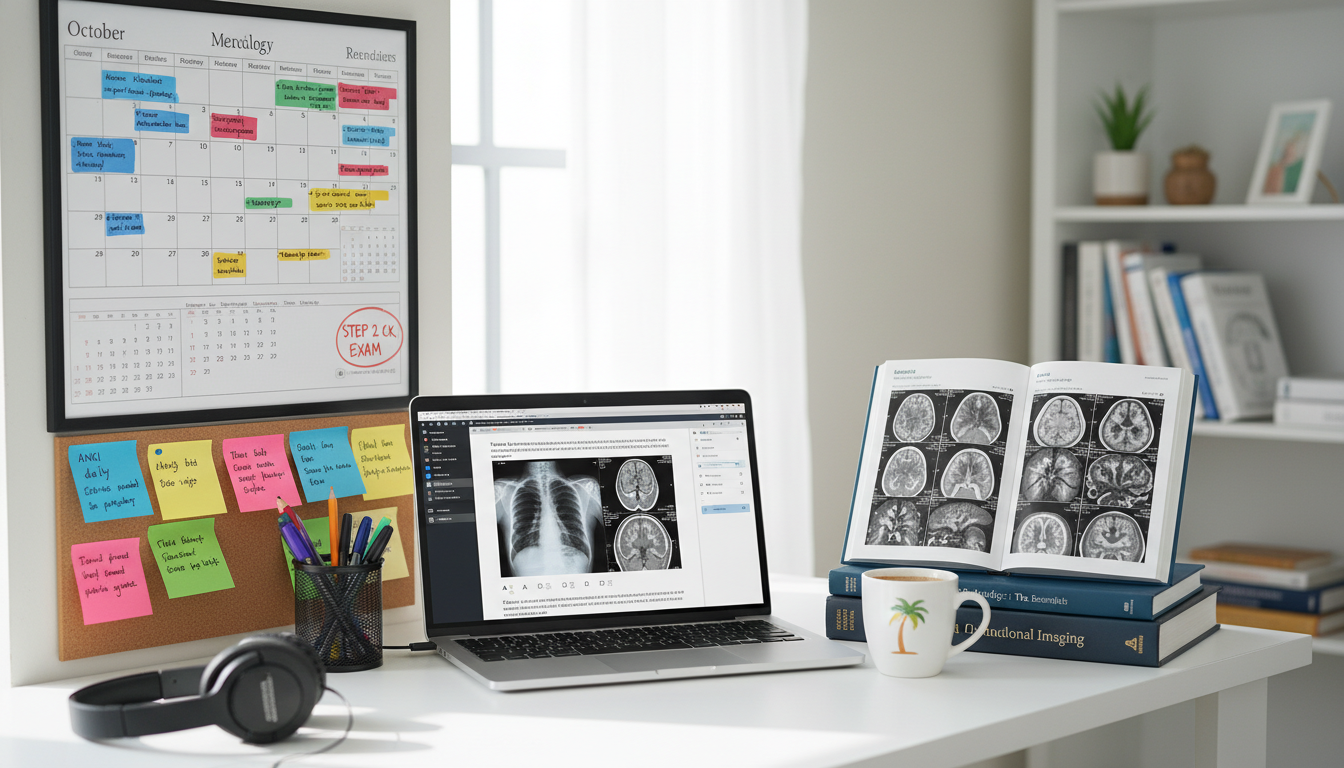
Building a High-Yield Study Plan as a Caribbean IMG
Caribbean IMGs face unique logistical and academic challenges: compressed clinical schedules, variable teaching quality, and visa considerations. A strong USMLE Step 2 study plan is your defense against these uncertainties—and your ticket to a credible SGU residency match or similar outcome from another Caribbean school.
Step 1: Set a Clear Target and Timeline
For a radiology-bound IMG, define:
- Ideal target: 250+
- Competitive target: 240–249 (with strong letters, research, and solid MSEs)
- Baseline acceptable: ≥ 230 (still workable, but you must strengthen the rest of your application significantly)
Then plan backward:
- Dedicated study period: Typically 6–10 weeks full-time
- Pre-dedicated (during rotations): 3–6 months of light but consistent practice Qs and reading
If you’re at an institution like SGU or another major Caribbean school, check your school’s typical Step 2 timeline and NBME requirements; many Caribbean programs require passing one or more NBME practice exams before signing off on eligibility.
Step 2: Choose Your Core Resources
Resist resource overload. Use a small, core set deeply and repeatedly:
1. Question Bank (Primary Tool)
- Examples: UWorld, AMBOSS (some use both; most choose UWorld as primary)
- Goal: 2x through your primary QBank if possible; minimum 1x with detailed review
- Emphasize timed, random blocks in the second pass to mimic test conditions
2. Concise Review Text / Outline
- “Step 2 Secrets,” “Master the Boards,” or a similar structured clinical review book
- Use as a framework and for last 2–3 weeks consolidation
3. NBME Practice Exams
- Use multiple NBME forms plus the Free 120
- Track progression to guide your timeline and decide your test date
4. Supplemental for Weak Areas
- Online videos for specific systems (e.g., cardiology, nephrology)
- OB/GYN or pediatrics review if your clinical exposure was weak
You don’t need a radiology-specific resource for Step 2 CK, but skimming radiology case-based question sets occasionally can sharpen pattern recognition and keep you motivated.
Step 3: Integrate Clinical Rotations and Step 2 CK Preparation
As a Caribbean IMG, you may rotate across multiple hospitals, sometimes in different cities or states. This can disrupt routine. Counter it with structured daily minimums:
During rotations (3–6 months leading up to Step 2 CK):
- Weekdays:
- 20–40 questions/day (timed, tutor mode acceptable early on)
- 30–60 minutes of review reading or note consolidation
- Weekends:
- 1–2 larger blocks of 40 questions each day
- 2–3 hours of focused review
Actively connect what you see on the wards to question stems. For example:
- Patient with suspected PE → ask:
- “What’s the next best step?”
- “When do we use CT angiography vs V/Q scan?”
- Post-op patient with fever → think:
- “Is imaging warranted? If so, which modality and when?”
This habit will help you on Step 2 CK and later as a radiology resident when you’re consulted for “Which test should I order?”
High-Yield Strategies for Step 2 CK Success as a Radiology-Bound Candidate
Mastering Question Banks: Technique Over Volume
Quality of review matters more than hitting arbitrary question numbers.
For each question:
- Diagnosis: Can you summarize the case in one line and name the most likely diagnosis?
- Why this answer? Explicitly articulate the reasoning.
- Why not the others? Identify the key phrase(s) that rule out incorrect choices.
- Pattern recognition: Note classic constellations (e.g., “elderly smoker + hemoptysis + mass on CXR → lung cancer workup”).
Create a digital or paper error log with:
- Topic/system
- Specific concept missed (e.g., “imaging choice in pregnant trauma,” “management of STEMI after tPA”)
- Short correction note (1–2 lines)
Review your error log weekly. This mimics how you’ll track misses and learning points in radiology (e.g., missed fractures, subtle lung nodules).
Time Management: Practicing Realistic Test-Day Conditions
By the last 3–4 weeks, you should:
- Simulate full test days at least 2–3 times using 7–8 blocks of practice questions
- Practice short, efficient breaks: 5–10 minutes for bathroom, quick snack, and eye rest
- Train yourself to allocate 60–75 seconds per question
Radiologists work under time pressure when reading long lists of studies. Step 2 CK is your training ground for structured, time-efficient cognitive work.
Reading Stems Like a Radiologist
As a future radiologist, your job will often be:
- Sift through long clinical histories
- Extract key relevant details
- Generate a differential and best next step
You can practice this on Step 2 CK:
- Before looking at the answer choices, summarize:
- “This is a [age, sex] with [acute/subacute/chronic] [primary symptom(s)] and key findings [X, Y, Z]. I suspect [Diagnosis]. Next step?”
- This “clinical impression” mirrors radiology reports’ “Impression” section.
Over time, you’ll notice that properly structuring your thought process improves your accuracy and speed even without extra factual knowledge.
Strengthening Core Clinical Domains Critical for Radiology
Focus particular attention on:
Cardiovascular & Pulmonary
- High frequency on Step 2 CK; constant intersection with chest radiology and CT
- Be solid on ACS, heart failure, arrhythmias, PEs, COPD, lung cancer, pneumonia
Neurology
- Stroke pathways (tPA vs thrombectomy timing, imaging choices)
- Seizures, CNS infections, demyelinating diseases, brain tumors
Gastroenterology & Hepatology
- Acute abdomen algorithms (when to CT vs ultrasound vs no imaging)
- GI bleeding, pancreatitis, liver disease staging, hepatocellular carcinoma screening
OB/GYN
- Pregnancy-related emergencies and hemorrhage
- Fetal and maternal imaging considerations, ectopic pregnancy
Pediatrics
- Developmental milestones (often tested), but also imaging-related issues: intussusception, pyloric stenosis, NEC, non-accidental trauma
This emphasis isn’t just for the exam—these are high-yield case types you’ll see daily in radiology training.

Using Practice Exams and Score Data to Time Your Test
For Caribbean IMGs, timing Step 2 CK is strategic—especially if you’re hoping for a strong SGU residency match or placement from any Caribbean institution into diagnostic radiology.
A Rational Practice Exam Schedule
Over a 6–10 week dedicated period, a typical sequence might be:
- Week 1–2: NBME 1 (diagnostic baseline)
- Week 3–4: NBME 2 or 3
- Week 5–6: NBME 4 or newer forms + Free 120
- Week 7–8+: Final NBME close to your expected test date
Aim for:
- Practice exam scores within ~10–15 points of your target score
- A clear upward trend or stable high performance before you lock in your test date
If your NBMEs are stalled or dropping, you may need:
- Additional time targeting specific weak subjects
- A temporary reduction in daily question volume to allow more review
- Faculty or mentor input—especially if your school tracks students’ performance for graduation or exam approval
Interpreting Scores as a Caribbean IMG
Programs know that some Caribbean schools have variable grading standards, so your NBME and Step 2 CK performance carry tremendous weight.
- If you’re consistently scoring above 245–250 in NBMEs, you’re tracking well for a competitive diagnostic radiology match outcome.
- If you’re in the 230–240 range, radiology is still possible, but you’ll want strong letters, possibly U.S. clinical electives with radiology exposure, and ideally some research or case reports.
- If < 230, you can still match into other fields, and sometimes into radiology with exceptional other credentials, but be realistic and discuss strategy with mentors.
For Caribbean medical school residency applicants, it is usually better to delay Step 2 CK by 2–4 weeks to convert a borderline performance into a clearly stronger one—provided that delay will not push your score report too late for ERAS (you typically want your Step 2 CK score available by early fall of the application year).
Integrating Step 2 CK Success Into Your Radiology Application Strategy
Your Step 2 CK preparation does more than produce a score—it shapes how you will present yourself for residency.
Using Step 2 CK Study to Build a Radiology-Relevant Profile
Show Clinical Depth in Personal Statements and Interviews
- Use Step 2 CK cases you found memorable to illustrate your interest in imaging-guided decision-making.
Align Research and Electives
- If you’re doing research, emphasize projects involving diagnostic accuracy, imaging utilization, or AI in imaging.
- During electives, ask: “How could imaging have changed or confirmed this diagnosis?”
Demonstrate Self-Directed Learning
- In interviews, you can discuss how you built and refined your USMLE Step 2 study plan, handled weaknesses, and monitored your performance objectively.
Program Directors in radiology want residents who are:
- Methodical
- Data-oriented
- Comfortable with uncertainty and decision-making
Your approach to Step 2 CK, not just your score, can reveal all of these traits.
How a Strong Step 2 CK Supports the Diagnostic Radiology Match
In the diagnostic radiology match, PDs often face uncertainty about Caribbean schools’ grading rigor. A strong Step 2 CK score:
- Reassures them that your clinical knowledge meets or exceeds U.S. standards
- Offsets skepticism some may have toward Caribbean institutions
- Helps if your Step 1 is less impressive (or just pass/fail without distinction)
For candidates from SGU and similar Caribbean schools with high U.S. residency placement:
- A high Step 2 CK can put you in the subset of IMGs programs feel comfortable ranking highly
- When combined with U.S. letters, especially from radiologists, your application becomes genuinely competitive
Even if you ultimately choose a transitional year or preliminary year before radiology, strong Step 2 CK performance will still be a key asset.
Frequently Asked Questions (FAQ)
1. What Step 2 CK score should a Caribbean IMG aim for to be competitive for diagnostic radiology?
Aim for at least the mid-240s or higher to be a competitive candidate for diagnostic radiology, especially as a Caribbean IMG. A Step 2 CK score of 250+ is a very strong asset. Scores in the 230s do not exclude you, but you will need a stronger overall application: excellent clinical evaluations, strong U.S. letters, and ideally some radiology-related research or leadership.
2. How far in advance should I start Step 2 CK preparation during my Caribbean medical training?
Begin light, consistent USMLE Step 2 study during your core clinical rotations—about 3–6 months before your dedicated period. Use question banks to reinforce what you see in the hospital. Then plan for 6–10 weeks of dedicated study before your exam date, depending on your baseline. As a Caribbean IMG, this staggered approach helps you overcome any variability in teaching quality and clinical exposure.
3. Does radiology-specific studying help for Step 2 CK?
You don’t need a radiology review book for Step 2 CK. Instead, focus on clinical reasoning and management in core disciplines (medicine, surgery, OB/GYN, pediatrics, neurology). However, thinking like a radiologist—considering which imaging tests are appropriate and recognizing classic imaging descriptions—will help you answer many Step 2 CK questions correctly and prepare you for residency.
4. If my Step 1 was average, can a strong Step 2 CK still help me in the diagnostic radiology match?
Yes. With Step 1 now pass/fail and increasing emphasis on clinical performance, a strong Step 2 CK score can significantly improve your competitiveness. For a Caribbean IMG, a high Step 2 CK is one of the most impactful ways to counterbalance an average Step 1 or a school name that some programs may view cautiously. Combined with strong clinical rotations, letters, and some radiology exposure, it can absolutely support a successful diagnostic radiology match.
By aligning a disciplined Step 2 CK preparation plan with your long-term goal of entering diagnostic radiology, you convert exam prep into genuine professional development. For a Caribbean IMG, this alignment—combined with a strong Step 2 CK score—can be the difference between being overlooked and being seriously considered by radiology programs across the U.S.