
Understanding Step 2 CK as a DO Graduate Targeting Interventional Radiology
As a DO graduate aiming for an interventional radiology (IR) residency, your USMLE Step 2 CK score is one of the highest-yield tools you have to strengthen your application. With the elimination of Step 1 numerical scores, Step 2 CK has become the primary standardized metric many programs use to compare applicants across schools and pathways—especially when evaluating DO graduate residency candidates alongside MD applicants.
For interventional radiology residency, which is now a highly competitive integrated specialty, a strong Step 2 CK score can:
- Demonstrate that you can perform at the same level as top MD applicants
- Offset a pass-only Step 1 report (or a lower COMLEX Level score)
- Support your application if you do not have a home IR program or extensive IR research
- Help PDs feel confident you can handle IR’s steep learning curve and intense clinical workload
Your goal is not just “passing.” For the IR match (IR/DR integrated programs), you want your Step 2 CK score to be as competitive as possible relative to national averages for matched applicants in diagnostic radiology and IR. While specific cutoffs vary, aiming for well above the national mean is a realistic mindset if you plan to apply broadly to IR.
In this guide, we’ll walk through a comprehensive, practical approach to USMLE Step 2 study designed specifically for a DO graduate targeting interventional radiology: from resources and schedule design to test-taking strategy and how to integrate this exam into a coherent IR match plan.
How Step 2 CK Fits into Your DO and IR Match Strategy
Why Step 2 CK Matters So Much for DO Applicants
For DO graduates, residency programs may see:
- COMLEX scores
- USMLE scores
- Both COMLEX and USMLE
Some IR/DR programs are now more comfortable evaluating COMLEX alone, but many still prefer or explicitly require USMLE scores. In competitive fields such as interventional radiology, having a strong Step 2 CK score:
- Simplifies comparison with MD applicants
- Reduces uncertainty for programs unfamiliar with interpreting COMLEX
- Demonstrates your ability to excel on a widely recognized standardized exam
If your COMLEX Level 1 or 2 scores are lower than you’d like—or you only have a pass on Step 1—a strong Step 2 CK score can be your academic “anchor.”
Timing: When a DO Graduate Should Take Step 2 CK
Ideal timing for DOs entering the IR match:
End of third year or early fourth year
- After core clerkships (internal medicine, surgery, pediatrics, OB/GYN, psychiatry, family medicine)
- While clinical knowledge is still fresh
Before ERAS submission and away rotations (if possible)
- Having your Step 2 CK score in hand when ERAS opens (typically mid-September) gives PDs more confidence in offering interviews
- If your Step 2 CK is strong and your COMLEX is average, this timing lets you lead with Step 2 CK as your main academic strength
Align with rotation schedule strategically
- Avoid testing right after a heavy, time-intensive IR or surgical sub-I
- Consider lighter rotations (e.g., outpatient, elective) before test day to protect your USMLE Step 2 study time
If you’ve already graduated or are in a research year before applying, build a full-time 6–8 week dedicated Step 2 CK preparation block into your timeline.
IR Programs and How They View Step 2 CK
Integrated interventional radiology programs want residents who can:
- Handle ICU and step-down-level medical complexity
- Manage peri-procedural care and complications
- Understand pathophysiology, pharmacology, and acute management
So program directors often use Step 2 CK as:
- A proxy for clinical reasoning under pressure
- A signal that you can thrive on tough IR-adjacent rotations (ICU, vascular surgery, inpatient medicine)
- A way to differentiate candidates in a highly competitive IR match pool
Action tip: When you shortlist IR/DR and DR programs, check each program’s website or FREIDA entry to see:
- Whether USMLE is required for DOs
- Preferred test combinations (COMLEX + USMLE vs COMLEX only)
- Any stated score considerations (though many won’t publish hard cutoffs)
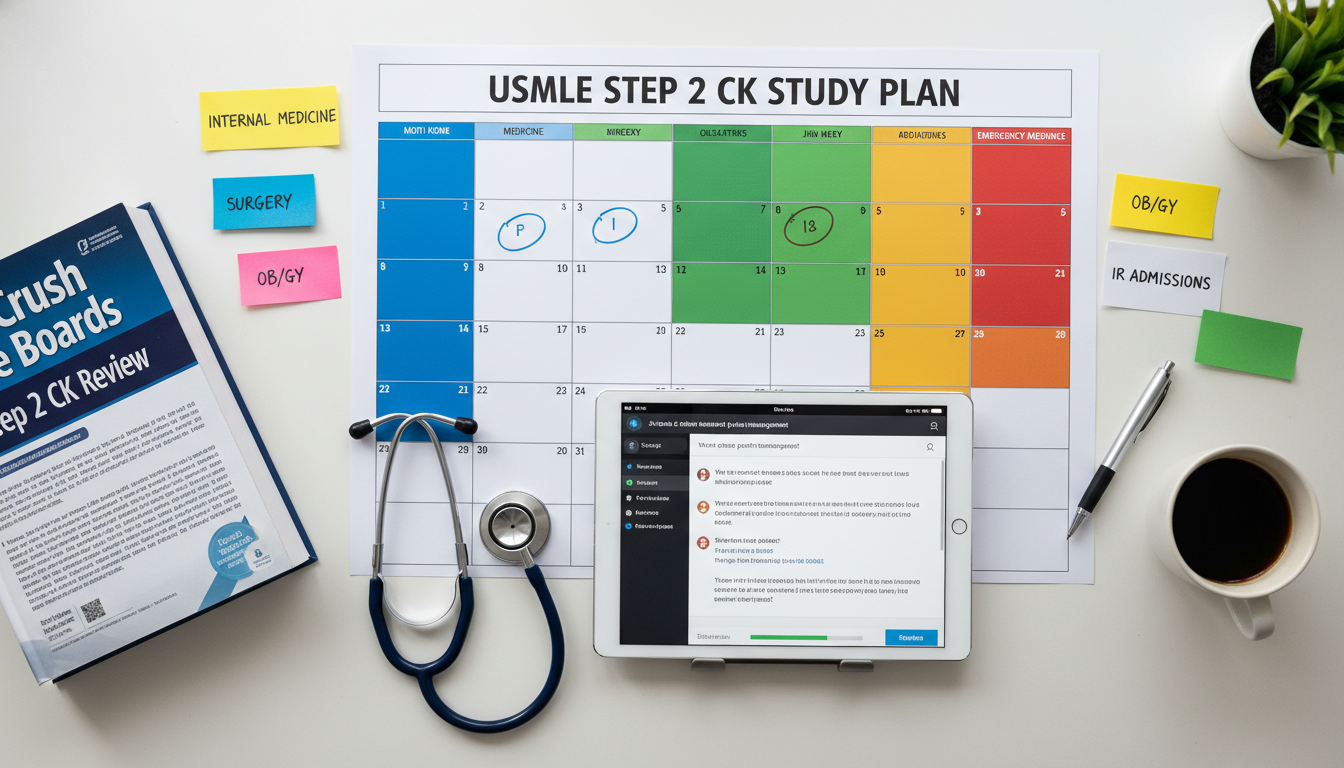
Core Step 2 CK Resources and How to Use Them Effectively
Your USMLE Step 2 preparation should be question-bank–centered, with a smaller set of high-yield texts and videos used as references when you identify weak areas.
Essential Primary Resources
UWorld Step 2 CK QBank (Non-negotiable)
- The gold standard for USMLE Step 2 study
- Use in tutor mode early, then timed mode as you progress
- Aim for at least one full pass, ideally ~80–100% completion or more
- Treat UWorld as both content review and test-taking practice
NBME Comprehensive Clinical Science Self-Assessments (CCSSA)
- High-fidelity score predictors
- Use 2–4 NBMEs spaced throughout your dedicated period
- Use as checkpoints to gauge your Step 2 CK score trajectory and adjust plans
Amboss (Optional but Helpful)
- Especially useful if you want extra questions after UWorld
- Strong for rapid reference and “learning cards” on weaker topics
- Good for reinforcing internal medicine, surgery, and emergency medicine
Anki (Spaced Repetition)
- Current, popular Step 2 CK decks can reinforce high-yield facts and algorithms
- Especially useful during third-year rotations to build a foundation before dedicated
High-Yield Reference and Review Materials
Online MedEd (OME) videos or similar clinical lecture series
- Useful early in third year or early in dedicated
- Great for building scaffolding around clinical reasoning and frameworks
Step-Up to Medicine (for internal medicine)
- Good reference for outpatient and inpatient IM topics
- Don’t read cover-to-cover during dedicated; instead, use it selectively when UWorld questions expose weak areas
Pestana’s Surgery Notes / concise surgery review
- Solid for perioperative management, trauma, and surgical complications—important for IR-adjacent content
Emergency medicine and ICU references (short, focused)
- For resuscitation, shock, sepsis, and acute respiratory failure
- These domains overlap heavily with IR’s acuity and are frequently tested
Tailoring Resources as a DO Graduate
As a DO, you may already be balancing:
- COMLEX-specific material (e.g., OMT)
- USMLE-style resources
For Step 2 CK preparation:
- De-prioritize OMT for USMLE purposes—it is not tested
- Focus on USMLE-style question banks, as COMLEX vignettes differ in style and emphasis
- Use your COMAT shelf prep experience, but recognize USMLE Step 2 CK questions are often longer, more integrative, and more nuanced
Building a High-Yield Step 2 CK Study Plan: From Third Year Through Dedicated
Phase 1: During Core Clerkships (Foundation Building)
Your USMLE Step 2 study starts long before dedicated. As you rotate through third-year clerkships, you’re building content and clinical reasoning that directly translate to your Step 2 CK score.
Strategies During Clerkships
Align shelf prep with Step 2 CK prep
- Use UWorld questions relevant to your current rotation (IM, surgery, etc.)
- Review explanations thoroughly—this is early Step 2 CK preparation
Use Anki or short daily review sessions
- 30–45 minutes a day of spaced repetition and questions
- Focus on consolidating high-yield algorithms (ACS, PE, stroke, sepsis, GI bleed, etc.)
Capture “clinical pearls” from the wards
- When you see a case (e.g., acute limb ischemia, biliary obstruction, DVT/PE), look it up, then do 3–5 related questions that evening
- This builds pattern recognition across your future IR patients
Practice test-style reasoning
- On rounds, mentally frame cases as Step 2 questions:
- What is the next best step in management?
- What is the most likely diagnosis?
- What is the best initial test vs the most accurate test?
- On rounds, mentally frame cases as Step 2 questions:
By the end of third year, aim to have:
- Completed at least 50–60% of a main Step 2 CK QBank (or a dedicated shelf-question resource)
- Developed a consistent question-review habit
- Clarified your weaker subjects (often OB/GYN, pediatrics, or psychiatry for DO applicants more focused on adult medicine and IR)
Phase 2: Dedicated Step 2 CK Preparation (4–8 Weeks)
The length of your dedicated period depends on:
- How busy your schedule is (are you on electives vs full-time studying?)
- How much you’ve done during third year
- Your baseline practice scores
Below is a common 6-week structure that can be adapted:
Weeks 1–2: Foundation + High-Yield Review
- Daily UWorld: 60–80 questions in timed, random or subject-specific blocks
- Review every explanation—log concepts you repeatedly miss
- Watch targeted videos (e.g., OME) for weak subjects
- Begin light NBME review if you’ve taken any practice tests previously
Goal: Identify your baseline performance and main gaps.
Weeks 3–4: Intensification + First NBME
- Increase to 80–120 UWorld questions/day (if full-time studying)
- Switch more blocks to timed random mode to simulate test conditions
- Take your first NBME CCSSA at the start or middle of this period
- Carefully review the NBME:
- Categorize missed questions by topic and type (knowledge vs reasoning vs misreading)
- Add weak topics to a focused review list
Goal: Push your cumulative UWorld completion above ~70%, and use your NBME to calibrate your Step 2 CK score target.
Weeks 5–6: Refinement + Simulation
- Focus on remaining UWorld questions and re-do missed/flagged questions
- Take 1–2 more NBMEs and, if desired, UWorld self-assessments
- Begin full-length simulation days:
- 4–6 blocks of 40 questions, timed, with minimal breaks
- Work on mental stamina and pacing
Goal: Solidify test-day endurance and refine your strategy to avoid repeated errors.

Test-Taking Strategy and Content Priorities for Future Interventional Radiologists
Clinical Domains Most Relevant to IR (and Step 2 CK)
Even though Step 2 CK is not specialty-specific, several domains map closely onto the skills you’ll use in interventional radiology and are heavily represented on the exam:
Internal Medicine (especially cardiology, pulmonology, GI, nephrology, and hematology)
- IR patients frequently have complex multisystem disease
- Learn workups and management algorithms cold: ACS, PE, DVT, GI bleeding, cirrhosis complications, AKI, sepsis
Surgery and Perioperative Care
- IR interacts closely with surgical services
- Common exam topics: trauma, post-op complications, wound infections, bleeding management
Emergency Medicine and Critical Care
- Recognizing unstable patients, choosing appropriate immediate management
- IR frequently manages acute bleeds, emboli, and septic or shock states
Radiology-Adjacent Content
- Interpretation of basic imaging (CXR, CT head/chest/abdomen, ultrasound)
- Understand which imaging modality to order and when—this is frequently tested
Procedural and Complication Management Thinking
- While IR procedures per se aren’t heavily detailed on Step 2 CK, patterns like:
- Contrast reactions
- Renal protection in contrast studies
- Anticoagulation management around procedures
- These questions test the same risk-benefit reasoning you’ll need in IR.
- While IR procedures per se aren’t heavily detailed on Step 2 CK, patterns like:
General Step 2 CK Test-Taking Strategies
Prioritize the stem: read actively and predict
- Before looking at the answer choices, ask:
- “What is the question really asking?” (diagnosis? next step? best test?)
- “What is the clinical trajectory?”
- Before looking at the answer choices, ask:
Use triage: identify the life-threatening issues first
- On questions involving hypotension, hypoxia, chest pain, or altered mental status, immediately think “stabilize first”
- Concepts of ABCs (airway, breathing, circulation) are heavily tested
Manage time aggressively
- Budget ~80–90 seconds per question
- If you’re stuck, eliminate obvious wrong answers, make a best guess, and move on
- Don’t let one question cost you several easier ones later in the block
Avoid overthinking with subspecialty knowledge
- Even as a future interventional radiologist, rely on core, guideline-based medicine, not obscure procedural details
- Step 2 CK rewards organized clinical reasoning more than super-technical knowledge
Leverage patterns in UWorld explanations
- For every missed question, ask:
- Was it lack of knowledge?
- Misinterpretation of the question?
- Rushing and misreading a key detail?
- Adjust your reading strategy accordingly (e.g., highlighting or paraphrasing questions in your head)
- For every missed question, ask:
Common Pitfalls for DO Applicants and IR-Minded Students
Over-focusing on IR-related details too early
- Time spent learning specific IR techniques (e.g., TACE vs TIPS technical minutiae) is lower yield for Step 2 CK compared to mastering sepsis management or ACS algorithms
Balancing COMLEX and USMLE prep poorly
- If you are still taking COMLEX, use largely overlapping resources (UWorld, OME, core internal medicine/surgery texts)
- Add OMT briefly and separately for COMLEX, but don’t let it dominate your study time
Underestimating general pediatrics, OB/GYN, and psychiatry
- Even though they’re not IR-heavy areas, they are test-heavy
- Missing too many questions in these blocks can drag down your total Step 2 CK score
After the Exam: Using Your Step 2 CK Score in the IR Match
Interpreting Your Score as a DO Graduate
When your Step 2 CK score arrives, interpret it in context:
- Compare your score to national means and standard deviations (available from NBME/USMLE websites)
- Look at NRMP Charting Outcomes data (for Diagnostic Radiology and IR/DR) to see:
- Average Step 2 CK scores for matched vs unmatched applicants
- How your score fits among successful applicants
If your Step 2 CK is:
Well above average
- Highlight it on your ERAS application
- Mention it (briefly and factually) during IR away rotations or when discussing your academic strengths
Average or slightly below
- Focus on strengthening other parts of your application:
- Strong letters from IR and DR faculty
- Research or quality improvement projects
- Strong Step 3 (if taken before or early in residency)
- Focus on strengthening other parts of your application:
Significantly below your target
- Consider:
- Broadening your residency target list (including DR, transitional, or preliminary programs)
- Strategically using your DO background and unique experiences (OMT skills, community service, etc.) to stand out
- Demonstrating an upward trend via other objective metrics (COMLEX Level 2 or 3, national exams)
- Consider:
Integrating Step 2 CK with ERAS, Away Rotations, and the IR Match
Your Step 2 CK preparation is part of a broader timeline:
Before ERAS Submission
- Ideally, have your Step 2 CK score reported so programs can see it from day one
- If your score is strong, it helps your IR application and gives PDs more confidence when offering interviews
During IR Away Rotations
- Use your Step 2 CK knowledge:
- Show strong clinical reasoning on consults and rounds
- Be the student who can manage pre- and post-procedure care confidently
- For DO graduates, demonstrating competence at or above the level of MD peers can overcome any lingering bias
- Use your Step 2 CK knowledge:
During Interviews
- Be ready to succinctly discuss your Step 2 CK score in context:
- If strong: how your preparation reflects your work ethic and readiness for IR
- If weaker: what you learned from the process and how you’ve grown since
- Be ready to succinctly discuss your Step 2 CK score in context:
If You Don’t Match IR on the First Try
- Your Step 2 CK score will still be crucial if you:
- Apply to DR with plan to pursue early specialization in IR
- Reapply after a research year
- Use the time to expand your IR research portfolio and clinical exposure.
- Your Step 2 CK score will still be crucial if you:
Frequently Asked Questions (FAQ)
1. As a DO graduate, do I need USMLE Step 2 CK if I already took COMLEX?
For interventional radiology and many diagnostic radiology programs, yes, Step 2 CK is strongly recommended and often effectively required. Some programs may consider COMLEX alone, but many still prefer USMLE scores to compare applicants directly, especially in highly competitive specialties. Taking and doing well on Step 2 CK:
- Reduces any uncertainty about your exam performance
- Demonstrates parity with MD applicants
- Strengthens your overall osteopathic residency match profile
2. What Step 2 CK score should I aim for if I’m targeting interventional radiology?
There is no official cutoff, and program directors consider your application holistically. However, because interventional radiology residency is highly competitive, you generally want a Step 2 CK score that is well above the national mean and solidly competitive for diagnostic radiology applicants. Use the latest NRMP Charting Outcomes data as a reference and aim to be comfortably in—or above—the range of matched DR and IR/DR candidates. Remember, stronger scores give you more flexibility with programs and geography.
3. How should I balance USMLE Step 2 CK preparation with my IR away rotations?
Plan your timeline so that:
- Step 2 CK is taken before your most important away rotations, if possible, so you can focus on clinical performance during those months.
- During away rotations, shift from heavy content learning to maintenance mode:
- 20–40 review questions/day
- Short, targeted review of weak areas
- Use your fresh Step 2 CK knowledge to shine clinically on IR and DR teams—showing excellent reasoning and understanding of imaging and management decisions.
4. Can a strong Step 2 CK score overcome a low Step 1 or COMLEX score as a DO applicant?
It can significantly help, especially in the current environment where Step 1 is pass/fail. For DO graduates with modest COMLEX scores, a strong Step 2 CK score can:
- Demonstrate academic growth and resilience
- Reassure program directors that you can handle the knowledge load in IR/DR
- Partially offset earlier weaker performance
Programs will still consider your entire application, but a clear upward trend with a strong Step 2 CK result is a powerful positive signal—particularly important in the competitive IR match.
By approaching your USMLE Step 2 study with a disciplined plan, thoughtful resource use, and an eye toward the specific expectations of interventional radiology programs, you can turn Step 2 CK into a major asset in your osteopathic residency match journey.