
Understanding Step 2 CK as a DO Graduate Aiming for Cardiothoracic Surgery
For a DO graduate targeting a cardiothoracic surgery residency, USMLE Step 2 CK is strategically critical. While board scores are never the only factor, they often determine whether you clear the first screening filter for highly competitive programs. As a DO, a strong Step 2 CK score can:
- Demonstrate equivalence with MD applicants on a standardized metric
- Compensate for a less competitive Step 1 outcome or COMLEX-only history
- Reinforce your readiness for high-acuity, high-responsibility training like cardiothoracic surgery residency
- Show mastery of internal medicine, surgery, ICU care, and peri-operative management central to heart surgery training
For a DO graduate seeking an osteopathic residency match in a field as competitive as cardiothoracic surgery, Step 2 CK is often the last major standardized test you can leverage to significantly enhance your application profile.
How Important Is Step 2 CK for Cardiothoracic Surgery?
Cardiothoracic surgery residency (integrated I-6 programs or traditional general surgery → fellowship pathways) is among the most competitive specialties. Program directors commonly view Step 2 CK as:
- A proxy for clinical reasoning under time pressure
- An indicator of how you’ll handle complex cardiac and thoracic pathology on rotations
- A predictor of in-training exam and board performance
While specific score cutoffs vary, aiming for a Step 2 CK score ≥ 250 is a realistic target for a DO graduate aspiring to an integrated cardiothoracic or a top-tier general surgery residency. Many successful applicants will cluster above this, but a 250+ generally makes you “score competitive” at a wide range of programs when combined with strong clinical evaluations, research, and letters.
If your Step 1 (or COMLEX Level 1) was average or below, Step 2 CK is the chance to tell a different story: steep upward trajectory, strong clinical ability, and readiness for demanding surgical training.
Strategic Timeline: When and How a DO Graduate Should Prepare
As a DO graduate, your timeline can be more complex—balancing COMLEX, rotations, research, and USMLE Step 2 CK. The goal is to optimize both score and application timing for the osteopathic residency match and NRMP Main Match.
Ideal Timing for Step 2 CK
For a DO graduate targeting cardiothoracic surgery:
Latest advisable test date:
- Mid– to late-August of the application year if you want your Step 2 CK score on your initial ERAS application.
- Some take it later (September–October) to build a stronger foundation, but this delays score release and can affect early screening.
Most common dedicated period:
- 4–8 weeks of focused study after core clinical rotations.
- Many DO students sit for COMLEX Level 2-CE around the same window and align USMLE Step 2 CK preparation with it.
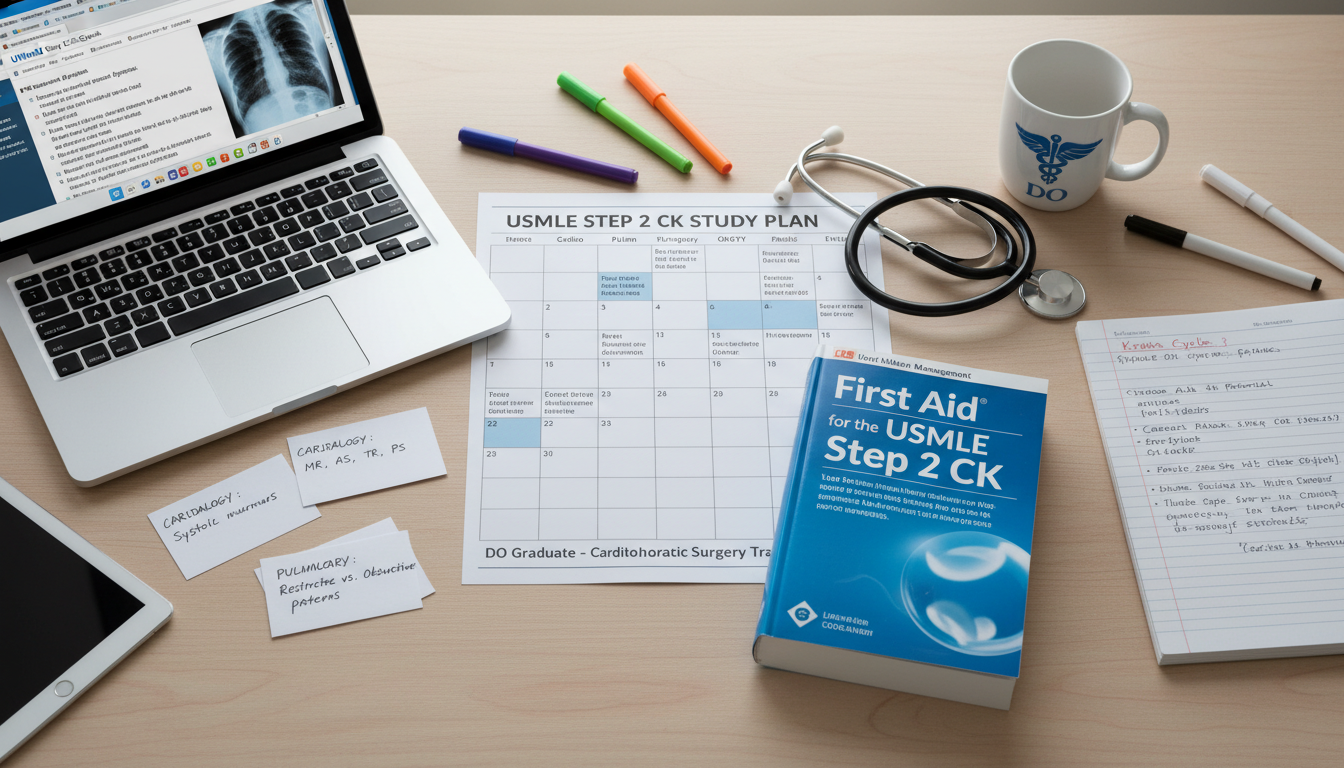
Creating a High-Yield Study Timeline (3–6 Months)
A practical structure for a DO graduate:
3–6 Months Out: Foundation and Integration
- Solidify knowledge from your core rotations (IM, surgery, pediatrics, OB/GYN, psych, FM, EM).
- Begin a USMLE Step 2 study plan using:
- One primary question bank (UWorld is standard)
- One main review resource (e.g., OnlineMedEd videos or similar)
- Study ~1–2 hours on busy clinical days; 3–4 hours on lighter days.
- Keep a study log: systems covered, question blocks completed, weak topics.
6–8 Weeks Out: Dedicated Period
- Transition to focused, exam-mode preparation:
- 6–10 hours/day, 5–6 days/week
- Prioritize timed, random question blocks and NBME practice exams
- Start building cardiothoracic surgery-relevant depth:
- Cardiology, pulmonology, critical care, peri-operative medicine, infectious disease, hematology.
Last 2 Weeks: Refinement and Exam Readiness
- Use NBME practice tests and UWorld self-assessment to:
- Confirm your score range
- Identify last-minute gaps
- Focus on:
- High-yield tables and algorithms (ACS, PE workup, HF management, arrhythmias, sepsis protocols)
- Weakest systems identified from your data.
- Emphasize sleep, diet, and exercise to maintain performance.
Core Resources and Study Methods for Step 2 CK Success
You don’t need 15 different resources; you need a tight, high-yield toolkit used consistently. The best Step 2 CK preparation for a DO graduate in cardiothoracic surgery combines question-heavy practice with targeted review.
Question Banks: Your Primary Learning Engine
1. UWorld Step 2 CK (Primary QBank)
Non-negotiable for most high scorers. Use it as your main learning tool, not just an assessment.
How to use UWorld effectively:
- Complete 100% of the questions, preferably 1.2–1.5 passes (review wrongs and flagged).
- Do 40–80 questions/day in timed, random mode during dedicated.
- Immediately review explanations, even for correct answers.
- Build concise notes or Anki cards for recurring mistakes.
Cardiothoracic relevance within UWorld:
- Cardiology: ACS, valvular disease, arrhythmias, HF, cardiomyopathies.
- Pulmonology: PE, pneumonia, ARDS, pleural effusions, pneumothorax.
- Critical care: shock, sepsis, ventilation management, peri-op risk stratification.
- Surgery: chest trauma, postoperative complications, mediastinitis, DVT/PE.
2. Supplemental QBank (Optional)
If time allows and you want extra depth:
- AMBOSS or Kaplan can be used for:
- Filling gaps after finishing UWorld
- Additional exposure to complex clinical vignettes
- Use selectively to focus on weaknesses (e.g., nephrology, statistics, pediatrics).
Core Review Material
1. Online Video/Outline Series
Resources like OnlineMedEd, Boards & Beyond (Step 2), or similar can:
- Refresh key concepts as you transition from rotations to dedicated study
- Clarify pathophysiology and reasoning behind management pathways
- Serve as lighter study on post-call or heavy clinic days
Prioritize:
- Cardiology and pulmonology
- Infectious disease and critical care
- Endocrinology, renal, and hematology (frequent Step 2 topics)
2. Text/Review Books
Use one main reference for structured reading, such as:
- A concise Step 2 CK text (e.g., Step-Up to Medicine or a similar IM/surgery-focused book)
But be careful not to get bogged down in reading. For high Step 2 CK scores, question-based learning tends to outperform passive text reading.
Practice Exams: Calibrating Your Score
To track and optimize your Step 2 CK score:
NBME Practice Exams:
- Take 2–4 forms, spaced about 2–3 weeks apart in the last 6–8 weeks.
- Treat each like a full exam: timed, strict conditions.
- Each NBME should generate a written “post-game analysis”: what you missed, why, and what to fix.
UWorld Self-Assessments (UWSA1 & UWSA2):
- Good predictors; many examinees find UWSA2 particularly close.
- Use one ~3–4 weeks out and one 7–10 days before the exam.
If your predicted score is below your cardiothoracic surgery target (say, below 240 when you’re aiming for 250+), consider:
- Extending your dedicated period if feasible.
- Intensively targeting your weakest 2–3 subject areas.
- Reassessing non-productive study habits (too much passive reading, not enough timed questions).
High-Yield Clinical Content with a Cardiothoracic Surgery Lens
Even though Step 2 CK is a general clinical exam, you can align your studying with competencies important for heart surgery training. This offers a double benefit: a higher Step 2 CK score and stronger foundation entering cardiothoracic rotations.
Cardiology and Peri-Operative Medicine
Expect numerous questions where cardiac disease intersects with internal medicine and pre-op evaluation.
Key high-yield topics:
Acute coronary syndromes (ACS):
- NSTEMI vs STEMI diagnosis, biomarkers, EKG interpretation
- Initial management: antiplatelets, anticoagulation, beta-blockers, nitrates, reperfusion strategies
- Complications: papillary muscle rupture, free wall rupture, arrhythmias, cardiogenic shock
Chronic coronary disease and valvular heart disease:
- Indications for CABG versus PCI
- Timing of valve repair vs replacement
- Pre-operative risk stratification in patients with AS, MR, or ischemic cardiomyopathy
Heart failure (HF):
- Acute decompensated vs chronic stable HF
- Guideline-directed medical therapy (ACEi/ARB/ARNI, beta-blockers, MRA, SGLT2i)
- Recognizing when to consider advanced therapies (LVAD, transplant)
Practical example (USMLE-style reasoning):
A 65-year-old with known CAD and reduced EF presents for elective non-cardiac surgery. You may be asked:
- Is stress testing indicated?
- Does he need further revascularization first?
- How should his beta-blocker and ACE inhibitor be managed around the time of surgery?
Questions like these bridge your Step 2 CK preparation with real-world pre-op cardiac evaluation you’ll do routinely in cardiothoracic surgery training.
Pulmonology and Thoracic Pathology
Cardiothoracic surgery encompasses not only the heart but also the lungs, mediastinum, and chest wall. On Step 2 CK, pulmonology is high-yield and closely tied to ICU care.
Key high-yield topics:
- Pulmonary embolism: diagnosis (CTPA, V/Q), risk stratification, thrombolysis vs anticoagulation
- Pneumonia: CAP vs HAP vs VAP, antibiotic selection, complications (empyema, lung abscess)
- COPD and asthma exacerbations: acute management and ventilatory support
- ARDS: diagnostic criteria, ventilator settings (low tidal volume), fluid management
- Pleural effusions and pneumothorax:
- Transudate vs exudate analysis
- Indications for thoracentesis, chest tube, needle decompression
These topics will reappear on your future ICU months, making them worth mastering now.
Surgery, Trauma, and Postoperative Care
As a future cardiothoracic surgeon, you’ll be expected to think beyond the operating room. Step 2 CK tests:
- Recognition and early management of postoperative complications:
- Atelectasis, pneumonia, PE, DVT, MI, ARDS
- Wound infections, mediastinitis, anastomotic leaks
- Identification of life-threatening thoracic trauma:
- Tension pneumothorax, massive hemothorax, cardiac tamponade, flail chest
- Priorities in ATLS, indications for emergent thoracotomy
Example concept:
A post-op patient after major thoracic surgery develops sudden tachycardia, dyspnea, and pleuritic chest pain. You should rapidly differentiate between PE, MI, pneumonia, and pneumothorax based on vital signs, exam, and risk factors—then choose appropriate imaging and initial therapy.
Critical Care and Shock States
Cardiothoracic surgeons spend substantial time in the ICU. Step 2 CK reflects this with many cases involving:
- Hypovolemic, cardiogenic, distributive (septic, anaphylactic), and obstructive shock
- Sepsis recognition and Surviving Sepsis Campaign-based management
- Pressor selection (norepinephrine vs dopamine vs vasopressin vs dobutamine)
- Basic ventilation strategies and recognizing ventilator-related complications
Develop a mental algorithm for shock:
- Identify hypotension + organ dysfunction.
- Rapidly classify type based on history, exam, and initial labs.
- Select appropriate fluids, pressors, antibiotics, or procedural interventions.
This exact logic will be vital in a cardiothoracic SICU.

Tailored Strategies for DO Graduates: Standing Out in the Match
As a DO graduate aiming for an osteopathic residency match or allopathic cardiothoracic pathway, you carry both strengths and unique challenges. Step 2 CK preparation should be integrated into a broader competitiveness strategy.
Leverage Your Osteopathic Background
Your DO training already emphasizes:
- Musculoskeletal and biomechanical understanding
- Holistic, patient-centered care
- Hands-on skills and physical diagnosis
In Step 2 CK questions, this translates into:
- Superior comfort with MSK exam, spine pathology, and gait abnormalities
- Strong clinical reasoning with complex, multimorbid patients
- Good bedside manner and ethical reasoning in communication-based questions
Show this advantage in:
- Clinical rotations and letters of recommendation
- Personal statement and interviews where you can articulate how osteopathic principles enrich your approach to complex cardiothoracic patients (e.g., rehab after thoracotomy, pain management, functional recovery).
Addressing DO-Specific Concerns About Step 2 CK
Many DO graduates worry about comparisons with MD peers or about limited access to certain residencies. To mitigate this:
Commit to USMLE Step 2 CK if you want competitive CT surgery or academic general surgery.
- A strong Step 2 CK score reassures programs accustomed to USMLE data.
If you took only COMLEX Level 1, Step 2 CK is your chance to add a widely recognized metric.
- Programs can now compare you more directly to other applicants.
Be strategic with score release and timing.
- Take the exam early enough that a strong score can be included in initial ERAS review.
- If you have reason to expect a suboptimal score, discuss with an advisor whether delaying might help improve your trajectory.
Integrating Research and Clinical Exposure
Parallel to your Step 2 CK study:
- Seek cardiothoracic or cardiac surgery research opportunities:
- Case reports, outcomes projects, chart reviews, QI projects in CT ICU.
- Aim for sub-internships or audition rotations in:
- Cardiothoracic surgery
- High-acuity general surgery or surgical ICU services
These experiences:
- Strengthen letters of recommendation from surgeons used to working with high-performing trainees
- Demonstrate that your interest in heart surgery training is sustained, informed, and realistic
Remember: a high Step 2 CK score gets your foot in the door; your clinical reputation and commitment keep you in the running.
Exam Day Strategy and Mental Performance
Even the best-prepared DO graduate can underperform without a solid test-day plan.
One Week Before the Exam
- Take your final NBME or UWSA 7–10 days out, not 48 hours before.
- Stop learning brand-new resources; focus exclusively on your existing notes, marked questions, and high-yield summaries.
- Normalize your sleep schedule to match test-day timing.
- Visit the testing center if you’re unfamiliar with the location.
The Day Before
- Do light review only (1–3 hours). No full blocks, no new NBME.
- Prepare logistics:
- Required IDs, confirmation email
- Snacks and water for breaks
- Comfortable layers of clothing
- Plan your break strategy (e.g., short 5–7 minute breaks every 2 blocks).
During the Exam
Time management:
- Aim for ~1 minute per question, with 10–15 minutes/ block for review.
- If stuck, pick the best answer and mark for review; don’t burn 3 minutes on a single vignette.
Question approach:
- Skim the last line first if helpful (“What is the next best step?”).
- Read the stem for key data: age, vitals, risk factors, timeline.
- Immediately rule out clearly wrong options.
- Anchor on guidelines and algorithms you’ve drilled (e.g., ACLS, ACS pathways, sepsis bundles).
Mindset:
- Expect difficulty: even 250+ scorers feel uncertain on many questions.
- Focus on execution, not perfection; your goal is consistent, calm reasoning across all blocks.
FAQs: USMLE Step 2 CK for DO Graduates Targeting Cardiothoracic Surgery
1. What Step 2 CK score should a DO graduate aim for to be competitive in cardiothoracic surgery?
For an integrated cardiothoracic surgery residency or a top-tier general surgery program leading to a CT fellowship, a Step 2 CK score of ≥ 250 is a strong target. This doesn’t guarantee interviews, but it clears many initial filters and signals that you can handle rigorous heart surgery training. If your score is in the 240s, you can still be competitive with substantial research, excellent letters, and strong clinical performance, especially at programs with a history of supporting DO graduates.
2. How should I balance COMLEX Level 2-CE and USMLE Step 2 CK preparation as a DO graduate?
There is significant overlap between USMLE Step 2 study and COMLEX Level 2-CE preparation. A practical approach:
- Use UWorld and a core clinical review source as your main study tools; these will serve both exams.
- Add targeted OMM review and COMLEX-specific question styles in the last 2–3 weeks before Level 2-CE.
- If possible, sit for USMLE Step 2 CK shortly after Level 2-CE, when your clinical knowledge is at its peak—this reduces total study time while maximizing retention.
3. I had a mediocre Step 1/COMLEX Level 1 score. Can a strong Step 2 CK score still help me match into cardiothoracic surgery or general surgery?
Yes. Programs pay close attention to trajectory. A DO graduate who moves from a modest Step 1 (or COMLEX) to a significantly higher Step 2 CK score demonstrates:
- Maturation of clinical reasoning
- Strong work ethic and resilience
- Readiness for the demands of surgical training
While cardiothoracic surgery remains highly competitive, a strong Step 2 CK performance—combined with research, strong MS3/MS4 evaluations, and compelling letters—can substantially improve your chances, particularly for general surgery paths with later CT fellowship.
4. Should I delay my application if my Step 2 CK score isn’t where I want it to be?
This is a nuanced decision best made with an advisor or mentor. Consider:
- If practice scores are far below target (e.g., <230) and you’re very early in the application cycle, a short delay to strengthen your foundation may be justified.
- If you’re close to target (e.g., mid-230s aiming for 250+), it’s usually better to fine-tune your preparation but still test on schedule to avoid delaying ERAS submission.
- For cardiothoracic surgery, late testing that delays score reporting can hurt if programs cannot see your Step 2 CK score during initial screening, so carefully weigh timing vs ideal performance.
By approaching Step 2 CK with a focused, data-driven plan—aligned with the clinical realities of cardiothoracic and critical care medicine—you can transform this exam from a source of anxiety into a powerful asset. As a DO graduate, your combination of osteopathic training, a strong Step 2 CK score, and deliberate preparation for heart surgery training can position you competitively in both the osteopathic residency match and the broader cardiothoracic surgery landscape.