



Understanding Step 2 CK as a DO on the Plastic Surgery Track
For a DO graduate aiming for plastic surgery, USMLE Step 2 CK is not just another exam—it is often the single most important data point programs will see by the time they screen your application. With Step 1 now pass/fail, your Step 2 CK score, clinical performance, and letters are the main objective elements differentiating you in an already hyper-competitive field.
As a DO graduate, you are navigating several overlapping realities:
- Plastic surgery (especially the integrated plastics match) is one of the hardest matches in all of medicine.
- Many academic plastic surgery programs are still more familiar with MD pathways than DO pathways.
- Your USMLE Step 2 CK preparation and performance can significantly counteract any perceived bias if you excel.
This article focuses on a practical, high-yield approach to USMLE Step 2 CK preparation tailored to:
- DO graduates
- Interested in plastic surgery residency (integrated or independent)
- Planning a competitive residency application timeline
We will walk through strategy, resources, daily schedules, and how to weave your Step 2 CK performance into a compelling plastic surgery application narrative.
Why Step 2 CK Matters So Much for a DO Plastic Surgery Applicant
1. Step 2 CK fills the gap left by Step 1 going pass/fail
Previously, many plastic surgery programs filtered based on strong Step 1 scores. With Step 1 now pass/fail, more emphasis has shifted to:
- Step 2 CK score
- Clerkship grades and clinical performance
- Research productivity
- Letters of recommendation
For a DO graduate, a high Step 2 CK score serves several crucial purposes:
- Demonstrates that your medical knowledge is equivalent to or better than your MD counterparts.
- Reassures programs that you can handle an intense academic environment.
- Offsets any concerns about school name recognition or DO vs MD background.
2. Program directors explicitly look at Step 2 CK
In surveys of program directors (including surgical subspecialties), Step 2 CK:
- Is frequently ranked among the top factors for granting interviews
- Is used as an objective screening metric when there are large numbers of applicants
- Influences how “safe” or “risky” an applicant appears
For integrated plastic surgery specifically, many applicants already have:
- Very strong academic records
- Multiple research projects or publications
- Honors in core clerkships
In that context, a high Step 2 CK score can:
- Move your application into “must-review” territory
- Support your case if your school, grades, or research volume are not as prestigious as others
- Provide a compelling reason for programs to take a closer look at a DO graduate
3. Step 2 CK and the osteopathic residency match reality
While some DO graduates pursue osteopathic residency match paths (through ACGME programs that are DO-friendly or DO-originated), many integrated plastics programs remain highly competitive and MD-dominant.
A standout Step 2 CK performance can:
- Show you are capable of thriving in a data-driven, exam-heavy training environment
- Help offset the relative scarcity of DO-specific integrated plastic surgery role models in certain institutions
- Signal that you took the extra step to sit for USMLE exams in addition to COMLEX, underscoring commitment and resilience
Building a Strategic Step 2 CK Study Plan as a DO Aiming for Plastics
1. Clarify your target score range early
Plastic surgery is typically among the highest Step 2 CK score averages across specialties. While exact numbers vary year to year, for a DO graduate trying to be competitive:
- Highly competitive target: 255+
- Solid competitive range: 245–255
- Borderline for many top programs: <240
These are not rigid cutoffs, but they reflect realistic competitiveness in the integrated plastics match.
If your Step 1 performance was:
- Pass with strong COMLEX scores / strong basic science background
→ Aim for the upper range (250+); programs will expect you to continue that trajectory. - Pass but with weaker COMLEX Step 1 scores
→ Focus on using Step 2 CK to show an upward trend. A clear jump from earlier standardized performance is very attractive.
2. Decide your study window and timing relative to applications
For plastic surgery, timing is strategic:
- Ideal: Take Step 2 CK by July or early August of the application year so that your score is available before many programs do initial screens.
- Typical intensive dedicated study period: 4–6 weeks full-time
– Shorter if your clerkship performance is strong and you’ve been doing ongoing USMLE Step 2 study throughout the year
– Longer if you need more foundational review or are balancing research/clinical work
Many DOs on the plastic surgery track:
- Schedule Step 2 CK after the core surgery and medicine clerkships
- Use dedicated time to consolidate knowledge and practice test-taking
- Try to ensure they have time afterward to:
- Update their ERAS application
- Inform letter writers of their score
- Emphasize performance in personal statements
3. Integrate COMLEX and USMLE preparation
As a DO graduate, you often juggle:
- COMLEX Level 2-CE
- USMLE Step 2 CK
If both are still pending:
- Content overlap: 80–90%
- Key differences:
- COMLEX includes OMM/OMT
- USMLE focuses more on classic NBME-style vignettes, less on osteopathic-specific details
Efficient approach:
- Use one unified core resource set (e.g., UWorld Step 2, a main text like Master the Boards or Step-Up to Medicine, plus an OMM resource for COMLEX).
- In the final 1–2 weeks before each exam:
- Emphasize OMT and COMLEX-specific content before Level 2-CE
- Emphasize NBME-style multiple-choice questions and timing before Step 2 CK
This unified strategy reduces burnout and keeps longitudinal retention high.
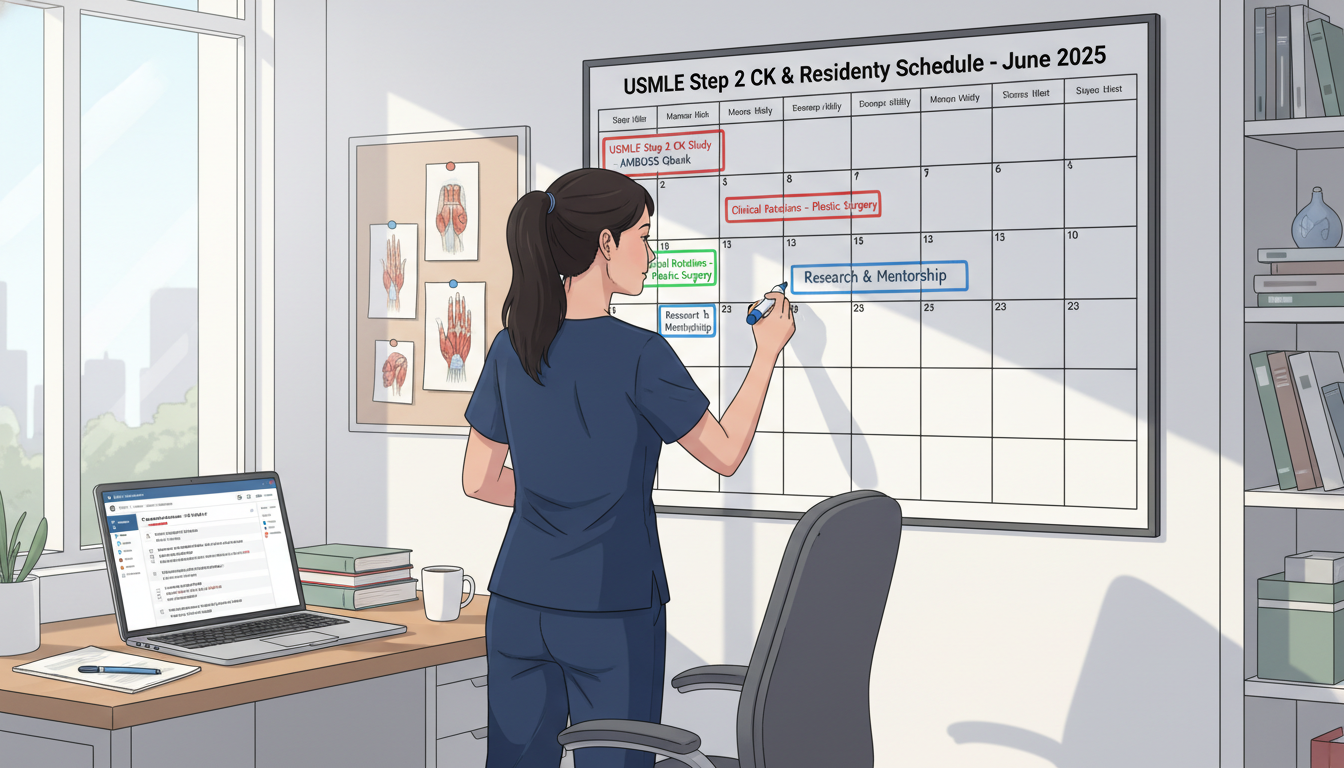
Core Resources and How to Use Them Effectively
1. Question banks: the backbone of Step 2 CK preparation
For a DO graduate aiming at plastic surgery, question banks (Qbanks) are your most high-yield tool. Treat them like a job.
Primary Qbank: UWorld Step 2 CK
- Use as your main learning resource
- Goal: Complete at least one full pass; ideally 1.2–1.5 passes
- Focus on:
- Doing tutor mode early → understand logic and explanations
- Shifting to timed blocks closer to the exam
- Carefully reviewing explanations and tables, not just right/wrong answers
Practical tips:
- Early phase:
- 40–80 questions/day in tutor mode, organ-system or rotation-based
- Dedicated phase:
- 2–4 blocks of 40 questions/day in timed or timed-tutor mode
- Detailed review immediately afterward, with notes
Secondary Qbanks (optional):
- AMBOSS Step 2 CK
- Useful if you complete UWorld early and still have time
- Strong on explanations and “why not the other options” reasoning
For a DO in plastic surgery:
- If time is tight, master UWorld rather than spreading thin across multiple banks.
- Use surgery and trauma questions as an opportunity to subtly reinforce the kinds of decision-making relevant to a surgical field.
2. Content review resources
While Step 2 CK is primarily a clinical reasoning exam, some structured content review helps, especially if you’ve had gaps in certain rotations.
Common high-yield references:
- Master the Boards Step 2 CK or similar concise review text
- Online MedEd videos and notes for conceptual clarity on core medicine topics
- Step-Up to Medicine (especially if internal medicine is a relative weakness)
For a DO plastic surgery applicant:
- Prioritize topics relevant to surgical and perioperative care:
- Preoperative risk assessment
- Postoperative complications (DVT, PE, infections, wound dehiscence)
- Burn management
- Fluid and electrolyte management
- Trauma primary survey and stabilization
- Remember: plastic surgery residency is not tested directly, but your surgical thinking and recognition of acute emergencies are.
3. NBME practice exams and score prediction
For USMLE Step 2 CK preparation, NBME practice exams are crucial:
- Take at least 2–3 NBMEs during your preparation:
- One at the start of dedicated → baseline
- One at midpoint → detect gaps and trends
- One 7–10 days before exam → final check
Interpreting scores:
- NBME scores often underestimate final Step 2 CK by ~3–8 points, but this varies.
- Track progression rather than any single point.
- If you are below your minimum target (for plastic surgery, often ~245+), consider:
- Extending your exam date (if feasible)
- Adjusting your study strategy (more questions, targeted review)
4. DO-specific additions: OMT and integration with COMLEX
While Step 2 CK doesn’t test osteopathic manipulative treatments, DO training can be an asset:
- Your OMM knowledge builds a deeper understanding of functional anatomy, which aligns well with surgical thinking.
- Integration strategy:
- Study OMM and COMLEX-specific topics briefly but regularly (e.g., 30–45 minutes/day during peak Step 2 CK prep if COMLEX is also upcoming).
- Use concise OMM resources rather than bulky textbooks.
Even though the USMLE won’t ask about OMT techniques directly, the discipline and pattern recognition skills you gain from OMM prep support your overall exam reasoning.
Daily Study Structure and Example Schedules
1. Principles of an effective study day
For intensive dedicated USMLE Step 2 study, structure matters more than sheer hours:
- Aim for 8–10 focused hours per day during full dedicated periods.
- Divide your time into:
- Question blocks (core)
- Content review (targeted)
- Anki or spaced repetition (if you use it)
- Brief wellness / exercise breaks
General flow:
- Morning: Fresh mind → new question blocks
- Midday: Deep review of explanations and high-yield topics
- Afternoon: Additional blocks & focused weak-area review
- Evening: Light review / flashcards / NBME correction if needed
2. Sample 6-week dedicated schedule for a DO headed toward plastics
Weeks 1–2: Foundation and baseline
- 2 blocks of UWorld (tutor or timed-tutor) daily → 80 questions
- 3–4 hours of content review focusing on:
- Internal medicine (cards/pulm/renal/endocrine)
- Surgery basics and perioperative management
- Finish week 1 with:
- NBME #1 → identify weak systems
Weeks 3–4: High-production mode
- 3–4 blocks/day UWorld in timed mode → 120–160 questions
- 2–3 hours/day:
- Reviewing marked questions
- Targeted reading (Master the Boards / Online MedEd)
- End of week 3 or start of week 4:
- NBME #2 → adjust strategy, emphasize weak topics (e.g., OB, psych, pediatrics if underperforming)
Weeks 5–6: Refinement and exam rehearsal
- 2–3 blocks/day, focused on:
- Mixed blocks to simulate real exam
- Re-doing key incorrect or flagged questions
- 2–3 hours/day:
- Rapid review of high-yield tables, algorithms, and notes
- Practice for stamina (e.g., doing 3–4 blocks in a row)
- 7–10 days before exam:
- NBME #3 → final readiness assessment
- Final 3–4 days:
- Light question practice (1–2 blocks/day)
- Quick review of must-know algorithms and last-minute notes
- Sleep and routine stabilization
Linking Step 2 CK Prep to a Strong Plastic Surgery Application
1. How your Step 2 CK score fits into the integrated plastics match
Plastic surgery residency programs evaluate you as a package. Your Step 2 CK score joins:
- Clerkship grades (especially surgery and medicine)
- Letters of recommendation from plastic surgeons or surgical mentors
- Research productivity (posters, manuscripts, case reports)
- Sub-internship (away rotation) performance
- Personal statement and narrative
Your goal as a DO graduate is to make Step 2 CK:
- Evidence of excellence, not just adequacy
- A platform you can refer to in your story: “I can handle the academic and cognitive demands of complex surgical training.”
If you achieve a strong Step 2 CK score:
- Mention it early in your ERAS application.
- Ensure your letter writers are aware, as some will subtly reference your exam performance as a sign of diligence and fund of knowledge.
- If you had a weaker Step 1 or COMLEX Level 1, explicitly frame Step 2 CK as part of an upward trajectory.
2. If your Step 2 CK score is lower than you hoped
Not every DO applicant will hit the 250+ range. If your score is weaker:
Do not panic.
Plastic surgery is holistic; a below-average score can be offset by:- Truly outstanding clinical performance and narrative evaluations
- Strong, personalized letters from plastic surgeons
- High-impact research in plastic surgery
- Demonstrated grit, resilience, and leadership
Strategize your application list:
- Include a balanced range of programs, with some known to be more DO-friendly.
- Consider whether to also apply to general surgery programs as an alternative route, especially if committed to eventually pursuing plastics (e.g., via independent fellowship).
Control the rest of the narrative:
- Emphasize how your USMLE Step 2 study process taught you discipline and time management.
- Highlight your strengths (e.g., surgical skills, professionalism, research productivity) as primary reasons you are a strong match for plastics.
3. Using Step 2 CK prep to sharpen clinical skills on rotations
Your USMLE Step 2 CK preparation doesn’t exist in a vacuum—it should enhance your clinical work, which in turn supports your letters and evaluations.
Practical integration while on surgery or plastics rotations:
- Spend 30–40 minutes at the end of each clinical day:
- Doing 1 UWorld block on surgery or relevant internal medicine topics
- Looking up one question related to each case you saw that day (e.g., flap coverage, wound healing, burn depth)
- Bring that knowledge back the next day:
- Ask a thoughtful question or suggest evidence-based approaches when appropriate.
- This shows your attendings that you’re not only studying for tests but also applying knowledge to patient care.
Program directors want residents who:
- Learn quickly
- Apply evidence to clinical decision-making
- Can handle the cognitive demands of a complex, artistic, and technically demanding field like plastic surgery
Your Step 2 CK preparation is an excellent training ground for exactly those qualities.
Practical Tips and Common Pitfalls for DOs Studying for Step 2 CK
1. Avoid these common mistakes
- Waiting too long to start questions:
Relying on reading instead of UWorld early on reduces your test-taking growth. - Over-resourcing:
Using five different textbooks and three Qbanks instead of mastering a core set. - Ignoring non-surgery content:
Step 2 CK is broad. Weak pediatrics, psychiatry, or OB can significantly drag your score, even if you love surgery. - Neglecting wellness:
Burnout reduces retention and test performance more than a single extra study block improves it.
2. Leverage your strengths as a DO graduate
- You’re used to balancing multiple exams (COMLEX and USMLE).
- You’ve had training that emphasizes:
- Comprehensive patient evaluation
- Functional anatomy
- Systems-based thinking
Use these to:
- Approach case vignettes holistically: not just “what is the diagnosis?” but “what is the next best step in management considering the whole patient?”
- Recognize patterns of compensation and dysfunction, which is directly applicable to trauma, wound healing, and reconstructive considerations.
3. Build exam-day readiness
In the final 1–2 weeks before Step 2 CK:
- Do at least a couple of full exam-length days:
- 7–8 blocks of 40 questions with short breaks
- Mimic timing and nutrition you’ll use on test day
- Prepare logistics:
- Comfortable clothing
- Approved snacks and hydration
- Travel and sleep plan for the night before
Psychological readiness matters. Plastic surgery demands performing under pressure; Step 2 CK is an early test of that composure and stamina.
FAQs: USMLE Step 2 CK Preparation for DO Graduates in Plastic Surgery
1. As a DO, is Step 2 CK absolutely necessary if I have COMLEX for applying to plastic surgery?
For highly competitive specialties like plastic surgery, yes, Step 2 CK is strongly recommended, if not effectively mandatory. Many programs are more familiar with USMLE scores and still use them as standardized comparison tools. Even if a program “accepts COMLEX,” a strong Step 2 CK score increases your chances of being taken seriously in the integrated plastics match.
2. How high does my Step 2 CK score need to be to have a realistic shot at integrated plastic surgery residency as a DO graduate?
There is no official cutoff, but realistic competitiveness often starts in the mid-240s, with many matched applicants scoring 250+. As a DO, a score above 250 is particularly powerful because it shows you are at or above the level of the top MD applicants. That said, some applicants with lower scores match due to exceptional research, clinical performance, letters, and fit.
3. Can I still match plastics if my Step 2 CK score is below my target (e.g., under 240)?
Yes, but the path gets narrower, and strategy becomes critical. You’ll want to:
- Strengthen other parts of your application aggressively (research, letters, sub-internships).
- Apply broadly and consider both DO-friendly programs and general surgery as a parallel path.
- Frame your narrative to emphasize growth, resilience, and strengths not fully captured by a single exam score.
4. How do I balance rotations, research, and Step 2 CK preparation as a DO interested in plastic surgery?
Think in phases:
- During core rotations: 20–40 UWorld questions/day + brief focused review.
- During research blocks: ramp up to 60–80 questions/day plus more content review.
- During dedicated: treat Step 2 CK preparation like a full-time job (8–10 focused hours/day).
Communicate with your research mentors about your exam timeline, and schedule the most intense Phase of your USMLE Step 2 study during lighter clinical or research obligations whenever possible.
By approaching USMLE Step 2 CK preparation with a clear strategy, disciplined question practice, and a focus on how it strengthens your plastic surgery residency application, you can transform this exam from a hurdle into a major asset—one that signals to competitive integrated plastics programs that a DO graduate can excel at the highest levels of academic surgery.




















