
Understanding Step 2 CK in the Context of a Neurosurgery Application
As a DO graduate targeting neurosurgery, your USMLE Step 2 CK preparation is not just about passing another exam; it is one of the few objective metrics programs can still use to compare applicants. With many programs moving away from Step 1 numerical scores and with persistent bias against DO graduate residency candidates in some academic centers, your Step 2 CK score can carry disproportionate weight—especially for competitive fields like neurosurgery and brain surgery residency pathways.
For DO graduates, there are three realities to keep in mind:
Neurosurgery is one of the most competitive specialties.
Programs are small, faculty know each other, and they tend to screen heavily on metrics before even considering your letters, research, or audition rotations.Step 2 CK has become the primary standardized metric.
While COMLEX scores matter, many neurosurgery programs (especially university-based) use USMLE Step 2 CK as their benchmark because it’s what they know best. A strong Step 2 CK score can help “translate” your DO background for MD-heavy selection committees.Your score is not everything, but it often determines whether your application is read.
Outstanding research, strong Sub-I performance, and robust letters are crucial, but without a competitive Step 2 CK score, your chances of even getting interviews at many neurosurgery programs drop drastically.
The good news: with disciplined planning and neurosurgery-specific prioritization, DO graduates can absolutely post Step 2 CK scores that align with top neurosurgery residency expectations and significantly strengthen their osteopathic residency match prospects.
Setting Strategic Score Goals for DO Applicants in Neurosurgery
Before you design your USMLE Step 2 study plan, you need a realistic and informed target. Your Step 2 CK score must be interpreted in the context of neurosurgery competitiveness and the osteopathic pathway.
What Is a Competitive Step 2 CK Score for Neurosurgery?
Exact “cutoffs” vary, but for a DO graduate seeking neurosurgery:
Highly competitive for academic neurosurgery programs
Aim for: ≥ 255
This will place you in a range that commands attention, especially if paired with strong research and Sub-I performance.Solidly competitive / viable at many programs
Aim for: 245–254
You may still be filtered out from the very top-tier programs, but many programs will seriously consider you if the rest of your application supports neurosurgery interest and capability.Borderline for neurosurgery, but still workable with a strong application
235–244
In this range, your DO status and the intense competition mean your success will depend heavily on research productivity, exceptional letters, and outstanding audition rotations.
Below 235, it becomes increasingly difficult to match into neurosurgery as a DO, though not impossible if you have unique strengths (e.g., robust research portfolio, dual degrees, prior career, or relationships with programs) and you are flexible geographically.
How Step 1 and COMLEX Scores Influence Your Strategy
Your existing exam history should shape your Step 2 CK preparation:
If your Step 1/COMLEX Level 1 was strong (e.g., Step 1 pass with >240-equivalent COMLEX):
- Use Step 2 CK to reinforce your trajectory.
- Programs will expect you to maintain or exceed your performance.
- A drop-off raises questions, so aim for consistency.
If Step 1 or COMLEX Level 1 was average or below your neurosurgery goals:
- Step 2 CK becomes a key chance for redemption.
- You must plan for a more aggressive and structured study schedule.
- Your osteopathic residency match strategy might hinge on this improvement.
If you only have COMLEX and are deciding whether to take Step 2 CK:
- For neurosurgery, taking USMLE Step 2 CK is strongly recommended.
- Many neurosurgery programs do not fully understand COMLEX percentile distributions and may screen you out if they can’t compare you directly to MD peers.
Balancing Ambition with Realism
Set a primary score goal (e.g., 250) and a minimum acceptable target (e.g., 240):
- Primary Target: What you aim for with focused work.
- Minimum Target: A score below this should make you reconsider neurosurgery vs. related fields (neurology, PM&R with neuro focus, general surgery) if other parts of your application aren’t exceptional.
Write these numbers down, and revisit them weekly. They should shape your daily USMLE Step 2 study choices.
Designing a High-Yield Step 2 CK Study Plan as a DO Neurosurgery Applicant
Your study plan must balance test preparation with neurosurgery-specific clinical competence and the realities of your schedule—often heavy rotations and Sub-Is.

Step 1: Decide on Your Study Structure
Common structures:
Dedicated Study Period (4–8 weeks) between rotations
- Ideal if you can negotiate this with your school.
- Best option for a DO graduate in neurosurgery aiming for a top Step 2 CK score.
- Allows 8–12 hours/day of focused study and consistent question bank work.
Integrated Study During Rotations (3–6 months)
- Necessary if dedicated time is limited or impossible.
- More realistic during lighter rotations (e.g., outpatient, electives) than during demanding surgical services.
- Requires disciplined daily minimums (e.g., 40 UWorld questions/day).
Hybrid Approach
- Long, lower-intensity prep during a few months of rotations.
- Followed by a shorter dedicated block (2–4 weeks) for consolidation and NBME practice.
For a DO graduate targeting neurosurgery residency, the hybrid approach is often optimal: sustained prep to avoid cramming, plus a focused period for exam-mindset training.
Step 2: Build a Core Resource Stack
Don’t drown in resources. Neurosurgery applicants often overcomplicate their plan. You need depth, but Step 2 CK rewards mastery, not volume.
Essential Resources:
UWorld Step 2 CK QBank
- Non-negotiable. The foundation of your USMLE Step 2 study.
- Aim for 1.5–2 full passes if time allows.
- Do timed, random blocks once your baseline comfort improves.
- Review every explanation, not just for questions you missed.
NBME and Official Practice Exams
- NBME Comprehensive Clinical Science Exams (CCSE-style forms).
- UWSA 1 and UWSA 2 are highly predictive when done near your exam date.
- Use them to fine-tune your schedule and confirm readiness.
Anki or Spaced Repetition Decks
- Especially core for long-term retention and busy rotations.
- Use high-quality Step 2 CK decks (e.g., reviews based on UWorld concepts).
- Focus on high-yield IM, neuro, neurosurgical complications, emergency management.
Rapid Review Text / Videos
- Examples: Boards & Beyond clinical videos, OnlineMedEd, or similar.
- Use them to patch weak topics after question bank sessions.
Supplemental (Use if You Have Specific Weaknesses):
- Emma Holliday, Divine Intervention, or other high-yield review lectures
- Specialty texts:
- For neurology/neurosurgery: a concise neurology review, not a full neurosurgery textbook.
- For surgery: a Step 2 CK–oriented surgery review (e.g., Pestana-type content).
Avoid getting lost in full neurosurgery textbooks for Step 2 CK. This exam tests broad clinical medicine, not the depth of a neurosurgery residency.
Step 3: Sample 8-Week Dedicated Schedule
Adapt this to your own pace and diagnostic scores:
Weeks 1–2: Foundation & Diagnostics
- 40–60 UWorld questions/day (system-based, untimed, tutor mode if needed).
- 4–5 hours/day reviewing explanations and building Anki cards.
- Watch 2–3 hours of review videos for weakest subjects (e.g., OB, peds).
- Take a baseline NBME practice exam at the end of Week 1 or 2.
Weeks 3–5: Acceleration & Refinement
- 60–80 UWorld questions/day, transition to timed, random blocks by Week 4.
- Daily Anki (1–2 hours).
- Targeted video or text review:
- Extra focus on internal medicine, emergency medicine, and neuro.
- Use your NBME performance profile to prioritize weaker areas.
- Take a practice NBME or UWSA at the end of Week 4 or 5.
Weeks 6–7: Exam Simulation & High-Yield Focus
- Continue UWorld (up to 80 questions/day, random timed blocks).
- Begin redoing missed/marked questions.
- Take UWSA 1 and UWSA 2, spaced about 5–7 days apart.
- Use score reports to identify last-minute gaps (e.g., OB postpartum care, pediatric rashes, endocrine emergencies).
Week 8: Taper & Final Polish
- Light UWorld review (redo tough questions, focus on neuro, trauma, ICU scenarios).
- 1 final NBME or UWSA if you didn’t already reach 2–3 practice exams.
- Sleep hygiene, exercise, and mental rest are critical.
- Day before exam: no heavy studying—do light flashcard review and logistics planning.
If you’re studying alongside rotations, scale down daily UWorld (e.g., 20–40/day) and lengthen the timeframe to 3–4 months.
High-Yield Content Strategy for Future Neurosurgeons
You may feel tempted to over-study neurosurgery-like material (brain tumors, spinal instrumentation, endoscopic skull base surgery). Step 2 CK, however, emphasizes generalizable clinical decision-making. For neurosurgery-bound DOs, your focus should be:
- Be excellent in neuro and neurosurgery-adjacent topics, and
- Avoid glaring weaknesses in bread-and-butter medicine.
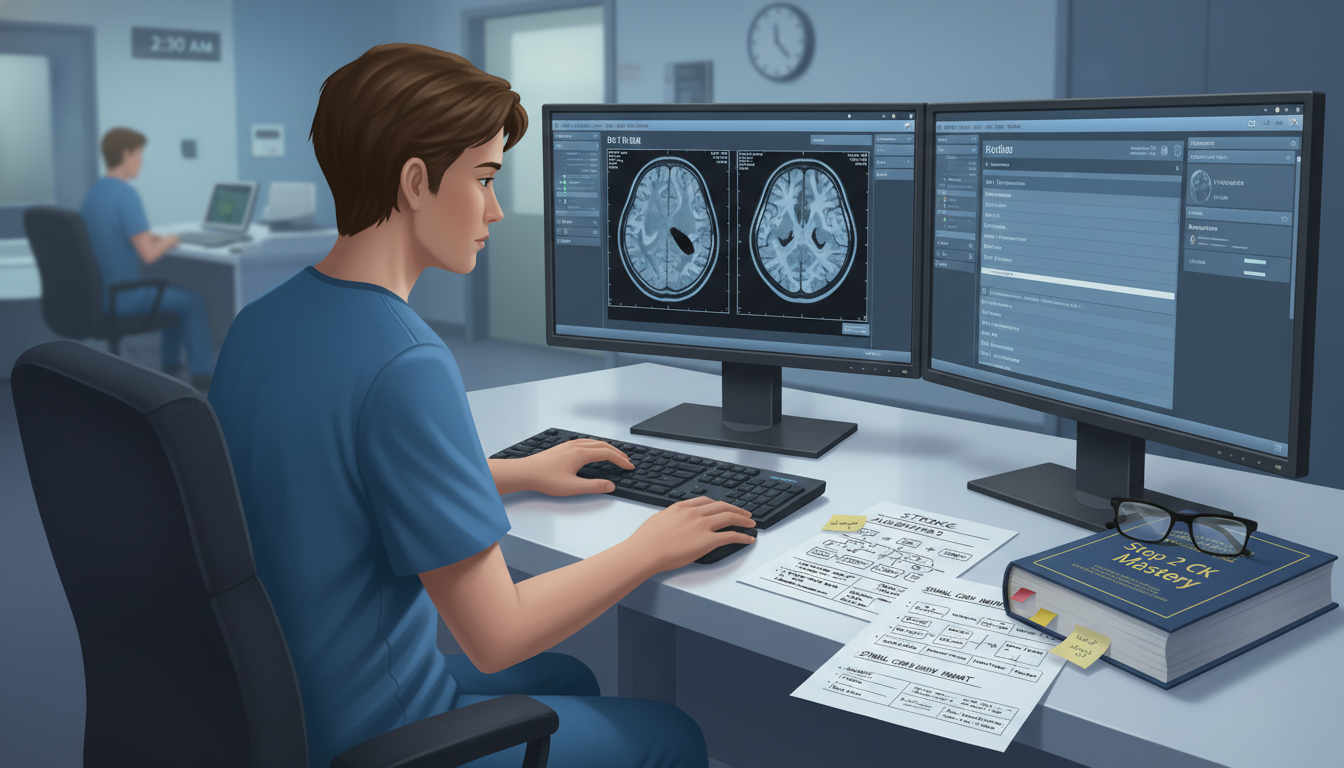
Neuro & Neurosurgery-Adjacent Topics You Must Master
These are areas where neurosurgery faculty might subconsciously expect you to excel:
Stroke and Intracranial Hemorrhage
- Distinguish ischemic vs. hemorrhagic presentations.
- Indications and contraindications for tPA, thrombectomy, and neurosurgical intervention.
- Blood pressure management targets, especially for intracerebral hemorrhage and subarachnoid hemorrhage.
- Complications such as vasospasm and hydrocephalus.
Traumatic Brain Injury (TBI) and Spine Trauma
- Glasgow Coma Scale (GCS) scoring and prognostic implications.
- Initial trauma assessment (ABCDE) in multi-trauma patients.
- When to order CT head vs MRI; red-flag findings.
- Indications for emergent neurosurgical referral (e.g., epidural hematoma, acute subdural, cord compression).
Spinal Cord Compression & Cauda Equina Syndrome
- Recognize urgent red flags: saddle anesthesia, urinary retention, severe motor deficits.
- Appropriate imaging (MRI spine with gadolinium).
- Initial management: steroids in specific cases (e.g., tumors) vs not in trauma, urgent surgical decompression.
Seizures and Epilepsy
- First-line treatments for focal vs generalized seizures.
- Status epilepticus management algorithms.
- When to image new-onset seizures.
- Basic understanding of post-op seizure management is helpful.
CNS Infections and Complications
- Meningitis vs encephalitis clinical features.
- Empiric antibiotic/antiviral therapy and timing of LP vs CT.
- Brain abscess management, indications for surgical drainage.
Brain Tumors (Basic Concepts)
- Recognize signs of increased intracranial pressure.
- Simple recognition of common adult vs pediatric tumors (glioblastoma, medulloblastoma, meningioma).
- Steroid use for vasogenic edema, seizure prophylaxis basics.
Bread-and-Butter Clinical Medicine You Cannot Neglect
Neurosurgery programs will notice if you fail Step 2 CK because you ignored OB or pediatrics. Your work as a resident will involve ICU management, post-op care, and multidisciplinary communication. Focus on:
Internal Medicine (largest exam portion):
- Cardiology: ACS, heart failure, arrhythmias, valve disease.
- Pulmonary: COPD, asthma, PE, pneumonia, ARDS.
- Endocrine: DKA, HHS, thyroid storm, adrenal crisis.
- Renal/electrolytes: AKI, CKD, acid–base disorders, hyponatremia/hypernatremia.
Emergency Medicine & Critical Care:
- Shock states, sepsis, fluid resuscitation, vasopressors.
- Airway management basics.
- Post-operative complications and ICU issues (DVT prophylaxis, ventilator management basics, delirium).
Obstetrics & Gynecology / Pediatrics / Psychiatry:
- You don’t need to be a specialist, but you must be safe and competent.
- OB: normal labor, postpartum hemorrhage, preeclampsia, ectopic pregnancy.
- Peds: vaccines, common infections, dehydration, failure to thrive.
- Psych: depression, bipolar disorder, schizophrenia, suicidality, substance use.
Leveraging Osteopathic Training
Your DO background gives you strengths you can emphasize, even in Step 2 CK preparation:
Holistic approach and strong physical exam skills:
These translate well to differential diagnosis questions and subtle history–exam clue integration.Musculoskeletal expertise:
You may find ortho, spine, and back pain questions more intuitive; leverage that to save time and mental energy.
Osteopathic principles and OMT are not directly tested on Step 2 CK, but your pattern-recognition abilities, musculoskeletal reasoning, and systems-based perspective can raise your clinical judgment—exactly what Step 2 CK evaluates.
Test-Taking Strategy, Timing, and Scheduling for DO Neurosurgery Applicants
Step 2 CK is a nine-hour stamina test as much as it is a knowledge test. For a DO graduate chasing neurosurgery, aligning timing with your neurosurgery application timeline is critical.
When Should You Take Step 2 CK?
For a DO entering the neurosurgery application cycle:
- Ideal window:
- Late spring to mid-summer of the year you apply (often between May–July of your 4th year).
- Why:
- You want your Step 2 CK score available before ERAS submission so that programs see your score when deciding who to interview.
- Taking it too late can limit your ability to use the score to “open doors” at neurosurgery programs.
If you are planning multiple neurosurgery Sub-Is/audition rotations, avoid taking Step 2 CK during your most demanding month if possible. Many DO graduates schedule Step 2 CK:
- After a neurology or general medicine-heavy rotation (for content reinforcement), and
- Before consecutive neurosurgery Sub-Is, so they can fully focus on clinical performance.
Simulating the Real Exam
To optimize your Step 2 CK score:
Practice full-length exam days:
- Once weekly in the last 3–4 weeks:
- Simulate 6–7 blocks of random UWorld questions in timed mode.
- Practice nutrition, hydration, and break patterns (e.g., 10–15 min break every 2–3 blocks).
- Once weekly in the last 3–4 weeks:
Refine your block strategy:
- Don’t spend more than ~75 seconds per question on first pass.
- Mark questions when uncertain, move on, and return if time allows.
- Practice reading vignettes efficiently—skim for age, setting (inpatient vs outpatient), vitals, and key physical exam findings first.
Analyze mistakes deeply:
- For every missed or guessed question, ask:
- Did I lack content knowledge?
- Did I misread the question?
- Did I fall for a distractor due to rushed logic?
- Adjust your study focus or test strategy accordingly.
- For every missed or guessed question, ask:
Managing Stress and Burnout
Neurosurgery applicants tend to push themselves aggressively. Yet cognitive performance degrades with sleep deprivation and chronic anxiety.
- Protect 7–8 hours of sleep, especially in the last 2–3 weeks.
- Schedule short, daily exercise sessions (15–30 minutes).
- Use simple mindfulness/breathing techniques before practice tests and on exam day.
- Avoid comparing your practice scores obsessively with peers, especially MD classmates; focus on your trajectory.
Frequently Asked Questions (FAQ)
1. As a DO graduate, do I really need USMLE Step 2 CK for neurosurgery?
For neurosurgery, yes—almost always. While a few osteopathic programs may consider COMLEX alone, most academic neurosurgery residency and brain surgery residency programs strongly prefer or effectively require USMLE Step 2 CK for direct comparison with MD applicants. Without it, you may be filtered out automatically at multiple programs, which can significantly weaken your osteopathic residency match prospects in neurosurgery.
2. How many UWorld questions should I complete for Step 2 CK?
Aim to complete all of UWorld at least once, ideally with a second pass of your weakest topics or all missed/marked questions. For a neurosurgery-oriented DO graduate, that often means 3,000–4,000+ questions total when including re-dos. Quality of review is more important than sheer volume: spend time understanding the “why” behind each answer and how to generalize the principle.
3. What if my Step 2 CK score is lower than I hoped for neurosurgery?
If your Step 2 CK score falls below your neurosurgery target:
- Be honest with yourself and with mentors.
- Analyze:
- Your absolute score
- Your overall application strength (research, Sub-Is, letters)
- Your geographic flexibility.
- If you’re still in a plausible range (e.g., 235–245) and have strong research and clinical evaluations, you can still apply neurosurgery, but consider a parallel plan (e.g., general surgery, neurology, or a prelim year).
- If your score is significantly below typical neurosurgery ranges, you may want to shift strategy early to minimize the emotional and financial toll of an unlikely match.
4. Can strong research and Sub-I performance compensate for a lower Step 2 CK score?
To a degree, yes—but not fully. In neurosurgery, interview offers often depend on meeting program-specific score screens. If your score is just below their threshold but you have:
- Significant neurosurgery research (abstracts, manuscripts, conference presentations),
- Multiple strong Sub-I evaluations with powerful letters from neurosurgeons, and
- A clear, sustained commitment to the field,
Some programs may look past a slightly lower Step 2 CK score. However, a very low score remains a major barrier. That’s why building your best possible Step 2 CK preparation strategy from the start is essential.
By aligning your USMLE Step 2 study approach with the realities of the osteopathic residency match and the intense competition of neurosurgery residency, you can use Step 2 CK not just as a hurdle, but as a strategic asset. With deliberate planning, consistent practice, and neurosurgery-focused prioritization, a DO graduate can achieve a Step 2 CK score that opens doors—and step confidently toward a future in neurosurgery.