
Why Step 2 CK Matters So Much for a Non‑US Citizen IMG in Anesthesiology
For a non-US citizen IMG aiming for anesthesiology residency, USMLE Step 2 CK is often the single most important academic factor you can still control at application time. Step 1 is now Pass/Fail, your medical school is fixed, and your visa status is what it is—but your Step 2 CK score is your most powerful lever.
Program directors in anesthesiology routinely use Step 2 CK as:
- A screening tool: Many programs have informal or formal score cutoffs.
- A predictor of success: They associate stronger clinical exam performance with the ability to manage complex perioperative patients.
- A way to compare IMGs to US grads: For a foreign national medical graduate, a high Step 2 CK score helps reduce concerns about unfamiliar schools or grading systems.
For a non-US citizen IMG in the anesthesia match, Step 2 CK can:
- Offset a less well-known medical school.
- Demonstrate readiness for high-acuity OR and ICU settings.
- Help compensate for late or limited US clinical experience.
- Strengthen your case if you need visa sponsorship (J-1 or H-1B).
Target score guidance (general, not absolute):
- Highly competitive for anesthesiology as a non-US citizen IMG:
Aim for ~245+ to be broadly competitive; 250+ will open more doors, especially in university programs. - Reasonably competitive:
Scores in the 235–245 range can still get interviews, especially with strong letters, US clinical experience, and a focused anesthesiology story. - Below this range:
You are not automatically out, but you must strengthen every other part of your application (research, strong anesthesia letters, US rotations, excellent personal statement, etc.).
The goal of your USMLE Step 2 study plan should therefore be:
“Maximize score potential on first attempt while building real clinical reasoning skills that translate to anesthesiology.”
Understanding Step 2 CK Through an Anesthesiology Lens
USMLE Step 2 CK is a clinical reasoning exam, not a pure knowledge test. For anesthesiology-minded IMGs, certain domains are particularly relevant and can also help you in interviews and rotations.
Core Content Areas with High Yield for Future Anesthesiologists
You will be tested across all specialties, but these areas are especially valuable for someone heading to anesthesiology residency:
Cardiology
- Perioperative risk stratification (Revised Cardiac Risk Index, functional capacity).
- Acute coronary syndromes, arrhythmias, valvular disease.
- Heart failure management, especially in acutely ill patients.
- Understanding which patients need further workup before surgery (e.g., stress testing, echo).
Pulmonology & Critical Care
- Management of acute respiratory failure (ARDS, COPD exacerbations, asthma).
- Ventilator settings, oxygenation vs ventilation problems, ABG interpretation.
- Pulmonary hypertension, sleep apnea, and pre-op assessment of lung disease.
Neurology
- Stroke, seizures/status epilepticus, intracranial hemorrhage.
- Perioperative concerns in neurologic disease (e.g., myasthenia gravis, neuromuscular disorders).
- Post-op delirium and emergence phenomena.
Nephrology & Fluid/Electrolytes
- Acute kidney injury, chronic kidney disease, dialysis indications.
- Acid-base disorders and compensation; interpretation of metabolic vs respiratory changes.
- Perioperative fluid management, sodium/potassium disturbances.
Endocrinology
- Diabetes management perioperatively (insulin regimens, DKA, HHS).
- Adrenal crisis, steroid stress dosing.
- Thyroid storm vs myxedema coma, peri-op concerns in hyper/hypothyroidism.
Emergency Medicine and Surgery
- Trauma management (ATLS principles, shock states).
- Sepsis recognition and early management.
- Acute abdomen, post-op complications, bleeding, DVT/PE.
Ethics, Communication, and Patient Safety
- Informed consent, capacity, and dealing with surrogates or language barriers.
- Do-not-resuscitate orders in the OR vs ICU.
- Handoffs and error prevention—highly valued in anesthesiology culture.
These domains mirror what anesthesiologists handle daily in the OR, PACU, and ICU. Strong performance in them not only raises your Step 2 CK score but builds credibility as a future anesthesia resident.

Building a High-Yield Step 2 CK Study Strategy as a Non‑US Citizen IMG
Your Step 2 CK preparation has to account for several realities that many US students don’t face: visa concerns, possible financial limitations, and sometimes distance from US clinical systems. A structured, realistic approach is essential.
1. Set a Clear Timeline Backwards from the Application Cycle
For anesthesiology residency, you want your Step 2 CK score available before programs start reviewing applications—typically by early to mid‑September of the application year.
Because scores take about 2–4 weeks to report:
- Plan to take Step 2 CK by late July or August at the latest in your application year.
- If you feel underprepared by that time, weigh the risks of:
- Taking it “on time” but unprepared vs.
- Delaying the exam and applying later or in a different cycle.
For many non-US citizen IMGs, a strong score is more important than being early by a few weeks. However, do not delay so late that you lack a score for the entire interview season.
2. Assess Your Baseline and Set a Target
Before designing your USMLE Step 2 study plan:
- Take a self-assessment:
- NBME forms or UWorld self-assessments (UWSA) are good.
- If your baseline is below 220, you likely need:
- 4–6 months of structured, consistent study.
- If your baseline is 220–235, you may need:
- 3–4 months with strong focus and full-time effort.
- If your baseline is 235+, you might consolidate in:
- 2–3 months, especially if you recently finished clinical rotations.
Adjust for your situation:
- Working or in internship? You may need longer.
- Full‑time studying with financial support? You can compress the timeline.
3. Choose and Limit Your Core Resources
Effective Step 2 CK preparation does not require a huge number of books. It requires deep mastery of a few high‑yield tools:
Essential:
Question Bank (QBank) – UWorld Step 2 CK
- Use it as your primary learning tool, not just for testing.
- Try to complete at least one full pass (ideally 1.25–1.5 passes).
- Do 40–80 questions per day, timed, random, to build exam stamina.
A Concise Review Book or Digital Resource
- Options include resources like Step 2 CK review texts (e.g., Step-Up to Medicine, Master the Boards, or a concise systems-based review).
- Use this:
- If your clinical base is weaker in certain specialties.
- Between QBank blocks to reinforce patterns and guidelines.
NBME/UWSA Self-Assessments
- Use 2–4 practice tests to gauge progress.
- Schedule:
- One at baseline.
- One around the midpoint.
- One 2–3 weeks before the exam.
- Optional final assessment 7–10 days before the exam.
Optional, use with discipline:
- Online video lecture series (for weak areas or if you prefer audio-visual learning).
- Anesthesiology-specific resources:
- Not needed for Step 2 CK itself, but during your preparation you may occasionally review basic anesthesia topics (airway management, sedation levels) for your own interest. These are not extensively tested but can help connect concepts.
Avoid getting lost in too many tools; quality of engagement beats quantity of materials.
4. Design a Daily and Weekly Study Structure
Your USMLE Step 2 study should be structured enough to drive progress, but flexible enough to handle real-life disruptions.
Example full-time study day (8–10 hours):
Morning (4 hours)
- 2 timed blocks of QBank (40 questions each).
- Short break between blocks.
Afternoon (3–4 hours)
- In-depth review of morning questions:
- Read explanations for all questions—right and wrong.
- Take short notes or concept cards for recurrent themes (e.g., peri-op beta blocker use).
- In-depth review of morning questions:
Evening (1–2 hours)
- Targeted reading or video for weak topics identified in QBank.
- Light review of high-yield notes.
If you are working or in clinical rotations:
- Weekdays (2–4 hours/day):
- 20–40 QBank questions timed.
- Short review and annotation.
- Weekends (6–8 hours/day):
- Larger QBank sets.
- Longer content review.
- Practice exams every 2–3 weeks.
5. Adapt for the Non-US Citizen IMG Context
As a foreign national medical graduate, you might face:
- Different clinical practice norms (guidelines may differ from US standard of care).
- Less familiarity with US-style multiple-choice testing.
- Language or speed challenges (reading pace in English).
Address these directly:
- Focus on US guidelines:
- Always trust QBank and NBME perspective over your local guidelines for exam answers.
- Practice timed blocks from early on:
- Do not wait until the end to simulate exam conditions.
- Reading speed and decision efficiency are critical to score gains.
- Language refinement:
- If English is not your first language, read question stems aloud quietly or mentally, focusing on key phrases.
- Build a personal glossary of terms or phrases you find confusing.
Step-by-Step: Phases of Step 2 CK Preparation
Breaking your USMLE Step 2 preparation into phases keeps you on track and reduces anxiety.
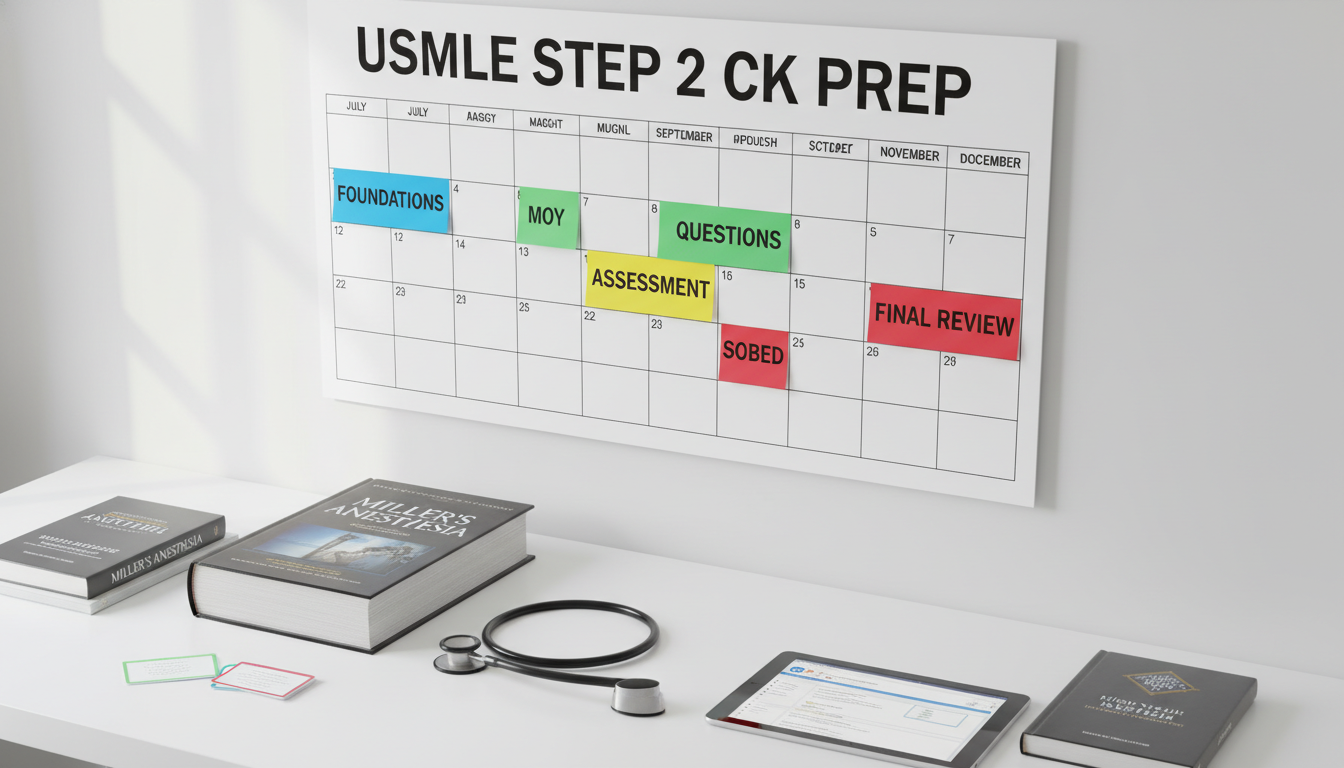
Phase 1 (Weeks 1–4): Foundation and Orientation
Goals:
- Understand the exam format and content weighting.
- Strengthen weak foundational areas.
- Learn how to use your QBank effectively.
Actions:
- Take a baseline NBME/UWSA to assess your starting level.
- Begin QBank in subject/tutor mode if you are very weak, or mixed/timed if your base is solid.
- Create a topic-based review schedule:
- E.g., Week 1: Cardiology/Pulmonology; Week 2: Infectious Disease/Nephrology, etc.
- Start making short, focused notes:
- For example: “Peri-op management of antiplatelets for stent patients” or “Pre-op evaluation of COPD patient for elective surgery.”
Phase 2 (Weeks 5–10): Intensive QBank and Systems Integration
Goals:
- Complete most of your QBank (60–75%).
- Move to random, timed blocks to simulate exam conditions.
- Build endurance for 8–9 hours of focused mental work.
Actions:
- Do 40–80 questions daily, strictly timed.
- After each block:
- Mark why you got each question wrong: knowledge gap vs misreading vs time pressure.
- Track recurring themes, especially in anesthesia-relevant domains like hemodynamic instability, shock states, post-op complications.
- At the midpoint (around Week 6–7):
- Take another NBME/UWSA.
- Analyze performance by specialty and question style.
If you are significantly below your target Step 2 CK score (e.g., more than 15–20 points away), consider:
- Extending your preparation timeline.
- Reducing non-essential commitments if possible.
- Adding focused review in your weakest systems (for many IMGs: psychiatry, ethics, or US-style preventive medicine).
Phase 3 (Weeks 11–13): Refinement and Simulation
Goals:
- Finish QBank (or at least 90%).
- Practice full-length exam simulations.
- Close remaining knowledge gaps.
Actions:
- Schedule at least one full 8‑block mock exam (mixed QBank blocks or an official practice test plus QBank).
- Focus on:
- Stamina: No long breaks, mimic exam timing strictly.
- Break strategy: Plan how you will divide your available break time on exam day.
- Finish any remaining high-yield topics:
- E.g., emergency medicine protocols, OB/GYN emergencies, pediatric resuscitation.
- Take another NBME/UWSA about 2–3 weeks before the real test:
- If close to target: stay on course.
- If far from target: reevaluate your test date.
Phase 4 (Final 7–10 Days): High-Yield Review and Mental Preparation
Goals:
- Consolidate, not cram.
- Build confidence and mental calm.
- Sharpen test-day strategy.
Actions:
- Review your personal notes and marked QBank questions.
- Revise key clinical frameworks:
- Types of shock and management ladders.
- Initial management of chest pain, stroke, sepsis, GI bleed, DKA, etc.
- Perioperative risk management algorithms.
- Practice 1–2 shorter timed blocks daily to stay sharp.
- In the last 2–3 days:
- Reduce question load.
- Focus on sleep hygiene and nutrition.
- Avoid starting entirely new resources.
Exam Day Strategy and Common Pitfalls for Non‑US Citizen IMGs
A strong Step 2 CK preparation plan is incomplete without a clear exam-day approach, especially if you are not accustomed to US testing centers or 9‑hour standardized exams.
Logistics and Environment
- Visit or research your Prometric test center in advance:
- Know travel time, traffic expectations, and local transport.
- Bring:
- Valid ID, permit, earplugs (if allowed), light snacks, and water.
- Dress in layers—testing rooms can be very cold or warm.
Time and Break Management
- You have 8 blocks and a total time limit for breaks.
- Common strategy:
- Short break (5–8 minutes) after every 1–2 blocks.
- Longer break (10–15 minutes) around the middle of the exam for food and restroom.
- As an IMG, test-day anxiety may be higher due to visa and career stakes; pre-planning helps.
In-Block Strategy
First Pass:
- Answer straightforward questions quickly.
- If uncertain but can narrow to 2 choices, mark and move on.
Flagging:
- Flag questions only if you truly have a chance to reconsider.
- Don’t over-flag; it wastes time at the end.
Language and Reading Speed:
- If English is not your first language, focus on:
- First and last sentences of the vignette.
- Vital signs, labs, key descriptors (e.g., “sudden onset,” “gradually worsening”).
- Avoid rereading full vignettes multiple times; rely on pattern recognition and structure.
- If English is not your first language, focus on:
Don’t Overthink “Local” vs US Guidelines:
- Always answer according to US practice standards, as reflected in UWorld/NBME.
- If something differs from your country’s norms, trust the exam perspective.
Common Pitfalls to Avoid
- Overemphasis on rare facts instead of common presentations.
- Ignoring ethics/communication questions, which are high-yield and often easier points.
- Cramming new resources in the final week—this usually dilutes focus and weakens recall.
- Scheduling the exam too early just to have a score:
- As a non-US citizen IMG, a low Step 2 CK score can be more harmful than applying a bit later with a stronger score.
Linking Your Step 2 CK Success to Anesthesiology Residency
A strong Step 2 CK score is not just a number; it must integrate into a coherent anesthesiology narrative in your application.
How Programs View Step 2 CK in the Anesthesia Match
For anesthesiology residency, program directors often interpret a strong Step 2 CK score as:
- Evidence of solid clinical reasoning under pressure.
- An indicator that you can handle:
- Complex perioperative decision-making.
- ICU/critical care rotations.
- Rapid changes in patient status.
As a non-US citizen IMG, you want your Step 2 CK performance to reassure them that:
- You will pass in-training exams and board exams.
- You are capable of practicing at the level of US MD/DO counterparts.
- You are worth the administrative effort of visa sponsorship.
How to Highlight Step 2 CK in Your Application
Personal Statement and ERAS Application
- You don’t need to explicitly state your Step 2 CK score, but you can:
- Emphasize how your clinical reasoning and patient care have developed.
- Mention how your exam preparation deepened your understanding of perioperative medicine.
- You don’t need to explicitly state your Step 2 CK score, but you can:
Interviews
- If asked about your Step scores:
- Explain briefly how your USMLE Step 2 study strengthened your ability to manage complex cases.
- Give clinical examples:
- “While preparing for Step 2 CK, I studied many scenarios involving shock and respiratory failure; this aligned closely with what I saw during my anesthesia observership…”
- If asked about your Step scores:
Letters of Recommendation
- Strong anesthesia letters that comment on your clinical reasoning, ICU/OR performance, and reliability will complement a strong Step 2 CK score and amplify its value.
Backup Planning and Resilience
If your Step 2 CK score is below your target:
- All is not lost. You can:
- Increase focus on:
- US clinical experience (especially anesthesia and ICU).
- Strong letters and a compelling story.
- Apply broadly, including:
- Community programs.
- Programs historically more open to IMGs.
- Increase focus on:
- Consider improving other metrics:
- Clinical research with anesthesiology faculty.
- Presentations or publications.
- Additional US rotations where possible.
Your Step 2 CK score is important, but not the sole determinant of your success as a foreign national medical graduate in anesthesiology.
FAQs: Step 2 CK Preparation for Non‑US Citizen IMGs in Anesthesiology
1. What Step 2 CK score should a non-US citizen IMG aim for to be competitive in anesthesiology residency?
For a non-US citizen IMG in the anesthesia match, aiming for 245+ is a strong goal, with 250+ significantly improving your chances at university and more competitive programs. Scores in the 235–245 range can still be workable if combined with strong anesthesiology letters, US clinical experience, and a coherent application story. Always remember: higher is better, but no single score guarantees or excludes you from matching.
2. How much time should I plan for USMLE Step 2 preparation if I’m an IMG still doing internship or working?
If you are working full-time or in a demanding internship, plan for 4–6 months of structured preparation, with 2–4 hours on weekdays and longer sessions on weekends. If you have full-time study availability, many candidates can prepare effectively in 3–4 months, provided they use a high-yield QBank and stay disciplined.
3. Do I need anesthesiology-specific resources for Step 2 CK?
No. Step 2 CK is a broad clinical exam. While some perioperative and critical care principles overlap with anesthesiology, the exam itself is not anesthesia-specific. Focus on:
- A strong QBank (e.g., UWorld).
- Solid coverage of internal medicine, surgery, OB/GYN, pediatrics, psychiatry, and emergency medicine. Anesthesiology resources are more helpful later, for interviews and actual residency.
4. Should I delay my residency application to retake Step 2 CK if my score is low?
This is highly individual. Consider:
- How far your current score is from typical anesthesiology match ranges for non-US citizen IMGs.
- Whether you realistically believe you can significantly improve with more time.
- The impact of delaying applications by one cycle (visa timelines, personal finances, etc.). Many IMGs do better by focusing on maximizing their first attempt, since retakes remain visible. If your score is modest but passing, you may still match by:
- Applying more broadly.
- Strengthening your anesthesiology narrative, research, and letters of recommendation. Discuss with mentors or advisors familiar with IMG anesthesiology placements before deciding on a retake strategy.
With a structured USMLE Step 2 CK preparation plan, smart resource use, and an anesthesiology-focused mindset, a non-US citizen IMG can turn Step 2 CK into one of the strongest assets in their anesthesiology residency application.