Why Step 2 CK Matters So Much for Non‑US Citizen IMGs Targeting Interventional Radiology
For a non-US citizen IMG aiming for interventional radiology residency, Step 2 CK is not just another exam—it can be the single most powerful part of your application after your clinical performance. With many interventional radiology (IR) programs receiving hundreds of applications for a few integrated (IR/DR) and independent IR positions, a strong Step 2 CK score often serves as:
- A filter to secure interview offers
- A signal that you can handle highly complex decision-making
- A way to compensate for disadvantages such as being a foreign national medical graduate from a less-known school or having a pass/fail Step 1
Because many non-US citizen IMGs face additional challenges—visa sponsorship, limited US clinical experience (USCE), and less access to home-institution IR mentors—your USMLE Step 2 study strategy must be both efficient and high-yield.
This guide focuses on USMLE Step 2 CK preparation specifically for the non-US citizen IMG pursuing interventional radiology, and how to use this exam to strengthen your overall IR match profile.
Understanding Step 2 CK in the Context of the IR Match
Why Step 2 CK is Crucial for IR Applicants
Interventional radiology is one of the most competitive specialties. Program directors know that IR residents must:
- Manage acutely ill patients pre‑ and post‑procedure
- Make rapid clinical decisions based on evolving data
- Understand internal medicine, surgery, critical care, and emergency medicine
Step 2 CK directly evaluates clinical reasoning in these domains. For an IR-bound foreign national medical graduate, your Step 2 CK score:
Shows readiness for US clinical training
Program directors worry whether non-US graduates can adapt quickly to US systems. A strong Step 2 CK score reduces that uncertainty.Balances or replaces Step 1 as a numeric metric
With Step 1 now pass/fail for many applicants, Step 2 CK becomes the main standardized number programs can compare across schools and countries.Offsets “IMG disadvantages”
A high Step 2 CK score can partially compensate for:- Lesser-known medical schools
- Lack of a home IR program
- Visa requirement (J‑1 or H‑1B)
Supports your interest in IR
Although Step 2 CK doesn’t test IR procedures directly, high performance in:- Internal medicine
- Emergency medicine
- Surgery
- Critical care
aligns with the clinical backbone of IR.
What Score Range Is Competitive for IR as a Non‑US Citizen IMG?
Score expectations vary each year, but for a non-US citizen IMG targeting interventional radiology residency, you should aim to be well above the national mean.
While exact cutoffs change and programs evaluate holistically, a useful mental framework:
- Above average (solid): Around or somewhat above the national mean
- Highly competitive: Significantly above the national mean
- For IR as an IMG: The higher, the better—treat Step 2 CK as a major opportunity to stand out.
Because you are a foreign national medical graduate, many IR/DR programs may have implicit or explicit score filters. You want your Step 2 CK score high enough that your application gets a careful read rather than an automatic rejection.
Building a Step 2 CK Study Strategy as a Non-US Citizen IMG

Step 1: Define Your Timeframe and Constraints
Non-US citizen IMGs often have additional constraints:
- Clinical rotations or internship in your home country
- Visa processing timelines
- Need to align your IR match cycle (ERAS, interviews, rank list)
Your USMLE Step 2 study timeline should consider:
- Ideal dedicated period: 6–10 weeks of full-time study if possible
- If working/doing internship: 3–6 months of part-time prep, then 4–6 weeks of more intense focus
- Target exam date: At least 2–3 months before ERAS submission so your Step 2 CK score is available when you apply
Example planning:
- Planning to apply for IR residency in September 2027
- Aim to take Step 2 CK by June or July 2027
- Start structured prep (lower intensity) 6–9 months earlier
Step 2: Baseline Assessment
Before serious USMLE Step 2 study, evaluate your starting point:
- Review your Step 1 performance (if taken with score)
- Assess your comfort with:
- Internal medicine
- Surgery
- OB/GYN
- Pediatrics
- Psychiatry
- Emergency medicine
Take a baseline self-assessment within the first 1–2 weeks:
- NBME or UWorld Self-Assessment (UWSA)
- Use the score not to panic, but to adjust your plan:
- Weak foundations → More time reviewing core content
- Strong foundations → Earlier heavy emphasis on question banks (Qbanks)
Step 3: Core Resources and How to Use Them
You do not need 10 different resources. As a busy non-US citizen IMG, your time is limited. Focus on a small, high-yield set:
1. Main Question Bank (Primary Resource)
- UWorld is still the gold standard for Step 2 CK preparation
- Strategy:
- Aim for 1 full pass (and ideally a partial 2nd pass of incorrects)
- Do 40–80 questions/day depending on your timeline
- Use Timed, Random blocks as you progress; start with subject-specific if your basics are weak
- Actively read explanations; take notes on:
- Diagnostic algorithms
- Management steps
- Imaging indications (especially relevant to IR)
2. Secondary Question Bank (Optional)
- Amboss or similar, only if time allows after finishing UWorld
- Good for reinforcing weak areas and adding extra questions
3. Rapid Review / Reference Text
- Resources like Step-Up to Medicine, OnlineMedEd notes, or other concise Step 2 CK texts
- Use for:
- Quick refresh of core medicine and surgery concepts
- Clarifying topics that repeatedly appear as UWorld incorrects
4. Anki / Flashcards (Targeted)
- Use targeted decks:
- High-yield Step 2 CK decks
- Your own cards for mistakes and tricky algorithms
- Be realistic: daily Anki reviews can be time-consuming; prioritize if memory retention is a weakness for you.
Step 4: Weekly Structure for Busy IMGs
Sample structure if you are doing internship or rotations:
Weekly Targets:
- Qbank: 160–240 questions/week
- Review: 2–3 hours of explanation review per 40-question block
- Content review: 4–6 hours/week focusing on weak systems
- Self-assessment: Every 3–4 weeks
Example weekday (busy with rotations):
- 2 blocks of 20–25 questions (timed)
- 1.5–2 hours reviewing explanations
- 30–45 minutes of Anki
Example weekend day:
- 40–80 questions
- 3–4 hours explanation review
- 1–2 hours focused content review (videos or text)
Integrating IR-Relevant Thinking into Your Step 2 CK Prep
While Step 2 CK does not directly test interventional radiology procedures, it tests clinical decision-making that directly overlaps with IR practice. You can subtly align your preparation toward IR-relevant thinking.
Clinical Domains Most Relevant to Future IR Physicians
Focus especially on:
Internal Medicine / Cardiology / Pulmonology
- Management of DVT/PE, anticoagulation, IVC filter indications
- Management of GI bleeds, variceal bleeds, and their imaging workup
- Use of CT, MRI, ultrasound in common conditions
Gastroenterology / Hepatology
- Portal hypertension, TIPS indications
- Management of ascites (paracentesis indications, SBP prophylaxis)
- Hepatocellular carcinoma screening and staging
Oncology / Hematology
- Staging and imaging for solid tumors
- Indications for biopsy, embolization, or palliative procedures
- Understanding of chemotherapy-related complications that may need IR input
Vascular Surgery / General Surgery
- Peripheral arterial disease, critical limb ischemia
- Mesenteric ischemia, aortic aneurysm, and dissection imaging
- Post-procedural complications and their recognition
Emergency / Critical Care
- Management of trauma (e.g., splenic/liver injury, pelvic fractures)
- Shock types and hemodynamic management
- Appropriate use of CT angiography, ultrasound in instability
When doing UWorld questions, add an IR lens:
- Ask yourself:
- Would this patient ever be referred to IR?
- What imaging would be ordered first, and why?
- What procedures might IR offer (biopsy, drain, angiography, embolization)?
This extra mindset layer will subtly build your IR reasoning without extra dedicated study time.
Using Step 2 CK Cases as IR Talking Points
Later, during the IR match process and residency interviews, you can reference your Step 2 CK preparation as evidence of your clinical depth. For example:
- Cases you learned about complex GI bleeding management
- Understanding imaging choices before invasive procedures
- Recognizing when IR consultation changes a patient’s trajectory
Document particularly memorable or complex cases from your Qbank in a small digital note—these can become great interview stories illustrating your readiness for IR.
Detailed 8–12 Week Step 2 CK Study Plan for Non-US Citizen IMGs
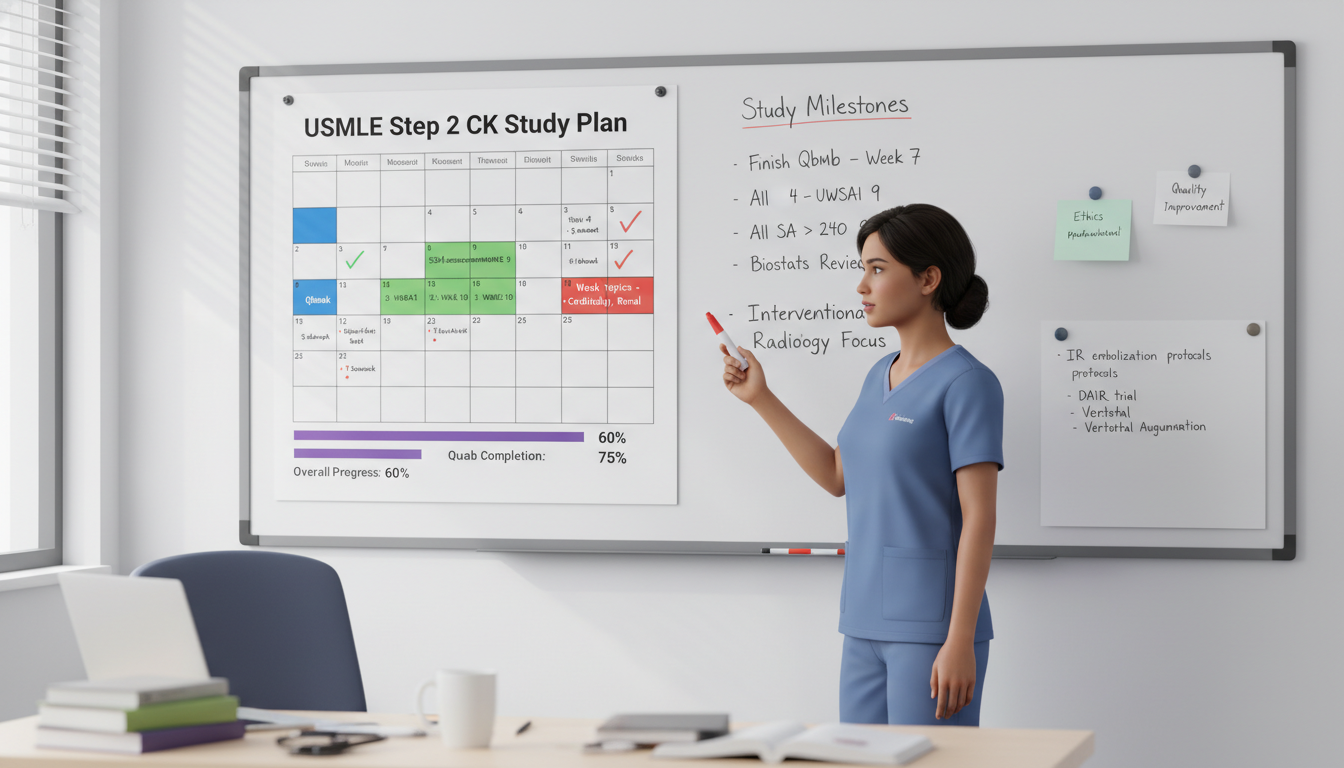
Below is a structured plan you can adapt based on your schedule and baseline performance. This assumes you have at least some daytime flexibility (e.g., lighter rotations or a dedicated period).
Weeks 1–2: Foundation and Structure
Goals:
- Set up resources and schedule
- Start Qbank systematically
- Identify weak areas
Daily:
- 40–60 UWorld questions (subject-focused if you feel rusty)
- 2–3 hours reviewing explanations
- 30–45 minutes of content review (e.g., internal medicine topics)
- Begin or resume targeted Anki
End of Week 2:
- Take NBME or UWSA self-assessment
- Analyze:
- Systems with lowest scores
- Types of mistakes: knowledge gaps vs. misreading vs. time management
Adjust upcoming weeks based on this.
Weeks 3–6: Heavy Qbank and Clinical Reasoning
Goals:
- Complete majority of first-pass UWorld
- Strengthen pattern recognition
- Improve timing and stamina
Daily:
- 60–80 UWorld questions (shift to more random, timed blocks)
- 3–4 hours explanation review
- 30–60 minutes of focused review on weakest subjects (top-down from your self-assessment data)
Weekly:
- 1 deep-dive session (2–3 hours) on a high-yield system:
- Cardiology, pulmonology, GI, renal, or infectious disease
- Add IR-relevant review:
- Imaging indications in common scenarios
- Pre- and post-procedure management concepts
End of Week 4–5:
- Take another self-assessment
- Compare progress:
- Are scores trending up?
- Are timed blocks more comfortable?
- Which systems remain problematic?
If scores are lower than you hoped but improving, continue. If plateaued, consider:
- Reducing new questions temporarily to prioritize reviewing weaknesses
- Rewatching short, high-yield videos for problem topics
Weeks 7–9: Refinement and Exam Simulation
Goals:
- Close knowledge gaps
- Build test-day stamina
- Fine-tune timing
Daily:
- 40–60 questions (mostly random, timed, exam-like blocks)
- 2–3 hours explanation review, prioritizing incorrects and “guessed but right” questions
- Focused content review only for persistently weak areas
Additional Tasks:
- Begin full-length simulation days:
- Example: 6–8 blocks in one day with realistic breaks
- Simulate exam conditions: quiet place, timed blocks, limited phone use
End of Week 8–9:
- Take UWSA 2 or NBME close to exam conditions
- Use this score to:
- Confirm you are within your target range
- Decide if you need slight delay (if possible) or can proceed confidently
Final 1–2 Weeks: Polishing and Confidence Building
Goals:
- Maximize recall
- Avoid burnout
- Enter exam calm but sharp
Focus On:
- Reviewing UWorld incorrects and marked questions
- Repeating key algorithms:
- ACS management
- Stroke management and imaging
- DVT/PE, anticoagulation, and IVC filter indications
- GI bleeding workup and imaging choices
- Light Anki, especially for frequently forgotten facts
Avoid:
- Starting new major resources
- Overloading with 80+ questions daily if you feel burnt out
- Obsessively checking online score “predictions”
Day Before Exam:
- Very light review only (a few notes or flashcards)
- Visit exam center route if unfamiliar
- Prepare documents, snacks, and layers of clothing
- Prioritize sleep over last-minute cramming
Common Challenges for Non‑US Citizen IMGs and How to Overcome Them
Challenge 1: Limited Clinical Exposure to US Guidelines
Many foreign national medical graduates train in systems where:
- Diagnostic resources differ
- Antibiotic choices are different
- Screening or imaging protocols vary
Solutions:
- Use Qbank explanations as your “US guideline textbook”
- For repeated topics (e.g., ACS, sepsis, pneumonia), directly look up or summarize:
- First-line medications
- Imaging choices (CXR vs CT vs ultrasound)
- Management sequences
- Make mini one-page “US version” summaries of:
- Hypertension, diabetes, dyslipidemia guidelines
- Cancer screening protocols
- VTE prophylaxis and treatment algorithms
Challenge 2: Balancing Internship/Work with Step 2 CK Prep
Non-US citizen IMGs often have mandatory internships or service obligations.
Strategies:
- Accept that your time is more limited—focus on consistency over perfection
- Protect non-negotiable study blocks:
- Early morning (1–2 hours) or late evening (2–3 hours)
- Use micro-learning:
- Anki or reading explanations on commutes (if safe) or breaks
- Coordinate with colleagues or family to reduce other obligations temporarily, especially in the final 4–6 weeks
Challenge 3: Visa and Application Deadlines
Your IR match strategy must align with visa and timeline realities.
- Target Step 2 CK completion before ERAS opens for your desired match year
- If your Step 2 CK score is borderline:
- A later exam date may delay score release and limit how programs view your application
- Seek advice from:
- Experienced IMGs in IR or diagnostic radiology
- Advising services familiar with visa constraints
Planning Step 2 CK too late can reduce interview opportunities, especially for programs that filter heavily on Step 2 CK score.
Using Your Step 2 CK Performance to Strengthen Your IR Application
A strong Step 2 CK score is an asset you can actively leverage in your IR match strategy.
Signaling Clinical Strength
In your ERAS application and personal statement, you can:
- Emphasize that your Step 2 CK performance reflects:
- Strong clinical reasoning
- Mastery of the internal medicine and emergency medicine background essential for IR
- Reference your deliberate focus on:
- Imaging indications
- Management of complex acute conditions
- Multidisciplinary care
Complementing Letters and US Clinical Experience
Pair your Step 2 CK score with:
- Strong letters of recommendation from:
- US-based internal medicine, surgery, or radiology attendings
- Any IR attendings you have worked with on electives or observerships
- Documented USCE where:
- You demonstrated clinical maturity
- Your attendings can confirm your bedside and decision-making skills that match your exam performance
If Your Step 2 CK Score is Below Your Target
Not every non-US citizen IMG will achieve an ideal Step 2 CK score. If your Step 2 CK score is lower than you hoped:
Reassess Targets
- You may still apply to IR, but also strongly consider:
- Diagnostic radiology (DR)
- Prelim/transitional years with later transition to independent IR track
- Look for programs with IMGs historically matched to IR or DR
- You may still apply to IR, but also strongly consider:
Strengthen Other Areas Aggressively
- High-impact IR or DR research
- Rigorous USCE with stellar letters
- Clear evidence of commitment to IR (conferences, case reports, QI projects)
Discuss Score Thoughtfully (If Asked)
- Own it without making excuses
- Emphasize what you learned from preparation and how you improved clinically despite the numeric outcome
Your Step 2 CK score is important, especially for an IR match as a non-US citizen IMG, but it is one piece of a larger story you are building.
FAQs: Step 2 CK and the IR Match for Non‑US Citizen IMGs
1. How high should my Step 2 CK score be to have a realistic shot at interventional radiology as a non‑US citizen IMG?
There is no universal cutoff, but for such a competitive specialty, you generally want a Step 2 CK score clearly above the national mean to stay competitive, especially when you need visa sponsorship. The more competitive the program and the fewer IMGs they typically accept, the more important a strong Step 2 CK score becomes. However, a slightly lower score can be offset by exceptional IR research, strong US letters, and meaningful US clinical exposure.
2. Should I delay my application if my Step 2 CK score is not as strong as I hoped?
If you receive your Step 2 CK score before ERAS opens and it’s significantly below your expectations, you may consider delaying your IR match attempt by one year, particularly if:
- You have limited USCE or weak letters
- You have minimal IR-related scholarly work
- You can use the extra year to substantially improve your profile
If you already have a solid CV otherwise and your Step 2 CK score is close to your target range, you may still proceed with a broad application strategy (IR, DR, prelim years) rather than delaying.
3. Are there any IR-specific topics I must focus on in my Step 2 CK preparation?
Step 2 CK won’t test procedural steps of embolizations or stenting, but several IR-relevant clinical topics are high yield:
- DVT/PE management, anticoagulation, and IVC filter indications
- Management of GI bleeding and appropriate imaging choices
- Portal hypertension complications (TIPS indications)
- Trauma imaging and management
- Cancer staging and imaging, indications for biopsy
Focus not on the technical aspects of IR, but on when and why patients need imaging or minimally invasive interventions.
4. Is UWorld enough for Step 2 CK as a non-US citizen IMG, or do I need extra resources?
For most candidates, including non-US citizen IMGs, UWorld as a primary resource plus self-assessments is sufficient, provided you:
- Complete a full pass
- Thoroughly review explanations
- Use self-assessments to guide additional content review
Add a concise text or video series for topics where you consistently perform poorly. Avoid overloading yourself with too many resources; depth and understanding in a focused set are more valuable than superficial exposure to many.
By approaching your USMLE Step 2 CK preparation with a strategic, clinically oriented plan tailored to your IR ambitions, you turn this exam from a hurdle into a powerful advantage—especially as a non-US citizen IMG seeking a place in a highly competitive interventional radiology residency.