Understanding Step 2 CK in the Context of Diagnostic Radiology
For a non-US citizen IMG aiming for a diagnostic radiology residency, USMLE Step 2 CK is not just another exam. It’s a critical data point program directors use to:
- Evaluate your clinical knowledge and reasoning
- Confirm your clinical foundation after Step 1 became pass/fail
- Compare you fairly against US graduates and other international applicants
- Assess whether you can handle the cognitive demands of radiology training
Diagnostic radiology is competitive. Many successful applicants, including foreign national medical graduates, have strong Step 2 CK scores. While score expectations vary by program and year:
- A Step 2 CK score ≥ 245 is often considered solid for radiology
- ≥ 250 strengthens your competitiveness, especially as a non-US citizen IMG
- Lower scores can be offset somewhat by strong research, US clinical experience, and letters, but the bar is high
Step 2 CK reflects how you think under time pressure and how well you can apply knowledge. This is directly relevant to radiology, where:
- You interpret complex clinical histories rapidly
- You choose the most appropriate imaging modality
- You integrate imaging findings with lab and clinical data
Think of your Step 2 CK preparation as building the clinical reasoning skills that will support you in radiology, especially when consulting with referring clinicians in the reading room or in tumor boards.
Unique Challenges for Non-US Citizen IMGs
As a non-US citizen IMG or foreign national medical graduate, you may face additional barriers:
- Different medical curriculum emphasis than US schools
- Variable exposure to US-style multiple-choice exams
- Limited access to US clinical experience
- Time zone differences and logistic issues for scheduling the exam
- Visa and test center availability constraints
All of this means you must be strategic and structured in your USMLE Step 2 study. A good score can help overcome other disadvantages, especially for a competitive field like diagnostic radiology.
Building a High-Yield Step 2 CK Study Strategy
1. Set a Clear Target and Timeline
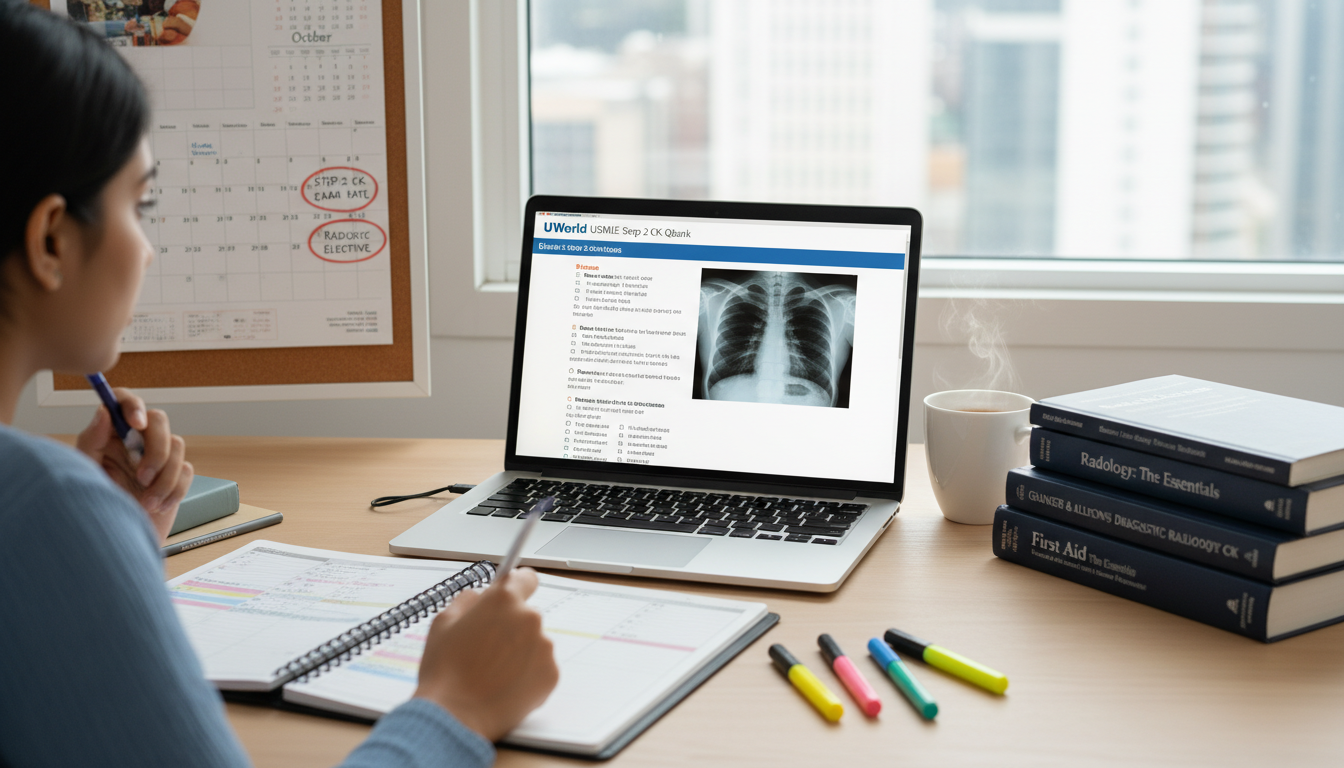
Before you start your USMLE Step 2 preparation, define:
- Target exam date: Typically 6–9 months before ERAS application if possible, so your Step 2 CK score is available at the time of application.
- Study duration:
- If you are within 0–6 months of finishing clinical rotations: ~3–4 months full-time can suffice.
- If you have been out of clinical practice or are working: 4–6 months part-time with a more spaced schedule is often needed.
- Target Step 2 CK score (realistic but ambitious):
- Example: If your Step 1 was strong, you may aim for 250+.
- If your Step 1 was borderline pass, a 240–245+ can significantly strengthen your profile.
This score goal should guide how intensive your plan must be and how much repetition you need.
2. Choose Core Study Resources (Less Is More)
You do not need a long list of books. For a non-US citizen IMG in radiology, a focused, exam-aligned set of resources is best:
Question Banks (Qbanks) – Your Primary Tool
- UWorld Step 2 CK – Non-negotiable core resource
- Aim to complete 100% of questions, preferably in timed, random mode.
- Review each question thoroughly, even the ones you get right.
- Optional second bank (if time permits and your baseline is weaker):
- AMBOSS or Kaplan Qbank
- Use selectively for weaker areas (e.g., OB/GYN, Psychiatry, or US-specific preventive medicine).
Reference & Review Resources
- Comprehensive review:
- Online MedEd (videos + notes) for conceptual review, especially early in prep
- A concise review book (e.g., Master the Boards Step 2 CK or similar) for quick reading, if you prefer text
- Clinical management guidelines:
- Familiarize yourself with US treatment standards (e.g., first-line, second-line therapies), commonly reflected in UWorld explanations.
Radiology-Relevant Reinforcement
While Step 2 CK is not a radiology exam, you can:
- Pay extra attention to questions involving imaging choices (CT vs MRI vs US vs X-ray)
- Learn when imaging is indicated and when it increases risk or cost without benefit
- Note common imaging findings mentioned in vignettes (e.g., CT findings in pulmonary embolism, ultrasound findings in ectopic pregnancy)
This mindset helps you both for the exam and for sounding clinically sharp in future radiology interviews.
3. Daily and Weekly Study Structure
A consistent routine is critical, particularly if you are balancing work, research, or visa-related tasks.
Sample Full-Time Daily Schedule (8–10 hours)
- 4–5 hours: Qbank blocks
- 2 blocks (40 questions each), timed, random
- Immediate or end-of-day review with detailed note taking
- 2–3 hours: Review high-yield notes / flashcards
- Many IMGs prefer Anki for spaced repetition of UWorld and NBME concepts.
- 1–2 hours: Videos or guidelines review
- Focus on weak systems (e.g., Psychiatry, Pediatrics, OB/GYN).
Sample Part-Time Daily Schedule (4–6 hours, for those working or in research)
- 2–3 hours: 1 Qbank block + review
- 1–2 hours: Notes/Anki
- 1 hour: Focused topic review or short video sessions on weak areas
Weekly Structure
- 5–6 days heavy study, 1 light day (short review, rest, or catch-up)
- Every 2–3 weeks: dedicated “consolidation day”
- Revisit incorrect questions, weak topics, and mis/overused strategies.
The key is consistency. Many foreign national medical graduates fall behind due to irregular schedules caused by external commitments. Protect your study time as if it were your job.
Phased Step 2 CK Preparation Plan: From Baseline to Exam Day
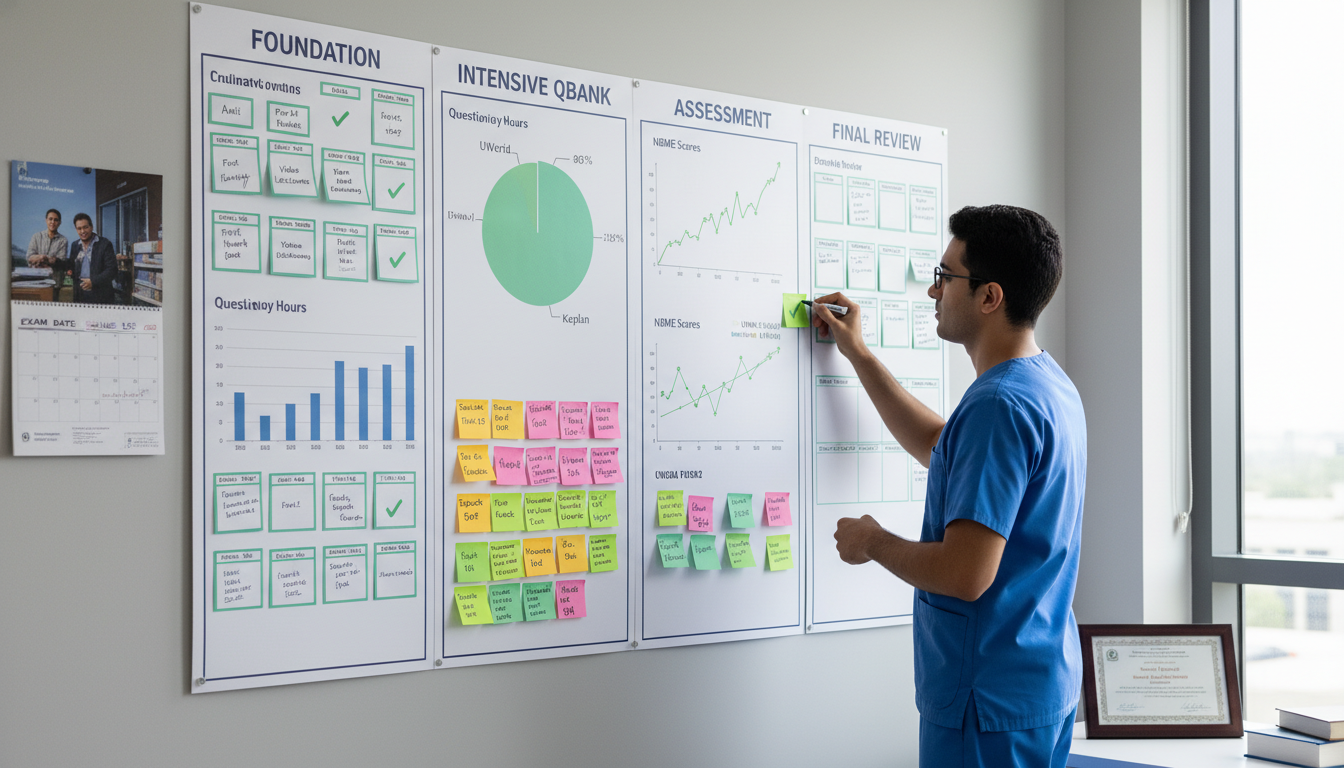
Phase 1: Baseline Assessment and Foundations (2–4 Weeks)
Goal: Understand where you stand and build your clinical foundation.
Take an initial assessment
- Use a NBME practice exam or UWorld self-assessment (UWSA1).
- This is uncomfortable but essential. It shows:
- How far you are from your target score
- Which systems are weakest (e.g., OB/GYN, Psychiatry, US preventive medicine)
Map out your weaknesses
- Rank each subject: Strong / Moderate / Weak
- Many non-US citizen IMGs have relative weakness in:
- US-style preventive care and screening
- Psychiatry and behavioral sciences
- Ethics, legal, and communication issues
Do targeted foundational review
- Use brief resources (Online MedEd, short notes) to quickly cover:
- Cardiology, Pulmonology, GI, Endocrinology – core internal medicine
- OB/GYN, Pediatrics – often underemphasized in some international curricula
- Aim for understanding concepts, not memorizing long lists.
- Use brief resources (Online MedEd, short notes) to quickly cover:
Start Qbank gently
- Begin with system-based, untimed blocks for the weakest areas to build comfort with the format.
- Write down patterns:
- How USMLE asks about management steps
- Which lab/imaging clues point to specific diagnoses
Phase 2: Intensive Qbank and Concept Reinforcement (8–12 Weeks)
Goal: Convert theoretical knowledge into exam-style problem-solving.
Switch to timed, random blocks
- Simulate actual exam conditions:
- 40-question blocks, 60 minutes each
- Try to complete 1–2 blocks per day, more if full-time.
- Simulate actual exam conditions:
Deep review of each question
- For every question, understand:
- Why the correct answer is correct
- Why each wrong option is wrong
- The core concept tested (diagnosis, management order, risk factor, imaging choice)
- Make study notes or Anki cards from concepts, not from entire explanations.
- For every question, understand:
Focus on management algorithms
- Step 2 CK heavily tests “What is the next best step?”
- Ask yourself:
- Is the patient stable vs unstable?
- Is this outpatient vs inpatient?
- Does the patient need urgent imaging or procedure before labs?
- These skills are similar to radiology decision-making: when to image and how urgently.
Parallel review of weak systems
- Dedicate extra time each week to your bottom 2–3 systems from your first assessment.
- Combine:
- UWorld questions in that system
- Short review notes or videos
- Summaries of guidelines (e.g., screening schedules, vaccines).
Phase 3: Assessment and Adjustment (4–6 Weeks Before Exam)
Goal: Measure progress objectively and adjust your plan.
Take a full-length NBME or UWSA under exam-like conditions
- Quiet room, timed, no interruptions
- Use an official timer and break schedule similar to the real exam day
Interpret results strategically
- Look at:
- Overall predicted score vs target
- Sub-scores by discipline and system
- If your predicted Step 2 CK score is:
- Within 10–15 points of your target: stay on course, refine weaker areas
15–20 points below your target: consider postponing and extending intensive study, if possible and if it won’t jeopardize your radiology residency timeline
- Look at:
Refine your study plan
- Emphasize:
- High-yield topics with repeated appearance across practice tests
- Weakest systems (but don’t neglect your strengths entirely)
- Use a “triage” mindset:
- Must-fix: topics that appear often and you frequently miss
- Nice-to-improve: niche topics that appear rarely
- Emphasize:
Link your preparation to diagnostic radiology
- Practice thinking:
- “Which imaging study would be best next?”
- “What are the contraindications to CT with contrast or MRI?”
- These appear on Step 2 CK in internal medicine, surgery, emergency scenarios, pediatrics, and OB/GYN.
- Practice thinking:
Phase 4: Final Review & Exam Readiness (1–2 Weeks Before Exam)
Goal: Consolidate, do not overload.
Revisit all incorrect questions
- Focus on:
- Patterns of mistakes (rushing, misunderstanding question stem, missing keywords)
- Misunderstood pathophysiology or management sequences
- Focus on:
Review high-yield notes/Anki
- Short, focused sessions:
- Rapid-fire recall of important facts
- Screenings, vaccines, drug side effects, classic triads
- Short, focused sessions:
Limit new resources
- Avoid last-minute switching to new books or banks.
- Stay with your primary materials; reinforce rather than expand.
Physical and mental preparation
- Adjust sleep schedule to match exam day
- Practice sitting for long blocks with minimal breaks
- Prepare documents and test center logistics early (especially critical for non-US citizens dealing with visa and travel issues)
Special Considerations for Non-US Citizen IMGs Aiming for Radiology
Balancing Step 2 CK with Radiology-Specific Activities
Your profile as a non-US citizen IMG applying to diagnostic radiology must be balanced:
- Step 2 CK score: Objective academic metric
- Radiology exposure: Electives, observerships, shadowing (US or home country)
- Research: Radiology or imaging-related projects, case reports, or QI initiatives
- Letters of recommendation: At least 1–2 from radiologists, preferably from US settings if available
While Step 2 CK preparation is time-intensive, do not completely abandon radiology-related activities:
- If you’re doing research, structure it around your study blocks, rather than the reverse.
- Discuss your Step 2 CK preparation with your radiology mentors—they can advise on timing relative to the diagnostic radiology match.
US-Style Clinical Reasoning vs Home-Country Practice
Many foreign national medical graduates come from systems where:
- Less emphasis is placed on cost-effective imaging
- Different screening guidelines are followed
- Certain diseases have different prevalence patterns
Step 2 CK will test you on US guidelines and practice patterns. To adapt:
- Always ask: “What would a US-trained physician do in this setting?”
- Pay special attention in UWorld explanations to:
- US-specific screening ages and intervals (e.g., colon, breast, cervical cancer)
- First-line vs second-line tests and treatments that may differ from your country
- When to avoid imaging due to radiation risk or lack of benefit
This habit helps your exam performance and also aligns you with the expectations of US diagnostic radiology programs.
Handling Logistics as a Foreign National Medical Graduate
As a non-US citizen IMG, plan early for:
- Test center availability: Prometric centers in some countries book quickly.
- Visa considerations (if taking exam in another country):
- Time for visa processing and travel
- Backup dates in case of delays
- Credential verification with ECFMG:
- Ensure all your documents are processed well in advance.
- Confirm eligibility windows and schedule early.
Delays can compress your preparation time or force you to test later than ideal for the diagnostic radiology match, so front-load these tasks.
Common Pitfalls and How to Avoid Them
1. Over-Resource Syndrome
Many IMGs collect too many resources and spread their effort thinly. This usually leads to superficial coverage and poor integration.
Solution:
- Commit to 1 primary Qbank (UWorld) + 1 secondary at most
- Use 1 main review system (Online MedEd, or a concise text)
- Resist adding new materials after the mid-point of your preparation
2. Passive Studying
Reading explanations or watching videos without active recall leads to an illusion of mastery.
Solution:
- After each question, close the explanation and summarize the concept from memory
- Teach the concept out loud or write a brief summary
- Use Anki or another active recall system daily
3. Ignoring Behavioral and Systems-Based Questions
As a future radiologist, you may naturally gravitate toward “hard science” (pathophysiology, imaging). But Step 2 CK heavily tests:
- Ethics
- Communication
- Quality and safety
- Practice-based learning and improvement
Solution:
- Do not skip or skim these questions in Qbanks
- Pay specific attention to questions tagged as “ethics” or “patient safety”
- Learn frameworks (e.g., when to override parental preferences, how to handle confidentiality)
4. Underestimating Fatigue
An 8-hour exam with multiple 60-minute blocks is cognitively exhausting, even if you are strong academically.
Solution:
- Simulate the full exam twice:
- 7–8 blocks of 40 questions in one day
- Planned breaks of 5–10 minutes as on actual day
- Learn your optimal snack, hydration, and caffeine routines
Using Your Step 2 CK Score Strategically in the Diagnostic Radiology Match
Once you have your Step 2 CK score:
- If strong (e.g., ≥ 245–250):
- Highlight it in your ERAS application, CV, and personal statement if appropriate.
- It supports your ability to handle the cognitive load in radiology and can help offset being a non-US citizen IMG.
- If moderate or borderline:
- Emphasize:
- Radiology research
- Strong letters of recommendation
- US clinical experience
- Be strategic about programs you apply to—include a range of competitiveness levels.
- Emphasize:
- If significantly below your target:
- Consider strengthening other areas aggressively (publications, electives).
- Discuss with mentors about applying broadly, including prelim/transitional years and possibly backup specialties if needed.
Remember that program directors look at the whole application, but in a competitive field like diagnostic radiology, a solid Step 2 CK score is often a gateway to interviews—especially for foreign national medical graduates.
FAQs: Step 2 CK Preparation for Non-US Citizen IMGs in Diagnostic Radiology
1. What Step 2 CK score should a non-US citizen IMG aim for to be competitive in diagnostic radiology?
While there is no fixed cutoff, aiming for a Step 2 CK score of at least 245 is reasonable. A score of 250+ will strengthen your chances, particularly if you lack US clinical experience or US letters. Programs consider all aspects of your application, but higher scores provide a clear advantage.
2. How should I balance Step 2 CK preparation with radiology research and observerships?
Prioritize Step 2 CK during your most intensive preparation months, but try to maintain some continuity with radiology:
- If you are in active research, protect at least 4–6 focused study hours daily.
- If you are doing observerships, use evenings and weekends for Qbanks and review. Your exam score is time-sensitive and affects your entire application cycle, so give it focused attention, especially in the 2–3 months before test day.
3. Are there radiology-specific resources I need for Step 2 CK?
You do not need radiology textbooks for Step 2 CK. However, within UWorld and NBME questions:
- Pay attention to when imaging is indicated vs unnecessary
- Note typical imaging findings mentioned in vignettes
- Understand contraindications and relative advantages of different imaging modalities
This will help your exam performance and prepare your mindset for radiology.
4. Should I postpone my Step 2 CK if my practice scores are low, even if it affects my application timing?
If your NBME/UWSA scores are far below your goal and you have realistic room to improve with extra study (and you can still submit a complete application), postponement may be wise. However, if postponing pushes your score past the ERAS deadline or significantly delays your radiology residency application, discuss with mentors:
- Your current predicted score
- Your overall application strength (research, letters, USCE)
- The specific programs and regions you’re targeting
For many non-US citizen IMGs, taking the exam once with solid preparation is better than rushing and risking a weak performance that is difficult to overcome later.
By approaching USMLE Step 2 CK with a structured plan, active learning, and a clear understanding of US practice patterns, you can transform this exam into a major asset in your diagnostic radiology residency application as a non-US citizen IMG.