Understanding the Role of Step 2 CK in a Urology Match as a Non‑US Citizen IMG
For a non-US citizen IMG targeting urology residency in the United States, USMLE Step 2 CK is far more than just another exam. It is a high‑stakes filter, a signal of clinical readiness, and often your strongest objective metric to stand out in a very competitive specialty.
Because Step 1 is now pass/fail, many program directors in surgical fields—especially urology—are placing greater emphasis on Step 2 CK scores. This is doubly true for a foreign national medical graduate, since you may not have US clinical grades, AOA membership, or a home urology department advocating for you. Step 2 CK can help “normalize” your application against US graduates.
Why Step 2 CK Is Critical for Urology Applicants
Several factors make a strong Step 2 CK score particularly important for urology:
- Highly competitive specialty: Urology is relatively small, with far more applicants than positions. PDs need quick, objective ways to filter applications.
- Clinical and surgical demands: Urologists deal with acute presentations (torsion, obstructive uropathy, urosepsis), oncologic decisions, and perioperative management—areas heavily tested on Step 2 CK.
- Step 1 pass/fail: Without a numeric Step 1, Step 2 CK often becomes the key standardized measure.
- IMG and visa status: As a non-US citizen IMG, some programs may be more cautious with visa sponsorship. A high Step 2 CK score can offset hesitation and demonstrate exceptional potential.
In surveys of program directors (and extrapolating from surgery and urology trends), the Step 2 CK score is commonly used to:
- Decide whom to interview
- Compare IMGs vs US graduates
- Assess readiness for US clinical medicine
If you are a foreign national medical graduate without US school brand recognition, Step 2 CK becomes a central part of your credibility as a candidate.
Target Scores and Strategy for Non‑US Citizen IMGs Aiming for Urology
What Is a “Good” Step 2 CK Score for Urology?
Exact cutoffs vary by program and year, but you should assume that urology programs will be on the higher end of score expectations.
While USMLE moved away from sharing detailed national stats in recent years, historical patterns and specialty competitiveness suggest the following goals for urology applicants:
Minimum to stay viable as an IMG:
Aim for ≥ 240
(Below this, match chances in urology become significantly lower, especially without strong US letters.)Competitive range (especially for IMGs):
Aim for 250–260+Highly competitive / standout score:
≥ 260 places you in a very strong position, particularly if paired with urology research and strong letters.
If you have a pass-only Step 1 or a borderline Step 1 score, Step 2 CK is your opportunity to show a strong upward trajectory. A significant jump can impress program directors and mitigate a weaker earlier performance.
Balancing Step 2 CK With Urology‑Specific Application Needs
As a non-US citizen IMG targeting urology, you’re often doing several challenging things at once:
- Preparing Step 2 CK
- Arranging US clinical electives or observerships in urology
- Completing research or publications
- Planning for ERAS and the urology specific match timeline (often earlier than NRMP)
You need a structured plan that acknowledges that a high Step 2 CK score is foundational but not the only piece of the puzzle. In most cases:
- Secure a strong Step 2 CK first, or at least ensure you are trending toward a strong score on practice exams.
- Use remaining time to intensively focus on:
- Urology research (case reports, retrospective studies)
- Urology‑relevant rotations (if possible in the US)
- Networking with attendings who can write letters.
To do this effectively, your USMLE Step 2 study must be systematic, disciplined, and tailored to your specific challenges as an IMG and foreign national.
Building a High-Yield Step 2 CK Study Plan for Urology‑Bound IMGs
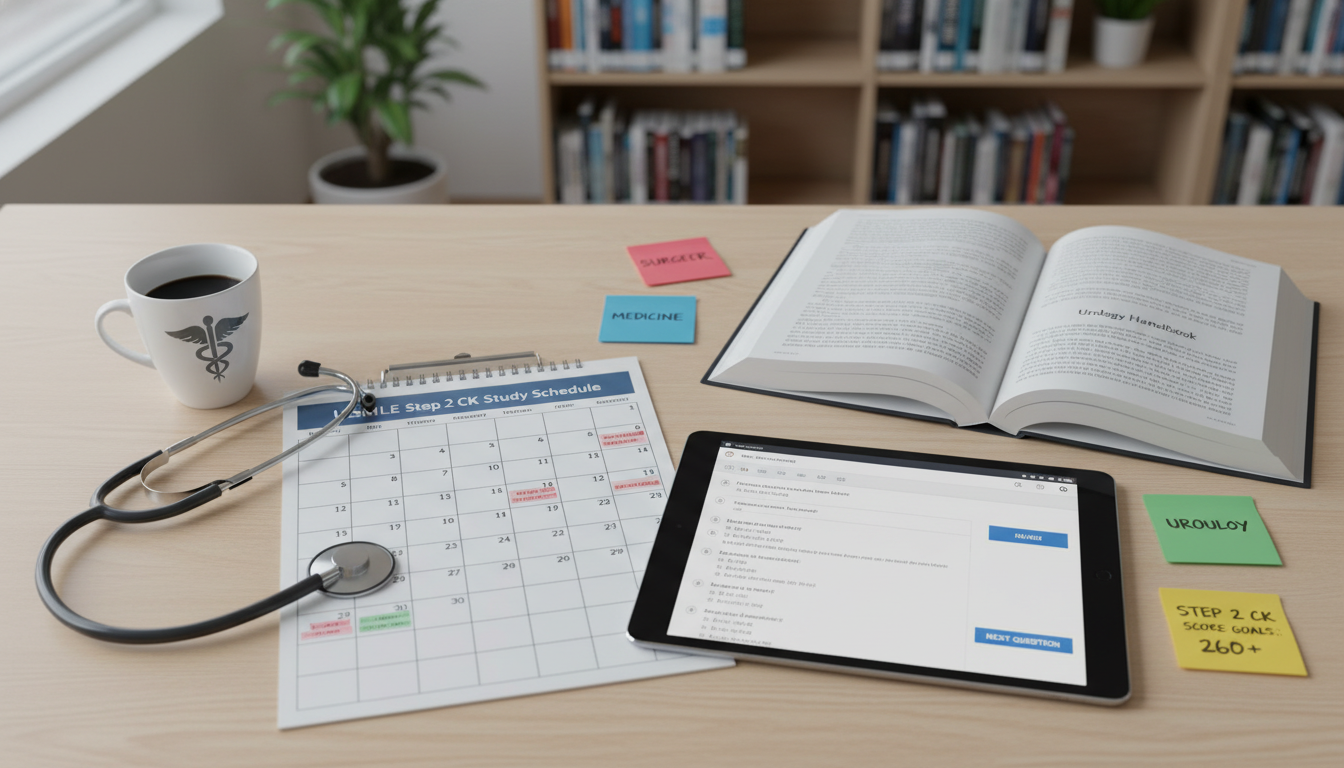
Step 1: Diagnose Your Baseline and Timeline
Before committing to a schedule, you need two things:
Baseline performance
- Take a NBME Comprehensive Clinical Science Self-Assessment (CCSSA) or a free practice test from NBME/USMLE.
- Alternatively, if you are early and haven’t finished core rotations, start with subject NBME exams (medicine, surgery) to see where you stand.
Clear exam date window
As an IMG, you must coordinate:- Exam date with:
- Completion of core clerkships
- ECFMG certification timing
- The earlier urology match deadlines (AUA match timeline)
- Aim to take Step 2 CK at least 2–3 months before ERAS submission so your score is available and can be included in program filters.
- Exam date with:
Typical dedicated preparation windows:
- If clinical knowledge foundation is strong: 6–8 weeks dedicated
- If you have been away from clinic for a while or studied in a very different system: 10–14 weeks may be more realistic.
Step 2: Choose Resources Strategically (Quality Over Quantity)
Having too many resources is a common pitfall, especially for IMGs trying to “cover everything.” Focus on mastering a core set:
Primary question banks:
- UWorld Step 2 CK QBank – Non‑negotiable. This should be your main resource.
- If you finish UWorld early and have time:
- AMBOSS or Kaplan QBank for extra practice, especially helpful for IMGs to build context.
Core references:
- Online MedEd (OME) videos or written notes – For structured review of major systems and diseases.
- Step-Up to Medicine or similar for internal medicine reinforcement (especially if IM training differs from the US style).
Assessment tools:
- NBME CCSSA practice exams x 2–3
- UWorld Self-Assessments (UWSA) x 1–2
Urology-specific reinforcement (for your long-term benefit): While Step 2 CK will not test highly specialized urology topics in depth, you should:
- Know core urology emergencies and common conditions, such as:
- Testicular torsion
- Obstructive uropathy
- Renal colic and urinary stones
- Acute urinary retention and BPH management
- Prostate cancer screening basics
- Consider a compact urology reference or review article during your broader clinical reading, but do not let specialty content derail your main Step 2 CK preparation.
Step 3: Structure Your Week – Example Schedules
If You Have Full‑Time Dedicated Study (No Clinical Duties)
Example 8‑Week Dedicated Plan (Target: 250+)
Weeks 1–4: Foundation and Heavy QBank
- 4 blocks of UWorld questions per day (40–44 questions per block)
- Thorough review of every question (2–3 hours per 2 blocks)
- Rotate systems weekly:
- Wk 1–2: Internal Medicine + Infectious Disease
- Wk 3: Surgery, OB/GYN
- Wk 4: Pediatrics, Psychiatry, Neurology
- Daily:
- 1–2 OME videos (only for weaker topics)
- Quick review of high-yield notes / flashcards (e.g., Anki)
Weeks 5–6: Mixed Blocks and First Assessments
- Switch to random, timed blocks in UWorld (simulate the real exam).
- Take:
- 1 NBME in week 5
- 1 NBME or UWSA in week 6
- Analyze each assessment:
- Identify top 3 weakest disciplines (e.g., endocrine, biostatistics, nephrology).
- Allocate 1–2 hours daily to targeted review of those weak spots.
Weeks 7–8: Refinement and Simulation
- Finish remaining UWorld questions.
- Repeat incorrectly answered or flagged questions.
- Take one full-length assessment each week:
- NBME or UWSA
- 3–5 days before the exam:
- Light review
- Focus on:
- Algorithms (ACS, PE, stroke)
- Ethics and patient communication
- Biostatistics formulas
- Urologic emergencies and genitourinary presentations (at least conceptually, though not overemphasized)
If You Are Studying While in Clinical Rotations
For non-US citizen IMGs who may still be in home-country rotations:
- Aim for 2–3 UWorld blocks per day on off days, 1 block on busy days.
- Weekend: simulate exam conditions with 3–4 blocks and full review.
- Expect total preparation time closer to 12–16 weeks.
Step 4: Integrate Urology-Relevant Knowledge Without Losing Focus
While the exam is broad and not urology-focused, some content directly aligns with urology practice and can indirectly strengthen your specialty readiness:
- Nephrology and electrolyte management – Essential for managing obstructive uropathy, AKI, and perioperative patients.
- Oncology basics – Prostate, bladder, renal, and testicular cancers overlap with internal medicine and surgery.
- Infectious disease – Urosepsis, complicated UTIs, pyelonephritis, prostatitis.
- Surgery and perioperative management – Fluids, antibiotics, DVT prophylaxis, perioperative beta-blockers.
When reviewing practice questions:
- Deliberately mark questions touching on renal, GU, oncology, or perioperative management.
- Keep a short “urology‑relevant pearls” document:
- Example: “Acute scrotum → pain < 6 hours + absent cremasteric reflex → immediate surgical exploration for torsion; do NOT delay for imaging.”
This dual focus helps your Step 2 CK preparation and builds a clinical mindset tailored to your future specialty.
Overcoming IMG‑Specific Challenges in Step 2 CK Preparation

Challenge 1: Different Medical Training Systems and Guidelines
As a foreign national medical graduate, your core training may emphasize different guidelines (e.g., European, Asian, or local protocols). Step 2 CK, however, tests US-based standards.
Strategies:
- Default to US guidelines in all answers (ACC/AHA, USPSTF, IDSA, AUA principles when relevant).
- While doing QBank questions, note differences from your local practice:
- Example: BP thresholds, diabetes treatment algorithms, cancer screening intervals.
- Create a small “US vs local” comparison sheet and review it weekly.
Challenge 2: Language and Test‑Taking Style
Even if your English is strong in conversation, Step 2 CK vignettes are dense and time‑pressured.
Strategies:
- Practice in timed mode early. Don’t wait until the last weeks.
- After each block, reflect on whether missed questions were due to:
- Knowledge gap
- Misreading or time pressure
- Vocabulary or nuance (e.g., “next best step,” “most appropriate initial management”)
- Read common USMLE phrases and what they truly mean:
- “Most appropriate next step” often means do not jump to invasive tests if a noninvasive or cheaper option is available.
- If needed, do a few blocks specifically focusing on reading speed—set a slightly stricter time limit (e.g., 55 minutes) and train to finish.
Challenge 3: Limited Access to US Mentors and Urology Departments
Non-US citizen IMGs often prepare for Step 2 CK without direct access to US residents or attendings.
Strategies:
- Join online IMG or USMLE communities that have structured discussion (e.g., focused study groups, moderated forums).
- If possible, connect with urology residents or fellows via:
- Academic Twitter/X
- Alumni networks
Ask: - How they balanced Step 2 CK preparation with urology research.
- What Step 2 CK scores they see commonly in matched applicants.
- Consider online tutoring (if financially feasible) especially if:
- You repeatedly plateau in practice scores.
- You have difficulty understanding feedback on practice questions.
Challenge 4: Visa and Timeline Pressures
As a non-US citizen, your Step 2 CK score and timing influence:
- ECFMG certification
- Your ability to apply in the same cycle
- Program willingness to consider you for J‑1 or H‑1B visas
Strategies:
- Work backward from ERAS submission and urology match deadlines:
- Aim to take Step 2 CK no later than June–July of the application year if applying that cycle.
- Be realistic:
If your practice scores are not near your target, consider:- Postponing the exam by 2–4 weeks (if possible) to avoid a mediocre score.
- Taking an extra year to strengthen:
- Step 2 CK score
- Urology research
- US clinical experience
A stronger application one year later is often better than a rushed, weak application now.
From Step 2 CK Score to Urology Match: Integrating Your Result Into Your Strategy
Interpreting Your Final Step 2 CK Score
Once you receive your Step 2 CK score, think about it in the context of urology residency:
≥ 260: Strong Position
- You can apply broadly with confidence, including many academic programs.
- Focus heavily on:
- High-quality urology letters
- Research productivity
- Strong personal statement and interview skills
250–259: Competitive
- Very solid for most urology programs, especially for an IMG.
- Emphasize:
- Urology‑specific achievements
- Any distinguishing experiences (leadership, global surgery, etc.)
- Apply broadly, but be especially strategic about visa‑friendly programs.
240–249: Borderline to Competitive (Context Matters)
- Context is crucial:
- Strong research and US letters can still make you competitive.
- Lower Step 1? Upward trend is helpful.
- You may need:
- Extra focus on networking and away rotations (if possible)
- A realistic mix of academic and community‑based programs that historically interview IMGs.
- Context is crucial:
Below 240: Challenging for Urology
- Not impossible, but extremely difficult, especially as a non-US citizen IMG.
- Consider:
- Strengthening other areas significantly (research, publications).
- Taking an extra research year.
- Having a backup plan:
- Applying to a less competitive specialty in parallel.
- Or applying to urology in a different country while pursuing US options long‑term.
Using Your Step 2 CK Preparation to Boost Clinical Performance
The knowledge you build in your USMLE Step 2 study should directly translate to clinical excellence during rotations and electives:
- When you see a patient with hematuria, think:
- Risk stratification for malignancy
- Appropriate imaging (CT urography vs ultrasound)
- When to involve urology urgently versus outpatient.
- Use Step 2 CK frameworks in your urology rotations:
- SOAP note formats
- Evidence‑based order of tests
- Prioritizing stabilization (ABCs) in emergencies
Residency programs notice applicants who apply exam-level reasoning to real patients. This also strengthens your letters of recommendation.
Practical Tips, Day‑Before Strategies, and Exam‑Day Execution
Final Week Checklist
In the week before your exam:
- Do not start new resources.
- Focus on:
- Reviewing incorrect and flagged UWorld questions.
- Skimming high-yield topics:
- Cardiology (ACS, heart failure, arrhythmias)
- Pulmonology (PE, pneumonia, COPD/asthma exacerbations)
- Endocrine (DKA, HHS, thyroid emergencies)
- Renal and electrolytes (AKI, hyperkalemia) – also relevant for urology.
- Infectious diseases (sepsis, meningitis, osteomyelitis, complicated UTIs).
- Ethics and biostatistics—disproportionately represented and easy points with practice.
Avoid full-length assessments in the last 3 days; opt for shorter blocks with deep review instead.
Day‑Before the Exam
- Review a brief formula sheet for biostatistics.
- Skim through any urology-emergency notes you kept (torsion, obstructive uropathy) but do not overemphasize them.
- Prepare logistics:
- Valid ID, confirmation email, route to the testing center.
- Comfortable clothing, snacks, water.
- Sleep is part of your strategy. Aim for 7–8 hours.
Exam‑Day Tactics
- Use breaks strategically:
7 blocks → you’ll have limited break time. Most candidates:- Take a 5–7 minute break between nearly every block.
- Do not obsess over one or two confusing questions:
- Use pattern recognition: eliminate wrong choices, choose the best remaining, move on.
- Watch pacing:
- Aim to have 10–12 minutes remaining at the halfway point of each block.
- Stay flexible: some blocks will feel harder. Exam difficulty may vary, but scoring is standardized.
FAQs: USMLE Step 2 CK Preparation for Non‑US Citizen IMGs in Urology
1. As a non-US citizen IMG, what Step 2 CK score should I realistically aim for to be competitive in urology?
For urology, especially as a foreign national medical graduate, aim for at least 240 as a minimum to be considered by many programs. A 250–260+ Step 2 CK score will make you substantially more competitive, and ≥ 260 can help compensate for IMG status or limited US experience. Also consider your entire profile—research, letters, and clinical performance matter as well.
2. How early should I take Step 2 CK before applying for urology residency?
Ideally, take Step 2 CK 2–3 months before ERAS submission so your score is available when programs screen applicants. For the early urology match, this often means testing by June–July of the application year. This also gives you time to adjust your application strategy once you see your official Step 2 CK score.
3. Should I focus on urology topics specifically during Step 2 CK preparation?
You should know core urology‑relevant emergencies and common conditions (torsion, renal colic, obstructive uropathy, urinary retention, UTIs) but do not over-specialize your studying. Step 2 CK primarily tests broad clinical medicine. Your main focus must remain on high-yield internal medicine, surgery, pediatrics, OB/GYN, psychiatry, and neurology. Think of urology as a layer on top of strong general clinical knowledge, not a substitute.
4. If my Step 2 CK score is lower than expected, is a urology match still possible?
It depends on how low and on the rest of your application. Scores below ~240 make urology significantly more difficult as a non-US citizen IMG. However, if you have:
- Strong urology research (publications, presentations)
- Excellent US letters from known urologists
- Demonstrated clinical excellence in rotations
you may still have a chance, especially with visa-friendly and community-focused programs. You might also consider: - Taking a research year to strengthen your profile.
- Having a backup specialty in mind during application.
- Carefully targeting programs with a history of interviewing/matching IMGs.
USMLE Step 2 CK preparation is one of the most controllable and high-yield parts of your journey to a urology residency. With a disciplined, resource-efficient study plan and attention to IMG-specific challenges, you can transform this exam from an obstacle into a cornerstone of a successful urology match strategy.