Why Step 2 CK Matters So Much for US Citizen IMGs Aiming for Urology
For a US citizen IMG interested in urology, USMLE Step 2 CK is often the single most important objective metric in your urology match application. Unlike many US MD students, you may not have a home urology program, a home department chair to advocate for you, or a long track record within the US system. That makes your Step 2 CK score a powerful proxy for your clinical readiness and your ability to compete.
Key reasons Step 2 CK is critical for a US citizen IMG and American studying abroad:
Step 1 is now Pass/Fail
Programs can no longer use Step 1 as a numeric screen. Step 2 CK becomes the main standardized test score to compare applicants.Urology is highly competitive
Average matched urology applicants typically have strong Step 2 CK scores (often in the 250+ range for many academic programs, and higher at top-tier institutions). As a US citizen IMG, you’re competing against US MD seniors from strong academic centers.Early urology match timeline
The urology match through the AUA often runs earlier than the NRMP main match. That compresses your timeline: you must plan when to take Step 2 CK so that a competitive score is available before application deadlines.Objective evidence that you can perform clinically
Because Step 2 CK emphasizes clinical reasoning, a strong score reassures PDs that, despite training abroad, you can handle the complexity and pace of US residency—especially in a surgical field like urology.
In other words: for a US citizen IMG targeting urology residency, Step 2 CK preparation is not just about passing—it's about deliberately building to your best possible score and timing it strategically for the urology match.
Understanding Step 2 CK in the Context of Urology
While Step 2 CK is a general clinical exam, urology applicants benefit from understanding how certain systems and disciplines connect to their chosen field.
Core Structure of Step 2 CK
Step 2 CK is a 1-day computer-based exam with:
- Eight 60-minute blocks
- Up to 40 questions per block
- Maximum 318 questions
- Total test day ~9 hours
It focuses on:
- Diagnosis and management
- Clinical reasoning
- Interpretation of labs and imaging
- Use of guidelines and next-step management
Urology-Relevant High-Yield Systems
Even though there is no dedicated “urology” section, several domains overlap heavily with urologic practice:
Renal and Urinary Systems
- Acute and chronic kidney disease
- Urinary tract infections (cystitis, pyelonephritis)
- Nephrolithiasis and obstructive uropathy
- Hematuria evaluation
- Electrolyte and acid-base disorders
Male Reproductive and Endocrine
- Benign prostatic hyperplasia and prostatitis
- Prostate cancer (screening, diagnosis, staging basics)
- Testicular torsion vs. epididymitis
- Testicular tumors, hydrocele, varicocele
- Hypogonadism, infertility basics, erectile dysfunction
Oncology
- Bladder, kidney, testicular and prostate cancers
- Workup of painless hematuria
- Interpretation of staging information and imaging findings
Infectious Disease
- Sexually transmitted infections: gonorrhea, chlamydia, syphilis, trichomoniasis
- Epididymitis/orchitis etiologies and management
- Catheter-associated UTIs, complicated UTIs
Surgery/Emergency Medicine
- Acute scrotum (testicular torsion – a surgical emergency)
- Trauma (renal, bladder, urethral injury patterns)
- Pre- and post-operative management
- Fluid, electrolytes, and basic peri-operative care
You do not need to become a urology specialist for Step 2 CK, but if you can show mastery in these areas, it aligns well with your stated interest in urology when programs review your application and when you are later asked clinical questions on interviews.
Strategic Step 2 CK Timeline for US Citizen IMGs in Urology
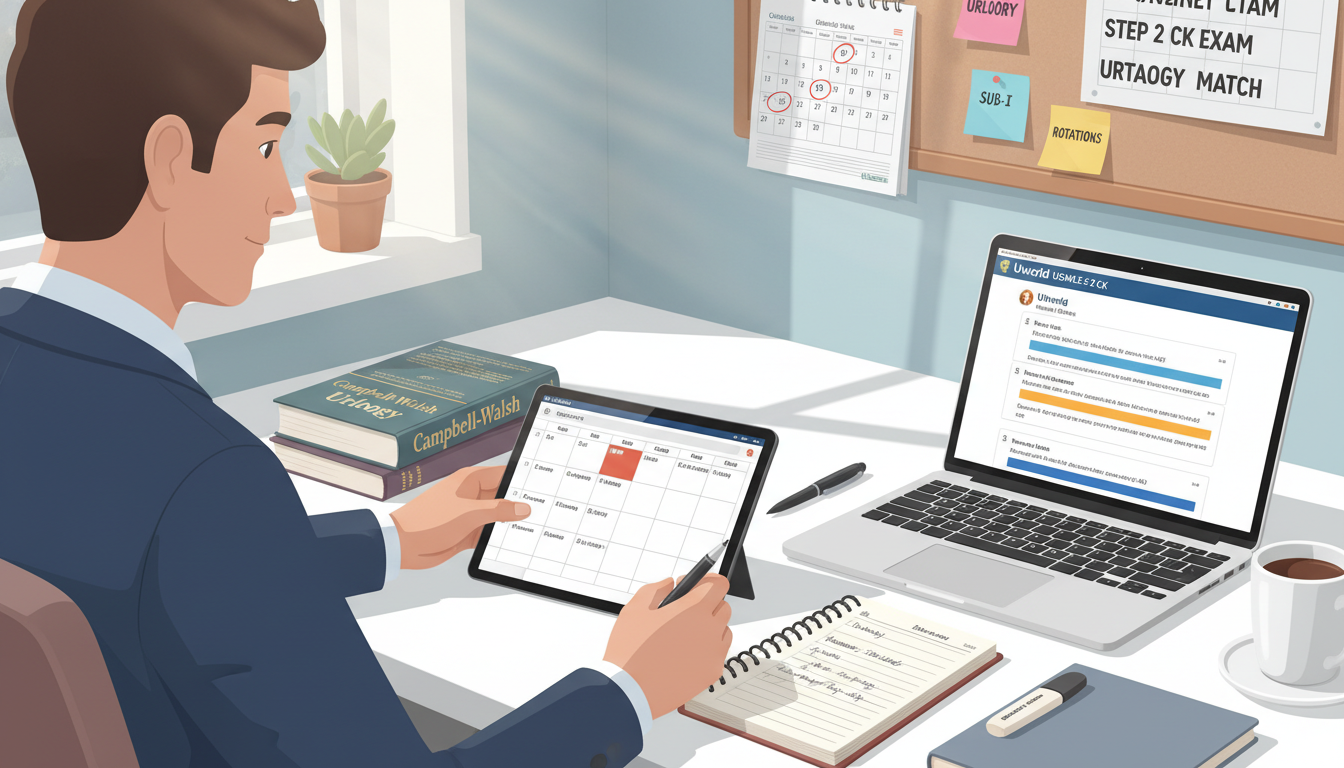
Planning is where US citizen IMGs and Americans studying abroad can set themselves apart. Your clinical calendar, visa logistics (if relevant), and urology match deadlines all intersect here.
Anchor Points: Urology Match and Application Timing
Most urology programs participate in the AUA match, which usually:
- Opens ERAS applications in late summer/early fall
- Has program interview invitations and interviews in the fall
- Releases match results in mid-winter (often January)
For your Step 2 CK score to help you:
- Score should be available before programs make interview decisions.
This usually means you should test no later than July–August of the application year (depending on the year’s exact calendar and score reporting schedule).
Common Timeline Scenarios
Scenario 1: Traditional US-Style 4th Year
If your school’s curriculum roughly parallels US schools:
- 3rd year (or penultimate year)
- Take core clinical clerkships (Internal Medicine, Surgery, Pediatrics, OB/GYN, Psych, Family Medicine).
- Begin light Step 2 CK review and build foundations using resources from your clerkships.
- End of 3rd year / start of 4th year
- Dedicated Step 2 CK study period: typically 4–8 weeks.
- Take Step 2 CK by late July at the latest for that year’s urology match.
- 4th year
- Early: urology electives/away rotations in the US.
- Submit ERAS and AUA applications with your Step 2 CK score already reported.
Scenario 2: Non-US Curriculum with Limited Dedicated Time
If you’re an American studying abroad with unpredictable clinical schedules:
- Plan 6–9 months ahead of the urology match application season.
- Build longitudinal study during clinical rotations to reduce pressure.
- When possible, negotiate/arrange a 4–6 week lighter rotation or elective as dedicated time before your planned exam date.
- Aim to test at least 2–3 months before application submission to allow for any unexpected delays or a retake (if needed, though retakes in this context are far from ideal).
Score Target Setting for Urology
Programs vary, but as a competitive field, urology generally expects strong Step 2 CK performance.
As a US citizen IMG, aiming for:
- Baseline target: 245+
- More competitive target: 250–260+
- Top-tier/academic programs: often see many applicants in the high 250s and above
These are not absolute cutoffs, but they’re a reasonable benchmark. If your Step 1 performance was strong, programs may expect a Step 2 CK score that is similar or higher. If Step 1 was pass-only (for recent cohorts), Step 2 CK carries even more weight.
Building an Effective USMLE Step 2 CK Study Plan
Your Step 2 CK preparation should be structured, question-heavy, and clinically focused. Below is a framework tailored for a US citizen IMG pursuing urology.
Step 1: Establish a Realistic Baseline and Timeline
Self-Assessment Early
- Take an NBME practice exam or a UWorld self-assessment 6–8 weeks before your exam (for shorter dedicated time) or earlier if you’re building gradually.
- Use this to estimate where you stand and how far from your target Step 2 CK score.
Dedicated Time
- Strong candidates typically use 4–8 weeks of primary dedicated study, depending on their baseline.
- If your core clerkships were recent and you used USMLE-style materials during them, you may need less dedicated time.
Daily Time Budget
- If full-time studying: 8–10 focused hours/day (with breaks).
- If on rotation: 3–4 focused hours/day on weekdays; 6–8 hours on weekends.
Step 2: High-Yield Resources (and How to Use Them)
For Step 2 CK, depth of resources beats breadth. You don’t get extra points for using every book on the market. Focus on:
Primary Question Bank: UWorld Step 2 CK
- Use as your main USMLE Step 2 study tool.
- Aim to complete at least 1 full pass, ideally 1.5–2 passes if time permits.
- Do questions in timed, random blocks (once you have covered most disciplines).
- After each block, spend at least as much time reviewing explanations as you spent answering questions.
- Tag or note urology-related and renal questions to revisit—these are especially relevant to your future specialty.
Supplementary Question Bank (optional)
- AMBOSS or another reputable Qbank can be used if:
- You finish UWorld with time to spare and
- Your practice scores are not at your target.
- Use selectively to shore up weak areas.
- AMBOSS or another reputable Qbank can be used if:
Rapid Review / Reference Text
- Online MedEd, Step-Up to Medicine (for IM concepts), or Boards and Beyond (clinical) can help patch conceptual holes.
- Don’t read cover-to-cover; instead:
- Use them to review topics you repeatedly miss in UWorld/NBMEs.
- Skim high-yield chapters on renal, infectious disease, surgery, OB/GYN, and pediatrics.
Urology-Oriented References (Optional, Not Primary)
- A concise urology handbook or chapter (e.g., in surgical texts) can deepen your understanding:
- Acute scrotum
- Obstructive uropathy
- Prostate, bladder, kidney cancers
- Use after you have strong generalist knowledge; don’t sacrifice core Step 2 CK topics for niche detail.
- A concise urology handbook or chapter (e.g., in surgical texts) can deepen your understanding:
Step 3: Structuring Your Daily Study Flow
Sample full-time dedicated day (8–10 hours):
- Morning (4 hours)
- 2 blocks of 40 UWorld questions, timed (80 total).
- Afternoon (3–4 hours)
- Detailed review of all 80 questions.
- Create brief notes or flashcards only for frequently tested patterns or your recurring weak areas.
- Evening (1–2 hours)
- Targeted video/reading review of weak topics found that day.
- 20–30 flashcards (if using Anki or similar).
For those on clinical rotations:
- Pre-round or post-call: 10–20 questions when possible.
- Post-clinic/ward: 20–40 questions with 1–2 hours of review.
- Weekend: 2–3 full blocks/day with thorough review.
Consistency is more important than heroic one-time efforts. A steady 30–40 question/day habit during rotations can dramatically lessen the load during dedicated time.
Step 4: Incorporating Urology-Relevant Practice
To align your Step 2 CK preparation with your urology trajectory:
- Flag all renal/urinary/reproductive questions in UWorld.
- Once/week, do a focused review block of:
- UTI and pyelonephritis
- Kidney stones
- Acute kidney injury and chronic kidney disease
- Hematuria workup
- Scrotal and testicular conditions
- Prostate disorders
Use these review sessions not just to memorize answers but to:
- Practice explaining the reasoning out loud, as if teaching a junior student.
- Clarify diagnostic algorithms (e.g., painless hematuria → cystoscopy vs. imaging).
- Understand “next best step in management” logic that interviewers may later probe.

Practice Exams, Score Interpretation, and Test Day Strategy
Using NBMEs and Self-Assessments Wisely
Self-assessments are your best tools for predicting your Step 2 CK score and tailoring your remaining preparation.
Recommended approach:
- NBME #1 (or equivalent): 4–6 weeks before exam
- Establish a baseline.
- Identify major weak systems (e.g., pediatrics, psych, OB/GYN).
- NBME #2 or UWorld Self-Assessment: 2–3 weeks before exam
- Check progress.
- Adjust final 2–3 weeks to reinforce low-performing areas.
- Final self-assessment (NBME or UWSA): 7–10 days before exam
- Confirm that you’re within range of your target Step 2 CK score.
- If scores are consistently below your minimally acceptable threshold, consider rescheduling—especially in a competitive field like urology.
Aim for practice scores that are at least 5–10 points above your minimum acceptable outcome since stress and test-day variability can lower performance.
When to Consider Rescheduling
As a US citizen IMG in a competitive specialty, test timing is strategic:
- Consider delaying if:
- Multiple practice tests in the last 2 weeks are >10–15 points below your target and <240.
- You have not yet completed at least ~70–80% of your primary QBank.
- Life events or clinical rotations significantly disrupted your study.
However, weigh delay against:
- Urology match application deadlines
- Potential conflicts with away rotations or visas
- Avoiding an overly late test date that leaves your application without a numeric Step 2 CK score
Err on the side of taking the exam once, well-prepared, rather than retaking after a weak performance. A low first attempt can be a significant obstacle in such a competitive specialty.
Test Day Strategy and Stamina
Simulation is crucial:
- Practice at least one or two full-length simulated days:
- 7–8 blocks with short breaks.
- Same start time as your real exam.
- Train your ability to:
- Maintain focus into the late blocks
- Manage nutrition and hydration
- Pace breaks strategically (e.g., after blocks 2, 4, 6, and 7)
On test day:
- Use flagging effectively: mark questions you’re unsure about but avoid obsessively re-checking every item.
- Manage time: aim to give yourself at least 5–10 minutes at the end of each block to revisit flags.
- Remember that most questions test pattern recognition and common presentations; if a question feels bizarrely rare, first re-check whether there’s a more common explanation.
Applying Your Step 2 CK Success to the Urology Match
Your Step 2 CK score is not just a number; it’s a tool to signal readiness and align with your narrative as a US citizen IMG aspiring to urology.
How Programs Use Step 2 CK in Urology
Typical ways urology programs use Step 2 CK:
Interview Screening
- Some programs have informal thresholds (e.g., 240, 245, 250+).
- As a US citizen IMG, a strong Step 2 CK score helps you clear initial filters used to manage large applicant pools.
Comparing Applicants
- Among similarly strong applicants (good LORs, research, clinical experiences), a higher Step 2 CK score can be a tiebreaker.
Risk Assessment
- Programs want residents who will pass in-training exams and board exams. A robust Step 2 CK performance gives confidence in your test-taking and clinical reasoning abilities.
Highlighting Step 2 CK in Your Application
With a strong score, you can strategically emphasize it:
ERAS Application
- Ensure your Step 2 CK score is available and properly reported before programs review your file.
- Use the “experiences” section and personal statement to show that your clinical performance and exam performance are aligned.
Personal Statement
- You don’t need to mention specific numbers, but you may subtly connect:
- “My clinical training abroad, combined with rigorous Step 2 CK preparation, has strengthened my diagnostic reasoning and readiness for high-acuity surgical training.”
- You don’t need to mention specific numbers, but you may subtly connect:
Interviews
- If asked about your Step 2 CK preparation, emphasize:
- Discipline and structured planning
- Focus on clinical reasoning
- Relevance to your interest in urology (e.g., how renal, infectious disease, and surgical topics particularly resonated with you)
- If asked about your Step 2 CK preparation, emphasize:
Using Step 2 CK Prep to Build Clinical Confidence
Your months of USMLE Step 2 study are also an opportunity to strengthen skills valued in urology:
- Interpreting imaging: CT scans for kidney stones or trauma, ultrasound findings in scrotal pathology.
- Recognizing emergencies: acute urinary retention, urosepsis, testicular torsion.
- Team communication: practice explaining cases concisely (one-liner + key data + plan), which translates directly to urology rounds and consults.
This mindset ensures your preparation benefits you beyond the exam and supports you once you’re on service as a urology resident.
Frequently Asked Questions (FAQ)
1. What Step 2 CK score should a US citizen IMG aim for to be competitive in urology?
While no single number guarantees success, aiming for at least 245+ is prudent, with 250–260+ making you more competitive, especially at academic or high-volume centers. As a US citizen IMG, you’re often compared closely with US MD seniors; a strong Step 2 CK score helps close that gap. Remember that research, letters, urology exposure, and away rotations also matter, but Step 2 CK is one variable you can optimize.
2. When is the best time to take Step 2 CK relative to the urology match?
Ideally, you should take Step 2 CK so that your score is available before ERAS/AUA applications are reviewed—commonly meaning an exam date by late July or August of your application year. This allows time for score reporting and for programs to see your Step 2 CK performance when deciding on interview offers.
3. How should an American studying abroad balance clinical rotations with Step 2 CK studying?
Use a hybrid strategy:
- During rotations:
- Complete 20–40 UWorld questions per day, focusing on the specialty you’re on (e.g., internal medicine, surgery).
- Spend 1–2 hours reviewing explanations.
- Before the exam:
- Arrange a 4–6 week lighter period or elective as dedicated study time.
- Scale up to 60–80 questions/day with thorough review. This approach keeps you engaged clinically while building your knowledge base for a strong Step 2 CK performance.
4. Does focusing on urology topics help improve my Step 2 CK score?
Yes—but only as a supplement to broad preparation, not as a replacement. Urology-related content (renal, urinary, reproductive, oncology, surgical emergencies) is important and aligns with your future specialty, but Step 2 CK heavily tests many non-urology areas (pediatrics, OB/GYN, psychiatry, etc.). First ensure solid performance in all major disciplines, then use urology-oriented review (e.g., acute scrotum, hematuria, nephrolithiasis, UTIs, prostate disease) to refine your understanding and help you excel on urology-relevant questions and future rotations.
By approaching USMLE Step 2 CK preparation with a structured plan, realistic timeline, and clear score goals tailored to the urology match, you can transform this exam from a hurdle into a powerful asset in your journey as a US citizen IMG entering urology.