
Preparing for USMLE Step 2 CK is one of the most strategically important steps on the road to an internal medicine residency. For many applicants, the Step 2 CK score becomes the single most influential standardized metric in the IM match—especially now that Step 1 is Pass/Fail. This guide walks you through a structured, internal-medicine–focused approach to USMLE Step 2 study and test-day performance.
Understanding Step 2 CK in the Context of Internal Medicine
Step 2 CK (Clinical Knowledge) tests your ability to apply medical knowledge to patient care. For internal medicine residency applicants, this exam is uniquely aligned with what you will do every day on the wards.
Why Step 2 CK Matters So Much for IM Match
Internal medicine residency program directors consistently rank USMLE Step 2 CK score among the top factors when deciding whom to interview and rank. Reasons include:
- Objective comparison tool: With Step 1 now Pass/Fail, the Step 2 CK score often serves as the primary numerical filter.
- Closer to clinical practice: The exam content mirrors internal medicine reasoning—diagnosis, management, and prognosis.
- Signal of readiness for residency: Strong performance suggests you can handle the cognitive demands of IM internship and in-training exams.
Practical implication: For most IM applicants, Step 2 CK is the last big opportunity to strengthen your application before ERAS. A strong score can offset weaker aspects (e.g., an “average” school name, a late research start) and reinforce a solid clinical narrative.
Exam Structure and Content Emphasis
Current Step 2 CK structure (subject to small changes by NBME/USMLE):
- One-day exam
- 8 blocks of up to 40 questions
- 9 hours total (8 × 1-hour blocks + 45-minute break time + 15-minute tutorial; tutorial can be skipped to add to break time)
- Mostly single-best-answer multiple-choice questions with clinical vignettes
Approximate content weighting with relevance to internal medicine:
- Internal Medicine & Adult Health: forms the bulk of the exam, scattered across:
- Cardiovascular
- Pulmonary
- Gastrointestinal
- Renal/Genitourinary
- Endocrine
- Rheumatology/Immunology
- Infectious disease
- Hematology/Oncology
- Emergency care & critical care
- Preventive medicine & outpatient care
- Psychiatry & Neurology
- OB/Gyn, Pediatrics, Surgery (still important but smaller fraction compared to internal medicine–type content)
Although Step 2 CK is multi-specialty, an internal medicine mindset—prioritizing differential diagnosis, risk stratification, and evidence-based management—is central across organ systems.
Laying the Groundwork: Timeline and Study Strategy
Your Step 2 CK preparation should be deliberate and aligned with your internal medicine career goals. The timeline below assumes you are a U.S. MD/DO student, but the principles apply broadly, including for international medical graduates (IMGs).
When Should You Take Step 2 CK for the IM Match?
Consider these factors:
- ERAS Timeline: For the best impact on your IM match application, aim to have your Step 2 CK score available before programs start reviewing applications (typically by early–mid September).
- Clinical Experience: Ideally, you should complete core rotations in Internal Medicine, Surgery, Pediatrics, OB/Gyn, Psychiatry, and Family Medicine before Step 2.
- Performance on Shelf Exams: Strong shelf performance suggests you can take Step 2 earlier; weaker performance might justify a slightly later date with more study time.
Common timing strategies:
Late 3rd year / Very early 4th year (June–August):
- Pros: Score available before ERAS; knowledge from clerkships is fresh.
- Cons: May overlap with demanding rotations; requires disciplined parallel prep.
Early 4th year after a dedicated study block:
- Pros: Focused USMLE Step 2 study, more control over schedule.
- Cons: Must ensure score returns in time for ERAS; too late can cause anxiety for both applicant and programs.
Rule of thumb for IM applicants:
If you aim for competitive academic IM programs or subspecialty-focused careers (cards, GI, heme/onc), target your exam date such that:
- You get at least 6–8 weeks of serious preparation, and
- Your official Step 2 CK score is available by early September of your application year.
Building a Step 2 CK Study Plan
Your plan should integrate:
- Question Banks (Q-banks)
- Clinical mastery resources (videos, textbooks)
- NBME assessments & UWorld Self-Assessments
- Test-taking strategy and error analysis
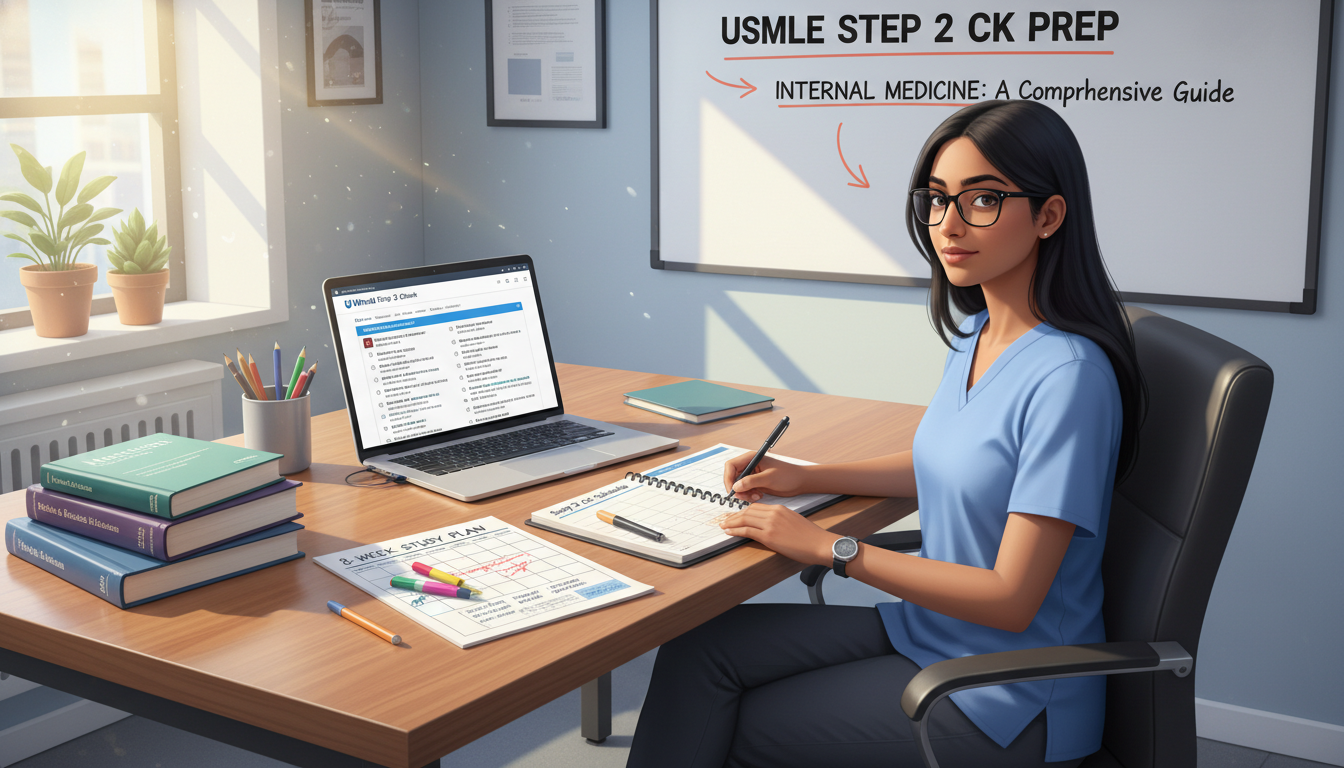
Below is a sample 8-week full-time Step 2 CK preparation plan. Adjust for your schedule and baseline.
Weeks 1–2: Foundation and Diagnostics
- Take a baseline NBME (e.g., the newest available form) to:
- Gauge starting level
- Identify weak domains (e.g., endocrine, biostatistics, psychiatry)
- Begin UWorld Step 2 CK:
- 40–80 timed, random-tutor hybrids per day depending on your pace.
- Start in tutor mode by system if you prefer structured review, then switch to timed random blocks as you improve.
- Start one primary review resource, such as:
- Online MedEd videos (for broad overview)
- Step-Up to Medicine (for IM-heavy review)
- Boards and Beyond Step 2 (if you used it for Step 1 and like the style)
Focus: Build strong internal medicine reasoning skills across common problems—chest pain, dyspnea, fever, abdominal pain, altered mental status, etc.
Weeks 3–5: High-Intensity Integrated Study
- Increase UWorld volume:
- 2–3 blocks/day timed, random (80–120 questions)
- After each block:
- Carefully review all questions, including correct ones.
- Create concise notes or an “incorrects” document/spreadsheet.
- Add in:
- Daily biostatistics/ethics practice (Anki, UWorld filter, or supplemental question sets).
- Targeted review of weak systems (e.g., renal, endocrine) using focused IM resources.
- Take another NBME at the end of week 4:
- Adjust your study targets based on subscores.
Weeks 6–7: Refinement and Exam Simulation
- Maintain 2 blocks/day of Q-bank in exam-like conditions:
- Timed
- Random
- No pausing
- Take:
- UWorld Self-Assessments (UWSA 1 and/or 2)
- One more NBME 2–3 weeks before the exam
- Work on:
- End-of-life care, communication, ethics, and professionalism
- Outpatient and preventive medicine (screening guidelines, vaccinations)
- Emergencies and “what’s the next best step?” style internal medicine decisions
Week 8: Taper and Consolidate
- Focus on:
- Light questions (1–2 blocks/day)
- Reviewing marked and incorrect questions
- Re-reading your high-yield notes
- Quick scanning of algorithms for chest pain, sepsis, DKA, stroke, GI bleed, etc.
- Do a full 8-block simulation about 7–10 days before your real exam to rehearse pacing and breaks.
- Decrease workload the last 48 hours:
- Light review only
- Prioritize sleep, nutrition, and stress management
Core Resources for Internal Medicine–Focused Step 2 CK Prep
With limited time, resource discipline is critical. You do not need every book and video series. Choose a minimal, complementary set and use them well.
1. Question Banks: Your Primary Learning Tool
UWorld Step 2 CK Q-bank
- Widely considered the gold standard.
- Emulates exam difficulty and style.
- Detailed explanations with high-yield tables and images.
- Strong focus on internal medicine topics.
How to use UWorld effectively:
- Treat every question as a learning opportunity, not just an assessment.
- For each question:
- Identify the diagnosis or major issue.
- Clarify the tested concept (e.g., choosing between NSTEMI vs unstable angina management).
- Write a brief takeaway:
- “In NSTEMI with hemodynamic stability: next step is anticoagulation + dual antiplatelet, THEN early invasive strategy, not immediate cath unless high-risk features.”
- Focus on understanding why wrong options are wrong, especially when they seem tempting.
Other Q-banks (Amboss, Kaplan, etc.)
- Useful if:
- You complete UWorld early and want extra practice.
- You prefer a second Q-bank for variety.
- Prioritize quality of review over quantity of questions.
2. Internal Medicine–Oriented Review Materials
For deeper understanding, especially in core IM areas:
- Step-Up to Medicine
- Great for IM clerkship and Step 2 CK reinforcement.
- Use selectively:
- Read key chapters on cardiology, pulmonology, GI, nephrology, and infectious disease.
- Online MedEd / Boards & Beyond
- Organized by system:
- Perfect for reviewing pathophysiology + management algorithms quickly.
- Don’t binge-watch passively; integrate with active question review.
- Organized by system:
3. Specialized Topics That Frequently Challenge Students
Some content domains are disproportionately high-yield and especially relevant to internal medicine residency:
Cardiology
- ACS management algorithms (unstable angina, NSTEMI, STEMI)
- Heart failure (acute vs chronic, reduced vs preserved EF)
- Valvular disease (indications for surgery)
- Arrhythmias and EKG interpretation (AFib, SVT, VT, heart blocks)
Pulmonology & Critical Care
- Mechanical ventilation basics
- ARDS management
- COPD and asthma exacerbation management
- Pulmonary embolism workup and treatment
- Pneumonia (CAP, HAP, VAP) and antibiotic selection
Endocrinology & Metabolism
- DKA vs HHS treatment
- Thyroid disorders (Graves vs thyroiditis vs toxic nodules)
- Hypercalcemia and hyponatremia workup/management algorithms
- Diabetes outpatient management and insulin regimens
Renal & Electrolytes
- AKI workup (prerenal vs intrinsic vs postrenal)
- CKD complications and management
- Electrolyte disturbances: hyper/hypo K+, Na+, Ca2+, Mg2+, phosphate
Infectious Disease
- Sepsis and septic shock protocols
- Empiric antibiotics: by site and risk factors
- Opportunistic infections in immunocompromised patients
- HIV and TB management basics
Heme/Onc & Rheumatology
- Anemia workup
- Coagulopathies and anticoagulation management
- Common malignancies (lung, breast, colon, prostate)
- SLE, RA, vasculitides: key features and initial management
Making internal medicine your “home base” in Step 2 CK preparation can help every part of the exam feel more intuitive.
Advanced Test-Taking Skills and Clinical Reasoning
Beyond raw knowledge, your IM match prospects are helped when you demonstrate strong clinical reasoning under time pressure. Step 2 CK is designed to reward that.
Reading and Dissecting Clinical Vignettes
Efficient vignette reading is crucial for time management and accuracy.
Structured approach:
- Read the last line first:
- “What is the most likely diagnosis?”
- “What is the next best step in management?”
- “Which of the following is the most appropriate pharmacotherapy?”
- Then read the vignette actively:
- Highlight or mentally note:
- Age, sex
- Key risk factors (smoking, diabetes, travel, IV drug use)
- Onset and tempo of symptoms
- Vital signs
- Key labs/imaging
- Highlight or mentally note:
- Formulate a working diagnosis or differential before looking at answer choices.
- Use the options to:
- Confirm
- Refine
- Or refute your initial thought
This is exactly how you’ll think as an IM resident—form a differential, then plan diagnostics and treatment.
“Next Best Step” in Management
Many internal medicine–flavored questions ask you to choose the single best next step, not the entire management plan.
Ask yourself:
- “Am I diagnosing or treating?”
- “Is the patient hemodynamically stable or unstable?”
- “Do I need to rule out a life-threatening condition first?”
Example (conceptual, not real test content):
A 65-year-old man with chest pain, hypotension, and jugular venous distension:
- Next best step: bedside echocardiogram to evaluate for tamponade or RV infarction (depending on context).
- Not: schedule outpatient stress test, because the acuity and hemodynamic instability demand emergent evaluation.
The exam often tests whether you can distinguish between:
- What is theoretically appropriate at some point
- What is urgently required right now
Prioritizing Life-Threatening Diagnoses
In ambiguous cases, prioritize:
- MI, PE, stroke, aortic dissection
- Sepsis, meningitis
- Airway compromise
- Ectopic pregnancy (in reproductive-age women with abdominal pain and positive pregnancy test)
This “sick vs not sick” mindset is central to both Step 2 CK and internal medicine practice.

Step 2 CK and the Internal Medicine Residency Narrative
Your Step 2 CK preparation is not just about an exam; it’s part of your broader internal medicine residency story.
Using IM Rotations as Step 2 CK Prep
During your internal medicine clerkship and sub-internships:
- Treat every patient as a living Step 2 case:
- Identify: chief complaint → differential → key tests → initial management → long-term plan.
- Practice writing concise assessment and plans:
- This maps nicely onto how Step 2 CK expects you to think.
- After rounds, review conditions you saw:
- Look up UpToDate/standard guidelines briefly, then see how topics are reflected in Q-banks.
- Ask residents and attendings:
- “What are the classic exam questions related to this condition?”
- “What’s the decision-making cutoff? When do you admit vs treat outpatient?”
Interpreting Your Step 2 CK Score for IM Programs
Different tiers of internal medicine programs may implicitly use score ranges:
- Top-tier academic programs / high-demand locations:
- Often prefer applicants with scores well above the national mean.
- Solid university and community programs:
- Usually focus on overall application plus a comfortably passing Step 2 CK score, with some bonus for higher performance.
- Community-focused or less competitive regions:
- May be more flexible as long as there is a passing score and consistent clinical performance.
Regardless of target program:
- A strong Step 2 CK score can:
- Reinforce your interest and ability in internal medicine.
- Support later success in ABIM in-training exams and boards.
- A weaker score does not end your IM match hopes:
- Compensate with strong letters, meaningful IM experiences, and a coherent personal statement.
- Consider a frank discussion with your dean’s office or advisor about strategy.
Exam Day Strategy, Logistics, and Well-Being
Your USMLE Step 2 study is only as effective as your performance on exam day.
Pre-Exam Logistics
- Visit your Prometric center in advance if possible:
- Know parking, lockers, and check-in procedure.
- Prepare:
- Acceptable ID (name must match exactly)
- Snacks and hydration for breaks (complex carbs, nuts, water or electrolyte drink)
- Layered clothing (testing centers can be cold)
- Sleep:
- Normalize your sleep schedule at least 3–4 days before the exam.
- Avoid heavy studying the night before; light review only.
During the Exam
- Use breaks strategically:
- Many students take a brief 3–5 minute break after every 1–2 blocks.
- Use one longer break (~10–15 minutes) for lunch midway.
- Maintain pacing:
- Aim to finish each block with 5–10 minutes to spare for review.
- If a question seems impossible, flag and move on; don’t let one item derail your rhythm.
- Mental resets:
- Brief breathing exercises during breaks.
- Positive self-talk—remind yourself you have prepared and that missing a few questions per block is expected.
After the Exam
- Don’t obsessively replay questions in your mind.
- Allow yourself time to decompress.
- When your Step 2 CK score arrives:
- Integrate it into your IM application strategy.
- If you plan a retake (in rare cases where required), seek structured guidance early.
Frequently Asked Questions (FAQ)
1. How high does my Step 2 CK score need to be for internal medicine residency?
There is no universal “cutoff” for all programs, but general patterns:
- Many solid IM programs are comfortable with scores around or modestly above the national mean, as long as the rest of the application is strong.
- Highly competitive academic programs and geographically competitive locations tend to favor scores significantly above the mean.
- Ultimately, your Step 2 CK score is one part of a holistic evaluation that also includes clinical grades, letters, research, and fit.
Aim for the highest score you can achieve reasonably, rather than chasing a specific number.
2. How long should I dedicate to Step 2 CK preparation if I want a strong IM-focused performance?
For most students:
- 6–8 weeks of focused preparation (full-time or near full-time) is typical.
- If your clinical base is strong and shelf scores have been high, you might compress into 4–6 weeks.
- If you struggled with shelves or Step 1, consider 8–10 weeks with a structured plan and close progress monitoring through NBMEs.
Remember that a lot of Step 2 CK preparation overlaps with your internal medicine and core clerkships; your “unofficial prep” starts well before dedicated study.
3. Which is more important for IM match: internal medicine letters or Step 2 CK score?
Both are important, but they serve different roles:
- Step 2 CK score:
- Often used early as a screening tool (to ensure you meet a program’s baseline).
- Provides objective evidence of clinical knowledge.
- Internal medicine letters (especially from IM faculty/PDs):
- Provide qualitative, personalized insight into your clinical performance, work ethic, and teamwork.
- Are crucial when programs build their rank lists.
In practice, you need both: a solid Step 2 CK score to pass initial filters and strong IM letters to stand out positively.
4. How can I integrate Step 2 CK study with a busy internal medicine rotation?
Suggestions:
- Use UWorld questions as a bridge between patients and exam prep:
- After seeing a patient with COPD exacerbation, do UWorld questions on COPD that evening.
- Set modest but consistent goals:
- 20–40 questions/day on weekdays
- 60–80 on weekends
- Listen to short video segments (Online MedEd/Boards & Beyond) during commute or breaks.
- Keep a small, focused notebook or digital note for “things I want to review tonight” from the wards.
This approach not only improves your USMLE Step 2 study but also makes you a better IM sub-intern and resident-in-training.
By approaching USMLE Step 2 CK preparation as an extension of your developing internal medicine identity—prioritizing clinical reasoning, internal medicine–heavy topics, and practical decision-making—you set yourself up for both exam success and a smoother transition into residency. Your IM match journey benefits when your Step 2 CK score, clinical performance, and narrative all align toward the same goal: becoming an excellent internist.