



Understanding Step 2 CK as a Caribbean IMG with Global Health Goals
If you’re a Caribbean IMG aiming for a global health residency track or a career in international medicine, USMLE Step 2 CK is more than just another exam. It is:
- The single most important standardized metric many programs use to assess your current clinical competence
- A chance to offset a modest Step 1 outcome (especially now that Step 1 is Pass/Fail)
- A way to signal readiness for demanding global health residency programs, including those with rigorous clinical and research components
For Caribbean medical school residency applicants—whether from SGU, AUC, Ross, Saba, or other schools—Step 2 CK can significantly influence your competitiveness, including the SGU residency match and similar outcomes from peer institutions.
Why Step 2 CK Matters for Global Health–Minded Caribbean IMGs
Clinical Reasoning in Real-World Scenarios
Global health residency tracks value physicians who can rapidly prioritize, triage, and manage patients with limited resources. Step 2 CK tests:- Diagnostic reasoning
- Initial management and stabilization
- Emphasis on high-yield primary care issues
Evidence-Based Care Across Diverse Populations
Questions often incorporate:- Obstetrics, pediatrics, and infectious diseases
- Health disparities, social determinants of health, and preventive care
All core themes in international medicine and global health.
Residency Screening for Caribbean IMGs
Program directors know that Caribbean IMG curricula can vary. A strong Step 2 CK score demonstrates:- You can compete at the level of U.S. grads
- You mastered clinical medicine enough to function safely in residency
- You can handle the academic rigor of a global health residency track
Target Step 2 CK Score ranges (general guidance, not guarantees):
- ≥250: Very strong for most programs, including academic and global health–focused IM/Peds/FM programs
- 240–249: Competitive; strong for many mid-to-upper tier programs
- 230–239: Solid; may still be competitive with a strong profile and commitment to global health
- 220–229: Potentially viable, especially in community programs or if balanced by strong clinical evaluations, global health experiences, and letters
Your personal target score should take into account:
- Your Step 1 performance
- Specialty interest (e.g., IM, FM, Peds, EM)
- How “academic” or competitive the global health program is
Building a Strategic Step 2 CK Study Plan as a Caribbean IMG

Caribbean IMGs often juggle clinical rotations, travel, visas, and sometimes work or family responsibilities. Your USMLE Step 2 study plan must fit realistically within that context while still being rigorous enough to achieve a strong Step 2 CK score.
Step 1: Set Your Timeline
Most Caribbean students take Step 2 CK:
- 3–6 months after finishing core rotations, or
- During the final phase of cores if school policy allows
Typical dedicated study periods:
- 8–10 weeks full-time (ideal if you can pause rotations)
- 12–16 weeks part-time (while on electives or lighter rotations)
If your school’s match outcomes (e.g., SGU residency match data) show that early Step 2 completion improves match chances, aim to take the exam by early fall of your application year (July–September) so that programs see your score early in the Caribbean medical school residency process.
Step 2: Audit Your Baseline
Before committing to a date, get a baseline diagnostic:
- Do 1–2 timed, random UWorld Step 2 CK blocks (40 questions each)
- Or take an NBME Comprehensive Clinical Science Self-Assessment (CCSSA) if you are reasonably close to the exam
Identify:
- Weak systems: e.g., Cardiology, Neurology, OBGYN
- Weak disciplines: e.g., Ethics, Biostatistics, Emergency medicine
This informs your schedule and helps you avoid “blind studying.”
Step 3: Design a Weekly Framework
Here’s a sample 8-week full-time plan for Caribbean IMGs:
Weeks 1–4: Foundation & Coverage
- 2–3 UWorld blocks/day (80–120 questions)
- Active review of all missed questions the same day
- Read corresponding sections in a primary Step 2 CK text (e.g., Step-Up, Online MedEd notes) as needed
- 30–45 minutes daily of:
- Biostatistics/Epidemiology
- Ethics/professionalism
- Patient safety & quality improvement (high-yield for global health)
Weeks 5–7: Refinement & Simulation
- 2 UWorld blocks/day (80 questions)
- Begin second pass of weak areas if you finish UWorld early
- Take an NBME self-assessment every 1–2 weeks
- Review incorrect NBME questions thoroughly
- Start full-length simulation days: 7–8 blocks in a single day to mimic test fatigue
Week 8: Taper & Focus
- 1–2 blocks/day (40–80 questions) focused on weak topics
- Re-do all “marked” or incorrect UWorld questions in high-yield areas (OBGYN, Peds, IM)
- Light reading; heavy emphasis on recall and practice
- Sleep, exercise, and exam-day logistics prep
If you’re studying while on rotations, adjust to 40–60 questions/day and extend the total calendar duration.
Step 4: Integrate Global Health Content into Your Plan
While Step 2 CK is not a “global health” exam per se, you can align your studying with your international medicine interests:
- Pay attention to:
- Infectious disease cases (HIV, TB, malaria, helminths, travel medicine)
- Maternal-child health, OBGYN, and pediatric preventive care
- Public health, vaccination, and screening guidelines
- Supplement with:
- WHO or CDC guidelines for TB/HIV if time permits
- Global burden of disease patterns that influence decision-making
Discuss these themes in your personal statement and interviews, linking your Step 2 preparation to your readiness for a global health residency track.
High-Yield Resources and How to Use Them Effectively
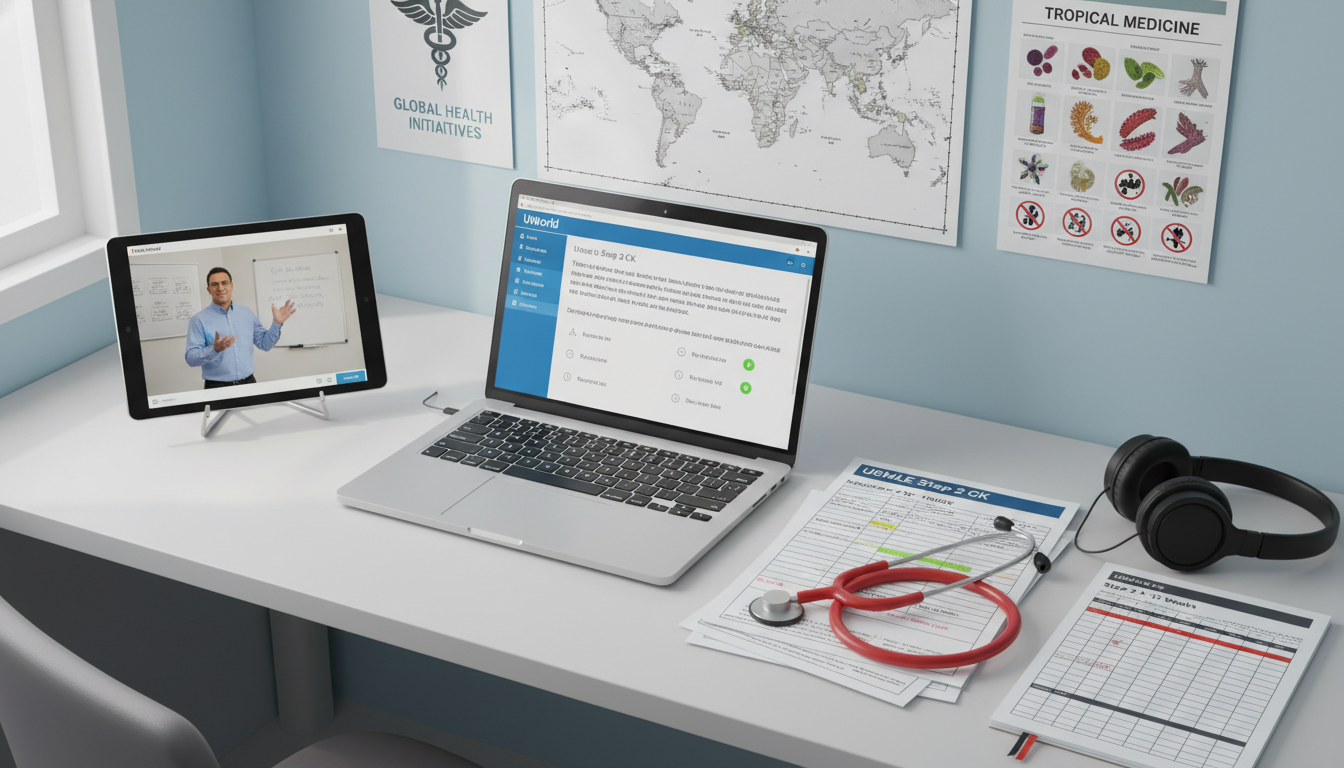
For Caribbean IMGs, resource overload is a real risk. Focus on a tight, efficient resource stack and use it deeply rather than superficially.
Core Resource: UWorld Step 2 CK QBank
UWorld remains non-negotiable for a strong USMLE Step 2 study strategy.
How to use it:
- Mode: Start with Tutor mode by system; transition to Timed, Random as you improve
- Goal: At least 1 full pass (and partial 2nd pass in weak areas)
- Benchmark: Many successful Caribbean IMGs aim for 65–75% correct on first pass
Review strategy:
- For every question (right or wrong), answer:
- Why is the correct choice right?
- Why is each wrong choice wrong?
- Build a running document or Anki deck of:
- Algorithms (e.g., chest pain workup, syncope, preeclampsia)
- Key diagnostic thresholds (e.g., BP cutoffs, lab values)
- Empiric treatments and first-line therapies
Self-Assessments: NBME and UWorld
Use NBME CCSSAs to track your Step 2 CK score trajectory:
- One 6–8 weeks out
- One 3–4 weeks out
- Optional final one 1–2 weeks before exam if scores are stable
Use UWorld Self-Assessments (UWSAs):
- Generally good predictors of performance
- Schedule 1–2 in the last month
Programs reviewing Caribbean medical school residency applicants often look for improvement patterns; upward-trending self-assessments can reassure you that your plan is working.
Supplemental Resources
Use these sparingly:
Online MedEd (OME)
- Great for conceptual clarity and “big picture” understanding
- Watch during earlier months or during rotations, not during crunch time
- Focus on:
- IM, Surgery, OBGYN, Pediatrics, Emergency medicine
Anki (Pre-made Decks + Personal Cards)
- Use reliable Step 2 decks (e.g., decks based on UWorld/OME)
- Add your own cards for:
- Global health–relevant infections
- Scoring systems (APGAR, Bishop score, Wells criteria, CURB-65)
- Guidelines and cutoffs
Textbooks/Review Books
- Choose one main text at most (e.g., Step-Up to Medicine or a Step 2 CK review book)
- Use for:
- Clarifying weak topics
- Quick reading on conditions you repeatedly miss in UWorld
Mastering Exam Skills: Clinical Reasoning, Timing, and Test-Day Performance
Clinical Reasoning for Global Health–Minded IMGs
Global health practice often forces rapid decision-making in uncertain environments. Step 2 CK mirrors this through complex vignettes with incomplete information.
To improve your reasoning:
- Always ask: What’s being tested?
- Diagnosis?
- Next best step in management?
- Most appropriate diagnostic test?
- Prioritize life-threatening issues first:
- ABCs (Airway, Breathing, Circulation)
- Hemodynamic instability, sepsis, acute coronary syndrome, stroke
- Recognize resource-limited equivalents:
- While Step 2 CK assumes U.S. resources, knowing minimal safe workups and emergency triage still helps, especially for your global health mindset.
Timing and Stamina
Step 2 CK is a 9-hour exam (8 blocks × 1 hour each). Caribbean IMGs who have been away from intense testing may struggle with stamina.
Practice strategies:
- Do full 7–8 block simulation days twice before test day
- Practice:
- 1 block in 60 minutes strict
- Avoid pausing or extending time
- Train yourself to:
- Flag only truly uncertain questions
- Avoid overthinking rare diagnoses unless clearly indicated
Ethics, Communication, and Systems-Based Questions
Ethics and systems-based practice have disproportionate scoring value and are very relevant to global health:
Study:
- Informed consent
- Surrogate decision-making
- Confidentiality (e.g., adolescents, STIs, HIV)
- Mandatory reporting
- Dealing with cultural beliefs and language barriers
Approach:
- Respect autonomy when patients have capacity
- Involve interpreters in language barriers
- Address health literacy and explain clearly
- Avoid bias or discrimination in management decisions
These questions often seem “easy,” but they differentiate borderline versus solid performers.
Leveraging Your Caribbean Training and Global Health Experiences
Caribbean IMGs often bring rich clinical exposure and multicultural experience—assets for both Step 2 CK and the residency match.
Integrate Rotations with Step 2 CK Prep
During core rotations:
- Practice Step 2–style reasoning with real patients:
- Formulate differential diagnoses
- Decide “next best steps” as if answering a UWorld question
- Keep a small notebook or app for:
- Interesting cases
- Mistakes you made
- Guidelines or algorithms you learned
- Practice Step 2–style reasoning with real patients:
During electives or sub-internships:
- Ask to present brief, focused literature summaries
- Pay attention to evidence-based medicine and guidelines (which appear heavily on Step 2 CK)
Highlighting Global Health in Your Application
After you take Step 2 CK, incorporate your preparation and outcomes into your overall global health narrative:
In your personal statement:
- Discuss how studying for Step 2 CK sharpened your understanding of:
- Prevention
- Public health
- Care for underserved populations
- Link this to your global health experiences in the Caribbean or abroad
- Discuss how studying for Step 2 CK sharpened your understanding of:
In interviews:
- Explain how you used your diverse training environments to build robust clinical reasoning
- Reflect on ethical scenarios, resource limitations, and cultural competency themes you encountered
Program directors looking at Caribbean medical school residency applicants—whether in internal medicine, family medicine, pediatrics, or EM—will consider not just your Step 2 CK score, but how your preparation reflects your maturity and readiness for a global health residency track.
Common Pitfalls for Caribbean IMGs and How to Avoid Them
1. Underestimating Step 2 CK Because Step 1 Is Pass/Fail
Even if Step 1 felt manageable, Step 2 CK is a different level of integration. For Caribbean IMGs:
- Avoid: Minimal dedicated time or “winging it” during busy rotations
- Do: Plan at least 6–8 dedicated weeks, or an extended part-time schedule
2. Over-Relying on Passive Resources
Binge-watching videos or reading PDFs without questions is low-yield.
- Avoid: Passive reading all day
- Do:
- Make question banks your primary modality
- Use videos/texts only to clarify weak points
3. Ignoring Weak Systems
Many Caribbean students feel underexposed in:
Psychiatry
Neurology
OB/GYN
Pediatrics
Avoid: Skipping these “uncomfortable” areas
Do:
- Dedicate focused weeks to weaker systems
- Use targeted UWorld filters and short review resources
4. Poor Test-Day Logistics
Visa issues, long travel, or unfamiliar centers can add anxiety.
- Confirm your eligibility period and scheduling permit early
- If you must travel internationally to a test center:
- Arrive at least one full day early
- Visit the test center location the day before
- Plan meals, hydration, and breaks:
- Bring snacks that are familiar and non-irritating
- Organize your locker items in separate bags for quick access
A calm test day can be worth several points, especially when you’re already pushing for a high Step 2 CK score.
Putting It All Together: A Sample 10-Week Plan for a Global Health–Focused Caribbean IMG
Assumptions:
- You’ve just finished core rotations
- You’re aiming for ≥240 Step 2 CK score
- You’re targeting internal medicine or family medicine with a global health residency track
Weeks 1–2
- 2 UWorld blocks/day, system-based (e.g., IM, OBGYN)
- Daily 30 minutes of:
- Biostats/epidemiology
- Ethics/global health topics
- Watch OME/brief videos for your worst systems
- Build or review Anki daily (20–40 minutes)
Weeks 3–4
- Transition to:
- 2–3 UWorld blocks/day, more random/timed
- First NBME at end of Week 4
- Identify bottom 3 systems → schedule extra question blocks & reading
Weeks 5–6
- Maintain 2–3 blocks/day
- Begin second pass of high-yield weak systems:
- Pediatrics, OB/GYN, Psychiatry
- NBME at end of Week 6
- Start 1 full-length (7–8 block) simulated test day
Weeks 7–8
- Focused remediation:
- Re-do incorrectly answered or flagged UWorld questions
- Add UWSA1 (Week 7) and NBME or UWSA2 (Week 8)
- 1 more full-length simulation day
- Address lingering deficiencies in ethics and public health questions
Week 9
- 1–2 blocks/day, light review of notes/Anki
- Sleep normalization, physical activity, stress control
- Logistics preparation for exam day
Week 10
- Minimal new content
- Review key summaries, algorithms, and personal mistake log
- Stay mentally fresh; avoid burnout in last 48 hours
This integrated plan serves both your USMLE Step 2 study goals and your long-term identity as a physician invested in international medicine and global health.
FAQs: Step 2 CK Preparation for Caribbean IMGs in Global Health
1. What Step 2 CK score should I aim for as a Caribbean IMG interested in global health?
Aim for the highest score realistically achievable, but as a rough target:
- ≥240 makes you competitive for many internal medicine, family medicine, and pediatrics programs, including some with a global health residency track.
- If your Step 1 performance was borderline or just pass, a strong Step 2 CK score can be a major positive signal for residency programs evaluating Caribbean IMGs.
Remember, some programs will weigh global health experiences, language skills, and prior international work alongside your scores.
2. When should I take Step 2 CK relative to the residency match?
For most Caribbean medical school residency applicants:
- Ideal: June–September of the year you’re applying
- Earlier is often better, because:
- Programs can see your Step 2 CK score when offering interviews
- You can reference your performance when discussing clinical readiness
If you’re at a school like SGU or other large Caribbean institutions, check your school’s specific timeline and SGU residency match or equivalent data for guidance.
3. How can I balance Step 2 CK prep with ongoing rotations?
- Use rotations as live Step 2 CK practice:
- For every patient, ask: What’s the Step 2 CK “next best step”?
- Keep a baseline of daily questions:
- 40–60 questions/day during busier rotations
- On lighter rotations:
- Increase to 80–120 questions/day
- Protect at least 6–8 weeks of partially or fully dedicated time before your test date if possible.
4. How can I emphasize my global health interest in the context of Step 2 CK?
- Choose electives related to:
- Infectious diseases
- Public health
- Community medicine
- During Step 2 CK prep:
- Pay special attention to cases involving:
- TB, HIV, malaria, neglected tropical diseases
- Maternal and child health
- Immunization and screening in underserved populations
- Pay special attention to cases involving:
- In your personal statement and interviews:
- Explain how your Step 2 CK preparation sharpened your readiness for international medicine (e.g., triage, preventive care, managing limited resources)
- Connect your Caribbean training, Step 2 CK performance, and global health experiences into a coherent narrative that supports your application to a global health residency track.
By approaching USMLE Step 2 CK preparation with a structured plan, a focused resource set, and a clear vision of your global health goals, you can transform this exam from a barrier into a powerful tool that strengthens your Caribbean IMG residency application and opens doors to a career in international medicine.




















