
Preparing for USMLE Step 2 CK as a Caribbean IMG targeting a vascular surgery residency is not just about passing an exam—it’s about strategically positioning yourself for a highly competitive surgical specialty from a non‑US school. Your Step 2 CK score can significantly impact your chances for an integrated vascular program, especially if your Step 1 was pass/fail or not as strong as you hoped.
This guide walks you through a comprehensive, realistic, and high‑yield approach tailored specifically to Caribbean IMGs with a vascular surgery goal.
Understanding the Stakes: Why Step 2 CK Matters for Caribbean IMGs in Vascular Surgery
For a Caribbean medical school residency applicant pursuing vascular surgery, Step 2 CK is often the most critical standardized metric in your application.
Why Step 2 CK is so important for vascular surgery
Highly competitive specialty
Integrated vascular surgery programs are among the most competitive surgical residencies. Programs receive many applications from US MD students with strong test scores and robust research portfolios.Step 1 is now pass/fail
With Step 1 no longer reporting a 3‑digit score, Step 2 CK score has become the primary standardized academic filter. For a Caribbean IMG, this can be both a challenge and an opportunity:- Challenge: You must stand out against US MD/DO applicants.
- Opportunity: A very strong Step 2 CK score can offset some perceived disadvantages of a Caribbean medical school background.
Objective metric amid bias
Caribbean graduates and SGU residency match applicants often face implicit bias. Program directors may worry about variability in clinical training quality. A high Step 2 CK score reassures them that you can handle the cognitive and clinical demands of an intense surgical program.Influence on interview offers
Many integrated vascular program coordinators screen applicants by Step 2 CK thresholds. A low score can limit your interview pool; a high one can open doors, especially if paired with vascular‑oriented experiences and letters.
Target score for a vascular surgery–bound Caribbean IMG
Scores vary by year, but in general, for a Caribbean IMG aiming for vascular surgery:
- Highly competitive target: 255+
- Reasonable competitive range: 245–255
- Risky territory: Below ~240, especially without exceptional research or connections.
These are not hard cutoffs, but they reflect the reality of integrated vascular program competitiveness. If your Step 1 performance was marginal, you should aim for the upper end of this range to compensate.
Core Strategy: Building a Step 2 CK Study Framework Around Vascular Surgery Goals
Step 2 CK is a clinical exam, not a specialty board exam; you won’t be tested only on arteries and bypasses. However, your preparation strategy can still be aligned with your vascular surgery ambitions while maximizing your score.

Step 2 CK content areas relevant to vascular surgery
These areas are both score‑dense and highly relevant to your future specialty:
General surgery & perioperative care
- Post‑operative complications (DVT, PE, bleeding, infection, anastomotic leak)
- Pre‑op risk stratification, especially in patients with CAD, COPD, CKD, and diabetes
- Fluid, electrolytes, nutrition, and pain management
Cardiovascular medicine
- Acute coronary syndromes, heart failure, arrhythmias
- Peripheral artery disease (PAD) and critical limb ischemia
- Hypertension, hyperlipidemia, secondary prevention
Vascular & thromboembolic disease
- DVT/PE diagnosis and management
- Anticoagulation (heparin, DOACs, warfarin) and perioperative bridging
- Aortic aneurysm and dissection (diagnosis, risk stratification, indications for surgery)
- Carotid artery disease and stroke prevention
Endocrine & metabolic (especially diabetes)
- Diabetic foot infections and ulcers
- Peripheral neuropathy and vascular complications
- Glycemic control in hospitalized and surgical patients
Neurology
- Stroke syndromes and acute management
- TIA vs stroke, secondary prevention strategies
- Neurovascular conditions relevant to carotid disease
Infectious disease / wound care
- Necrotizing fasciitis, osteomyelitis, cellulitis
- Diabetic foot infections, vascular insufficiency wounds
- Empiric antibiotic regimens for common surgical infections
Phased USMLE Step 2 study plan (Caribbean IMG–specific)
Because Caribbean clinical schedules and exam windows differ, you need a flexible yet structured approach.
Phase 1: Foundation & diagnostics (2–3 weeks)
Goal: Identify your baseline and set realistic targets.
Take a baseline NBME or UWSA:
- Don’t wait to be “ready.” You need a starting score.
- Use this to decide if you are closer to a 4‑, 6‑, or 8‑week dedicated period.
Inventory your strengths and weaknesses:
- Caribbean curricula can be variable; many students have gaps in:
- Ambulatory care (outpatient medicine)
- Psych, biostatistics/ethics, and preventive care
- Vascular‑oriented students often over‑focus on surgery and under‑prepare medicine and psych.
- Caribbean curricula can be variable; many students have gaps in:
Build a realistic schedule:
- Decide your daily study hours based on clinical obligations.
- If you’re still in core rotations, aim for 3–4 focused hours/day plus weekend blocks.
- During dedicated, aim for 8–10 efficient hours/day, not 14 hours of low‑quality studying.
Phase 2: Intensive QBank & content integration (4–6 weeks)
Goal: Make a high‑yield pass through a primary QBank and review key resources.
Question bank strategy (UWorld or equivalent)
- Complete 100% of the Step 2 CK QBank if possible.
- Use tutor mode early when you’re weak; switch to timed blocks later.
- Start mixed blocks as early as you can tolerate them; the exam is mixed.
Content resources (keep it lean)
- One main text: Step‑Up to Medicine, Master the Boards, or similar (light reading, heavy focus on weak systems).
- For surgery:
- Key chapters in Surgical recall/Essentials but do not overdo specialty details.
- Focus on perioperative medicine and complications—high yield for Step 2.
Integrate vascular‑relevant knowledge intentionally
- When you encounter:
- PAD: link it with your understanding of claudication, ABI, imaging, and management.
- AAA: memorize size thresholds for surveillance vs repair.
- Carotid disease: clarify indications for endarterectomy vs stenting vs medical therapy.
- Create a small vascular notebook or digital notes (1–2 pages per major topic).
- When you encounter:
Phase 3: High‑yield refinement & exam simulation (2–3 weeks)
Goal: Convert knowledge into exam‑day performance and push your score higher.
Take additional NBME and UWSA exams:
- Assess readiness and adjust goals.
- Look at pattern of missed questions:
- Are you missing “easy” questions by reading too fast?
- Are you consistently weak in psych, OB/GYN, or biostatistics?
Dedicated error log review:
- Organize by system and by type of error: knowledge gap, misreading, premature closure, etc.
- For each vascular‑relevant topic (e.g., DVT, AAA, carotid stenosis), ensure:
- You know the diagnostic algorithm cold.
- You know first‑line vs second‑line treatments.
- You know indications for surgery vs medical management.
Simulate exam conditions:
- Full‑length (or near full‑length) practice days:
- 6–7 blocks with timed breaks.
- No phone, no long breaks, just like test day.
- Practice stamina and focus as if you were on a long vascular call night.
- Full‑length (or near full‑length) practice days:
Resource Selection: What Caribbean IMGs Should Use (and Avoid) for Step 2 CK
As a Caribbean IMG, you may feel pressure to “make up” for perceived disadvantages by using every resource possible. That’s a trap. For a vascular surgery applicant, you need depth where it matters, but still a lean, controllable resource stack.
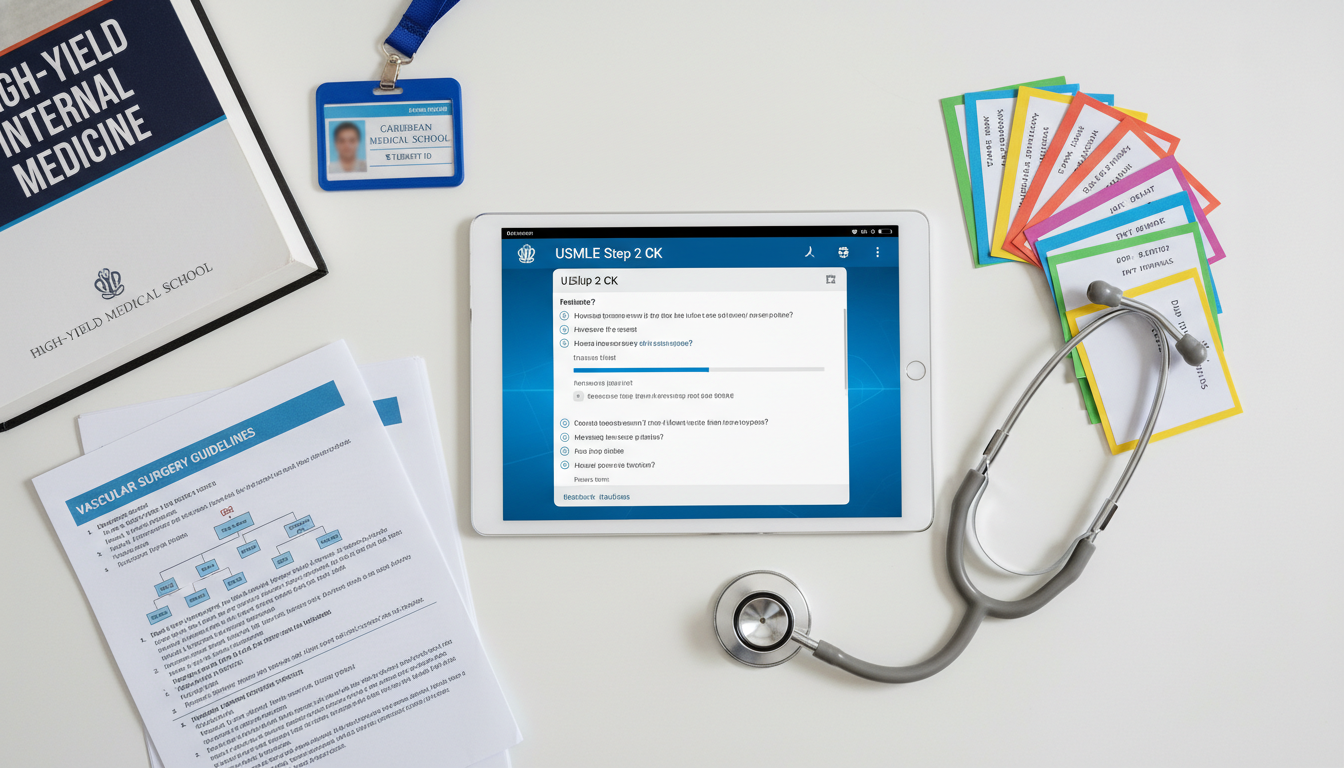
Essential resources
Primary QBank: UWorld Step 2 CK
- Treat this as your curriculum, not just practice.
- Annotate or summarize explanations in:
- A simple notebook, or
- An electronic document or spaced‑repetition system.
Clinical review text
- Choose ONE:
- Step‑Up to Medicine (strong internal medicine emphasis).
- Master the Boards Step 2 CK (more concise).
- Focus on:
- Cardio, pulm, renal, endocrine, ID, neuro.
- Perioperative risk, anticoagulation, thromboembolism.
- Choose ONE:
NBME + UWSA exams
- At least:
- 2 NBMEs, and
- 1–2 UWSAs.
- Use them to guide:
- When to take your exam.
- Whether you need to delay for more preparation.
- At least:
Supplemental vascular/surgical orientation (optional but strategic)
- For deeper vascular context (not to be memorized for Step 2 CK, but to connect dots):
- A concise vascular surgery review or guideline summary (e.g., SVS guidelines overview).
- Use sparingly:
- 1–2 hours/week to see how what you’re learning will apply to your future practice.
- For deeper vascular context (not to be memorized for Step 2 CK, but to connect dots):
Resources to use with caution
Multiple QBanks at once
- Don’t split your effort across several big QBanks initially.
- If you finish UWorld with time to spare, then consider a second QBank or incorrect questions reset.
Overly detailed surgical texts
- Campbell’s or comprehensive vascular textbooks are not Step 2 CK resources.
- Focus on high‑yield concepts, not operative minutiae.
Random online videos without a plan
- Only add video resources if:
- You learn better visually.
- You have a concrete weakness (e.g., EKGs, murmurs, ventilator management).
- Only add video resources if:
Tailored Strategies for Caribbean IMGs: Maximizing Your SGU Residency Match Potential in Vascular Surgery
If you are from SGU or another Caribbean school (AUC, Ross, etc.), you likely face:
- Non‑traditional clinical sites.
- Variable teaching quality in rotations.
- Logistics of studying while rotating across different hospitals or even countries.
Integrating Step 2 CK prep with your clinical rotations
1. Use your surgery and medicine rotations as live Step 2 CK prep.
- Ask attending physicians and residents:
- “How would this case appear on Step 2 CK?”
- “What’s the classic board‑style question about this condition?”
- For vascular‑type patients (PAD, DVT, AAA, stroke):
- Actively create board‑style vignettes in your mind:
- Presentation, key diagnostic tests, first‑line management, complications.
- Actively create board‑style vignettes in your mind:
2. Build a “clinical‑to‑boards” habit.
Every time you see:
- A post‑op fever:
- Identify POD day and likely differential.
- A DVT patient:
- Think about Wells score, diagnostic algorithm, and treatment steps.
- A diabetic foot ulcer:
- Distinguish neuropathic vs ischemic features and management.
Write 1–2 bullet points for each such case in a running document you review weekly.
Overcoming common Caribbean IMG challenges
Inconsistent teaching
- Compensate with structured question‑driven learning:
- 20–40 questions per day even during busy rotations.
- Use post‑call time efficiently: short, focused review sessions instead of aimless reading.
- Compensate with structured question‑driven learning:
Scheduling delays and uncertainty
- Lock in a reasonable Step 2 CK test date early, then adjust only if:
- NBME scores are significantly below your target range.
- Avoid:
- Indefinite postponements hoping to feel “perfectly ready.”
- Lock in a reasonable Step 2 CK test date early, then adjust only if:
Visa and timing issues for interviews
- For an integrated vascular program, you want your Step 2 CK score reported early in application season.
- Ideal timeline:
- Take Step 2 CK no later than late June–July for that year’s match.
- Coordinate with your dean’s office for:
- Score reporting.
- MSPE and transcript timing.
Showing vascular surgery commitment beyond the score
While this guide is about Step 2 CK preparation, remember that for a Caribbean medical school residency in vascular surgery, programs also look closely at:
- Sub‑internships or electives in vascular or general surgery (preferably in the US).
- Research in vascular or related fields (outcomes, quality improvement, PAD, aortic disease).
- Strong letters from vascular or reputed general surgeons.
Your Step 2 CK preparation and your vascular profile should reinforce each other:
- Read about vascular disease complications as part of your Step 2 CK study.
- Discuss evidence‑based management on rounds, using what you’ve learned for the boards.
- Ask mentors about vascular surgery training paths, integrated programs, and expectations.
Exam Day Execution: Clinical Reasoning, Timing, and Vascular‑Relevant Pitfalls
Step 2 CK is as much about reasoning and strategy as it is about raw knowledge. As a future vascular surgeon, you’ll be making fast, high‑stakes decisions—this exam mimics that cognitive style.
Clinical reasoning approach you should practice
Identify the clinical phase:
- Presentation: What is the likely diagnosis?
- Workup: What is the best next test?
- Management: What is the best next step in management?
- Follow‑up: What is the most appropriate long‑term therapy?
Prioritize life‑threatening issues first:
- Aortic dissection, massive PE, acute limb ischemia, stroke.
- For any sudden chest/back pain + risk factors ⇒ Rule out life‑threatening aortic pathology before worrying about chronic issues.
Use algorithms, not memorized trivia, especially for vascular‑related topics:
- DVT:
- Assess pretest probability (e.g., Wells score).
- If high probability ⇒ anticoagulation + imaging.
- AAA:
- Screen: ultrasound for certain age/risk group males.
- Indications for repair: size threshold, rapid growth, symptoms.
- Stroke:
- Distinguish ischemic vs hemorrhagic.
- Time window for thrombolysis vs thrombectomy.
- Role of carotid endarterectomy in secondary prevention.
- DVT:
Timing and stamina on test day
- Aim for 1 minute 10–15 seconds per question (average).
- If stuck:
- Eliminate wrong choices quickly.
- Mark the question and move on; many easier points are ahead.
- Between blocks:
- Light snack, hydration.
- Brief reset (deep breathing, short stretch), no deep content review.
Vascular‑relevant pitfalls on Step 2 CK
Be alert to common themes where vascular knowledge intersects with other disciplines:
- Mismanagement of anticoagulation around surgery
- Know when to bridge, when to hold, and when to continue agents.
- Missing subtle signs of acute limb ischemia
- Pain, pallor, pulselessness, paresthesia, paralysis, poikilothermia.
- Urgent management and imaging are key.
- Over‑ or under‑treating PAD
- Not every patient needs bypass or stenting.
- Optimize medical therapy and lifestyle when appropriate.
Putting It All Together: A Sample 6‑Week Step 2 CK Plan for a Vascular‑Bound Caribbean IMG
Here is a practical template you can adapt. Assume you have finished most core rotations and have a relatively open, “dedicated” study period.
Weeks 1–2: Baseline + foundation
- Take NBME on Day 1 or 2.
- Daily:
- 40–60 QBank questions (tutor mode, system‑based).
- 1–2 hours reading from your chosen main text.
- 30 minutes dedicated to vascular‑relevant topics:
- PAD, AAA, carotid disease, DVT/PE, diabetic foot, stroke.
- Weekend:
- Half‑day review of errors and weak systems.
Weeks 3–4: Mixed blocks + deeper integration
- Switch to mixed QBank blocks (timed).
- Daily:
- 60–80 QBank questions (2 blocks).
- Review explanations thoroughly.
- 1 hour of targeted review of low‑performing systems (e.g., psych, OB/GYN, biostats).
- End of Week 4:
- Take UWSA or NBME to track score progress.
Week 5: High‑yield consolidation
- Focus on:
- Incorrect questions.
- Weakest systems identified from practice exams.
- Daily:
- 2 mixed QBank blocks (reviewed in depth).
- 1–1.5 hours of notes review and high‑yield summaries.
- Schedule:
- Another NBME or UWSA mid‑week.
Week 6: Exam simulation + polishing
- First half:
- Simulate full exam day (6–7 blocks) once.
- Identify residual weak points and refine them.
- Second half:
- Light QBank (30–40 questions/day).
- Rapid review of key tables/algorithms:
- Vascular screening/management thresholds.
- Anticoagulation guidelines.
- Perioperative care protocols.
- Last day:
- Very light review only; focus on sleep, food, logistics.
FAQ: USMLE Step 2 CK Preparation for Caribbean IMG in Vascular Surgery
1. What Step 2 CK score do I need as a Caribbean IMG to be competitive for an integrated vascular program?
For a Caribbean medical school residency applicant in vascular surgery, aim for at least the mid‑240s, with 255+ making you more competitive. Lower scores may still match if you have:
- Strong US letters (especially from vascular surgeons),
- Substantial vascular research,
- Outstanding clinical evaluations and a compelling story.
But given the competitiveness, a high Step 2 CK score is one of your best tools to offset Caribbean IMG bias.
2. How should I balance Step 2 CK preparation with ongoing clinical rotations?
During busy rotations:
- Commit to 20–40 QBank questions per day (even if only on weekdays).
- Use patients you see as triggers for board review (e.g., DVT, PAD, stroke).
- On lighter rotations or electives (especially in surgery or vascular), add:
- Extra weekend sessions for reading and practice tests. Try to align your lighter rotations closer to your exam date so you can have near‑dedicated time beforehand.
3. Should I delay my exam if my NBME scores are below my target?
Consider delaying if:
- Your practice scores are more than ~15–20 points below your minimum realistic target, and
- You see clear, fixable content gaps, and
- You can afford the delay without harming your ERAS timing (for the upcoming match).
If your practice exam is only 5–10 points below your target, a focused 2–3 weeks of high‑yield review may be enough, and delaying excessively can be counterproductive. Always weigh:
- Score improvement potential vs
- Application timing and your ability to maintain momentum.
4. Does being from SGU or another Caribbean school hurt my chances even with a high Step 2 CK score?
Caribbean status does introduce some barriers, but a strong SGU residency match history (or similar) plus:
- A high Step 2 CK score,
- US clinical experience with excellent evaluations,
- Vascular‑oriented research or electives, can make you a credible candidate. Some programs may still prefer US MDs, but many surgical departments value work ethic, clinical competence, and clear specialty commitment. Use Step 2 CK to prove your academic readiness, then build the rest of your application to show you are already thinking and acting like a future vascular surgeon.
By anchoring your Step 2 CK preparation in disciplined QBank usage, targeted clinical reasoning, and strategically chosen resources—while tying everything to the vascular problems you hope to treat—you give yourself the best chance to turn a Caribbean medical education into a successful match in vascular surgery.