
Understanding Step 2 CK as a DO Graduate Pursuing Emergency Medicine–Internal Medicine
As a DO graduate targeting an Emergency Medicine–Internal Medicine (EM IM) combined program, your USMLE Step 2 CK preparation carries outsized importance. With the discontinuation of USMLE Step 1 numeric scores and COMLEX Level 1 moving to pass/fail, residency programs—especially competitive combined tracks like EM IM—lean more heavily on your Step 2 CK score to gauge knowledge, clinical reasoning, and readiness for residency.
At the same time, as a DO graduate you may have unique considerations:
- Balancing USMLE Step 2 CK with COMLEX Level 2-CE and possibly Level 2-PE alternatives
- Demonstrating parity with MD applicants in an osteopathic residency match or ACGME programs that are still learning how to interpret COMLEX-only applications
- Highlighting the strengths of osteopathic training (holistic approach, OMT background, strong clinical skills) while showing excellence in a standardized allopathic exam
This article provides a detailed, practical guide to USMLE Step 2 CK preparation specifically tailored to DO graduates interested in EM IM combined training. We will cover strategy, resources, timelines, and test-day execution, with an eye toward how your Step 2 CK score can support your goal of matching into Emergency Medicine-Internal Medicine.
How EM IM Programs View Step 2 CK for DO Graduates
Why Step 2 CK Matters So Much for EM IM
EM IM combined programs are relatively few and highly selective. They need residents who can:
- Manage acute emergencies with rapid decision-making
- Handle complex, chronic medical issues on the wards and in the ICU
- Transition seamlessly between ED and inpatient contexts
Program directors often describe combined EM IM residents as “workhorses with strong clinical reasoning.” Because of this, a solid Step 2 CK score carries several functions:
- Objective evidence of your ability to synthesize large amounts of clinical information
- Predictor of performance on in-training exams, ABIM, and ABEM boards
- A way to compare DO and MD applicants on the same scale in the osteopathic residency match and ACGME match
Even at programs that are DO-friendly and understand COMLEX, USMLE Step 2 CK provides a familiar, standardized benchmark.
What Is a “Good” Step 2 CK Score for EM IM?
There is no universal cutoff, but broad ranges can help frame your target:
- ≥260: Exceptional; makes you highly competitive for most EM IM combined programs if the rest of your application is solid
- 250–259: Strongly competitive; aligns with many top applicants
- 240–249: Competitive at most EM IM programs, especially with strong SLOEs, clinical performance, and a compelling story
- 230–239: Potentially competitive, particularly at DO-friendly and mid-range programs, but other application components must be strong
- <230: Still possible to match if you compensate with excellent clinical grades, strong EM SLOEs, research, leadership, and/or retake improvement (if applicable), but some EM IM programs may screen you out
As a DO graduate, aim for at least the mid-240s or higher if feasible. This isn’t a strict requirement, but it gives you the best chance to stand out in a specialty that values high clinical performance.
How Much Weight Does Step 2 CK Carry for DO Applicants?
For a DO applying to EM IM:
- When you have both COMLEX Level 2-CE and USMLE Step 2 CK, PDs often rely more on Step 2 CK because they’re more familiar with it.
- If you only have COMLEX, some programs convert scores using internal formulas; others may view COMLEX alone as less predictive.
- Many EM IM programs endorse DO applicants and are familiar with COMLEX, but having a strong Step 2 CK score reduces any uncertainty.
In other words: Step 2 CK is your opportunity to show you can compete anywhere, not just in osteopathic-focused environments.
Building an Effective Step 2 CK Study Plan as a DO Graduate
Step 1: Clarify Your Timeline and Clinical Rotation Context
Your position as a DO graduate or senior student shapes your approach:
If you’re a rising MS4 / OMS-IV:
- Ideal window: After core rotations (IM, Surgery, OB-GYN, Peds, Psych, Family) and before or early in sub-internships / EM rotations.
- Typical dedicated period: 4–8 weeks.
If you’re already graduated (DO graduate taking a gap year or after an unsuccessful match):
- You may have more flexibility but also more pressure.
- Dedicated 6–10 weeks is ideal, depending on how long you’ve been away from test-taking.
Consider:
- Application deadlines (ERAS, SOAP timelines, EM IM programs with specific Step 2 CK requirements)
- When EM rotations and SLOEs are scheduled (you don’t want Step 2 CK to interfere with performance on these critical experiences)
Step 2: Establish a Realistic Dedicated Study Length
For most DO applicants:
Short dedicated (4–5 weeks)
- Reasonable if:
- You did well on shelves and COMATs
- You’ve kept up with qbanks throughout third year
- Risk: Compressed time for content review; heavy daily workload.
- Reasonable if:
Standard dedicated (6–8 weeks)
- Best for: Majority of students aiming for a competitive Step 2 CK score for EM IM
- Allows:
- 1–1.5 full passes of a primary qbank
- Targeted review of weaker areas
- At least 3–4 full-length practice assessments
Longer dedicated (9–10+ weeks)
- Useful if:
- Step 1/Level 1 performance was borderline or low
- You’ve been away from core clinical content for >6–12 months
- Risk: Burnout and loss of efficiency if poorly structured
- Useful if:
Step 3: Integrate COMLEX Level 2-CE and USMLE Step 2 Study
As a DO, you may be preparing for both COMLEX Level 2-CE and Step 2 CK. Fortunately, the USMLE Step 2 study foundation overlaps substantially with Level 2-CE, with these differences:
- COMLEX:
- Includes osteopathic principles and practice (OPP), OMT
- Sometimes emphasizes different question styles and length
- USMLE:
- No OMT
- More emphasis on biostatistics, ethics, systems-based practice
Strategy:
- Use a single core clinical resource base (e.g., UWorld, NBME-style resources, a concise review book or notes).
- Add OMT/OPP resources specifically for COMLEX.
- Time your exams so they’re close together (e.g., Level 2-CE within 1–4 weeks of Step 2 CK), so you leverage overlapping material.
Core Resources for High-Yield Step 2 CK Preparation
Primary Question Bank: UWorld
UWorld remains the anchor for nearly everyone’s Step 2 CK preparation.
How to use it effectively:
- Complete 80–100% of the questions
- Mode: Primarily tutor mode early, switching periodically to timed blocks as you get closer to the exam
- Block size: 40-question blocks simulate test conditions; 20–30-question blocks if you’re in a busier clinical period
- Focus:
- Emergency presentations (trauma, shock, toxicology, acute abdomen, chest pain, dyspnea, sepsis)
- Internal medicine mainstays (cardiology, pulmonology, nephrology, GI, ID, endocrinology, rheumatology)
For an EM IM hopeful, pay attention to:
- Decision-making in acute settings: who goes to the ICU vs floor vs discharge
- Initial stabilization and diagnostic workups in the ED
- Management of undifferentiated complaints (e.g., “fever and hypotension,” “sudden onset chest pain”)
Supplemental Qbanks and Practice
Additional qbanks (e.g., AMBOSS, USMLE-Rx, Kaplan) can be useful if:
- You finish UWorld early and want extra practice
- You need more emphasis on complex reasoning or multi-step questions
But don’t spread yourself too thin. Depth with one primary qbank is usually better than shallow coverage of multiple.
Practice Exams: NBMEs and UWorld Self-Assessments
You should plan on at least 3–4 full-length assessments:
- NBME practice forms (latest versions):
- Provide the best correlation with real Step 2 CK performance
- Use them to estimate your predicted score and adjust your schedule
- UWorld Self-Assessments (UWSA 1 and 2):
- Excellent for building confidence and simulating test day
- Often slightly optimistic or similar to your final performance, but individual variability is common
Suggested sequence in a 6–8 week dedicated period:
- Week 1–2: UWSA 1
- Week 3–4: NBME Form 1 (or latest available low-number form)
- Week 5–6: NBME Form 2
- Week 6–7: UWSA 2 + possibly a final NBME if time allows
Aim for at least one exam in full test-day conditions (same timing, minimal breaks, same start time).
Concise Content Review Resources
While Step 2 CK is largely question-based learning, some structured content is valuable:
- Step-up to Medicine / other IM review texts: For refining outpatient and inpatient internal medicine—core for EM IM.
- Online rapid review videos (e.g., Boards & Beyond, OnlineMedEd-like platforms):
- Use for weak systems (e.g., nephrology, OB, pediatrics)
- Watch at 1.25–1.5x speed and annotate into your own notes or a concise outline.
Remember: You’re not trying to re-learn all of medicine. You’re trying to organize and sharpen what you already know, with an emphasis on clinical reasoning and management.
Strategic Study Approach for an EM IM-Focused DO Graduate

Weekly Structure During Dedicated Study
A sample 6–8 week plan:
Daily (5–6 days/week):
- 2–3 blocks of UWorld (40 Q each) → 80–120 questions/day
- 2–4 hours of review of those blocks (reading explanations, annotating, updating notes)
- 1–2 hours of targeted content review (videos, outlines, or high-yield notes)
Weekly:
- 1 “lighter” day (e.g., half-day) for:
- Reviewing marked questions
- System-based review (cardio, pulm, neuro, etc.)
- Rest and mental reset
- Every 1–2 weeks:
- One full practice exam block (NBME/UWSA) under timed conditions
High-Yield Clinical Themes for EM IM Applicants
You want to be particularly sharp in areas that mirror real EM IM practice:
Cardiovascular Emergencies
- STEMI, NSTEMI, unstable angina
- Aortic dissection, PE, tamponade, arrhythmias
- Heart failure and cardiogenic shock
Respiratory and Critical Care
- Intubation indications, ventilator management basics, ARDS
- Asthma and COPD exacerbations, pneumonia, sepsis
- Pulmonary embolism diagnosis and treatment
Shock and Sepsis
- Types (hypovolemic, cardiogenic, distributive, obstructive)
- Initial steps: fluids vs vasopressors, antibiotic timing
- Recognizing subtle early septic shock
Neurologic Emergencies
- Stroke (tPA and thrombectomy criteria, BP targets)
- Status epilepticus, meningitis, encephalitis
- CNS infections in immunocompromised patients
Toxicology & Environmental
- Overdose (opioids, benzodiazepines, acetaminophen, salicylates, TCA)
- Carbon monoxide poisoning, cyanide, organophosphates
- Heat stroke, hypothermia, drowning, burns
Acute Abdomen and Surgical Emergencies
- Appendicitis, cholecystitis, perforation, bowel obstruction
- Ectopic pregnancy, ovarian torsion, testicular torsion
- GI bleeding management (upper vs lower)
Core Internal Medicine Foundations
- Diabetes (DKA/HHS), thyroid storms & crises
- Kidney disease and electrolyte derangements
- Rheumatologic emergencies (e.g., SLE flare, vasculitis with organ involvement)
Although Step 2 CK is not specialty-specific, these themes come up frequently and also overlap heavily with EM IM training. Prioritizing them not only helps your score but also prepares you realistically for residency.
Using Your DO Background to Your Advantage
Your DO training can enhance your Step 2 CK performance:
- Strong emphasis on holistic assessment helps with multi-system, “sick vs not sick” questions.
- OMT knowledge deepens your understanding of musculoskeletal and pain presentations (even though OMT itself is not tested).
- Many osteopathic schools place heavy emphasis on clinical reasoning and patient communication, which directly maps to Step 2 CK’s style.
However, be mindful of differences:
- USMLE rarely cares about structural lesions or Chapman’s points; don’t waste time reviewing those for Step 2.
- Instead, use that time to strengthen biostatistics, ethics, and systems-based questions, where DO students sometimes feel less prepared.
Step 2 CK Test-Day Strategy and Performance Optimization
Simulating the Test Environment
To reduce anxiety and surprises:
- Take at least one full-length practice exam starting at the same time as your scheduled test day.
- Use:
- Earplugs or noise-canceling headphones
- The same snacks, drinks, and break pattern you plan to use on exam day
- Minimal phone or internet use during breaks
This helps you refine pacing and adjust if you find yourself rushing or fatiguing too early.
Section-Level Strategy During the Exam
Each Step 2 CK block:
- ~40 questions
- ~60 minutes → about 1.5 minutes per question
Practical approach:
First pass:
- Move efficiently. If you don’t see the answer in <45 seconds, mark it, pick your best guess, and move on.
- Don’t get stuck on one question; protect your overall score.
Second pass (if time allows):
- Return to marked questions and refine answers if you have stronger insight now.
- But avoid overthinking and changing answers without clear justification.
Handling Uncertainty and Difficult Questions
Many Step 2 CK questions feel vague or “too much like the real world.” That’s intentional. Focus on:
- What is the single best next step? (Diagnosis, test, or treatment)
- What is the most life-saving or time-sensitive action?
- Are they asking for initial management, long-term management, or next diagnostic step?
For EM IM aspirants, this mindset aligns with your future workflow: stabilize the patient, then refine.
Break Strategy
You get up to 45 minutes of break time (more if you finish the tutorial early). Plan:
- 5–10 minutes after every 1–2 blocks
- One slightly longer break around midpoint (10–15 minutes) for a snack and mental reboot
- Avoid heavy, greasy foods that make you sluggish; use water, coffee/tea, nuts, fruit, or light carbs
Navigating Imperfect Scores, Retakes, and Overall Application Strategy
If Your Practice Scores Are Below Target
As you approach your test date, your NBME/UWSA scores may not be where you hoped. For EM IM, you may have been aiming for ≥245, but your practice scores are in the 230s.
Ask:
Is there time to meaningfully improve?
- If your dedicated period is short and applications are looming, delaying may not help much.
- If you have 4–6 extra weeks, an extension could raise your score modestly (often 5–15 points with focused work).
What are your weak points?
- Are you missing basic knowledge (e.g., simple guidelines, diagnostic criteria)?
- Or are you struggling with multi-step reasoning and test-taking stamina?
Can your broader application compensate?
- Strong EM SLOEs, honors in rotations, robust research, leadership, and clear EM IM motivation can soften a slightly lower Step 2 CK score.
If Your Step 2 CK Score is Lower Than Expected
For a DO graduate aspiring to EM IM combined training:
Do not panic. One exam is important, but it’s not everything.
Emphasize your strengths:
- EM rotations with excellent comments
- IM performance and strong internal medicine letters
- Holistic, team-based leadership, and commitment to underserved or complex patients
Be transparent when needed:
- If you have a clear explanation (major life event or illness during prep), discuss it briefly with your mentors. Often, they can help contextualize the score in letters.
- Don’t dwell on excuses in your personal statement, but you can frame growth and resilience.
Target DO-friendly and EM IM programs that explicitly welcome osteopathic applicants:
- Look for program websites or EM organizations that highlight DO residency match success.
- Contact recent DO grads from those programs to understand how they weighed Step 2 CK.
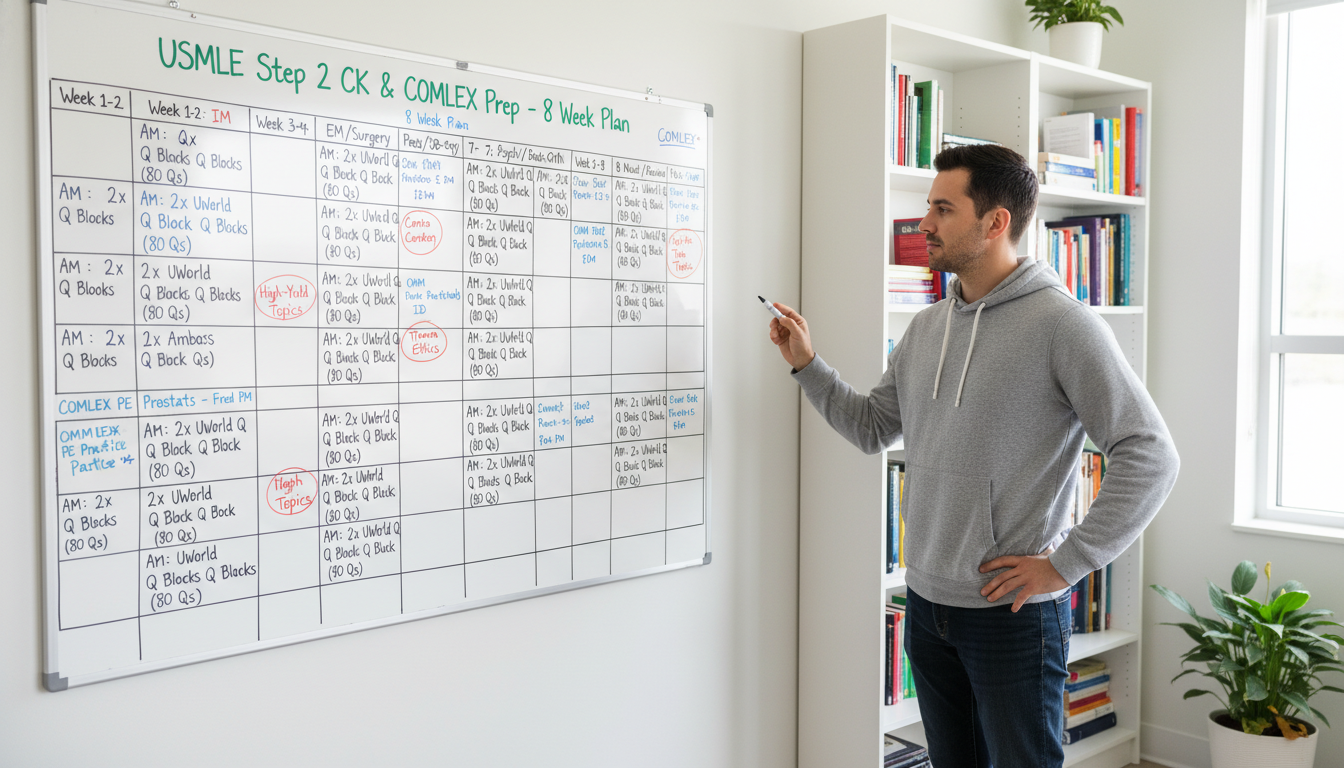
Putting It All Together: A Sample 8-Week Plan for a DO Interested in EM IM
Week 1–2: Foundation and Qbank Ramp-Up
- 60–80 UWorld Q/day (tutor mode)
- Focus on IM core topics (cardio, pulm, GI, renal) + ED presentations
- Short daily content review sessions
- End of Week 2: UWSA 1 → identify weak zones
Week 3–4: Broad Coverage and First NBME
- 80–100 UWorld Q/day (mixed subjects, some timed blocks)
- Daily review of missed/marked Qs
- 3–5 focused video or note sessions per week on weak systems
- End of Week 4: NBME Form → adjust goals and focus
Week 5–6: Higher-Order Refinement
- Finish remaining UWorld Qs; begin second pass of incorrects or marked
- Mix of tutor and timed modes
- Emphasis on emergency medicine internal medicine overlap (shock, sepsis, chest pain, dyspnea, neuro emergencies)
- End of Week 6: NBME Form 2
Week 7: Exam Readiness and Simulation
- Mostly timed UWorld blocks
- Review all incorrects from UWorld and NBMEs
- UWSA 2 under full exam conditions
- Taper slightly at week’s end to avoid burnout
Week 8: Final Review and Light Study
- Focused review of:
- Biostatistics and ethics
- OB/GYN, pediatrics, and psychiatry high-yield algorithms
- Classic ED algorithms (ACLS basics, trauma primary/secondary survey principles in concept form)
- 1–2 light question blocks daily; no new resources
- Take the day before the exam relatively light—review quick notes only
Frequently Asked Questions (FAQ)
1. As a DO graduate, do I really need to take USMLE Step 2 CK if I already have COMLEX Level 2-CE?
For EM IM combined and many ACGME EM programs, yes, it’s strongly recommended. While some DO-friendly programs accept COMLEX alone, many still prefer or require a USMLE Step 2 CK score for easier comparison with MD applicants. A strong Step 2 CK score reassures program directors about your readiness and helps you compete broadly in both the allopathic and osteopathic residency match environments.
2. How should I balance studying for COMLEX Level 2 and USMLE Step 2 CK?
Use a USMLE Step 2 study foundation (UWorld, NBME-style thinking) as your base. Then, 1–2 hours a few days per week, add specific OMT/OPP resources just for COMLEX. Schedule the exams within a month of each other so that your clinical knowledge is fresh for both. Avoid duplicating full sets of resources; it’s better to go deep on one main qbank and add targeted COMLEX-only content where necessary.
3. What Step 2 CK score should I aim for to be competitive for EM IM combined programs?
Aim for at least the mid-240s or above if you can. Many successful EM IM residents fall in the 240–260+ range. However, numbers are not absolute gatekeepers. A score in the 230s may still be competitive if you have strong EM SLOEs, excellent clinical evaluations, compelling leadership or research, and clear commitment to EM IM.
4. Does my performance on Step 1/Level 1 predict how I’ll do on Step 2 CK?
Partially, but not completely. Many DO students with modest Step 1 or COMLEX Level 1 scores show substantial improvement on Step 2 CK because it’s more clinically oriented and aligns better with how they think and learn. If you were stronger on clinical rotations and shelf exams, you may outperform your prior test history. Thoughtful, focused preparation can produce meaningful score gains, especially if you target your weakest systems and refine test-taking strategy.
By aligning a structured, question-driven USMLE Step 2 CK preparation plan with your strengths as a DO graduate and your long-term goal in Emergency Medicine-Internal Medicine, you position yourself for both a strong exam performance and a compelling residency application.