
Orthopedic surgery is one of the most competitive specialties—and as a DO graduate, your USMLE Step 2 CK preparation can significantly influence your osteopathic residency match prospects. While holistic review and COMLEX are gaining broader acceptance, a strong Step 2 CK score still opens doors, especially for orthopedic surgery residency programs that remain highly score-conscious.
This guide walks you through a targeted, evidence-informed approach to USMLE Step 2 study as a DO interested in orthopedics. It blends strategic planning, resource selection, and test-day execution—specifically tailored to your background and goals.
Understanding the Role of Step 2 CK for a DO Applying to Orthopedic Surgery
Why Step 2 CK Still Matters in an Ortho Match
Even with Step 1 now pass/fail, Step 2 CK remains a key differentiator in the ortho match. For a DO graduate, it serves several purposes:
Standardized comparison metric
Many programs use Step 2 CK as the primary numeric score to compare MD and DO candidates on the same scale.Evidence of clinical reasoning
Orthopedic surgery residencies emphasize decision-making under pressure. Step 2 CK assesses clinical application, diagnosis, and management—skills critical in the OR and on trauma call.Signal of readiness for rigorous training
A solid Step 2 CK score reassures programs that you can handle:- Busy trauma services
- High-stakes decision-making
- In-house call as an intern
Compensatory signal for DO applicants
If your COMLEX scores are average or you attended a lesser-known osteopathic school, a strong Step 2 CK score can demonstrate that you can compete nationally, not just within the DO cohort.
Where Step 2 CK Fits in Your Overall Application
Your orthopedics application is an integrated story:
- Objective metrics: COMLEX, Step 2 CK score
- Ortho-specific credentials: Sub-I performance, letters from orthopaedic surgeons, research, and away rotations
- Osteopathic identity: OMT background, holistic training, and musculoskeletal focus
- Professionalism and work ethic: Reflected in your clinical evaluations and recommendations
For a DO graduate, Step 2 CK is a bridge between your osteopathic training and the expectations of predominantly allopathic residency programs.
Bottom line: Treat Step 2 CK as a strategic tool, not just another exam. Your preparation should be calibrated to the level of competitiveness you are aiming for in orthopedic surgery.
Setting Goals and Building a Step 2 CK Study Plan as a DO Ortho Applicant
Step 2 CK Score Targeting for Orthopedic Surgery
Score expectations vary by program, but for a DO applicant targeting competitive academic or busy community ortho programs, aim for a Step 2 CK score that:
- Is comfortably above the national average
- Minimally aligns with, and ideally exceeds, typical entering ortho classes
While exact numbers change every year, conceptually think in tiers:
- Highly competitive ortho programs:
Aim for a solidly above-average score (often in the top quartile of Step 2 CK takers). - Moderately competitive programs:
A slightly above-average or strong average score can be acceptable if combined with excellent rotations, strong ortho letters, and research. - Safety programs / backup specialties:
For programs more DO-friendly or community-based, a respectable but not stellar score may still be adequate if other aspects of your application are strong.
When setting your personal target:
- Review your COMLEX Level 1 & 2 performance.
- Look at historical data (NRMP Charting Outcomes, program-specific info when available).
- Consider your geographic and program-type preferences (high-powered academic vs community, DO-friendly vs historically MD-heavy).
If your COMLEX scores are borderline for ortho, your Step 2 CK preparation should be aggressive and highly structured to give yourself the best shot.
Timing Step 2 CK Around Rotations and Applications
For a DO aiming for the osteopathic residency match in orthopedics:
- Optimal timing: Take Step 2 CK before ERAS submission (late summer / early fall of application year) so programs can see your score in initial screening.
- Avoid: Taking the exam too early before adequate clinical exposure (e.g., right after second year) or too late so that scores arrive after interview offers are largely decided.
Common timelines:
- Rising 4th year DO student
- Step 2 CK: Late June–August after core rotations
- Sub-Is/Aways in ortho: Summer–early fall
- ERAS submission: September
- If COMLEX Level 2 was weaker than expected
- Consider taking Step 2 CK after some targeted remediation but still early enough for scores to be available before interview season.
Building a Realistic Study Schedule
A structured but flexible schedule is essential. Consider:
Your starting point
- Strong on COMLEX Level 2? You may need 4–6 weeks full-time.
- Average or weaker performance? Plan 6–10 weeks, depending on other responsibilities.
Clinical responsibilities
- During an easier elective or lighter rotation: You may manage 4–5 hrs/day of serious studying.
- During sub-I or busy ortho elective: Prioritize rotation performance; plan fewer hours and lower intensity.
Life realities
- Factor in wellness, commuting, personal responsibilities, and board-related stress.
Example full-time 6-week Step 2 CK preparation schedule for a DO ortho applicant:
Weeks 1–2: Foundation & Systems Review
- 40–60 UWorld questions/day (timed, random or system-based early on)
- 2–3 hours of content review using a primary resource (e.g., UWorld explanations + a concise Step 2 CK text)
- Weak areas: dedicate an extra 30–60 mins daily to IM, peds, OB/GYN, or psych (since ortho-leaning students often underemphasize these)
Weeks 3–4: Intensive QBank & NBME Integration
- 60–80 UWorld questions/day (timed, random)
- NBME practice exam at start of Week 3 and end of Week 4
- Focused review of every missed question—know why you missed it: knowledge gap vs reasoning vs test-taking error
Weeks 5–6: High-Yield Polishing & Exam Readiness
- Finish UWorld (1st pass)
- Add additional QBank blocks focusing on weakest disciplines
- One full-length simulation day (7 blocks) to test endurance
- Light but consistent daily review of flashcards, notes, or a rapid-review resource
If you’re on a full-time rotation while studying, simply halve the daily question volume and extend the prep period (e.g., 8–10 weeks).

Core Resources for High-Yield Step 2 CK Preparation (with a DO-Ortho Lens)
The Non-Negotiables
For almost every successful Step 2 CK strategy—MD or DO—the following core resources are essential:
UWorld Step 2 CK QBank
- Your primary learning tool, not just a test.
- Use timed, random blocks once you’re comfortable; this best simulates the actual exam.
- Carefully read explanations—not just for what you got wrong but to:
- Learn patterns of presentation
- Understand reasoning pathways
- Pick up high-yield facts
NBME Practice Exams
- Take at least 2–3 NBME forms during your prep.
- Use them to:
- Calibrate your progress toward your Step 2 CK score target
- Identify persistent weak areas
- Practice real exam pacing
Anki or Another Spaced-Repetition Tool (Optional but Powerful)
- Particularly useful if:
- You struggled with info retention on COMLEX.
- You’re balancing a busy schedule with long study timelines.
- Consider pre-made Step 2 CK decks or create your own from:
- UWorld misses
- NBME concepts
- High-yield lists
- Particularly useful if:
Content Review Resources
Because you already have a strong musculoskeletal base as a future orthopedist, you should prioritize non-ortho domains where Step 2 CK is heavier weighted. Useful resources include:
Comprehensive Review Text
- Examples (any one solid, concise Step 2-specific text):
- A well-regarded Step 2 CK review book (e.g., Step-Up to Medicine for IM, plus a general Step 2 book)
- Use as a reference and for targeted review, not as your primary study method.
- Examples (any one solid, concise Step 2-specific text):
Subject-specific books or notes
- Internal Medicine: A high-yield IM review is particularly valuable; IM is the backbone of Step 2 CK.
- Pediatrics, OB/GYN, Psychiatry: Short, focused resources can quickly address gaps in these underemphasized areas for many ortho-bound students.
Video Lectures (Optional)
- Great if you’re an auditory or visual learner.
- Use selectively for:
- Topics you consistently miss (e.g., OB hemorrhage protocols, pediatric rashes)
- Conceptually tricky material (e.g., acid-base, renal failure, ventilator management)
DO-Specific Considerations
As a DO graduate, you might have some unique gaps and strengths:
Strengths:
- Musculoskeletal and neuromuscular disorders (back pain, joint pathology, fractures, etc.)
- Holistic patient assessments and physical exam emphasis
Potential Gaps:
- Less intensive exposure to allopathic-focused board prep culture (especially if your school emphasized COMLEX only)
- Limited experience with certain USMLE-style question patterns, especially test-taking traps
Address these by:
- Using UWorld and NBMEs as your main calibration tools.
- Reviewing USMLE-specific online explanations or forums to recognize question style and common distractors.
- Ensuring you don’t neglect OB/GYN, peds, psych, and internal medicine complexities, which weigh more heavily than orthopedics on Step 2 CK.
Strategic Study Tactics for DO Graduates Targeting Ortho
Leveraging Your Ortho Mindset Without Overemphasizing Ortho Content
Orthopedic surgery applicants tend to gravitate to what they enjoy: fractures, sports injuries, spine, and trauma. While this background helps with certain musculoskeletal questions, Step 2 CK is not an orthopedic surgery exam.
Key mindset shifts:
Don’t over-allocate study hours to orthopedics.
Your extra 2 hours memorizing Salter-Harris fractures may improve 1–2 questions. Those same hours spent mastering heart failure management, OB emergencies, or ventilator settings can net more points.Use ortho strengths to free up cognitive bandwidth.
Move quickly through straightforward MSK questions so you have more time for complex IM or OB/GYN scenarios.Think like a generalist, not a surgeon.
Step 2 CK will test whether you can stabilize and initially manage patients before surgical consultation, particularly in trauma, infections, and chronic disease.
High-Yield Systems and Topics for Ortho Applicants
Focus especially on:
Internal Medicine
- Cardiology: ACS, CHF, arrhythmias, valvular disease
- Pulmonary: COPD, asthma, PE, pneumonia, ARDS
- Renal: AKI, CKD, electrolyte disorders
- Endocrinology: DKA, HHS, thyroid disease, adrenal crises
- Infectious Disease: sepsis, osteomyelitis (relevant to ortho), post-op infections
Emergency Medicine & Trauma
- Initial trauma survey (ATLS-like approaches)
- Airway, breathing, circulation priorities
- Spinal cord injury, head trauma, shock states
OB/GYN
- Labor and delivery management
- Hypertensive disorders, hemorrhage, fetal distress
- Early pregnancy complications
Pediatrics
- Developmental milestones
- Common infectious diseases and rashes
- Congenital heart disease basics
Psychiatry & Neurology
- Mood disorders, psychosis, anxiety, substance use
- Acute neurologic emergencies (stroke, seizures, status epilepticus)
You will of course see orthopedics content (fractures, back pain, joint infections, etc.), but it’s a smaller piece of the exam pie than IM, OB, or peds.
Question Practice Strategy
Transform your USMLE Step 2 study into a deliberate practice routine:
Block design
- Begin each day with one full timed block (40 questions) to simulate exam conditions.
- Later in the day, you can do additional blocks untimed if needed, focusing on careful review.
Post-block review
- For each question, identify:
- The clinical “buzzwords” or pattern
- The key decision point (diagnosis? next best step in management? interpretation of labs?)
- Why each wrong answer is wrong
- Create a one-line takeaway if it’s a key concept (especially if new or something you previously missed).
- For each question, identify:
Error analysis
- Maintain a simple log:
- Topic
- Type of mistake: knowledge gap, misread question, time pressure, over-thinking
- Revisit this log weekly to track your evolving weaknesses.
- Maintain a simple log:
Pacing practice
- Many DO students under timed pressure overthink or get stuck.
- Practice finishing blocks with 3–5 minutes to spare, so you have margin on test day.
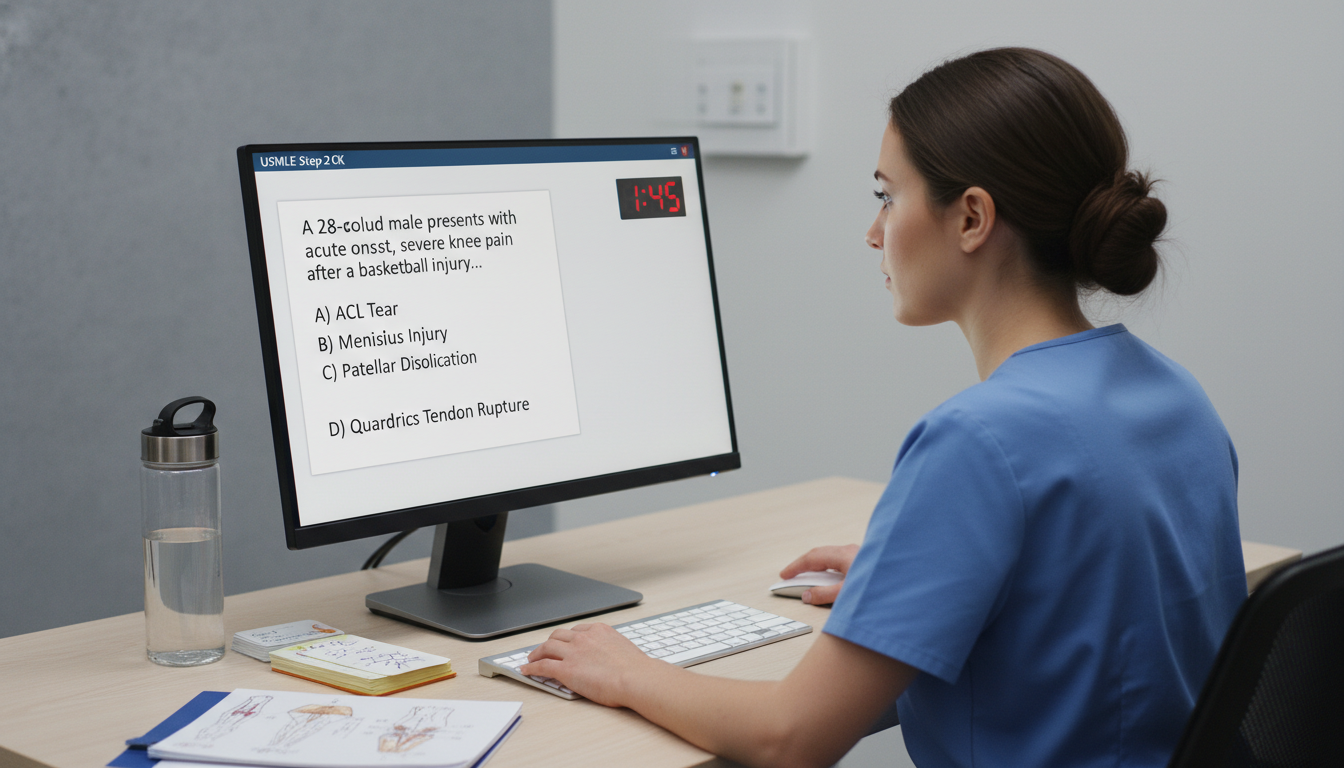
Test Week, Test Day, and After the Exam: Execution for Ortho-Minded DOs
The Final Week: Polishing and Protecting Your Score
The last 5–7 days should focus on consolidation, not cramming:
Light question blocks
- 40–80 questions/day, focusing on:
- Your persistently weak subjects
- Random blocks to maintain test-style thinking
- 40–80 questions/day, focusing on:
Rapid review
- Revisit:
- Your highest-yield notes or summary sheets
- Common algorithms (e.g., chest pain workup, stroke management, OB hemorrhage)
- Particularly tricky infections, endocrine emergencies, and pediatric vaccine schedules
- Revisit:
NBME or Full Simulation
- If your previous NBME was 7+ days ago and you still have a form left, one more exam can:
- Confirm you’re on target for your Step 2 CK score goal
- Give you additional question patterns to review
- Avoid taking a new NBME within 48 hours of test day unless absolutely necessary.
- If your previous NBME was 7+ days ago and you still have a form left, one more exam can:
Wellness and sleep
- Shift your schedule to mirror exam day timing.
- Prioritize 7–8 hours of sleep, especially the final 2–3 nights.
Test Day Strategy
Treat test day like a long call shift—this aligns well with your future as an orthopedic resident:
Logistics
- Arrive early, test your ID, store snacks.
- Bring simple, familiar food and caffeine if you routinely use it (avoid trying anything new that day).
Block management
- Plan your breaks in advance (e.g., after every 2 blocks, plus a longer break mid-day).
- During questions:
- Move steadily; don’t get stuck longer than ~90 seconds on any item.
- Make your best selection and flag only if truly necessary.
Mental approach
- Accept that you’ll see unfamiliar or strange questions.
- Ask yourself: “What would a reasonable, evidence-based clinician do next?”
- Use pattern recognition from UWorld and NBME exposures:
- Stable patient? Outpatient testing or follow-up.
- Unstable? ABCs first, then targeted interventions.
After the Exam: Interpreting Your Score as a DO Ortho Applicant
When your Step 2 CK score arrives:
If it meets or exceeds your target:
- Highlight it in your application.
- Request that letter writers mention your strong clinical reasoning and board performance.
If it’s slightly below your ideal but still solid:
- Double down on:
- Strong sub-I and away rotation performance
- Excellent letters from orthopaedic surgeons
- Any ongoing research or presentations
- Emphasize your clinical strengths, reliability, and manual skills in interviews.
- Double down on:
If it’s significantly below expectations:
- Talk to a trusted advisor, orthopaedic faculty mentor, or program director familiar with the osteopathic residency match.
- Consider:
- A focused narrative in your personal statement if there’s a clear explanation (e.g., significant life event, illness).
- Adjusting your program list to include more DO-friendly or mid-tier programs.
- Identifying backup specialties that still align with your interests.
Regardless of outcome, remember that orthopedics evaluates the whole package: hands-on skills, reliability on trauma call, team fit, and the capacity to learn under stress. Step 2 CK is important—but it is not the only determinant of your orthopaedic future.
FAQs: USMLE Step 2 CK Preparation for DO Graduates in Orthopedic Surgery
1. As a DO, do I really need Step 2 CK if I have COMLEX for an orthopedic surgery residency?
Many ortho programs still either prefer or require USMLE scores, even for DO applicants. Taking Step 2 CK:
- Makes you directly comparable to MD applicants.
- Demonstrates comfort with USMLE-style assessments.
- Expands the list of programs where you are a fully competitive candidate.
For the ortho match, especially at historically MD-heavy or academic programs, Step 2 CK can be a substantial advantage and sometimes a de facto requirement.
2. How should my Step 2 CK preparation differ from my COMLEX Level 2 prep?
The knowledge base is similar, but:
- USMLE Step 2 CK emphasizes:
- Long-vignette, multi-step reasoning
- Clear best-next-step decision making
- Evidence-based algorithms
- COMLEX includes:
- More OMT and osteopathic principles
- Some differences in style and focus
For Step 2 CK:
- Lean more heavily on UWorld, NBME exams, and algorithm-based thinking.
- Practice timed random blocks to adjust to USMLE pacing and style.
- De-emphasize OMT for CK and refocus on mainstream management and diagnostic strategies.
3. How many weeks should I dedicate to Step 2 CK if I’m also doing orthopedic sub-Is?
If you’re on intense rotations:
- Plan 8–10 weeks part-time, with:
- 2–4 hours of study on lighter days
- Lower expectations during heavy call weeks
If you can take dedicated time:
- 4–6 weeks full-time can work well, especially if your COMLEX foundation is solid.
Ensure you don’t let Step 2 CK prep compromise sub-I performance, which is crucial in orthopedics. Some DO students schedule Step 2 CK before their heaviest ortho rotations, to allow full clinical focus later.
4. What if my Step 2 CK score is average—can I still match into orthopedic surgery as a DO?
Yes, especially if:
- You excel on sub-Is and away rotations.
- You secure strong letters from orthopaedic surgeons that highlight your work ethic, technical aptitude, and team skills.
- You build a program list that includes DO-friendly and mid-tier ortho programs.
- You have other strengths—research, leadership, or a compelling story—that distinguish you.
An average score doesn’t eliminate you from the osteopathic residency match in ortho, but you should be strategic: cast a wide net and maximize every other part of your application.
By approaching USMLE Step 2 CK preparation with a structured plan, targeted resources, and the mindset of a future orthopedic surgeon, you can transform this exam from a hurdle into a powerful asset. As a DO graduate, your osteopathic training and musculoskeletal strengths already position you well; disciplined, focused preparation will help ensure your Step 2 CK score reflects your potential and supports your path to a competitive orthopedic surgery residency.