Understanding the Role of Step 2 CK in Diagnostic Radiology
For diagnostic radiology applicants, USMLE Step 2 CK sits at a critical intersection of clinical reasoning and future specialty performance. While imaging is central to radiology, the foundations of your interpretive skills are built on robust clinical knowledge—and that’s precisely what Step 2 CK is designed to test.
Why Step 2 CK Matters in Radiology Residency
In the modern application landscape, especially after the Step 1 pass/fail change, residency programs rely more heavily on Step 2 CK scores as an objective academic metric. For radiology residency applicants, this has several implications:
Stronger emphasis on clinical reasoning
Diagnostic radiologists are consultants for almost every specialty. Your ability to integrate lab values, physical findings, and clinical context with imaging depends on the kind of clinical knowledge Step 2 emphasizes.Programs use Step 2 CK score as a sorting metric
In the diagnostic radiology match, many programs now:- Use score cutoffs to screen applications
- Weigh Step 2 CK more heavily than before
- Compare applicants’ Step 2 CK performance to their class averages and Step 1 history
Redemption or reinforcement after Step 1
- If Step 1 was borderline or just passing, a strong Step 2 CK score can reassure program directors that you can handle a rigorous academic environment.
- If Step 1 was strong, Step 2 CK can confirm consistent performance and support competitiveness at top radiology programs.
What Radiology Programs Look for in Step 2 CK
Radiology PDs and faculty tend to value:
- Above-average or high scores relative to national norms and your school’s average
- Consistent performance trajectory (no significant drop from Step 1 to Step 2, if Step 1 score is available)
- Timely completion — most programs want a Step 2 CK score available by ERAS review or at least before rank lists
While specific cutoff scores vary, competitive academic diagnostic radiology programs often expect Step 2 CK scores clearly above national mean, with many matched applicants clustering in higher score ranges. However, a single number is never the whole story; it’s one piece of the overall application.
Step 2 CK Content Strategy for Future Radiologists
Your USMLE Step 2 study plan should respect that this is a clinical exam, not an imaging exam. Yet, some domains are especially relevant for future radiologists and can give you both exam points and long-term specialty benefits.
High-Yield Clinical Domains for Radiology-Bound Students
Internal Medicine (Core of Step 2 CK)
- Cardiovascular, pulmonary, renal, and GI pathologies
- Infectious disease and sepsis management
- Electrolyte and acid–base disorders
- Thrombosis, anticoagulation, and bleeding disorders
How it helps radiology: - Understanding indications for CT angiography, MRI, ultrasound, and nuclear medicine
- Anticoagulation considerations for invasive procedures (e.g., biopsies, drains)
Surgery & Perioperative Care
- Management of acute abdomen, trauma, and postoperative complications
- Indications for operative vs non-operative management
- Wound complications, infections, and DVT prophylaxis
Radiology relevance: - CT findings for appendicitis, SBO, perforation, pancreatitis
- Trauma imaging algorithms (FAST, CT, X-ray sequences)
Obstetrics & Gynecology
- Ectopic pregnancy, early pregnancy complications
- Hypertensive disorders of pregnancy
- Fetal well-being and monitoring
Radiology relevance: - First-trimester ultrasound indications and interpretation basics
- Imaging choices in pregnancy (when to avoid radiation)
Pediatrics
- Congenital heart disease basics
- Common pediatric infectious and respiratory conditions
- Child abuse evaluation (very high-yield for both Step 2 CK and radiology)
Radiology relevance: - Non-accidental trauma imaging protocols
- Pediatric dose reduction considerations
Emergency Medicine
- Acute chest pain, stroke, PE, aortic dissection
- Acute abdomen, trauma, spinal emergencies
- Toxicology basics
Radiology relevance: - Emergency CT/MRI/US pathways and imaging triage
Neurology & Psychiatry
- Stroke, seizures, headaches, demyelinating disease
- Acute psychosis, mood disorders, delirium
Radiology relevance: - Understanding indications for CT vs MRI vs no imaging
- Stroke imaging pathways (non-contrast CT, CTA, CTP, MRI)
Step 2 CK Content Areas Often Overlooked by Radiology Applicants
Radiology-leaning students sometimes underinvest in:
- Psychiatry – yet it’s a substantial component of the exam and scoring
- Ethics & communication – a major source of “easy” questions if you’ve seen enough scenarios
- Preventive medicine & screening guidelines – critical for recognizing when imaging is indicated vs overused
Build these areas into your USMLE Step 2 study plan deliberately so you don’t leave straightforward points on the table.
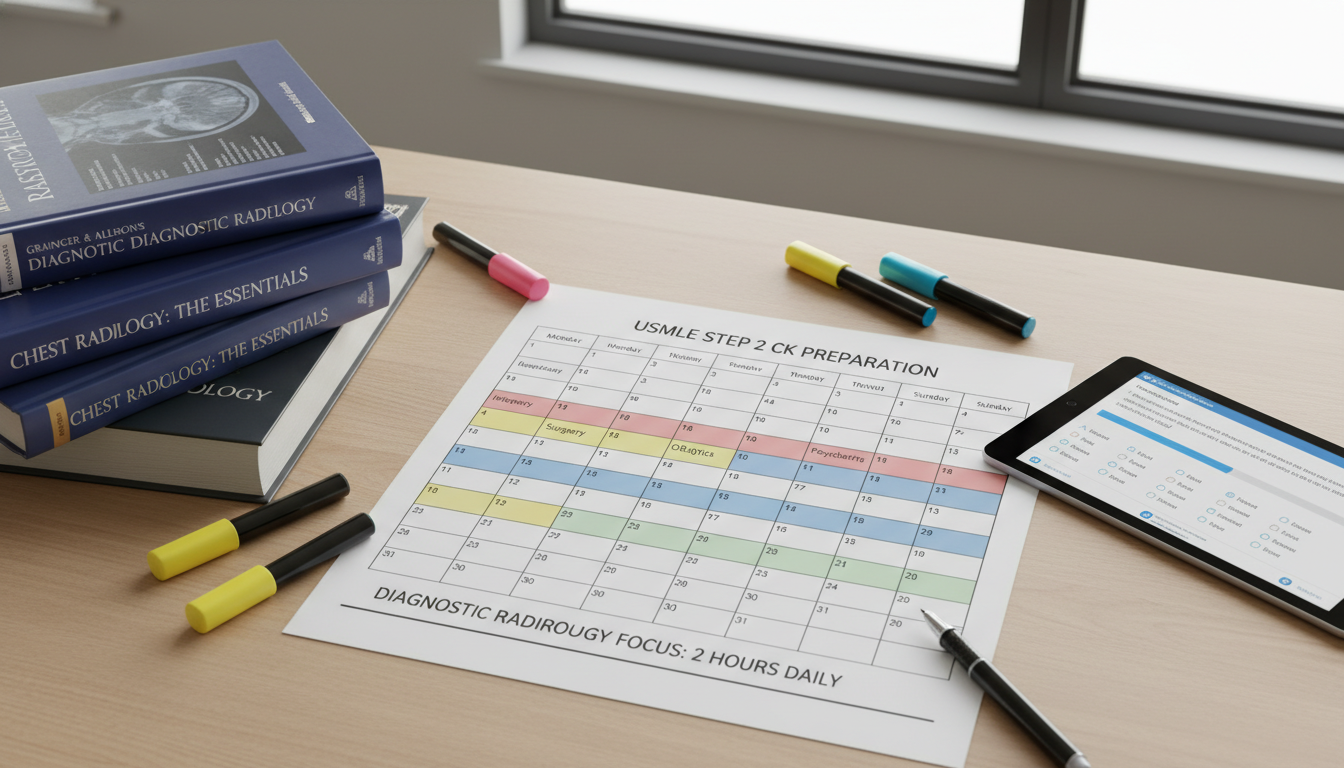
Building a Strategic Step 2 CK Study Plan as a Radiology Applicant
A strong Step 2 CK preparation plan blends consistency, question-based learning, and realistic timelines. Below is a template framework you can adapt based on your schedule and target exam date.
Step 1: Clarify Your Goals and Constraints
Ask yourself:
- When is your ideal test date relative to:
- Core clinical rotations
- Dedicated study period
- ERAS submission / radiology interview season
- What is your target Step 2 CK score range based on:
- Your Step 1 performance (if applicable)
- Competitiveness of your radiology programs of interest
- How much dedicated time can you realistically secure?
- Purely dedicated (4–8 weeks)
- Partially dedicated (during lighter rotations)
- Integrated with ongoing core rotations
Recommendation for radiology applicants:
Aim to take Step 2 CK by late summer or early fall of application year so your score is available for most program reviews. If possible, schedule it soon after your heaviest clinical rotations (medicine, surgery, OB/Gyn) while that knowledge is fresh.
Step 2: Core Study Resources
You don’t need a massive library. Depth with a few high-yield resources typically beats breadth.
1. Question Bank (Primary Resource)
- A comprehensive Step 2 CK-style Qbank (e.g., UWorld or equivalent) is non-negotiable.
- Use tutor mode early for learning and timed mode later for exam conditioning.
- Radiology angle: Pay close attention to:
- Indications for imaging
- Next best step when imaging is or isn’t appropriate
- How imaging results change management
2. Concise Review Book or Digital Summary
- A high-yield Step 2 CK review text or digital outline to consolidate key facts.
- Use it to:
- Fill in gaps revealed by Qbank
- Review summarized algorithms for emergencies and common conditions
3. NBME and Official Practice Exams
- Use NBME practice tests and any official practice materials to:
- Benchmark your Step 2 CK score trajectory
- Calibrate time management and stamina
- Identify weak systems to be shored up
4. Supplementary Resources (Targeted)
- For particularly weak areas (e.g., OB, psychiatry, ethics), consider:
- Short video series
- Targeted review notes or flashcards
- Avoid overloading your resource list; prioritize completing your main Qbank and reviews.
Step 3: Example 6–8 Week Dedicated Study Plan
You can adapt this for a shorter or longer timeline.
Weeks 1–2: Foundation & Systematic Review
- Daily:
- 40–60 Qbank questions in tutor mode (mixed or system-based)
- Thoroughly review explanations, especially:
- Why wrong answers are wrong
- Imaging indications and contraindications
- 1–2 hours of content review (text or videos)
- Focus on:
- Internal medicine
- Surgery/trauma
- OB/Gyn basics
Weeks 3–4: Build Exam Realism
- Daily:
- 60–80 Qbank questions, begin shifting to timed blocks
- Start mixed blocks to simulate real exam distribution
- 1 NBME or practice exam every 1–2 weeks
- Focus on:
- Pediatrics, neurology, psychiatry
- Ethics, patient safety, and quality improvement
- After each practice exam:
- Do a detailed post-test review
- Categorize misses: knowledge gap vs. reasoning vs. test-taking strategy
Weeks 5–6 (and up to 8 if available): Consolidation & Targeted Review
- Daily:
- 80+ questions in timed mode (if your schedule allows)
- Rapid-cycle review of weak subjects, including guideline-driven topics
- Focus on:
- High-yield algorithms: chest pain, stroke, sepsis, GI bleed, trauma
- Preventive care and screening (including when imaging is indicated)
- Take a final practice exam 7–10 days before test day to fine-tune your timing and confirm readiness.
Example Integrated Plan During Rotations
If you don’t have a clear “dedicated” block:
- Aim for:
- 20–40 Qbank questions on busy days
- 40–60 on lighter days or weekends
- Use commute or downtime for:
- Reviewing explanations
- Quick-reference notes or flashcards
- Finish your Qbank at least 2–3 weeks before test day so you can:
- Re-do incorrect questions
- Take multiple practice exams
Integrating Radiology-Relevant Learning into Step 2 Prep
Even though Step 2 CK is not an imaging exam, radiology applicants can subtly align their preparation with future specialty skills.
Use Clinical Questions to Build Imaging Judgement
Any time a question touches on imaging:
Ask yourself: What’s the guideline-based imaging choice?
- Acute stroke: non-contrast CT vs CTA vs MRI
- PE: CT angiography vs V/Q scan vs no imaging
- Trauma: FAST vs CT abdomen vs no imaging
- Pregnancy: ultrasound vs MRI vs limited CT
Consider radiation and contrast risk
- Would a CT in this context be justified?
- Is there an ultrasound or MRI alternative?
- Are there contraindications to iodinated or gadolinium contrast?
Think beyond the exam: How would imaging change management?
- If CT confirms appendicitis → surgery
- If CT shows uncomplicated diverticulitis → outpatient antibiotics
- If CT angiogram is negative for PE, what’s the next step?
By building this habit, you’re not just studying for the USMLE Step 2 CK; you’re creating early mental frameworks that will serve you as a radiology resident.
Leverage Clinical Rotations to Prime Step 2 and Radiology Skills
During:
- Internal medicine and ICU
- Observe when and why CT, MRI, and ultrasound are ordered
- Ask the team: “If this test is negative, what’s our next step?”
- Surgery/trauma
- Pay attention to trauma imaging protocols
- Learn indications for CT vs diagnostic laparoscopy vs serial exams
- OB/Gyn and pediatrics
- Note when ultrasound is the first-line test
- Recognize “don’t image” scenarios (e.g., routine low back pain in children)
Document these scenarios in a small notebook or digital note system. Many will reappear as Step 2 question patterns.
Maximizing Practice Exams, Test Strategy, and Score Potential
Even with solid content knowledge, your Step 2 CK score can suffer without good test-taking strategies and exam-day discipline.
Using Practice Exams Wisely
1. Timing and Frequency
- Start with:
- 1 baseline practice test early in your study window (to triage weaknesses)
- Subsequent exams every 1–2 weeks in dedicated period
- Use a mix of:
- NBME forms (closest reflection of real exam)
- Qbank self-assessments for extra data points
2. Interpreting Scores for Radiology Applicants
Programs know predictive value isn’t perfect, but as a rule:
- If your practice scores cluster in a given range, expect your real score to be similar ± a modest margin.
- If aiming for competitive diagnostic radiology programs, it’s ideal to see your practice scores:
- At or above your target range at least twice before taking the real exam
- Stable or trending upward over time
If your score plateaus below your target and test date is flexible, consider:
- Delaying your exam by 2–4 weeks if:
- You still have major Qbank sections unfinished
- You’re consistently missing straightforward questions in one core area
- Focusing on:
- High-yield algorithms and systems with the largest score potential
Test-Taking Techniques Specifically for Step 2 CK
Master the “next best step” reasoning pattern
- Always ask: “What is being tested here?”
- Diagnosis? Initial management? Long-term follow-up?
- Avoid reflexively ordering imaging when guidelines don’t recommend it.
- Always ask: “What is being tested here?”
Combat overthinking
- Radiology-minded students sometimes get lost in rare differentials.
- Step 2 CK rewards:
- Recognition of common patterns
- Application of guidelines
- If two answers seem plausible, favor:
- The safer option
- The one aligning with standard algorithms
Time management in long blocks
- Aim for:
- ~1 minute per question on average.
- If stuck:
- Use elimination to narrow down answers
- Make your best guess and mark
- Move on to avoid end-of-block time pressure
- Aim for:
Reviewing Images on Step 2 CK
- The exam includes basic imaging (X-ray, CT, MRI, ultrasound).
- You are not expected to interpret like a radiologist, but:
- Recognize major findings (e.g., pneumothorax, free air, intracranial bleed)
- Integrate images with clinical data to choose the right management step
Exam-Day Setup and Mental Strategy
- Sleep and nutrition:
- Prioritize a stable schedule for several days before your test.
- Plan meals and snacks that won’t cause energy crashes.
- Logistics:
- Know your testing center location and policies.
- Bring earplugs if allowed and you’re sensitive to noise.
- Mental framing:
- Treat each block as a fresh start; don’t carry anxiety from previous blocks.
- Accept that you will feel uncertain about many questions—that’s normal and built into score distributions.
Positioning Your Step 2 CK Score in the Diagnostic Radiology Match
Once your score is in, think strategically about how it fits into your diagnostic radiology match narrative.
Scenario 1: Very Strong Step 2 CK Score
- Use it to:
- Confidently target a mix of top-tier academic and mid-tier programs.
- Supplement slightly weaker elements (e.g., limited research) with clear academic strength.
- On your application:
- Mention your Step 2 CK preparation briefly if it reflects discipline and time management (e.g., balancing with research or leadership).
Scenario 2: Solid but Not Exceptional Score
- Contextualize appropriately:
- If consistent with or above your school’s average, it’s likely fine.
- Strengthen other aspects: radiology interest, research, letters.
- During interviews:
- Focus on:
- Clinical strengths and experiences
- How your Step 2 CK reflects reliable, broad-based clinical competence
- Focus on:
Scenario 3: Below Target Score
Even a lower-than-hoped-for score does not automatically remove you from contention for radiology.
- Concrete steps:
- Emphasize upward trajectory in clinical performance (clerkship honors, strong evaluations).
- Highlight:
- Radiology research
- Electives and sub-I performance
- Letters of recommendation from radiologists
- Apply broadly:
- Include community and mid-tier academic programs.
- Consider transitional year or prelim medicine/surgery programs if your application is borderline for categorical radiology.
- On interviews:
- If asked, frame your score honestly:
- Discuss what you learned from the process.
- Emphasize how you’ve addressed any underlying weaknesses.
- If asked, frame your score honestly:
FAQs: Step 2 CK Preparation for Diagnostic Radiology Applicants
1. What Step 2 CK score should I aim for if I want to match into diagnostic radiology?
There is no universal cutoff, and programs vary. However:
- Many successful radiology applicants score clearly above the national mean.
- More competitive academic programs often see applicants with higher-than-average Step 2 CK scores, but a single number doesn’t decide your fate.
- Use practice exam trends and guidance from your school’s advising office to define a realistic target range for your profile.
2. When should I take Step 2 CK in relation to the residency application timeline?
For most radiology applicants, a good window is:
- Late spring to early fall of the year you apply:
- Early enough to have your score available for ERAS review.
- Close enough to your core rotations (IM, surgery, OB/Gyn) so that clinical knowledge is fresh.
- If your Step 1 was borderline and radiology is your goal, consider taking Step 2 CK a bit earlier to have a strong score ready as part of your initial application.
3. Should I study radiology-specific resources for Step 2 CK?
Not primarily. Step 2 CK tests clinical medicine, not detailed imaging interpretation. Focus on:
- High-yield Step 2 CK materials (Qbanks, review texts, NBME-style questions).
- Clinical guidelines that naturally intersect with imaging (e.g., stroke, trauma, PE workups).
- Radiology-specific learning is better reserved for:
- Fourth-year radiology electives
- Pre-residency reading and intern year preparation
Use the exam to solidify your clinical framework, which will make you a better imaging consultant later.
4. How can I balance radiology research and Step 2 CK preparation?
Balance depends on your timeline:
- If Step 2 CK is imminent (within 1–2 months):
- Prioritize exam preparation.
- Temporarily shift research to maintenance mode (e.g., weekly check-ins, limited tasks).
- If your test date is farther out:
- Use a structured weekly schedule:
- Protected daily Step 2 study blocks (e.g., mornings)
- Designated research time (e.g., afternoons or certain days)
- Use a structured weekly schedule:
- Communicate with your research mentors:
- Be upfront about USMLE commitments.
- Most academic radiologists understand that a strong Step 2 CK score supports your competitiveness and future success.
By approaching USMLE Step 2 CK preparation with a structured plan, clinically grounded resources, and a subtle radiology-focused mindset, you can both maximize your Step 2 CK score and lay a strong foundation for success in diagnostic radiology residency and beyond.