
Why Step 2 CK Matters So Much for Caribbean IMGs in Internal Medicine
For a Caribbean IMG aiming for an internal medicine residency in the U.S., USMLE Step 2 CK is not just another exam—it is often the single most important data point program directors use to judge your readiness for residency.
Here is why Step 2 CK is especially critical for Caribbean medical school residency applicants:
Programs rely on it heavily
Many internal medicine programs now weigh Step 2 CK more than Step 1 (especially since Step 1 is Pass/Fail). Your Step 2 CK score shows how you think clinically and whether you can handle inpatient and outpatient medicine.It can offset perceived “red flags”
As a Caribbean IMG, you may face biases about school reputation or clinical environment. A strong Step 2 CK score demonstrates high-level knowledge and can partially compensate for:- Average Step 1 performance
- Less-known Caribbean school
- Gaps in U.S. clinical exposure
It helps your IM match strategy
For competitive internal medicine programs and university-based residencies, a strong Step 2 CK score:- Increases your chances of screening in
- Makes your application more competitive compared with U.S. grads
- Helps when aiming for strong academic or subspecialty-oriented programs (cards, GI, heme/onc, etc.)
Timing affects your ERAS application
Caribbean students often graduate off-cycle, and school calendars can delay scheduling. If your Step 2 CK score is available before ERAS submission, it can significantly strengthen your application, especially if:- Your Step 1 is borderline
- You’re targeting stronger internal medicine programs
- You need to reassure programs you can pass the boards on the first attempt
If you are from a school like SGU, AUC, Ross, Saba, or others, a strong Step 2 CK performance can be your biggest asset in the SGU residency match–style outcomes you see advertised: the students with excellent scores and strong clinical evaluations are the ones landing the better internal medicine residency positions.
Understanding Step 2 CK: Content, Format, and IM Relevance
USMLE Step 2 CK is a one-day, 9-hour exam testing the application of medical knowledge and clinical reasoning. It is heavily aligned with internal medicine, making your prep directly useful for residency.
Exam Structure
- Approx. 8 blocks of up to 40 questions each
- 1-hour per block, total test time up to 8 hours plus breaks
- Mostly clinical vignettes (multi-step reasoning)
- Mix of:
- Diagnostic reasoning
- Interpretation of labs, ECGs, imaging
- Management decisions and next-best-step questions
Internal Medicine–Heavy Content Areas
Internal medicine dominates the exam. High-yield IM areas include:
- Cardiology: ACS, CHF, arrhythmias, valvular disease, hypertension, endocarditis
- Pulmonology & Critical Care: COPD, asthma, pneumonia, ARDS, PE, ventilator management
- Endocrinology: diabetes, thyroid disease, adrenal disorders, hyper/hypocalcemia
- Infectious Diseases: sepsis, meningitis, opportunistic infections, HIV, antibiotic choices
- Nephrology: AKI, CKD, acid-base disorders, electrolytes, glomerulonephritis
- Gastroenterology & Hepatology: GI bleeds, pancreatitis, cirrhosis, hepatitis
- Rheumatology: vasculitis, connective tissue disease, gout, inflammatory arthritides
- Hematology/Oncology: anemias, leukemias, lymphomas, coagulopathies
Also tested but slightly less IM-centric (still important):
- OB/GYN
- Pediatrics
- Psychiatry
- Surgery (mostly perioperative & management decisions)
- Preventive medicine & ethics
As a future internist, mastering these domains does double duty: securing a strong Step 2 CK score and building the foundation you need to function confidently in inpatient and outpatient internal medicine settings.
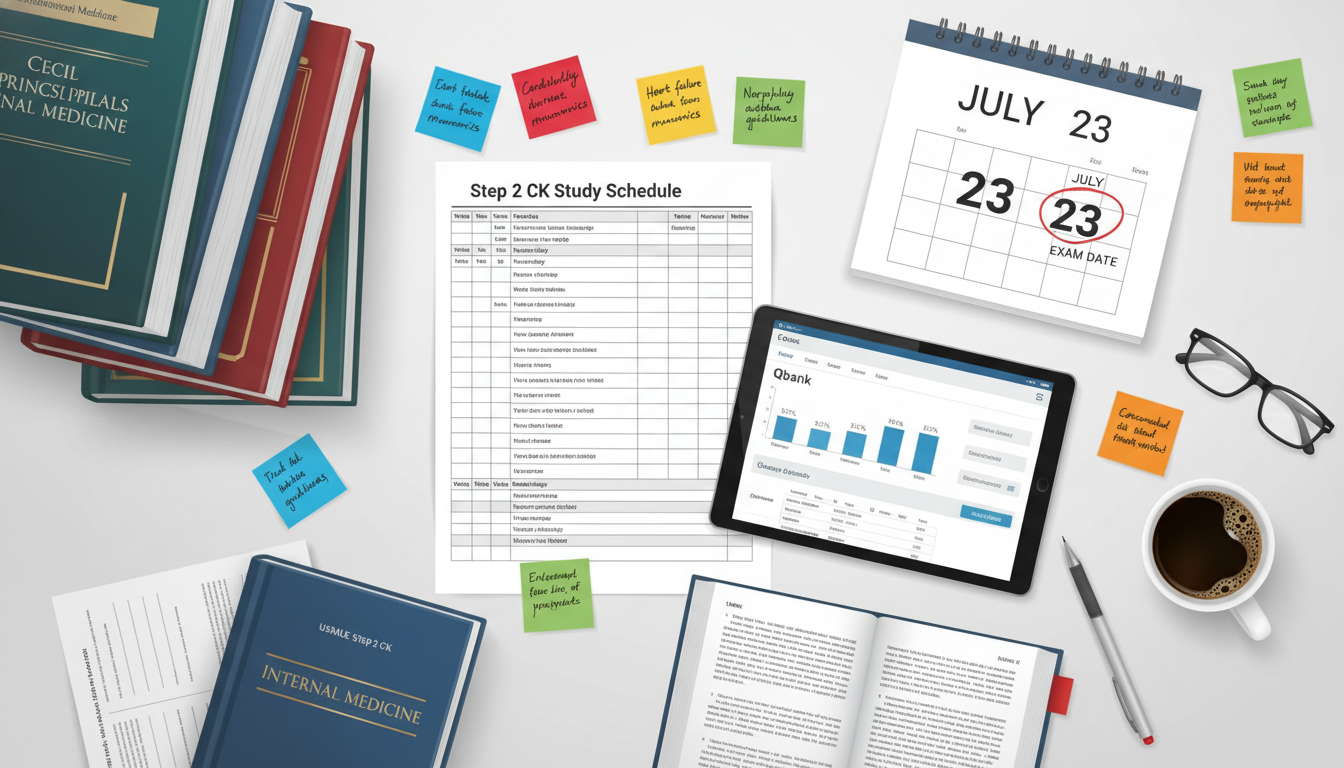
Building a Step 2 CK Study Plan as a Caribbean IMG
Your circumstances as a Caribbean IMG are unique: diverse clinical sites, variable teaching quality, potential travel, and exam logistics. A realistic, structured plan is key.
Step 1: Assess Your Starting Point
Before crafting your USMLE Step 2 study plan:
Review your Step 1 performance
- Weak in pathophysiology? You may need extra time for reasoning-based questions.
- Strong Step 1 but rusty? You may ramp up faster.
Take a baseline assessment
- Use a NBME Comprehensive Clinical Science Self-Assessment (CCSSA) or a UWorld Self-Assessment early:
- Not to predict your final score, but to identify weaknesses
- Helps estimate how long you’ll need to reach your target score
- Use a NBME Comprehensive Clinical Science Self-Assessment (CCSSA) or a UWorld Self-Assessment early:
Clarify your IM match goals
- Aiming for:
- Community internal medicine residency?
230–240 may be competitive in many places, depending on your overall profile. - Mid-tier university IM programs?
Aim closer to mid-240s+ where possible. - Highly academic/university + future fellowship?
A Step 2 CK score 250+ is very helpful, though not strictly mandatory if other parts of your app are outstanding.
- Community internal medicine residency?
- Aiming for:
Step 2: Decide on Your Timeline
Common Step 2 CK preparation timelines for Caribbean IMG students:
6–8 weeks full-time (post-cores)
- If you did well on shelves and Step 1
- You have strong clinical exposure and Qbank usage already
10–14 weeks full-time
- Typical for many Caribbean IMGs
- Allows time to catch up on weaker topics, especially if shelf scores or Step 1 were average
Longer, part-time (during rotations)
- 3–6 months with structured daily question blocks and reading
- Essential if you must prep around busy medicine, surgery, or sub-I rotations
For internal medicine–focused applicants, if possible, avoid cramming immediately after a very heavy rotation (like surgery nights or ICU) without taking at least a short rest and then dedicating focused full-time weeks at the end before the exam.
Step 3: Set Concrete Score and Time Goals
Turn vague goals into specific targets:
- “I want a good score” → “I want a 245+ Step 2 CK score and I have 12 weeks.”
- “Study a lot” → “2–3 timed Qbank blocks/day, daily review, and 3 NBME forms completed by week 10.”
Example weekly target for a 12-week plan:
- Weeks 1–4: 40–60 Qs/day, content review of weakest systems
- Weeks 5–8: 60–80 Qs/day, second pass of high-yield topics, begin NBMEs
- Weeks 9–11: Intensive Qbank focus, back-to-back NBMEs every 7–10 days
- Week 12: Taper volume, focus on error log and weak areas, light review before test
Core Resources for High-Yield Step 2 CK Prep in Internal Medicine
The right resources can streamline your approach. More is not better—mastery of a few high-yield tools outperforms shallow use of many.
1. Question Banks: Your Primary Tool
UWorld Step 2 CK Qbank
Your main weapon for both content and exam-style thinking.
Approach:
- Use Timed, Random blocks (as early as possible) to simulate exam conditions.
- Aim for at least one full pass of UWorld (~3,000+ Qs).
- Many Caribbean IMGs aiming for a strong IM match do:
- 1.0–1.5 passes (full pass plus review of wrong/flagged questions).
Focus especially on internal medicine–heavy sections:
- Cardio, pulm, ID, nephro, GI, rheum, endocrine
- Learn the “UWorld language” of next-best-step questions.
Amboss (Optional Supplement)
- Particularly useful if:
- You are weaker in pathophys explanation
- You want more internal medicine nuance and reference-like explanations
- Use selectively:
- To target weak systems after identifying patterns from UWorld
- During rotations when you need fast concept reinforcement
2. Core Text/Review Books
Pick one main structured text, not three.
Boards & Beyond (videos) + own notes
- Excellent for conceptual understanding and bridging basic science with clinical medicine.
- Good for Caribbean IMGs who feel their didactic teaching was inconsistent.
Step-Up to Medicine (for IM core)
- Not a pure Step 2 CK book, but fantastic for solidifying internal medicine fundamentals.
- Use it selectively: cardio, pulm, nephro, rheum, ID, and endo chapters.
- Especially useful during your internal medicine clerkship or sub-I.
Online MedEd
- Great as an overview: watch during rotations, then deepen with UWorld.
- Combines well with Qbank-directed learning.
3. Shelf/Rotation Integration
Make your clinical rotations work for you:
During your core internal medicine rotation:
- Do 20–40 UWorld Step 2 Qs per day (related to current patients when possible).
- After seeing a COPD patient, review the COPD/emphysema/asthma Qbank topics.
- Use attendings’ teaching points as cues to look up and reinforce knowledge via Qs.
During other rotations:
- Continue IM-related Qs several times weekly.
- This keeps your internal medicine base warm for Step 2 CK and the IM match.

Daily Study Structure and Exam-Style Practice
Your daily routine should resemble the real test environment and mental load of an internal medicine intern: sustained focus, decision-making, and time pressure.
A Sample Full-Time Study Day (8–10 Hours)
Morning (3–4 hours): Timed Qbank Blocks
- 2 blocks (40 questions each), timed and random
- No pausing; simulate exam fatigue and pacing
- After each block:
- Brief 5–10 minute break
- Mark questions you’re unsure of for later review
Midday (2–3 hours): Deep Review
- For each question:
- Identify why each wrong answer was wrong (differential reasoning)
- Summarize 1–2 key learning points per question in a digital or handwritten log:
- Example: “Elderly + syncope + systolic ejection murmur at RUSB + delayed carotid upstroke → aortic stenosis → TTE; no stress test with severe AS symptoms.”
- Group your notes by system:
- Cardio, Pulm, Nephro, etc. for easier last-week review.
Afternoon (2–3 hours): Focused Content Review
- Use:
- Boards & Beyond / Online MedEd / Step-Up to Medicine chapters
- Focus on topics that came up repeatedly in the morning’s Qs
- Example:
- If you missed several electrolyte questions → spend focused time on hyponatremia/hyperkalemia algorithms.
Evening (Optional 1–2 hours): Light Review / Flashcards
- Flashcards for:
- Antibiotic regimens
- Cardiac murmur associations
- Vaccine schedules, screening guidelines
- Brief review of your error log before sleeping.
Part-Time Study During Rotations
If you’re on a busy internal medicine service:
- Aim for 10–20 Qs/day on weekdays, 40–60 on weekends
- Use commuting time (if safe), early mornings, or evenings:
- Watch short explanation videos
- Summarize tricky concepts in 5–10 bullet points
This slower but steady preparation lays the groundwork for your final dedicated period.
Mastering Time Management and Endurance
Many IMGs know the content but underperform due to timing and fatigue:
- Practice:
- Full 40-question blocks with <2–3 minutes left at the end.
- Avoid spending >90 seconds on any one question; mark and move on if needed.
- Once weekly in the last 4–6 weeks:
- Simulate 3–4 blocks back-to-back under realistic test conditions
- Minimal break time, quiet environment, no phone
- This builds cognitive stamina—essential for a 9-hour exam day.
Data-Driven Strategy: NBMEs, Self-Assessments, and When to Take the Exam
As you get closer to exam day, objective feedback becomes crucial.
Using NBMEs and Self-Assessments
Plan to take:
- 2–4 NBME CCSSA exams
- 1–2 UWorld Self-Assessments, depending on time
Suggested schedule for a 12-week plan:
- Week 4: NBME #1 → Identify major weaknesses; adjust study priorities
- Week 7–8: NBME #2 → Check for improvement; confirm you’re on track
- Week 9–10: UWSA #1 (often slightly optimistic but useful for confidence)
- Week 11: NBME #3 or #4 → Final “go/no-go” check
Track your scaled scores and trends. For a Caribbean medical school residency applicant in internal medicine, you ideally want:
- Practice scores close to or slightly above the Step 2 CK score you’re targeting, especially on NBMEs, which tend to correlate more closely with actual results.
Recognizing When to Postpone
You may need to adjust your exam date if:
- Multiple NBMEs remain below your minimum needed target (e.g., consistently <225–230 if you need ~240+).
- You are still heavily missing basic high-yield IM questions (e.g., CHF management, antibiotic selection, chest pain algorithms).
- Life stressors (health, family, immigration issues, housing instability) significantly disrupt your study.
Remember: for Caribbean IMGs, taking an extra few weeks to solidify your Step 2 CK preparation can have long-term benefits for your internal medicine residency prospects, especially for competitive programs.
Caribbean IMG-Specific Challenges and Solutions
Being a Caribbean IMG means navigating additional hurdles beyond pure content.
Challenge 1: Variable Clinical Exposure and Teaching
Your core rotations may be spread across different hospitals with inconsistent supervision or case mix.
Solutions:
- Use every patient as a Step 2 CK case:
- Write a simplified one-liner and problem list.
- Ask yourself: “What would be the next best step if this were a USMLE question?”
- After a shift:
- Do 10–20 Qs on diagnoses you saw that day.
- If teaching is minimal:
- Lean heavily on Qbanks and Online MedEd/Boards & Beyond to standardize your learning.
Challenge 2: Limited Peer Comparison and Mentorship
You may not have many peers taking Step 2 CK at the same time or mentors familiar with the nuances of the IM match.
Solutions:
- Seek mentorship from:
- Recent graduates from your Caribbean school now in internal medicine residency.
- Alumni who had a successful SGU residency match or similar outcomes—you can learn concrete strategies.
- Join:
- Online IMG/Caribbean-focused communities and study groups (while filtering advice carefully).
- When in doubt:
- Consult multiple sources and trust objective data (NBMEs, Qbank performance).
Challenge 3: Logistical and Visa Considerations
Travel, exam center availability, and visa expiration dates can constrain scheduling.
Solutions:
- Plan exam dates well in advance:
- Consider ERAS timelines (ideally have Step 2 CK score back by early/mid-September of the application year).
- If you must take Step 2 CK earlier than ideal:
- Front-load study intensity, especially internal medicine and your weakest subjects.
- Buffer for rescheduling:
- Keep at least 2–3 weeks of flexible time around your target date, in case your practice scores are not where you want them.
Translating Step 2 CK Mastery Into Your Internal Medicine Application
Your USMLE Step 2 CK preparation doesn’t end with the exam; it fuels multiple parts of your internal medicine residency application.
Strong Step 2 CK Score → Better Screening Outcomes
- Many programs have hard filters for Step 2 CK.
- A high score can:
- Compensate for a weaker Step 1
- Offset non-U.S. school bias for Caribbean medical school residency applicants
- Allow your clerkship grades, letters, and personal statement to actually be read
Shelf Exams and MSPE/Dean’s Letter
If your Caribbean school uses NBME subject exams:
- Studying seriously for Step 2 CK also improves shelf scores:
- Internal medicine shelf
- Surgery, pediatrics, OB/GYN, psychiatry
- Strong shelves enhance your MSPE narrative and class rank (if reported), further helping your IM match.
Using Step 2 Knowledge on Rotations and Sub-Is
Your improved clinical reasoning and knowledge will:
- Make you stand out to attendings on internal medicine rotations.
- Lead to stronger letters of recommendation (crucial for internal medicine residency).
- Allow you to contribute meaningfully on rounds—demonstrating you’re already thinking like an intern.
FAQs: Step 2 CK Preparation for Caribbean IMGs in Internal Medicine
1. What Step 2 CK score should a Caribbean IMG aim for to match into internal medicine?
Targets vary, but as a rough guide:
- Community IM programs: being around 230–240+ is often competitive if other parts of your application are solid (good LoRs, U.S. clinical experience, no major red flags).
- University/academic IM programs: aiming for 240–250+ is safer, especially as a Caribbean IMG.
- Highly competitive IM + future subspecialty focus: 250+ helps significantly, though it’s not the only deciding factor.
Always interpret these numbers in the context of your entire profile: clinical evaluations, visa status, research, and communication skills also matter.
2. How early should I start Step 2 CK preparation during my Caribbean medical school training?
Ideal approach:
- During core rotations:
- Start with 10–20 UWorld or Amboss questions per day aligned with your rotation.
- Use Online MedEd or Boards & Beyond videos as you go.
- Dedicated period:
- Plan 6–12 weeks of focused prep after completing the majority of cores (especially internal medicine and surgery).
- The earlier you build habits of daily clinical questions and review, the smoother your final dedicated period will be.
3. Should I delay Step 2 CK if my NBME scores are low, even if it affects my ERAS timing?
In many cases for Caribbean IMGs, a stronger Step 2 CK score is worth a modest delay, but it depends on:
- How far you are from your target (e.g., 10 points vs. 25 points).
- How much more time you realistically can dedicate and whether your scores are trending upward with each NBME.
- Application year constraints (you may choose to apply slightly later or strategically apply if you improve later in the season).
If you’re consistently scoring well below your minimum acceptable range with no upward trend, postponing and improving is usually wiser than rushing into an exam that becomes a permanent part of your record.
4. What is the most efficient way to balance Step 2 CK prep with internal medicine rotations?
Think synergy, not competition:
- Use real patients as anchors: for every major diagnosis you see (e.g., DKA, CHF exacerbation, COPD flare), do 5–10 related Step 2 questions that evening.
- Keep a small pocket notebook or phone note:
- List 2–3 topics per day you must review after your shift.
- On lighter days or weekends:
- Do a full Qbank block in timed mode.
- This will simultaneously improve your clinical performance, impress attendings, and keep your Step 2 CK preparation active even during busy months.
A deliberate, structured, and exam-predictive Step 2 CK preparation strategy can transform your profile as a Caribbean IMG. By aligning your USMLE Step 2 study with internal medicine–focused learning, objective self-assessment, and rotation-based reinforcement, you give yourself the best chance at both a strong Step 2 CK score and a successful internal medicine residency match in the U.S.