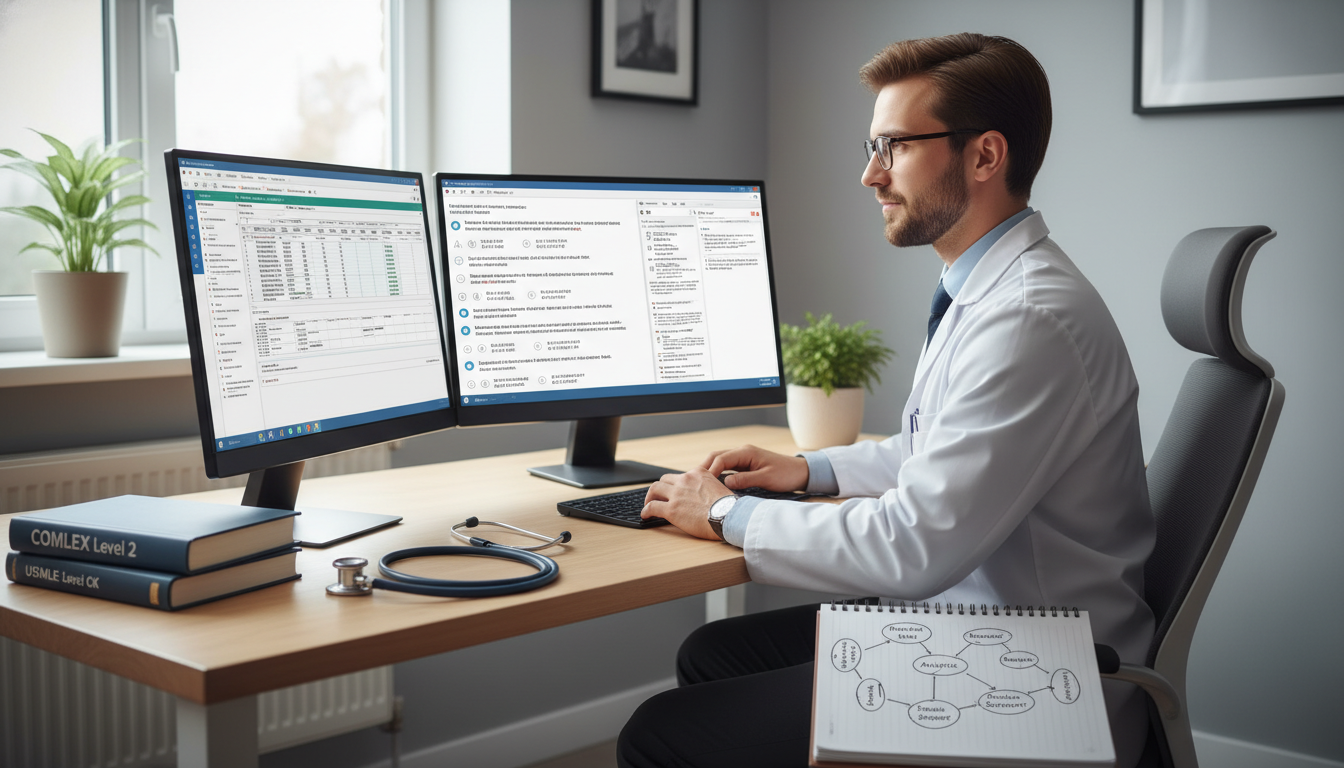
Understanding Step 2 CK as a DO Graduate Aiming for Clinical Informatics
USMLE Step 2 CK is more than an exam box to check; for a DO graduate interested in clinical informatics, it’s a strategic opportunity. Your Step 2 CK score can:
- Strengthen your academic profile, especially if your COMLEX scores are average or if you took time off for research or health IT training
- Demonstrate readiness for data-driven, patient-centered decision-making—the core of clinical informatics
- Signal to internal medicine, family medicine, pediatrics, EM, or pathology programs (common feeder specialties to clinical informatics fellowship) that you can manage complex, guideline-based care
While Clinical Informatics is a subspecialty that you’ll pursue later through a clinical informatics fellowship, your success starts with the core residency match. A solid Step 2 CK performance can help you:
- Stand out in the osteopathic residency match and ACGME match, especially at academically oriented programs
- Compensate for a less competitive geographic location or program list
- Show that your skills extend beyond bedside care into systems thinking and applied evidence-based medicine
For DO graduates, Step 2 CK is also a bridge exam:
- It aligns your profile more directly with MD applicants
- It allows PDs who are less familiar with COMLEX to benchmark you
- It may offset confusion if programs are unsure how to interpret your COMLEX scores
Think of Step 2 CK as your first “informatics-style test”: it assesses how you process complex inputs (history, labs, imaging, guidelines) and output a safe, efficient decision—exactly what you’ll do later with EHRs, decision support tools, and clinical data systems.
Mapping Your Exam Strategy to a Clinical Informatics Mindset
Approaching USMLE Step 2 CK with an informatics lens helps you use your unique strengths as a DO graduate interested in data, workflows, and systems.
1. Step 2 CK Blueprint Through an Informatics Lens
Step 2 CK tests:
- Diagnosis and management across internal medicine, surgery, pediatrics, OB/GYN, psychiatry, EM, and specialties
- Use of guidelines and clinical reasoning in simulated real-world scenarios
- Interpretation of labs, imaging, and monitoring data
For someone interested in clinical informatics:
- Think of each question as a “mini clinical decision support (CDS) scenario”
- Practice identifying the key signal among the “noise” in long question stems
- Understand not just the right answer, but how a guideline or algorithm would formalize that decision
This is exactly the cognitive process you’ll bring later to EHR order sets, alerts, and quality dashboards.
2. Translating COMLEX Experience Into Step 2 CK Success
As a DO graduate, you’ve already completed COMLEX Level 1 and Level 2 CE. Leverage that:
- Strength in holistic assessment: You’re used to thinking about structure/function, biopsychosocial factors, and longitudinal care. That helps in preventive care, chronic disease management, and outpatient-focused questions.
- Osteopathic manipulation (OMM) content doesn’t appear on Step 2 CK, so refocus that time on high-yield internal medicine, pediatrics, and OB/GYN.
- COMLEX questions sometimes feel more ambiguous; Step 2 CK rewards a more algorithmic, guideline-based reasoning style—perfect for an informatics-oriented thinker.
3. Using Data to Design Your Study Plan
Instead of a vague “study hard” approach, treat your Step 2 CK preparation like a mini quality improvement (QI) project:
Baseline assessment
- Take an early NBME or UWorld self-assessment.
- Identify subscores: internal medicine, surgery, OB/GYN, pediatrics, psychiatry, emergency medicine.
- Note patterns (e.g., “I consistently miss questions involving risk stratification or multi-step management”).
Define a measurable target
- Example: “Increase self-assessment scores by 20 points over 8 weeks.”
- If you already have COMLEX Level 2 CE, align expected Step 2 CK score with your COMLEX performance using online conversion tables (approximate only).
Iterative improvement
- Weekly question blocks, tracked performance, and short feedback cycles
- Adjust topic focus as your “data” (scores and error patterns) shift
This is exactly the mindset used in health IT training: measure, analyze, and iterate.

Building a High-Yield, Evidence-Based Study Plan
A strong study plan for USMLE Step 2 CK preparation balances efficiency, repetition, and reflection—very similar to designing effective clinical decision tools.
Core Resources for DO Graduates
Primary Question Bank: UWorld Step 2 CK
- Use tutor mode early, timed blocks later.
- Aim for 2,000–3,000 questions total, including repeats of missed/flagged items.
- Treat every question as a case-based learning session, not just test practice.
Secondary Qbank (if time and need)
- AMBOSS or Kaplan can supplement if your baseline is lower or your Step 2 CK goal is particularly high.
Content Review
- Online MedEd, Boards & Beyond, or similar: for conceptual gaps and framework building.
- UWorld explanations should be your main detailed content review. Add notes to Anki or a digital notebook.
Anki / Spaced Repetition
- Use a curated Step 2 CK deck or create cards from your own errors.
- Focus on patterns: management algorithms, diagnostic criteria, first-line vs. second-line therapies.
Integrating Clinical Rotations and Informatics Interests
You’re likely near or just after core clinical rotations, which gives you an advantage:
- Align your Step 2 CK preparation with your current or recent rotations.
- After each clinic or inpatient day, log 3–5 cases and then find similar UWorld questions that reinforce those topics.
- Note system-level issues you encounter (e.g., delayed lab review, confusing order sets) and consider how guidelines and workflows intersect—this reinforces clinical reasoning and your future informatics mindset.
Example:
- You see a patient with suspected PE on your medicine rotation.
- That night, you do UWorld blocks specifically on PE, DVT, and chest pain risk stratification.
- You compare how the Wells score, D-dimer thresholds, and imaging choices would be implemented inside a decision support tool.
Example 8-Week Study Plan for a DO Graduate
Assuming full-time dedicated study (post-rotations or light rotations):
Weeks 1–2: Foundation & Baseline
- 40–60 UWorld questions/day in tutor mode
- 1–2 hours/day of focused content review (e.g., Online MedEd IM/OB/Peds)
- Start Anki for wrong questions and weak topics
- Take a baseline NBME or UWSA at the end of Week 2
Weeks 3–5: Volume & Timing
- 60–80 timed questions/day (mixed blocks if possible)
- Short, targeted review of weakest subspecialties
- Add one full-day simulation each week:
- 4–6 back-to-back blocks, timed, minimal breaks
- Reassess with another NBME or UWSA around Week 4–5
Weeks 6–7: Refinement & Repetition
- Focus primarily on missed and flagged UWorld questions
- Increase emphasis on high-yield internal medicine, OB/GYN, and pediatrics
- Continue full-day simulations; reflect on test stamina and cognitive fatigue
Week 8: Taper & Mental Readiness
- Lighter volume (40–50 questions/day)
- Final practice exam (UWSA1/2 or NBME) about 5–7 days before test day
- Focus on sleep, routine, and learning light—no new major resources
If you are actively on rotation, stretch this structure to 12–16 weeks, scaling daily question volume down but maintaining the same principles.
Leveraging Your Informatics Mindset in Daily Study
Your interest in clinical informatics can actively enhance your USMLE Step 2 study. This is not just about content—it’s about how you think.
Turning Explanations into Algorithms
For each question, ask:
- “If I had to build a simple guideline or EHR alert for this situation, what would it look like?”
Example: A 45-year-old with chest pain:
- Identify key variables: age, risk factors, pain characteristics, troponin, ECG.
- Determine which guidelines apply (e.g., ACC/AHA ACS guidelines).
- Create a mental flowchart:
- STEMI? → immediate cath
- NSTEMI/unstable? → early invasive strategy
- Low-risk chest pain? → observation and serial enzymes
By doing this routinely, you calibrate your brain to recognize patterns that Step 2 CK questions are built around.
Using Study Metrics Like a Clinical Dashboard
Approach your prep like monitoring a patient panel:
Track your performance by system and topic every week:
- Cardiology: 72% → goal 80%
- OB/GYN: 60% → critical priority this week
- Psychiatry: 78% → maintenance
Evaluate trends over time, not single-day fluctuations.
Adjust study time and question emphasis accordingly.
This mimics how clinical informaticians work with EHR dashboards, quality measures, and outcome metrics.
Practicing “Data Triage” in Question Stems
Long stems often include irrelevant data. Train yourself to:
- Skim first for age, setting, and chief concern (triage level data).
- Identify red flags (hemodynamics, mental status, pregnancy, immunosuppression).
- Prioritize key tests and findings; ignore decorative details.
This data triage skill will be invaluable later when you are designing or refining EHR interfaces and clinical decision support that avoid cognitive overload.

Positioning Your Step 2 CK Score for Clinical Informatics-Focused Career Goals
Your Step 2 CK performance will feed directly into residency selection, which then opens the door to a future clinical informatics fellowship and advanced health IT training.
Step 2 CK in the Context of DO Graduate Residency Applications
For DO graduates, the osteopathic residency match now largely overlaps with the ACGME match. Programs may evaluate you through:
- COMLEX Level 1 and Level 2 CE
- USMLE Step 1 (if taken)
- USMLE Step 2 CK (now often more heavily weighted than Step 1)
A strong Step 2 CK score can:
- Compensate for a pass/fail or weaker Step 1
- Validate that you can handle evidence-heavy internal medicine or other core specialties
- Stand out in programs that prioritize data-driven QI and research—fertile ground for future informatics work
Choosing a Residency That Aligns with Clinical Informatics
Common “base specialties” that feed into clinical informatics fellowship include:
- Internal Medicine
- Family Medicine
- Pediatrics
- Emergency Medicine
- Pathology
- Anesthesiology and some surgical specialties in certain programs
When researching programs, look for:
- Presence of a formal clinical informatics fellowship or strong health IT infrastructure
- Involvement in quality improvement projects using EHR data
- EMR customization teams, home-grown dashboards, or participation in multicenter data collaboratives
Highlight your Step 2 CK preparation and eventual Step 2 CK score in your application narrative:
- Emphasize your love of structured clinical reasoning
- Mention how you approached USMLE Step 2 study like a “clinical data optimization project”
- Connect that mindset to your interest in clinical informatics and system-level patient safety
Building an Early Informatics Portfolio During USMLE Prep
While you are studying, you can simultaneously begin laying groundwork for your informatics future:
- Join or initiate QI projects involving medication safety, sepsis alerts, or workflow redesign.
- Talk with your institution’s IT, EHR, or data analytics team; ask to shadow or participate in small projects.
- Explore simple tools (e.g., Excel, basic SQL, or R) for handling de-identified datasets when allowed.
Later, when you apply to a clinical informatics fellowship, your narrative can include:
- Strong Step 2 CK score as evidence of clinical decision-making skill
- COMLEX and USMLE records that show steady or improving performance
- Real experiences bridging clinical care and health IT training
Practical Test-Day Strategies for DO Graduates
Once your USMLE Step 2 study is complete, execution on test day is critical.
Simulating the Exam Environment
In the final 2–3 weeks:
- Take at least one full 8–9-hour simulation:
- Same start time as your scheduled exam
- Timed blocks with short breaks
- Test-day nutrition and hydration plan
- Practice using only NBME-style interfaces (e.g., sample tests) to minimize surprises.
Cognitive and Physical Endurance
You’ll face long, dense stems over multiple blocks. To prevent burnout:
- Use micro-breaks during blocks:
- Briefly close your eyes between questions every 10–15 items.
- Use break time wisely:
- Light snacks with protein and complex carbs
- Hydrate, but not so much you’re constantly needing the restroom
Remember: Step 2 CK doesn’t just test knowledge; it tests stamina and consistency.
Strategy for Difficult Questions
For challenging items:
- Identify what the question is truly asking (diagnosis? next step? most likely cause?).
- Eliminate clearly wrong options first.
- Look for guideline-based distinctions:
- Stable vs. unstable
- Inpatient vs. outpatient
- First-line vs. rescue therapy
Mark and move on when stuck; don’t let a single question hijack your time or confidence.
Common Pitfalls and How DO Graduates Can Avoid Them
Pitfall 1: Treating Step 2 CK as Just “More Step 1”
Step 2 CK is more:
- Clinical
- Time-pressured
- Focused on real-world decision-making
Solution:
Anchor every piece of knowledge in a clinical scenario. Ask: “How would this show up in a patient? What would I do next?”
Pitfall 2: Underestimating Outpatient Management and Preventive Care
Many DO curricula emphasize holistic outpatient care, which can be an advantage—but Step 2 CK expects very specific guideline-driven answers.
Solution:
Review USPSTF recommendations, vaccination schedules, prenatal care, pediatric milestones, and chronic disease management algorithms.
Pitfall 3: Not Aligning Step 2 Preparation With Residency and Informatics Goals
You might focus only on passing without considering how your score fits into your future narrative.
Solution:
Set a target Step 2 CK score that aligns with:
- The competitiveness of your desired core specialty
- The programs known for clinical informatics, QI, or health IT training
- Your COMLEX scores and overall application profile
FAQs: USMLE Step 2 CK Preparation for DO Graduates Interested in Clinical Informatics
1. As a DO graduate planning a career in clinical informatics, do I really need USMLE Step 2 CK if I already have COMLEX?
Many ACGME programs are increasingly comfortable with COMLEX alone, but some still prefer or better understand USMLE scores. Taking Step 2 CK can:
- Make your application more directly comparable to MD peers
- Strengthen your case at academically focused programs and those later offering a clinical informatics fellowship
- Help if your COMLEX performance is average and you want to demonstrate growth
If you’re targeting highly academic or data-driven programs, Step 2 CK is often a valuable asset.
2. What Step 2 CK score should I aim for if I want a strong shot at a clinical informatics-oriented residency and, later, fellowship?
Programs don’t have fixed “informatics” cutoffs, but in general:
- Aim for a Step 2 CK score at or above the national mean, preferably higher if you’re targeting competitive internal medicine or EM programs.
- If your COMLEX scores were modest, aim for a Step 2 CK that shows clear improvement relative to your prior testing history.
- Remember, your informatics potential will also be judged by research, QI projects, EHR initiatives, and letters, not just scores.
3. How can I connect my interest in clinical informatics to my USMLE Step 2 preparation in a meaningful way?
You can:
- Approach question review as “designing mini-guidelines or decision support tools” in your head
- Track study metrics (question performance by system/topic) like a quality dashboard
- Reflect on how each topic might relate to EHR alerts, order sets, or performance metrics
- Mention in your personal statement and interviews that you treated Step 2 CK prep like a data-driven improvement project
This shows PDs you already think like a future clinical informatician.
4. Can I balance Step 2 CK prep, rotations, and starting early involvement in informatics or health IT training?
Yes, but it requires intentional planning:
- Create a 12–16 week USMLE Step 2 study schedule with daily question targets that fit your rotation workload.
- Prioritize doing at least one block of questions most days, even on busy rotations.
- Use lighter rotations or elective time to:
- Join QI or EHR optimization projects
- Meet with informatics or IT faculty
- Learn basic data handling skills
Done well, these activities reinforce each other: your clinical acumen from Step 2 CK study makes you a better contributor to informatics work, and your systems-based thinking from informatics work makes you a more efficient and analytical test-taker.
By combining disciplined USMLE Step 2 study with the systems-thinking mindset you’ll later apply in clinical informatics, you position yourself not only for a successful DO graduate residency match, but also for a compelling trajectory into health IT training and, ultimately, a clinical informatics fellowship.