
Understanding Step 2 CK as an MD Graduate in Internal Medicine
As an MD graduate aiming for internal medicine residency, your USMLE Step 2 CK score is one of the most important numerical components of your application. With Step 1 now pass/fail, program directors rely more heavily on your Step 2 CK performance to gauge your clinical knowledge, reasoning, and readiness for an internal medicine (IM) internship.
For an MD graduate from an allopathic medical school, Step 2 CK is both a screening tool and a differentiator:
- Screening: Many internal medicine residency programs (especially academic and university-affiliated ones) use Step 2 CK score cutoffs to decide which applications to review.
- Differentiator: In the IM match, a high Step 2 CK score can offset a more average preclinical record, a modest Step 1 performance, or a less “brand-name” medical school; it also complements your clinical evaluations and letters of recommendation.
Because you’re already an MD graduate, you have several advantages:
- You’ve completed core and often sub-internship rotations.
- You have real clinical context for the questions.
- You may have more control over your schedule compared with being in the middle of clerkship year.
The challenge is turning that clinical exposure into exam-ready, test-taking performance. That requires a strategic Step 2 CK preparation plan tailored to the internal medicine residency applicant.
This guide will walk you through:
- How Step 2 CK impacts the internal medicine match
- Building a high-yield, realistic study plan as an MD graduate
- Core resources and how to use them effectively
- Internal medicine–specific focus areas
- Test-taking strategy and exam day execution
- Frequently asked questions about Step 2 CK and the IM match
How Step 2 CK Impacts the Internal Medicine Residency Match
For an MD graduate in internal medicine, your Step 2 CK score shapes both whether you match and where you match.
Why Step 2 CK Matters More Now
Since Step 1 became pass/fail, the allopathic medical school match process changed substantially. Program directors now rely on:
- Step 2 CK score
- Clerkship grades and internal medicine rotation performance
- Letters of recommendation (especially from IM faculty)
- Medical school reputation and transcript
- Research, leadership, and other experiences
Among these, Step 2 CK is the most standardized, comparable metric across all MD graduates. That’s why your Step 2 CK preparation should be as intentional and rigorous as your Step 1 prep—if not more.
Target Ranges for Internal Medicine
Exact score thresholds shift slightly year to year, but broadly:
- Solid competitiveness for academic IM programs:
Typically Step 2 CK score in the high 230s–250s+ - Highly competitive / top-tier university IM programs:
Often 250+, with some applicants in the 260s - Community or mid-tier university IM programs:
Frequently consider applicants starting around 220–230+, though a higher score always helps.
Your personal target depends on:
- Competitiveness of your desired programs
- Your Step 1 result (pass/fail only, but the context still matters)
- Your medical school performance, research, and leadership
- Any red flags (remediated courses, leaves of absence, etc.)
If other parts of your file are weaker, consider aiming for the upper range of Step 2 CK performance for internal medicine residency.
Timing of Step 2 CK for MD Graduates
When to take Step 2 CK is strategic for an IM match:
- Ideal timing:
- Late 3rd year to early 4th year for current students
- As soon as feasible after core clerkships for recent MD graduates
- Goal: Have your Step 2 CK score available by the time you submit ERAS (typically in September).
If you have already graduated and are applying for MD graduate residency spots, it is especially important:
- To take Step 2 CK early enough to show programs your most recent performance.
- Not to delay so long that the score is pending during the interview offer period.
For borderline or lower Step 1 performers, a strong Step 2 CK score early in the application cycle can significantly alter how programs perceive your application.
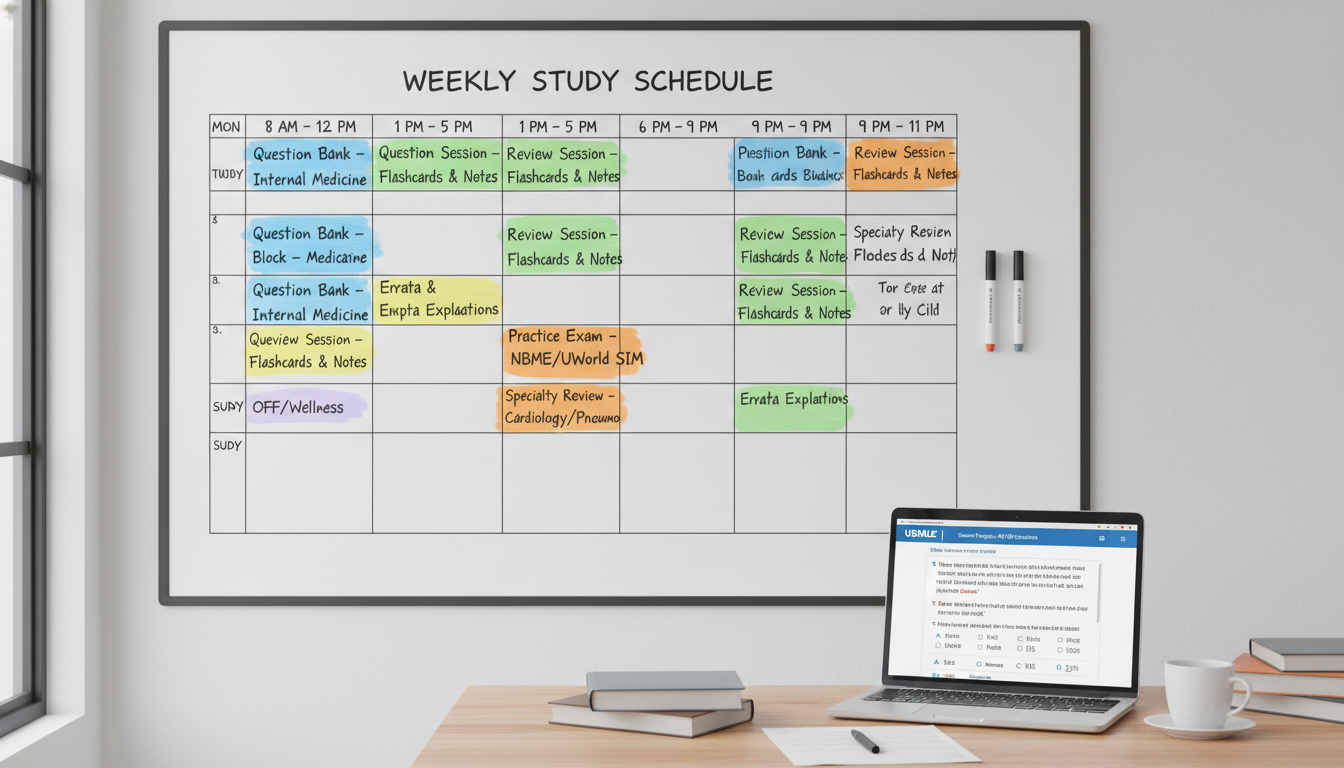
Building an Effective Step 2 CK Study Plan as an MD Graduate
A powerful Step 2 CK preparation plan for internal medicine residency focuses on question-based learning, integrated review, and targeted remediation of weak areas.
Step 1: Define Your Time Frame
Start by deciding your dedicated and non-dedicated periods:
Non-dedicated phase (while working or doing research/electives):
- 6–12 weeks
- 10–20 questions/day on weekdays, 20–40/day on weekends
- Light review and note-building
Dedicated phase (full-time or near full-time studying):
- 4–6 weeks is common for MD graduates
- 60–80+ questions/day, plus content review and practice exams
- 6–8 hours/day of focused studying with one rest day per week
Align this with your application timeline. For example:
- If ERAS opens in September, aim to test by late July or August so your Step 2 CK score is reported on time.
Step 2: Establish Score Baseline and Goals
Before or at the start of dedicated study:
Take a baseline self-assessment:
- NBME Comprehensive Clinical Science Self-Assessment (CCSSA) form
- Or an early UWorld Self-Assessment (UWSA)
Compare:
- Current estimate vs desired score for IM match
- The gap will dictate how aggressive your Step 2 CK preparation needs to be.
Example:
- Baseline NBME: 223
- Target for academic internal medicine: 245+
- Gap: ~20–25 points → requires structured, high-yield plan and consistent progress monitoring.
Step 3: Prioritize Question-Based Learning
For Step 2 CK, question banks (Qbanks) are the core of your USMLE Step 2 study.
Recommended approach:
Primary Qbank: UWorld Step 2 CK
- Strive to do 1 full pass (most will do 2, but quality > quantity).
- Use tutor mode early, timed blocks later.
- Aim for 40-question blocks to simulate exam conditions during dedicated.
Secondary Qbank (if time and need):
- Amboss or another high-quality bank for reinforcement and alternative explanations, especially if your UWorld performance plateaus.
How to use each block:
- Do 40 questions timed (simulate the exam).
- Post-block, spend at least the same amount of time reviewing:
- Carefully read explanations for right and wrong answers.
- Identify the key learning point for each question.
- Note repeat patterns: “I keep missing heart failure management questions,” etc.
Step 4: Create a Focused Note System
Instead of rewriting entire explanations, create a high-yield, rapidly reviewable note system, such as:
- A running Word/Google Doc of “things I didn’t know”
- A personal Anki deck with:
- Short, focused flashcards
- Emphasis on algorithms and classic presentations
- Sectioned notes (Cardiology, Pulmonology, ID, Ethics, Biostatistics, etc.)
Key: Only include new or easily forgotten information. Your goal is a compact, revisitable set of notes for the final 2–3 weeks.
Step 5: Schedule Practice Exams
Integrate self-assessments to track your readiness:
- At least 3–4 practice tests throughout your prep:
- NBME CCSSAs spaced every 2–3 weeks.
- UWorld Self-Assessment 1 mid-way through, and UWSA 2 near the end.
- Review practice exams thoroughly:
- Classify errors: knowledge gap vs misreading vs time pressure vs reasoning error.
- Adjust your study to target high-frequency weaknesses.
Example schedule for a 6-week dedicated period:
- Week 1: NBME CCSSA #1 (baseline)
- Week 3: UWSA 1
- Week 5: NBME CCSSA #2
- Week 6: UWSA 2 (final readiness check)
Core Resources and How to Use Them for Internal Medicine–Focused Success
As an MD graduate, you’ve already encountered many clinical resources. For Step 2 CK, stick to a tight, high-yield set and master them.
1. Question Banks
UWorld Step 2 CK
- Treat it as your primary “textbook.”
- Aim for:
- 2,000+ questions overall (full bank)
- System- or mixed-mode depending on your phase:
- Early: by system, to consolidate blocks of knowledge.
- Later: mixed, timed blocks for true exam simulation.
- Monitor your percent correct, but focus more on:
- Progress over time
- Performance by system (e.g., Cardio, Pulm, GI, ID)
Amboss or Second Qbank
- Use selectively for:
- Reinforcing weak systems (e.g., hematology/oncology)
- Additional exposure to ethics, biostatistics, or ambulatory scenarios
2. Books and Written Resources
Common high-yield options:
- Step-Up to Medicine (for internal medicine concepts)
Excellent for:- Heart failure, COPD, pneumonia, diabetes, CKD, etc.
- Provides foundational reading that underpins many Step 2 CK questions
- OnlineMedEd notes or videos (if you used them in school):
- Good for rapid review, especially of non-IM systems.
- NBME/USMLE practice materials:
- Official style and phrasing practice.
- Use them to calibrate your approach to question stems and answer choices.
Avoid spreading yourself across too many full textbooks; depth is helpful, but Step 2 CK is a breadth + reasoning exam.
3. Video Lectures
If you prefer audio-visual learning or need to refresh:
- Use OnlineMedEd (OME) or similar:
- Watch at increased speed (1.25–1.5x).
- Pair with doing questions in that system.
- Focus on:
- Complex algorithms you’re consistently missing (e.g., chest pain, syncope, anemia workup).
- Weak rotations (e.g., OB/GYN, pediatrics) if your clinical experience there was limited.
4. Anki and Active Recall
For MD graduates who already used Anki:
- Update your deck with Step 2 CK–level content:
- Management thresholds and drug choices.
- Scoring criteria for tests (Wells, CHA₂DS₂-VASc, etc.).
- Imaging choices and first-line tests.
Keep flashcards highly targeted and minimalist to prevent fatigue.

High-Yield Internal Medicine Focus Areas for Step 2 CK
Because you’re targeting internal medicine residency, internal medicine is both your strength and your highest-yield content block on Step 2 CK. Many exam questions mirror decisions you’ll make daily as an IM intern.
Cardiology
Extremely high yield and central to the IM match:
- ACS/Chest Pain:
- Distinguish unstable angina vs NSTEMI vs STEMI.
- Initial management: MONA, heparin, beta-blockers, reperfusion strategies.
- Heart Failure:
- Acute decompensated vs chronic stable management.
- Use of ACEi/ARB/ARNI, beta-blockers, MRA, SGLT2 inhibitors.
- Arrhythmias:
- Atrial fibrillation (rate vs rhythm control, anticoagulation).
- SVT vs VT vs torsades, ACLS basics.
- Valvular Disease:
- Aortic stenosis vs regurg, mitral stenosis/regurg.
- Indications for surgery vs medical management.
Actionable advice:
- Build flowcharts for chest pain, syncope, and dyspnea.
- Practice reading EKG findings described in text (e.g., “irregularly irregular with narrow complexes”).
Pulmonology and Critical Care
Frequently tested and central to IM practice:
- COPD and Asthma:
- Step-up/step-down therapies.
- Management of acute exacerbations.
- Pneumonia:
- CAP vs HAP vs VAP: most likely organisms, empiric antibiotics.
- Outpatient vs inpatient criteria (CURB-65, PSI concepts).
- Pulmonary Embolism:
- Wells score, PERC rule concepts, D-dimer, CT angiography.
- ARDS and Mechanical Ventilation:
- Recognize ARDS on question stem.
- Basic vent settings (PEEP, FiO2) and troubleshooting.
Actionable advice:
- Keep an “antibiotic by scenario” mini-chart.
- Memorize key risk factors and first-line imaging modalities.
Endocrinology and Metabolism
Common, straightforward points if you memorize key thresholds:
- Diabetes Management:
- First-line therapy (metformin), when to add insulin.
- DKA vs HHS diagnosis and management.
- Thyroid Disease:
- Hypo vs hyperthyroidism workup.
- Thyroid storm vs myxedema coma.
- Adrenal Disorders:
- Cushing’s syndrome screening tests.
- Addison’s disease and adrenal crisis.
Actionable advice:
- Mini cheat-sheets for:
- DKA management steps.
- Thyroid function test interpretation patterns.
Nephrology and Electrolytes
Reliably tested and core to IM internship:
- Acute Kidney Injury:
- Pre-renal vs intrinsic vs post-renal.
- FeNa concepts and initial management steps.
- Chronic Kidney Disease:
- Staging basics, anemia management, complications.
- Electrolyte Disorders:
- Hyper/hyponatremia, hyper/hypokalemia.
- Quick treatment algorithms and when to give IV calcium, insulin/glucose, etc.
Actionable advice:
- Practice “electrolyte question drills” specifically.
- Build rapid-action tables: “If K+ = X and EKG is Y → do Z.”
Infectious Disease
Central to both Step 2 CK and internal medicine residency:
- Common Infections:
- UTI/pyelonephritis, cellulitis, osteomyelitis.
- Meningitis, endocarditis, osteomyelitis.
- Antibiotic Selection:
- First-line and alternatives by organism/site.
- MRSA coverage, Pseudomonas coverage.
- HIV and Opportunistic Infections:
- Screening, prophylaxis thresholds (CD4 counts).
- Regimens and typical OI presentations (PCP, toxoplasmosis).
Actionable advice:
- Create tables linking:
- Organism → likely setting → first-line antibiotic.
- Pay attention to “most appropriate next step” vs “most effective long-term management.”
Systems Outside Internal Medicine
Even as an IM-focused MD graduate, you must not neglect:
- OB/GYN:
- Prenatal screening, hypertensive disorders of pregnancy, postpartum hemorrhage.
- Pediatrics:
- Vaccination schedules, common pediatric infections, congenital heart disease basics.
- Surgery:
- Acute abdomen, pre-op and post-op complications, trauma basics.
- Psychiatry:
- Depression, bipolar disorder, schizophrenia management.
- Suicide risk assessment and emergency interventions.
Allocate 20–30% of your study time to non-IM systems to avoid blind spots that can significantly drag your Step 2 CK score.
Test-Taking Strategy, Exam Day, and Final Weeks
Your Step 2 CK preparation is only as effective as your ability to execute under 9 hours of exam pressure.
Final 2–3 Weeks: Consolidation Phase
Shift your focus from broad content acquisition to high-yield consolidation:
- Review:
- Personal notes and “wrong question” highlights.
- Core algorithms: chest pain, sepsis, anaphylaxis, stroke, GI bleeds, ACS, PE, DKA.
- Focused drilling:
- Weak systems identified from your Qbank stats and practice exams.
- Ethics, biostatistics, and risk communication (often underestimated).
Take your final self-assessment (e.g., UWSA 2) about 5–7 days before the exam:
- If your score is within ~5–10 points of your target and your trend is positive, you’re generally ready.
- Avoid last-minute major schedule changes unless your self-assessment is significantly lower than prior tests.
Test-Day Strategy
On Step 2 CK exam day:
- Logistics:
- Arrive early, bring appropriate ID and snacks.
- Plan your breaks (you have 45 minutes of break time):
- For example: 10–10–10–15 minutes across blocks.
- Block Management:
- Pace: ~1 minute 15 seconds per question.
- Mark items you’re unsure of, but don’t overmark.
- Commit to a best possible answer before moving on—avoid burning time.
Mental strategies:
- Treat each block as a separate mini-exam.
- Don’t fixate on a difficult prior question or block; Step 2 CK is scored across the entire day.
- Use real clinical reasoning:
- Think: “If this were my patient on the wards, what would I do next?”
- Then adapt to the answer choices and exam-style priorities.
Handling Anxiety and Burnout
As an MD graduate preparing for a high-stakes exam while planning your internal medicine residency:
- Set non-negotiable rest:
- At least one day per week with no heavy studying.
- Short daily physical activity:
- 20–30 minutes walking or light exercise to maintain cognitive stamina.
- Sleep:
- Protect 7–8 hours where possible, especially in final weeks.
If anxiety is severe or impairing your study, consider:
- Talking to a mentor, advisor, or mental health professional.
- Using structured study groups or accountability partners if that fits your learning style.
FAQs: Step 2 CK Preparation for MD Graduates in Internal Medicine
1. What Step 2 CK score should an MD graduate aim for to be competitive in internal medicine residency?
For the IM match, many applicants target at least the mid-230s to be broadly competitive. For academic or university-based internal medicine programs, aim for 240–250+. For highly competitive or top-tier IM programs, a Step 2 CK score of 250+ strengthens your profile, especially if combined with strong letters and clinical evaluations.
2. How long should I study for Step 2 CK as an MD graduate?
Most MD graduates preparing for internal medicine residency benefit from:
- Non-dedicated phase: 6–12 weeks of lighter USMLE Step 2 study (10–40 questions/day, depending on schedule).
- Dedicated phase: 4–6 weeks of focused Step 2 CK preparation (60–80+ questions/day plus review).
The exact duration depends on your baseline, your target score, and how recently you completed core clinical rotations.
3. What are the most important resources for Step 2 CK preparation?
For an allopathic medical school match with an IM focus, a lean, high-yield set usually includes:
- UWorld Step 2 CK Qbank (primary resource)
- NBME CCSSA and UWorld Self-Assessments for score prediction
- A concise internal medicine text or notes (e.g., Step-Up to Medicine, high-yield summaries)
- Optional: OnlineMedEd or similar videos for systems review and weaker areas
Consistent, thoughtful question-based learning is more important than accumulating many different resources.
4. I’m an MD graduate with an average Step 1 performance. Can a strong Step 2 CK score still help my internal medicine application?
Yes. With Step 1 now pass/fail, many programs use Step 2 CK score as the primary standardized academic metric. A strong Step 2 CK performance can:
- Demonstrate clear improvement and academic maturity.
- Compensate, to an extent, for earlier weaker performance.
- Strengthen your profile for MD graduate residency positions in internal medicine, especially when combined with strong clinical evaluations and letters.
Prioritize a structured study plan, multiple self-assessments, and targeted internal medicine–focused practice to maximize this opportunity.
By approaching your USMLE Step 2 CK preparation with a clear, structured plan and internal medicine–oriented priorities, you can transform your clinical experience into a powerful Step 2 CK score that supports a successful internal medicine residency match.