
Understanding Step 2 CK in the Context of Medicine-Psychiatry
Preparing for USMLE Step 2 CK as a future med psych residency applicant brings unique opportunities—and pressures. Combined medicine psychiatry programs are highly interested in applicants who demonstrate strong clinical reasoning across both internal medicine and psychiatry. Step 2 CK is the exam where that integration really shows.
Step 2 CK is not just a “harder Step 1.” It is a test of:
- Clinical judgment
- Prioritization and triage
- Diagnostic reasoning with incomplete data
- Management plans aligned with guidelines
- Integration across disciplines (medicine, psychiatry, neurology, ethics, preventive care)
For applicants targeting medicine psychiatry combined programs, Step 2 CK offers three key advantages:
Show you can think like a dual-trained physician
Many questions blend medical and psychiatric elements: delirium vs psychosis, medical causes of agitation, managing antipsychotics in metabolic syndrome, or addressing depression in chronic illness. Program directors notice when your Step 2 CK score reflects strength in both domains.Compensate for earlier testing weaknesses
If your Step 1 was pass-only or lower than hoped, a strong Step 2 CK score can reassure med psych residency programs that you are ready for high-acuity, complex inpatient and outpatient care.Reinforce your narrative of dual interest
A thoughtful Step 2 CK preparation plan—especially one that deliberately integrates internal medicine and psychiatric concepts—supports your personal statement and letters when you describe why you are drawn to medicine psychiatry combined training.
Before designing your study plan, clarify your goals:
- Target Step 2 CK score: based on your Step 1 performance and the competitiveness of programs you’re aiming for.
- Exam timing: usually end of 3rd year or early 4th year, after core clerkships, especially internal medicine, psychiatry, surgery, pediatrics, OB/GYN, and neurology.
- Application cycle: you want your score in time for ERAS submission (typically by early–mid fall).
A realistic understanding of where you stand now—and what your timeline allows—is essential before you build your USMLE Step 2 study strategy.
Core Strategy: Building a High-Yield Study Framework
Step 1: Diagnostic Assessment and Goal Setting
Start with a structured self-assessment:
Clerkship shelf exam performance
- Strong in IM and psych? Great—your base for med psych residency is solid.
- Weaker in medicine or neuro but strong in psych (or vice versa)? Your Step 2 CK preparation should deliberately correct that imbalance.
Baseline practice exam
- Take an NBME or UWorld self-assessment 6–8 weeks before your planned test date.
- Use percent-correct and content breakdown (medicine vs psychiatry vs other) to guide your plan.
- For med psych–bound students, pay special attention to:
- Psychiatric disorders and treatment
- Neurology (especially neurocognitive disorders, seizures, movement disorders)
- Endocrine, cardiovascular, and infectious causes of psychiatric symptoms
Score goals and competitiveness
For combined medicine psychiatry residency, programs often favor applicants with solid, above-average Step 2 CK scores. While cutoffs vary, aim to be comfortably above the national mean if possible. Use this to calibrate your study volume and intensity.
Step 2: Build a Tailored Schedule (6–10 Weeks)
A typical dedicated Step 2 CK preparation period is 6–8 weeks full-time or 8–12 weeks part-time around rotations. For med psych–interested students, consider this sample 8-week outline:
Weeks 1–2: Foundation + Systems Review (Medicine-heavy with daily Psych)
- Daily:
- 40–60 UWorld questions (timed, random)
- 20–30 minutes of psychiatry/anxiety/mood/psychosis or neuro review
- Systems focus: cardiology, pulmonology, renal, infectious disease.
- Psychiatry emphasis: mood disorders, anxiety disorders, psychosis, suicidality, emergency psychiatry.
Weeks 3–4: High-Yield Integration (More Psych and Neuro)
- Increase practice blocks to 60–80 questions/day as tolerated.
- Systems focus: neurology, endocrine, rheumatology, hematology/oncology.
- Psychiatry emphasis: substance use disorders, personality disorders, somatic symptom–related disorders, eating disorders.
- Daily timed blocks simulating exam conditions (block length, timing).
Weeks 5–6: Advanced Management and Complex Cases
- Focus on:
- Ethics, communication, capacity assessment
- Geriatrics, delirium vs dementia vs depression
- Managing chronic medical illness with psychiatric comorbidity
- Start second pass of weak areas based on UWorld and NBME performance.
- Take at least one full-length practice exam.
Weeks 7–8: Refinement and Exam Readiness
- Focused review of wrong questions and notes.
- Rapid review of emergency management algorithms (cardiac, sepsis, status epilepticus, acute agitation).
- Light but consistent psychiatry and neurology review to keep skills sharp.
Adjust this framework based on your diagnostic data and schedule. For example, if you are very strong in psych but weaker in medicine, tilt the schedule 70/30 toward internal medicine and other fields while maintaining daily psych exposure.
Step 3: Choosing Resources for USMLE Step 2 Study
You don’t need a long list of resources. Depth with a few is more powerful than superficial coverage of many.
Core resources (recommended for almost everyone):
UWorld Step 2 CK QBank
- The backbone of Step 2 CK preparation.
- Do questions in timed, mixed blocks to simulate the exam.
- Review explanations thoroughly—not just the correct answer, but why other options are wrong.
NBME practice exams
- Best predictors of performance.
- Use 2–3 spaced over your study period:
- One early to set a baseline.
- One midway to adjust strategy.
- One 1–2 weeks before the exam to confirm readiness.
An integrated content reference
- Common options: Step 2 review books or online notes. Choose one and stick with it.
- Use as a “spine” to organize what you learn from questions.
Psychiatry-focused resources (for med psych residency applicants):
- A concise psychiatry shelf or board review text.
- Brief psychotherapy and psychopharmacology references.
- Academic articles or guidelines on:
- Antipsychotics and metabolic syndrome
- Management of depression in medical illness
- Treatment of substance use disorders, especially in medically ill patients
You’re not training to be a psychiatrist yet, but Step 2 CK expects you to confidently diagnose and manage core psychiatric conditions, especially when they intersect with medical care.
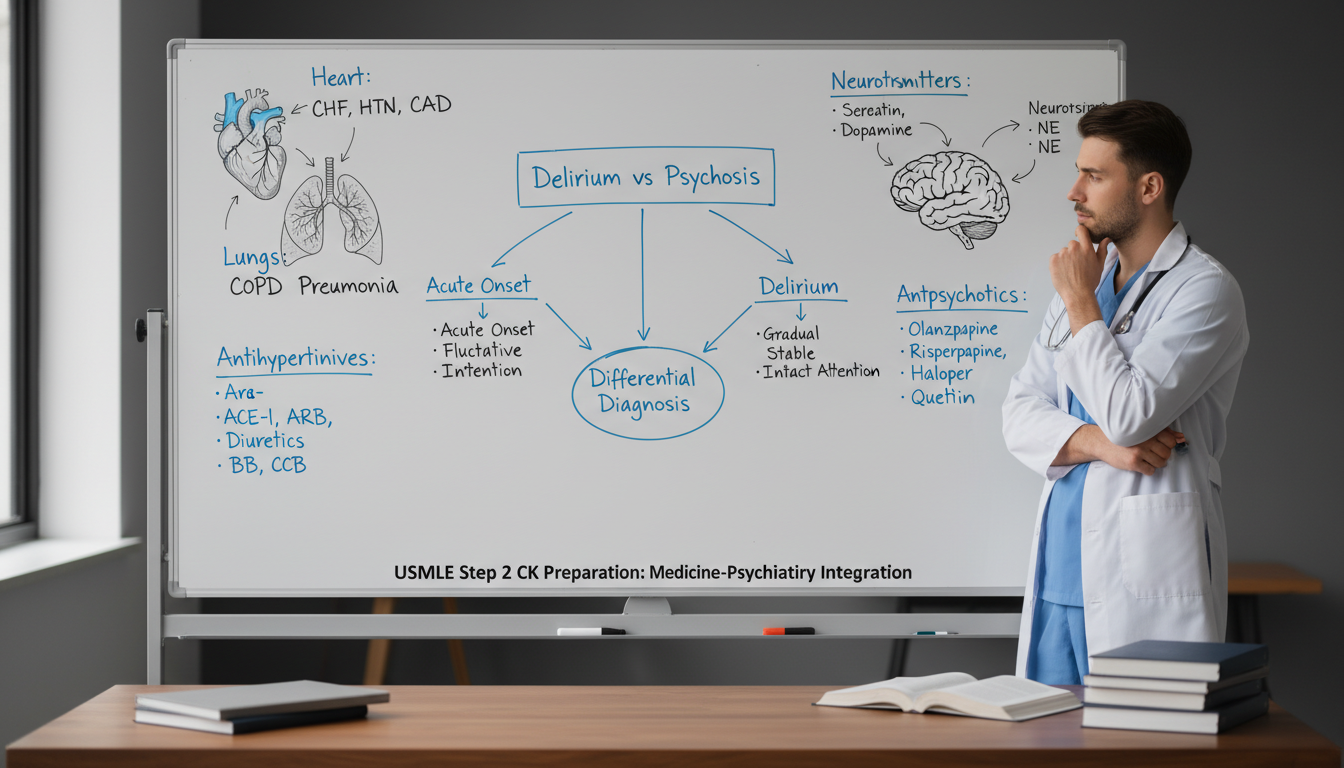
Mastering High-Yield Internal Medicine-Psych Integration
For a future med psych resident, the most valuable part of Step 2 CK preparation is learning to think in a truly integrated way. Many of the hardest exam questions—and the clinical scenarios you’ll face in residency—sit at the interface of medicine and psychiatry.
Delirium vs Psychosis vs Dementia
This triad is central to both exam and clinical work.
Key exam-ready distinctions:
Delirium
- Acute onset, fluctuating course, impaired attention.
- Common causes: infections, medications (e.g., anticholinergics, benzodiazepines in elderly), metabolic derangements.
- Management: treat underlying cause, low-dose antipsychotics if severe agitation, avoid benzodiazepines except for alcohol/benzo withdrawal.
Dementia
- Gradual decline, preserved attention until late.
- Subtypes: Alzheimer, vascular, Lewy body, frontotemporal; each has characteristic features.
- Management: safety, caregiver support, cholinesterase inhibitors or memantine in select cases.
Primary psychotic disorders
- Predominantly psychiatric symptoms without acute medical triggers.
- Normal orientation and attention between episodes; labs often normal.
- Thorough medical workup still needed to rule out secondary causes.
Exam-style scenario:
An elderly hospitalized patient becomes acutely agitated and paranoid overnight. Exam shows fluctuating orientation, visual hallucinations, and a new fever. Labs reveal elevated WBC.
- Step 2 CK question: diagnosis and first best step in management?
- High-yield answer: delirium due to infection; treat infection, address precipitating factors, use low-dose haloperidol if necessary; avoid benzodiazepines.
This type of reasoning—deciding whether a behavioral change is medical, psychiatric, or both—is exactly the kind of thinking med psych programs value.
Medical Workup of Psychiatric Symptoms
On Step 2 CK, when patients present with psychiatric symptoms, always scan for underlying medical causes.
Common medical causes to consider:
- Endocrine: thyroid disease (hyper- or hypothyroidism), Cushing syndrome, Addison disease.
- Metabolic: electrolyte derangements, hepatic encephalopathy, uremia.
- Neurologic: seizures (especially temporal lobe), brain tumors, stroke, Parkinson disease.
- Infectious: neurosyphilis, HIV-associated neurocognitive disorders, CNS infections.
- Substance-related: intoxication or withdrawal (alcohol, benzodiazepines, stimulants, hallucinogens, opioids).
Exam tip: If there is:
- Late age of onset,
- Abrupt change without clear psychosocial trigger,
- Focal neurologic signs,
- Abnormal vital signs or lab abnormalities, then the question is likely pointing you toward a medical workup, not immediate psychiatric labeling.
Always be ready to choose:
- CT/MRI of head
- CBC, CMP, TSH, B12, folate
- Urine tox, serum drug levels
over “start SSRI” or “start antipsychotic” when red flags are present.
Psychopharmacology with Medical Comorbidity
USMLE Step 2 CK loves to test medication selection in the context of medical illness. That’s exactly the day-to-day reality of medicine psychiatry combined practice.
Examples to master:
Antipsychotics and metabolic risk
- Olanzapine and clozapine: high metabolic risk.
- Ziprasidone, aripiprazole, lurasidone: more weight-neutral.
- For a patient with schizophrenia and poorly controlled type 2 diabetes, move away from high-risk agents.
- Step 2 CK question might ask: “Best next step in management” for weight gain and hyperglycemia after starting an antipsychotic. The correct answer often involves switching to a lower-risk antipsychotic and intensifying metabolic monitoring.
Antidepressants and cardiac disease
- SSRIs are generally safe; sertraline often preferred post-MI.
- TCAs and some SNRIs can worsen conduction problems or blood pressure.
- Avoid citalopram at high doses in patients with prolonged QT.
Benzodiazepines in medically fragile patients
- Avoid in elderly (fall and delirium risk), patients with COPD or OSA, and those at high risk of misuse.
- But benzodiazepines remain first-line for alcohol withdrawal.
- Be prepared for nuanced vignettes where the same drug is correct in one context and dangerous in another.
Capacity, Ethics, and Safe Disposition
Combined med psych residents are often consulted on questions of decision-making capacity, involuntary treatment, and safe discharge, especially for medically complex patients with psychiatric symptoms.
On Step 2 CK, you should:
Know the criteria for capacity:
- Understand information about diagnosis and options.
- Appreciate consequences.
- Reason with the information.
- Communicate a consistent choice.
Distinguish capacity from competence:
- Capacity: clinical determination made by physicians.
- Competence: legal determination by courts.
Recognize when involuntary hospitalization is appropriate:
- Imminent risk to self or others.
- Inability to care for basic needs due to mental illness.
- Always tied to the jurisdiction’s legal standards but principles are similar.
These topics are heavily tested and directly relevant to med psych residency work.

Practical Study Techniques for High-Yield Step 2 CK Preparation
Using Question Banks Effectively
Your USMLE Step 2 study should revolve around active engagement with clinical questions.
Best practices with UWorld or similar QBank:
Timed, random blocks
- Replicates the real exam.
- Forces you to integrate multiple specialties.
- Essential for practicing pacing.
Active note-taking
- Instead of copying whole explanations, capture:
- “Why I got this wrong.”
- One-line summaries of key distinctions (e.g., when to use clozapine; how to differentiate delirium vs psychosis).
- Keep a dedicated medicine-psychiatry notebook or digital document where you log:
- Common medical mimics of psychiatric disease.
- Interaction between psych meds and medical comorbidities.
- Instead of copying whole explanations, capture:
Systematic review of incorrects
- Don’t just re-do wrong questions blindly.
- Ask:
- Did I miss the diagnosis, or the next best step, or a safety issue?
- Did I anchor prematurely on a psychiatric diagnosis without ruling out medical causes?
Integrating Shelf Exam Review with Step 2 CK Preparation
If you are still on rotations while preparing:
- Use medicine and psychiatry shelf prep as Step 2 CK prep.
- After each patient encounter with delirium, depression, or psychosis, ask yourself:
- What would Step 2 CK test here?
- Diagnosis? Next best diagnostic test? First-line treatment? Safety or disposition?
Consider keeping a “Cases to Question” list: a running list of real patients whose presentations map closely to typical USMLE vignettes, especially at the med-psych interface (e.g., depression in cirrhosis, psychosis in lupus, catatonia vs neuroleptic malignant syndrome).
Time Management and Endurance
Step 2 CK is a long exam (8 blocks, 1 hour each, in a single day). Med psych residency training will also demand sustained focus for long stretches. Build endurance during preparation:
- At least once weekly in dedicated study, do:
- 2–3 full blocks back-to-back with minimal breaks.
- In the final 1–2 weeks:
- Simulate near-full-length testing days, including:
- Waking up at exam time.
- Eating the same breakfast you plan for test day.
- Timing your breaks.
- Simulate near-full-length testing days, including:
Put particular attention on minimizing mental fatigue in late blocks, when subtle medicine–psychiatry questions may appear.
Managing Stress: A Med-Psych Perspective
Your own mental health matters, particularly if you are drawn to psychiatry and understand the impact of stress.
Prepare psychologically for near misses and uncertainty
- You will miss questions. Everyone does.
- Reframe each miss not as “failure” but as “one more case I’ll now know how to manage in residency.”
Use evidence-based stress strategies
- Brief, regular physical activity.
- Structured breaks with clear boundaries.
- Short mindfulness or breathing exercises between study blocks.
Monitor for signs of burnout or depression
- Disrupted sleep, loss of interest, persistent guilt, or hopelessness.
- If present, consider:
- Speaking with student health or a mental health professional.
- Modifying your schedule.
- Adjusting your exam date if necessary; safe performance is more important than arbitrary deadlines.
Your capacity to care for patients as a med psych resident will depend on learning to care for your own mind now.
Positioning Your Step 2 CK Performance for Medicine-Psychiatry Residency
Step 2 CK is one element of your med psych residency application, but an influential one.
How Programs View Step 2 CK
Combined medicine psychiatry program directors often consider:
- Step 2 CK score trend relative to Step 1
- Improvement suggests growth, resilience, and increased clinical maturity.
- Strength in clinically relevant domains
- Strong performance is especially reassuring if:
- You had a weaker medicine or psychiatry clerkship grade.
- You have gaps in your transcript (e.g., leaves of absence).
- Strong performance is especially reassuring if:
Programs know that Step 2 CK is more clinically predictive of residency performance than Step 1. A strong USMLE Step 2 study effort that leads to a solid score is a concrete demonstration that you are ready for high-acuity, cognitively demanding dual training.
Using Your Preparation Story in Your Application
Without oversharing, you can show insight and professionalism by talking about your Step 2 CK preparation in your:
- Personal statement
- Interviews
- Conversations with mentors
Examples:
- “As I prepared for Step 2 CK, I noticed how often internal medicine vignettes required a psychiatric lens, and vice versa. That experience deepened my interest in medicine-psychiatry combined training.”
- “My Step 2 CK study plan focused on recognizing medical causes of psychiatric symptoms and on safe prescribing of psychotropics in medically ill patients, which I know will be essential in med psych residency.”
This narrative shows that your USMLE preparation was not just about getting a Step 2 CK score, but about developing the integrated clinical reasoning med psych residency demands.
Frequently Asked Questions (FAQ)
How high should my Step 2 CK score be for medicine psychiatry combined programs?
There is no universal cutoff, but many med psych residency programs look for applicants at or above the national mean, with stronger programs preferring comfortably above-average scores. More important than any single number is the overall picture: your Step 2 CK score trend compared to Step 1, your medicine and psychiatry clerkship grades, letters of recommendation, and evidence of sustained interest in integrated care. If your Step 2 CK score is modest but consistent with your overall performance and you have strong clinical evaluations and med-psych involvement, you can still be a competitive applicant.
When is the best time to take Step 2 CK if I’m applying to med psych residency?
Most students benefit from taking Step 2 CK:
- After completing core rotations in internal medicine, psychiatry, neurology, pediatrics, surgery, and OB/GYN.
- Ideally by late summer or early fall of the year you apply, so that scores are available when you submit ERAS and when programs start offering interviews.
If your clerkships are medicine- or psych-heavy early in third year, consider taking the exam shortly after those rotations, while clinical details are fresh.
How much psychiatry is actually on Step 2 CK?
Psychiatry-related content typically comprises a moderate but significant portion of the exam (including neurocognitive disorders, mood and anxiety disorders, psychosis, substance use, and ethics/capacity). However, many other questions integrate psychiatric concepts indirectly—for example, depression in chronic heart failure, delirium during hospitalization, or safe opioid prescribing. For med psych residency applicants, treating psychiatry as a “core” subject (not an afterthought) is crucial in Step 2 CK preparation.
What if I’m stronger in psychiatry and weaker in internal medicine?
This is common among med psych–interested students. Your USMLE Step 2 study plan should:
- Emphasize internal medicine, neurology, and emergency topics while maintaining daily psychiatry review.
- Use QBank performance and NBME breakdowns to identify weak organ systems.
- Pay special attention to:
- Cardiovascular emergencies.
- Infectious disease.
- Pulmonology and critical care.
- Renal and electrolyte disorders.
If you can bring your medicine knowledge up while maintaining strong psychiatry skills, your application to medicine psychiatry combined programs will be significantly strengthened.
By approaching USMLE Step 2 CK preparation through a medicine-psychiatry lens—prioritizing integration, safety, and nuanced clinical reasoning—you are not only positioning yourself for a strong Step 2 CK score, but also building the diagnostic and management skills you will rely on every day in med psych residency.