



Understanding Step 3 in the Context of Clinical Informatics
USMLE Step 3 is more than just the final licensing examination in the USMLE sequence—it’s often your first major exam taken during residency and a critical milestone on your path to a clinical informatics fellowship. For residents aiming for a career in health IT, Step 3 does two important things:
- Establishes your baseline clinical decision-making in real-world, unsupervised practice.
- Signals program readiness for advanced training such as a clinical informatics fellowship and other health IT training opportunities.
What Step 3 Really Tests
Step 3 focuses on whether you can function as an independently practicing physician:
- Diagnose and manage common and serious conditions
- Prioritize patient safety and quality of care
- Understand systems-based practice and cost-effective care
- Make decisions in ambiguous, real-world scenarios (especially in CCS cases)
For future clinical informaticians, this is directly relevant. You’ll be asked to:
- Choose appropriate diagnostic tests (cost/value-based thinking)
- Use guidelines and evidence in decision-making (core to clinical decision support)
- Manage patients over time (mirrors workflow design and longitudinal care in EHRs)
Why Step 3 Matters for Clinical Informatics Fellowship Applicants
Most ACGME-accredited clinical informatics fellowship programs require:
- Full medical licensure, which includes passing Step 3
- Demonstrated strong clinical acumen to inform your informatics work
- Evidence of professional reliability—passing Step 3 early sends a strong signal
Many program directors will expect Step 3 to be completed by:
- End of PGY-1 or early PGY-2 for categorical residents
- Early in residency for transitional/preliminary residents applying for informatics or other subspecialty training
A delayed or repeated Step 3 attempt will not automatically prevent you from pursuing a clinical informatics fellowship, but a strong performance:
- Frees you to focus on informatics projects, research, and health IT training
- Reduces licensure barriers when you start fellowship
- Shows that your clinical foundation is solid while you invest in technical skills
Timing Step 3 During Residency for Future Clinical Informaticians
One of the most strategic decisions is when to take Step 3 during residency. Your choice can affect both your performance and your ability to build a strong informatics portfolio.
Ideal Timing Windows
Most residents choose one of these timing strategies:
Early PGY-1 (5–8 months into residency)
- Pros:
- Clinical knowledge from Step 2 CK still relatively fresh
- Shows initiative to programs and future fellowship directors
- Clears the exam before deeper involvement in research, QI, or informatics projects
- Cons:
- You may feel overwhelmed adapting to intern responsibilities
- Less experience with real-world clinical workflows (which can actually help with CCS)
- Pros:
Late PGY-1 / Early PGY-2
- Pros:
- Stronger clinical reasoning from months of front-line work
- More familiarity with common presentations and inpatient management
- Better grasp of systems-based practice—useful for exam questions on utilization and safety
- Cons:
- More clinical and call responsibilities can constrain study time
- You may be simultaneously starting informatics-related projects
- Pros:
PGY-2 or later (only if necessary)
- Sometimes unavoidable due to visa issues, heavy schedules, or personal reasons
- If you’re aiming for a clinical informatics fellowship right after residency, late completion can:
- Compress your timeline to build a competitive informatics profile
- Create licensure bottlenecks in states with early Step 3 expectations
Step 3 During Residency: Practical Scheduling Tips
Plan around lighter rotations
Aim for electives, outpatient blocks, or consult months with more predictable hours.Secure two consecutive days off
Coordinate with your chief resident or scheduler early. Some programs will treat Step 3 as an educational activity that can justify protected days.Avoid critical informatics deadlines
If you’re involved in:- EHR go-live
- Major data analytics project
- Fellowship application cycle
Avoid clustering your exam and those high-stress periods.
Example Scheduling Plan
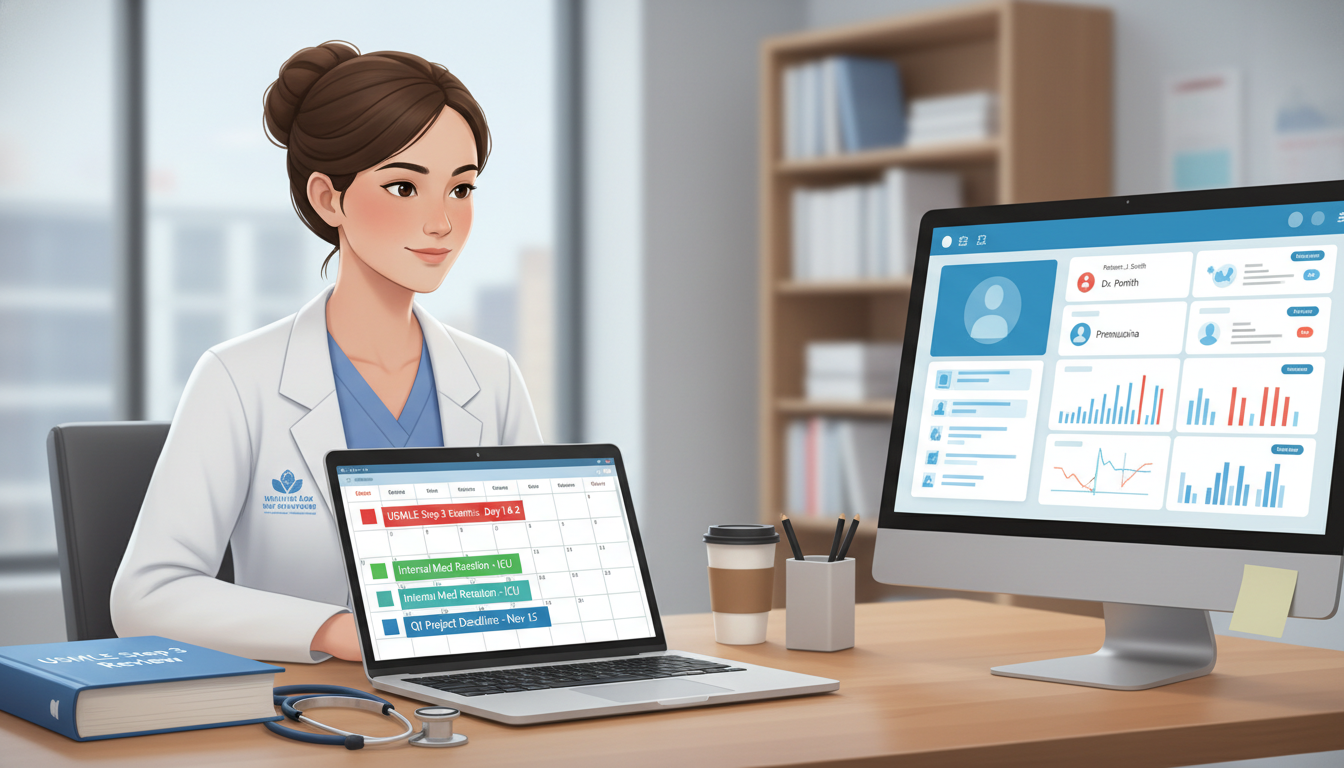
- PGY-1 October–December: Identify a lighter rotation in March–May
- PGY-1 January: Book a test date 3–4 months ahead
- PGY-1 February–April: Steady low-intensity studying (30–60 minutes on most days)
- PGY-1 May: Increase intensity; take the exam at the end of the month
Building a High-Yield Step 3 Study Strategy for Informatics-Minded Residents
USMLE Step 3 preparation does not need to be a full-time job, especially if you approach it with structure and realistic expectations.
Understand the Exam Structure
Step 3 has two test days:
Day 1: Foundations of Independent Practice (FIP)
- Multiple-choice questions (MCQs)
- Focus: basic science review in a clinical context, epidemiology, biostatistics, ethics, patient safety, and population health
- Heavy on: prevention, screening, risk calculation, research methods
Day 2: Advanced Clinical Medicine (ACM)
- MCQs plus Computer-based Case Simulations (CCS)
- Focus: diagnosis and management, inpatient and outpatient care, emergency care, longitudinal scenarios, and real-time decision-making
For future clinical informaticians, note how similar this is to:
- Evaluating evidence for decision support tools (Day 1 emphasis)
- Modeling clinical workflows and care pathways (Day 2/CCS emphasis)
Recommended Study Timeline (6–8 Weeks)
Assuming you’re a reasonably prepared PGY-1 or PGY-2:
Weeks 1–2: Orientation and Baseline
- Take a Step 3 diagnostic or first block of a question bank under timed conditions.
- Identify weak areas: pediatrics, OB/GYN, biostatistics, ethics, etc.
- Set a realistic weekly question goal (e.g., 150–200 questions/week).
Weeks 3–5: Core Question-Driven Study
- Primary focus: questions and explanations, not passive reading.
- Track your incorrects by category (use a simple spreadsheet or note tool).
- Use your EHR and daily cases to reinforce learning:
- Notice guideline-based order sets (e.g., sepsis bundles, anticoagulation protocols)
- Think: “What would Step 3 expect me to do next for this patient?”
Weeks 6–7: CCS and Integration
- Dedicate specific sessions to CCS practice.
- Review algorithms for:
- ACS, stroke, sepsis
- DKA, hyperkalemia, GI bleed
- Prenatal care and obstetric emergencies
- Pediatric fever, respiratory distress, and dehydration
- Continue a lighter question bank pace (100–150 per week).
Final 5–7 Days: Taper and Consolidate
- Review high-yield summaries:
- Ethics and professionalism
- Common management algorithms (e.g., chest pain, back pain, headaches, hypertension)
- Preventive care and screening ages
- Focus on sleep, nutrition, and stress management—especially important when you’re also working clinical shifts.
Study Resources: What Actually Works
For most residents, especially those with limited time, a lean but disciplined resource list is best.
Core Resources
Step 3 Question Bank (QBank)
- Essential resource—forms the backbone of your study.
- Do in timed, random mode to simulate real testing when possible.
- Goal: complete 70–100% of a reputable bank with full explanation review.
CCS Practice Software
- Many commercial providers mimic the real CCS interface.
- Practice:
- Entering orders
- Transferring levels of care (ED → floor → ICU → stepdown)
- Reassessing at appropriate intervals
Concise Review Book or Online Summary
- Use only for:
- Quick reference on weak topics
- Algorithms you keep getting wrong in QBank
- Use only for:
Clinical Informatics Mindset Tip
Approach question explanations like designing a clinical decision support rule:
- What data triggered the decision?
- What outcome are we optimizing? (mortality, morbidity, cost, patient satisfaction)
- How would this guidance appear in the EHR (alert, order set, care pathway)?
Integrating Studying into a Busy Resident Schedule
Residents pursuing health IT training often juggle:
- Clinical duties
- Quality improvement or informatics projects
- Data or analytics work
- Fellowship or career planning
Practical strategies:
Micro-sessions (10–15 minutes)
Use:- Commutes (if not driving)
- Brief breaks between tasks
- Post-call downtime
Complete 5–10 questions and thoroughly review explanations.
Shift-based Adaptation
- On lighter days: Target 20–30 questions.
- Post-call: Gentle review of explanations, avoid heavy new material.
- Off days: Longer blocks (40–60 questions + CCS practice).
Batching by Content If you notice repeated weaknesses (e.g., OB, peds), schedule 1–2 focused sessions to clean up those topics instead of letting them linger.
Mastering CCS Cases with an Informatics Workflow Perspective
For many residents, CCS is the most intimidating part of Step 3. For those pursuing clinical informatics, it’s also uniquely aligned with the way you think about clinical workflows and health IT systems.
What CCS Is Really Evaluating
- Appropriateness and timeliness of orders
- Logical sequence of evaluation and management
- Safety: avoiding harmful or unnecessary tests/treatments
- Follow-up and longitudinal care
You’re effectively “piloting” a virtual EHR and clinical environment.
General CCS Strategy
Stabilize First
- Always address ABCs (Airway, Breathing, Circulation) immediately.
- For unstable patients:
- Place in ED or ICU
- Order vital signs, IV access, oxygen, monitors, urgent labs/ECG as appropriate.
Use Structured Order Sets in Your Mind Think like an informatician designing a default order set for a condition:
- History, physical exam, vital signs
- Immediate stabilization orders
- Initial diagnostic set
- Monitoring and reassessment orders
- Long-term therapy and disposition
Advance Time Thoughtfully
- For emergent conditions: reassess every 15–30 minutes.
- For acute but stable cases: reassess every few hours.
- For chronic/clinic scenarios: schedule appropriate follow-up.
Don’t Forget Preventive and Supportive Care
- DVT prophylaxis, pain control, GI protection when indicated
- Vaccinations, smoking cessation counseling, contraceptive counseling
- Discharge planning and follow-up appointments
High-Yield CCS Scenarios You Should Expect
These are particularly aligned with common clinical pathways and guidelines:
- Chest pain / suspected ACS
- Stroke/TIA
- Sepsis and septic shock
- DKA/HHS
- COPD/asthma exacerbation
- GI bleed
- Pyelonephritis and UTI in pregnancy
- Pediatric fever, pneumonia, bronchiolitis
- Prenatal care and labor management
- Trauma evaluation
For each, explicitly memorize:
- Must-not-miss initial orders
- Criteria for ICU vs floor vs discharge
- Key contraindications (e.g., thrombolytics, anticoagulation)
Using CCS Prep as Informatic Training
As you practice CCS:
- Imagine translating your CCS steps into:
- Clinical order sets
- Care pathways or flow diagrams
- “If–then” logic for decision support rules
- Ask:
- Where could an alert meaningfully improve safety?
- Which steps are repetitive and could be automated?
- How can the EHR surface the right information at the right time?
This mindset not only improves your CCS performance but is excellent preparation for formal clinical informatics fellowship training, where you’ll often work on similar care pathways and decision support designs—just with real patients.

Aligning Step 3 Preparation with Clinical Informatics Career Goals
Even though Step 3 is a general clinical exam, you can use your preparation time to advance your trajectory toward clinical informatics and health IT training.
Highlighting Your Clinical Strengths for Fellowship Applications
Many clinical informatics fellowship program directors will review:
- Your USMLE transcript (including Step 3)
- Your residency performance
- Evidence of consistent clinical reasoning and safety awareness
You don’t need a perfect score, but you do want to demonstrate:
- No major red flags (multiple failures, very low scores without explanation)
- Upward trajectory, especially if earlier board scores were marginal
- Timely completion, ideally by early PGY-2
In your future fellowship application or interviews, you might emphasize:
- How Step 3 study reinforced your understanding of:
- Evidence-based care pathways
- Population health metrics
- Systems-based practice and quality improvement
- How these concepts inspired or complemented specific informatics projects.
Using Step 3 Topics as Springboards for Informatics Projects
Step 3 content can naturally inspire informatics-focused initiatives:
Preventive Care and Screening
- Project idea: Design or improve EHR reminders for cancer screening or vaccinations.
- Link to Step 3: Understanding age-based screening guidelines, risk factors, and compliance barriers.
Errors, Safety, and Transitions of Care
- Project idea: Analyze discharge summaries for completeness or develop templates that improve clarity.
- Link to Step 3: Many questions focus on preventing errors and ensuring safe handoffs.
Cost-Effective Medicine and Test Utilization
- Project idea: Build or analyze dashboards tracking resource utilization (e.g., imaging, labs).
- Link to Step 3: Questions often ask for “best next test” that balances sensitivity, specificity, and cost.
Biostatistics and Population Health
- Project idea: Collaborate on a QI or data analytics project using EHR data to monitor outcomes.
- Link to Step 3: Interpreting trial data, screening metrics, and population interventions.
Integrating Health IT Training with Step 3 Prep
If your residency allows early exposure to informatics, coordinate your learning:
During Step 3 preparation:
- Attend informatics committee meetings or EHR optimization sessions.
- Note how clinical guidelines appear in order sets, alerts, and flowsheets.
- Connect clinical management algorithms you’re memorizing to actual EHR configurations.
After Step 3:
- Free up mental bandwidth to dive deeper into:
- Data analytics tools
- Clinical decision support
- Workflow redesign
- Interoperability and standards (HL7, FHIR, etc.)
- Begin preparing your clinical informatics fellowship application with a clear clinical and technical narrative.
- Free up mental bandwidth to dive deeper into:
Test Day Logistics, Wellness, and Risk Management
Even well-prepared residents can underperform if they mismanage logistics or stress. This is particularly crucial when balancing clinical work and exam prep.
Before the Exam
Confirm schedule and policies
- Verify test center location, parking, and check-in requirements.
- Understand allowed breaks, ID requirements, and security measures.
Simulate exam conditions
- Do at least one full-length practice day (or near full-length) to build stamina.
- Use noise-cancelling headphones or earplugs similar to what you’ll use at the test center.
Plan call/shift timing
- Avoid night shifts or 24-hour calls immediately before the exam.
- If impossible, negotiate at least one lighter day before your test.
During the Exam
Pace yourself on MCQs
- Don’t obsess over a single question—guess and move on if truly stuck.
- Use educated elimination; Step 3 rewards safe, guideline-consistent choices.
For CCS
- Use checklists: stabilization, diagnosis, treatment, monitoring, preventive care.
- Don’t be afraid to order reasonable baseline tests (as long as not harmful/unnecessary).
Manage breaks wisely
- Eat small, balanced snacks.
- Hydrate (without overdoing caffeine).
- Brief stretching can reduce cognitive fatigue.
If Step 3 Doesn’t Go as Planned
Even strong residents sometimes fail Step 3. If this happens:
- Debrief honestly
- Was it timing? Content gaps? Poor CCS familiarity? Burnout?
- Communicate early
- Inform your program leadership. Many have structured remediation plans.
- Reframe for fellowship
- One failure, followed by a strong pass and clear insight into what changed, is rarely a deal-breaker for clinical informatics fellowship programs.
- Be prepared to briefly and confidently explain the context and what you learned.
FAQs: USMLE Step 3 Preparation in Clinical Informatics
1. When should I take Step 3 if I’m planning a clinical informatics fellowship?
Ideally by the end of PGY-1 or early PGY-2. This timing:
- Ensures you’re eligible for full licensure by fellowship start
- Allows you to focus on informatics projects, research, and other health IT training activities later in residency
- Signals to fellowship programs that your clinical foundation is in place
2. Does my Step 3 score matter for clinical informatics fellowship applications?
Most programs care more about:
- Passing without major delay or multiple attempts
- Demonstrating solid clinical judgment and reliability
A very high score is nice but not required. A timely pass, combined with a strong informatics portfolio (projects, QI work, EHR optimization, data analytics), is more impactful than a marginal score difference.
3. How can I balance Step 3 preparation with residency and informatics work?
Focus on:
- A question-based approach (150–200 questions per week)
- Short, consistent daily sessions (10–30 minutes)
- Dedicated CCS practice on off days
- Aligning what you see in the EHR (order sets, clinical pathways) with Step 3 algorithms, so your clinical work and studying reinforce each other.
4. Can I use my Step 3 studying to strengthen my informatics CV?
Yes. Use high-yield Step 3 topics as foundations for informatics projects:
- Preventive care → build or refine EHR reminders and dashboards
- Safety and transitions → optimize discharge templates or handoff workflows
- Test utilization → analyze and improve ordering patterns
Then, after passing Step 3, you can describe how your clinical exam preparation directly informed system-level improvements—exactly the kind of integrated thinking that strong clinical informatics fellowship programs value.
By approaching USMLE Step 3 strategically—timing it wisely during residency, using efficient preparation methods, and actively connecting its content to real-world health IT and clinical workflows—you not only maximize your chance of passing, but also build a stronger foundation for a successful career in clinical informatics.




















