
Preparing for USMLE Step 3 as an Emergency Medicine–Internal Medicine (EM IM combined) resident is uniquely challenging—and uniquely advantageous. You are juggling two demanding specialties, erratic schedules, and a steep clinical learning curve. At the same time, your dual exposure to acute care and longitudinal management gives you powerful preparation for the exam’s real-world focus.
This guide walks through a structured, realistic approach to USMLE Step 3 preparation for EM-IM residents, with an emphasis on integrating study into your residency schedule, using your clinical experiences, and timing the exam effectively.
Understanding Step 3 in the Context of EM-IM Training
What Step 3 Actually Tests
USMLE Step 3 is designed to answer one core question: Can you independently manage common clinical problems safely and effectively? Compared with Step 1 and Step 2 CK, Step 3:
- Focuses more heavily on management and next best step, not just diagnosis
- Emphasizes ambulatory and chronic care, but still tests emergencies
- Includes assessment of systems-based practice, ethics, and patient safety
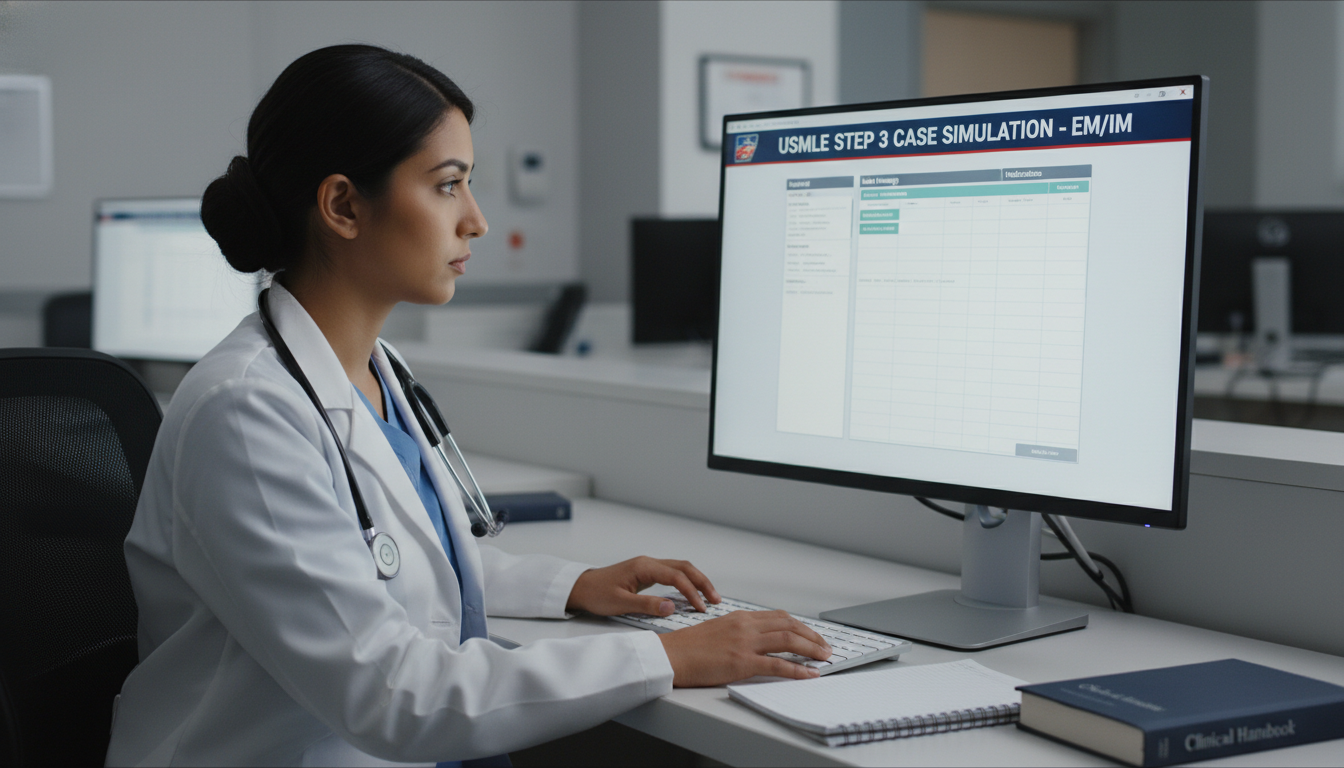
- Adds Computer-based Case Simulations (CCS) to test real-time decision-making
Step 3 is taken over two days:
Day 1 – Foundations of Independent Practice (FIP)
- Heavy on multiple-choice questions (MCQs)
- Emphasizes diagnosis, fundamentals, and broad clinical knowledge
- Topics: medicine, pediatrics, OB/GYN, psychiatry, preventive medicine, biostatistics, ethics
Day 2 – Advanced Clinical Medicine (ACM)
- MCQs plus CCS cases (typically 13 cases)
- Emphasis on management, monitoring, follow-up, and long-term care
- Heavy focus on ambulatory settings, inpatients, and transitions of care
How EM-IM Combined Training Influences Step 3 Prep
As an Emergency Medicine-Internal Medicine resident, you bring specific strengths and vulnerabilities to Step 3:
Strengths:
- Acute management: Codes, sepsis, trauma, chest pain, stroke, and airway management are routine for you.
- Broad differential thinking: EM teaches rapid triage and broad consideration of life-threatening diagnoses.
- Inpatient complexity: IM builds depth in chronic disease management and complex inpatients.
- Systems thinking: You regularly coordinate across specialties, which mirrors Step 3’s emphasis on safety and disposition.
Potential Gaps:
- Outpatient continuity care (especially for PGY-1s early in training)
- OB/GYN and pediatrics, especially well-child care and prenatal care
- Psychiatry and substance use in non-crisis, longitudinal contexts
- Prevention, screening, and counseling beyond the ED/ICU setting
Understanding these tendencies will help you build a targeted Step 3 preparation plan: lean on your acute and inpatient strengths, and deliberately focus on outpatient, preventive, and non-internal-medicine specialties.
When to Take Step 3 During Residency as an EM-IM Resident
Timing Considerations
For most residents, Step 3 during residency is ideal during PGY-1 or early PGY-2. Specifically for EM-IM combined programs, think about these factors:
Licensing and contract requirements
- Some states and some hospitals require Step 3 for a full medical license by the end of PGY-2.
- Some programs encourage or require passing by a certain year to renew contracts or moonlight.
Schedule predictability
- EM-IM schedules can be intense and variable.
- Look for a block with fewer overnight shifts (e.g., ambulatory, elective, or lighter IM rotations) rather than a high-intensity ED or ICU block.
Knowledge trajectory
- Too early (pre-residency or early PGY-1): You may lack the clinical reasoning and management experience Step 3 expects.
- Too late (late PGY-2 or beyond): Studying may become harder with increasing responsibilities, and you delay full licensure and moonlighting opportunities.
Typical EM-IM sweet spots:
- Mid to late PGY-1: After you have experienced inpatient IM, some ED, and ideally a bit of outpatient.
- Early PGY-2: If you want more clinical comfort and time to prepare thoroughly.
Practical Timing Examples
Case 1: PGY-1 EM-IM resident
- First half of year: Busy on wards, ICU, ED. Overwhelmed adjusting to residency.
- Plan: Schedule Step 3 for May–June of PGY-1 during an ambulatory IM or elective month with fewer nights.
Case 2: PGY-2 EM-IM resident
- Completed a full year of mixed ED and IM.
- Plan: Schedule Step 3 for fall of PGY-2, before applying for moonlighting privileges or before heavy ICU/ED stretches.
Aligning with EM IM Combined Rotations
Try to avoid scheduling Step 3:
- Immediately following night float
- During heavy trauma, MICU, or CCU months
- When you have back-to-back EM shifts and limited days off
Instead, aim for:
- Continuity clinic / ambulatory IM months
- A less intense ED block with some control over shift scheduling
- An elective where you can pre-plan study time
If your program has a say in your schedule, let your chiefs and program leadership know 2–3 months in advance that you’re planning Step 3 so they can help optimize your schedule.

Building an Effective Step 3 Study Plan for EM-IM Residents
Step 1: Set a Realistic Timeline
Balancing EM and IM rotations demands intentional planning. Common timelines:
4–6 weeks (intensive)
- Best if you have a lighter rotation or elective.
- Ideal if you remember Step 2 CK content well and have strong test-taking skills.
8–12 weeks (moderate)
- Most realistic for EM-IM residents on average schedules.
- Allows consistent but manageable daily study (60–90 minutes on most days, longer on days off).
>12 weeks (extended)
- May be necessary if you have major responsibilities (family, research, chief duties) or significant test anxiety.
- Risk: lose momentum and retention if too spread out; combat this with spaced repetition.
Establish a test date first, then work backwards to allocate weeks and major study tasks (Qbank completion, CCS practice, high-yield review).
Step 2: Choose Core Study Resources
You don’t need a huge stack of books. For Step 3 preparation, depth from a few resources is far better than skimming many.
Essential categories:
Question Bank (Qbank) – Non-negotiable
- Examples: UWorld Step 3, Amboss Step 3 (or similar high-quality Qbank)
- Goal: Complete at least 60–75% of a high-quality Qbank thoroughly.
- Strategy for EM-IM:
- Do mixed, timed blocks (to mimic the exam’s random specialty mixing).
- Focus review on outpatient, pediatrics, OB/GYN, and psych—areas where EM-IM residents may be less comfortable.
CCS Case Practice
- Use the official USMLE Step 3 CCS practice software (from the NBME/USMLE website).
- Supplement with:
- A CCS-focused resource or guide (book or online).
- Goal: Complete 20–30 practice CCS cases before test day, including both 10- and 20-minute formats.
Concise Review Text / Notes
- A focused Step 3 review resource (e.g., a Step 3 review book, condensed notes, or digital outline).
- Use it after you’ve done some questions so your review becomes more targeted.
Biostatistics & Ethics
- Either:
- Short dedicated chapters in your review book, or
- Step 2 CK resources (biostatistics/ethics largely carry over).
- Don’t neglect these; they’re high-yield and very learnable.
- Either:
Step 3: Daily and Weekly Structure
On busy EM or inpatient IM days:
- Aim for:
- 1 timed block of 10–20 Qbank questions (20–30 minutes)
- 20–40 minutes of review focusing on why each answer is right or wrong.
- If post-call or after a brutal string of shifts, let yourself do:
- 5–10 questions + brief review, or
- CCS walk-through or passive review (lighter cognitive load).
On days off or lighter days:
- Increase to:
- 2–3 timed Qbank blocks of 20–30 questions each
- 1–2 hours of focused review
- 1–2 CCS practice cases
Weekly goals:
- 120–160 Qbank questions per week (adjust based on your timeline).
- 4–6 CCS practice cases per week once you’re in the second half of your preparation window.
- Short review of:
- Outpatient guidelines (screening, chronic disease intervals)
- Pediatric well-child milestones and vaccines
- OB prenatal and postpartum care basics
Step 4: Integrate EM-IM Clinical Work into Studying
Use your unique training to your advantage by turning the hospital itself into your Step 3 study environment.
In the Emergency Department:
- For every chest pain patient, mentally ask:
- “What would be the next best step if this were a Step 3 question?”
- “What about disposition, follow-up, and long-term management?”
- After managing a patient:
- Look up recommended outpatient follow-up, preventive care, or chronic medication adjustments.
- Think beyond the ED: “What should their PCP focus on next?”
On Internal Medicine wards:
- For each patient, consider:
- “If this were an outpatient follow-up scenario, what screening/prevention do they need?”
- “What is the safest discharge plan, and what should be checked at the next visit?”
- Translate inpatient problems into Step 3-style questions:
- Example: “65-year-old man, post-NSTEMI, now stable and discharged—what adjustment should be made to his medications at his 2-week follow-up?”
In clinic or continuity rotations:
- Use real patients to solidify:
- Vaccine schedules
- Screening guidelines (mammograms, colon cancer screening, PAPs, AAA, lung cancer screening)
- Chronic disease targets (A1c, BP, lipids) and medication algorithms
Mastering Question Strategy and CCS for EM-IM Residents
MCQ Strategy: Leaning into Your EM-IM Mindset
Your EM background already trains you to prioritize life-threatening diagnoses and stabilization. Step 3 expects that—but then moves quickly into nuanced management decisions.
Adapting your thought process:
Stabilize first, then optimize
- Always mentally check: “Is this patient unstable?” If so, immediate ABCs and stabilization are priority.
- Once stable, Step 3 is often asking about:
- Best diagnostic test
- Most appropriate next management step
- Optimal long-term plan or preventive intervention
Avoid “admit reflex” bias
- Not every moderate-risk patient needs admission in Step 3 world.
- Many questions test safe outpatient management with appropriate follow-up—especially in Day 2 ACM.
Embrace guidelines and cost-effective care
- Step 3 rewards:
- Evidence-based guidelines
- Avoidance of unnecessary tests
- Choosing generic, cost-effective medications when appropriate
- Step 3 rewards:
Common traps for EM-IM residents:
- Overly aggressive imaging (CT scans/MRIs) when guideline steps recommend conservative management first.
- Choosing an inpatient setting when outpatient management with close follow-up is safest and recommended.
- Forgetting to add lifestyle counseling, vaccinations, or screening measures.
CCS Case Strategy: Stepwise Approach
The CCS cases are where your real-world EM-IM thinking shines if you adapt to the software.
General CCS process:
Initial Stabilization
- Quickly:
- Assess vitals and mental status
- Order ABC interventions if needed (O2, IV access, monitor, etc.)
- For critically ill patients, move them to ED/ICU early.
- Quickly:
Focused Diagnostics
- Order tests relevant to top differentials:
- Labs, imaging, EKG, pregnancy test in reproductive-age women, etc.
- Avoid ordering “everything”—stick to what’s clinically justified.
- Order tests relevant to top differentials:
Initial Treatment
- Start time-sensitive therapies promptly (antibiotics, anticoagulation, insulin, fluids).
- Step 3 rewards starting reasonable empiric therapy once you have enough evidence.
Reassessment and Disposition
- Advance the clock and check for:
- Vital sign trends and symptom change
- Lab and imaging results
- Adjust:
- Level of care (ED → ward → ICU or discharge)
- Medications and monitoring
- Advance the clock and check for:
Long-Term & Preventive Care
- Before ending case:
- Consider vaccinations, lifestyle counseling, screening tests, chronic medication optimization, and follow-up appointments.
- Before ending case:
EM-IM tailored CCS tips:
- In acute cases (sepsis, MI, PE, stroke), think exactly like the ED: early stabilization, rapid diagnostics, time-critical intervention.
- In chronic and primary care cases, switch to your IM/clinic mindset: guideline-based optimization and prevention.
- Practice a mix of acute and outpatient CCS cases so you don’t over-focus on one style.
High-Yield Content Areas for EM-IM Residents on Step 3
1. Outpatient Internal Medicine & Preventive Care
Even though you’re EM-IM combined, Step 3 heavily emphasizes primary care:
- Chronic disease management:
- Diabetes: A1c targets, oral agents, insulin initiation, microvascular screening
- Hypertension: stepwise pharmacologic approach, JNC/ACC-AHA style guidelines
- Lipid management: statin indications by age and risk
- Screening:
- Colon cancer: age and modality
- Breast and cervical cancer guidelines
- AAA, lung cancer screening (low-dose CT in high-risk smokers)
- Vaccinations:
- Adult vaccine schedule: influenza, pneumonia, shingles, Tdap, HPV, COVID (if tested)
- Preventive counseling:
- Smoking cessation, alcohol use, weight management, exercise
2. Pediatrics
As an EM-IM resident, you may have limited peds exposure, especially outside the ED. Step 3 expects:
- Well-child visits:
- Growth and developmental milestones
- Vaccine schedules (infant through adolescence)
- Common pediatric conditions:
- Otitis media, bronchiolitis, asthma exacerbations, gastroenteritis
- Fever in various age groups:
- Workup thresholds, sepsis rules, and when to hospitalize
- Pediatric emergencies:
- Dehydration, meningitis, seizures, anaphylaxis
3. OB/GYN
Step 3 OB/GYN is manageable with focused review:
- Prenatal care:
- Routine prenatal labs and visit schedule
- Gestational diabetes screening and management
- Preeclampsia diagnosis and management
- Obstetric emergencies:
- Ectopic pregnancy, placental abruption, preterm labor
- Shoulder dystocia basics, postpartum hemorrhage
- Gynecologic:
- Abnormal uterine bleeding workup
- Pap smear follow-up algorithms (HPV, CIN results)
4. Psychiatry & Substance Use
Step 3 tests both acute crises (suicidal ideation, psychosis) and longitudinal management:
- Depression, anxiety disorders, bipolar disorder
- Antidepressant and antipsychotic selection and side effects
- Substance use disorders:
- Alcohol withdrawal, opioid use disorder, medication-assisted treatment basics
- Capacity assessment, involuntary hold criteria
5. Ethics, Biostatistics, and Systems-Based Practice
These are often low-effort, high-yield points:
- Ethics:
- Autonomy, beneficence, non-maleficence, justice
- Informed consent, surrogate decision-making, confidentiality
- Biostatistics:
- Sensitivity, specificity, PPV, NPV
- Relative risk, odds ratio, NNT, confidence intervals, p-values
- Quality and safety:
- Hospital-acquired infection prevention
- Error disclosure
- Appropriate use of resources
Putting It All Together: Example 6–8 Week Study Plan
Here’s a sample 8-week Step 3 preparation schedule tailored to an EM-IM resident:
Weeks 1–2: Foundation & Baseline
- 15–20 Qbank questions/day (mixed, timed)
- Start with IM and outpatient-heavy questions
- 1–2 hours/week reviewing:
- Adult outpatient guidelines
- Screening and vaccines
- Observe ED and inpatient cases through a Step 3 lens (always ask: “next best step?”)
Weeks 3–4: Build and Expand
- 20–30 Qbank questions/day (140–180/week)
- Focus blocks on pediatrics, OB/GYN, and psych if you’re weak there
- Begin CCS:
- 2–3 CCS cases/week (mainly acute/ED style at first)
- Brief sessions on:
- Ethics and biostatistics
Weeks 5–6: Integrate and Refine
- Maintain 20–30 Qbank questions/day
- CCS:
- 4–5 CCS cases/week, mix of inpatient and outpatient
- On shifts:
- Pick 1–2 patients per day and consciously connect their care plan to Step 3-style questions and outpatient implications.
Weeks 7–8: Final Review and Simulation
- Finish remaining Qbank questions
- CCS:
- 6–8 cases/week, including timed runs
- Take a self-assessment (NBME or Qbank-based) under exam conditions
- Targeted review of:
- Missed question topics
- Preventive care, pediatric vaccines, prenatal care
- Ethics and biostatistics formulas/concepts
Two to three days before the exam:
- Reduce question volume
- Sleep well, adjust your schedule to match exam hours
- Light review of CCS interface and a few quick cases
FAQs: EM-IM Residents and USMLE Step 3
1. Should I take Step 3 before or during my EM-IM residency?
Taking Step 3 during residency is generally better. Your EM IM combined training will give you real-world context that makes questions and CCS cases easier. Most residents benefit from taking it in late PGY-1 or early PGY-2, when you’ve experienced both inpatient and some outpatient care but before responsibilities and fatigue accumulate too much.
2. Is Step 3 important for fellowship or job applications in EM-IM?
Step 3 is usually a threshold requirement rather than a major differentiator. Programs and employers mainly want to see:
- That you passed, preferably on the first attempt
- That you achieved licensure on time
For competitive fellowships (e.g., critical care, cardiology, or other IM-based fellowships), a very low Step 3 score or multiple failures can raise concerns, but a solid pass is typically sufficient.
3. How much time should I realistically spend preparing as a busy EM-IM resident?
Most EM-IM residents do well with 6–8 weeks of focused Step 3 preparation, averaging:
- 60–90 minutes on most workdays
- 3–5 hours on days off
If your schedule is intense, aim for 8–10 weeks with lower daily volume. The key is consistency: regular Qbank use, CCS practice, and targeted review of weaker areas.
4. What’s the best way to practice CCS for Step 3?
Use the official USMLE CCS practice software and a dedicated CCS guide. Treat CCS like a simulation rotation:
- Practice both acute EM-style cases and primary care follow-ups
- Always:
- Stabilize first
- Order justified diagnostics
- Start timely treatments
- Advance the clock and reassess
- Address preventive care before ending
Doing 20–30 practice cases is usually enough to become comfortable with the interface and typical case flow.
With deliberate planning, strategic resource use, and smart integration of your EM-IM clinical work, USMLE Step 3 becomes far more manageable—and even a useful bridge from exam-based learning to the realities of independent practice.