


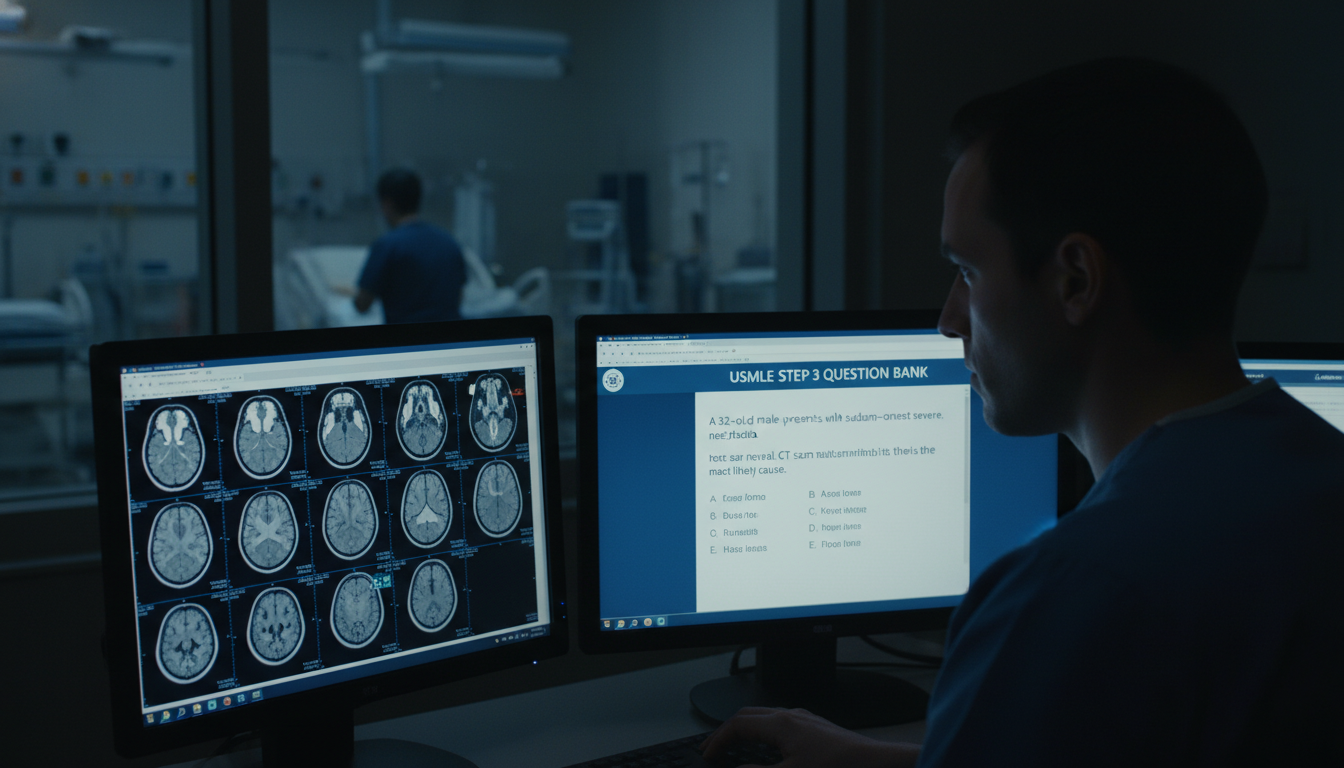
Why Step 3 Matters for Neurosurgery Residents
For many residents, USMLE Step 3 feels like a final administrative hurdle. In neurosurgery, it’s much more than that. How you approach Step 3 preparation can:
- Influence your schedule flexibility and licensing timeline
- Affect fellowship and early-career opportunities
- Reinforce critical clinical reasoning skills you’ll use in the ICU, ED, and OR
- Set the tone for your ongoing self-study habits during a very demanding residency
Although Step 3 is less high-stakes than Step 1/Step 2 CK for the residency match, neurosurgery is unique: the expectations are higher, the clinical context is more complex, and your time is more limited once residency begins. Planning ahead for USMLE Step 3 and integrating it intelligently into your neurosurgery residency is an investment in both your training and your sanity.
This guide focuses on USMLE Step 3 preparation for neurosurgery residents and incoming interns—how to time the exam, what and how to study, and how to balance serious prep with neurosurgical responsibilities.
Step 3 in the Context of Neurosurgery Training
Understanding What Step 3 Really Tests
Step 3 is a two-day exam designed to assess whether you can practice medicine safely and independently. Core domains:
- Diagnosis and management of common inpatient and outpatient problems
- Clinical decision-making over time (especially via CCS cases)
- Prioritization, safety, and cost-effective care
- Communication, ethics, systems-based practice
Unlike Step 1/2 CK, Step 3 is:
- Breadth-over-depth: heavy on internal medicine, pediatrics, OB/GYN, psychiatry, and emergency care
- Less subspecialty-focused: surprisingly little about detailed neurosurgical operative techniques
- Very primary-care oriented: routine follow-up, chronic disease management, preventive care
For a neurosurgery resident, this can feel foreign. You may spend most of your time managing SAH, TBI, spine trauma, and post-op care, while Step 3 wants to know about diabetes foot exams and prenatal counseling. This mismatch is exactly why structured Step 3 prep is essential.
Why Step 3 Still Matters in Neurosurgery
Step 3 scores are rarely used for neurosurgery fellowship selection, but the exam still matters:
Medical licensure requirement:
- Many states require Step 3 for full and sometimes even for unrestricted training licenses.
- Delays can interfere with moonlighting or certain roles later in residency.
Program and hospital requirements:
- Some neurosurgery programs have internal deadlines (e.g., pass Step 3 by end of PGY-2).
- Failing Step 3 can trigger remediation plans, administrative hassles, and personal stress.
Skill reinforcement:
- You will co-manage complex ICU patients with medicine and anesthesia teams.
- Broad internal medicine and critical care knowledge improves your neurosurgical care.
Professional reputation:
- A clean, timely Step 3 pass supports the narrative that you are organized, reliable, and self-directed—a big deal in neurosurgical culture.
Think of Step 3 as your baseline generalist competence guarantee before you double down on high-level neurosurgical subspecialization.
When to Take Step 3 During Neurosurgery Residency
Timing Step 3 during residency is one of the highest-yield decisions you’ll make about the exam.
Common Timing Options: Pros and Cons
Late MS4 / Transitional Period (if allowed by state rules)
- Some states and institutions allow taking Step 3 early (rare but increasing in some contexts).
- Pros:
- Knowledge of general medicine and Step 2 CK material is fresh.
- More control over your schedule before residency starts.
- Cons:
- Logistical barriers: not all states allow this.
- You may not know your residency program’s specific Step 3 expectations yet.
PGY-1 (Intern Year) – most common and often ideal
- Pros:
- Close in time to your clinical clerkship and Step 2 CK knowledge.
- Many interns rotate through internal medicine, ED, ICU—perfect for reinforcing Step 3 content.
- Cons:
- Adjusting to call schedules, neurosurgical workflow, and documentation is already stressful.
- Hard to carve out consistent study blocks on some rotations.
- Pros:
PGY-2 Early (Junior Neurosurgery Resident)
- Pros:
- Slightly more autonomy and familiarity with hospital systems.
- You’re more settled into residency.
- Cons:
- Neurosurgery-specific responsibilities ramp up: more OR time, independent call, ICU involvement.
- Step 2 CK material is less fresh; more re-learning required.
- Pros:
PGY-3 and Beyond – generally not recommended unless required
- Pros:
- Greater maturity and clinical reasoning experience.
- Cons:
- The further from medical school, the more general medicine you forget.
- Higher opportunity cost; demands of research, senior call, and leadership grow.
- Pros:
Strategic Recommendations for Brain Surgery Residency Trainees
For most neurosurgery residency programs, the sweet spot is:
- Target: Mid-to-late PGY-1 or very early PGY-2
- Aim to finish Step 3:
- Before your heaviest neurosurgical call responsibilities
- Before major research projects or sub-specialization ramp up
A practical framework:
Early PGY-1
- Clarify your program and state licensing requirements.
- Identify an upcoming lighter rotation (e.g., elective, outpatient, research block) for intensive study.
Mid PGY-1
- Schedule Day 1 and Day 2 of Step 3 about 1–2 months apart or within 1 week (depending on your preference and schedule availability).
- Block off 7–10 days of focused prep before the first test day, and 3–5 days before the second (if separated).
Late PGY-1 / Early PGY-2
- If you’ve delayed, set a firm deadline and get program director support to protect some study time.
Coordinating With Your Neurosurgery Program
Be transparent and proactive:
Ask senior residents:
- “When do most people here take Step 3?”
- “Which rotations are realistically lighter for studying?”
Talk to your program director or chief resident about:
- Time off for exam days
- Study time during less intense weeks
- Avoiding back-to-back 24-hour calls right before test days
Neurosurgery culture respects planning and ownership; approaching Step 3 this way demonstrates both.

What to Study: High-Yield Content for Neurosurgery Residents
Even though Step 3 is generalist-focused, you can prepare efficiently by targeting high-yield areas that neurosurgery residents often neglect.
High-Yield Systems and Topics
Internal Medicine (Largest Proportion)
- Cardiology: ACS, CHF, arrhythmias, hypertension, anticoagulation, endocarditis
- Pulmonology: COPD, asthma, pneumonia, pulmonary embolism, ventilator management basics
- Endocrinology: DKA/HHS, thyroid disorders, adrenal insufficiency, diabetes management and complications
- Nephrology: AKI vs CKD, electrolytes, acid-base, dialysis basics
- Infectious disease: sepsis, meningitis, HIV, opportunistic infections, antibiotic selection
Emergency Medicine / Critical Care
- Initial stabilization and triage (ABCs, shock management, trauma basics)
- Toxicology (overdoses, antidotes)
- Acute abdominal pain, chest pain, SOB algorithms
- ICU complications: delirium, ventilator management, sepsis bundles
Pediatrics
- Developmental milestones and red flags
- Common pediatric infections and vaccinations
- Pediatric rashes, dehydration, bronchiolitis, asthma
- Congenital disorders that may present to ED or primary care
OB/GYN
- Prenatal care, pregnancy screening, Rh incompatibility
- Ectopic pregnancy, preeclampsia, abnormal uterine bleeding
- Normal labor stages; intrapartum and postpartum complications
- Simple contraception counseling and management
Psychiatry & Behavioral Health
- Depression, bipolar, schizophrenia, anxiety disorders
- Substance use disorders and withdrawal
- Suicidality risk assessment and emergency management
- Capacity, informed consent, and confidentiality
Ethics, Biostatistics, and Systems-Based Practice
- Informed consent, surrogate decision-making, advance directives
- Confidentiality exceptions (duty to warn, reportable diseases)
- Quality improvement and patient safety concepts
- Test interpretation (sensitivity, specificity, predictive values, likelihood ratios)
Neurology and Neurosurgery-Relevant Content
- Stroke (ischemic vs hemorrhagic), TIA: diagnosis, acute management, secondary prevention
- Seizures and status epilepticus, first-time seizure workup
- Head trauma, spinal cord injuries (emergent assessment algorithms)
- CNS infections, brain tumors (high-level management, not detailed surgical technique)
Even though you’re training in brain surgery residency, don’t overemphasize neurosurgical minutiae. Step 3 rewards balanced generalist knowledge plus solid clinical judgment.
CCS (Computer-based Case Simulations): A Crucial Component
CCS cases are often the most unfamiliar part of Step 3 during residency:
- Simulated patient encounters where you:
- Order tests and treatments
- Adjust management over time intervals
- Decide on inpatient vs outpatient disposition
- Recognize when to escalate care
Neurosurgery residents often excel at ICU-style acute management but may underperform in:
- Outpatient follow-up and chronic disease management (e.g., DM, HTN, asthma)
- Preventive care (vaccines, screening, counseling)
- Cost-effective ordering and avoiding overtesting
You should:
- Practice CCS early, not just in the last week
- Learn a simple, repeatable framework, e.g.:
- Immediate stabilization (ABCs, vitals, IV access)
- Focused H&P
- Targeted initial labs and imaging
- Early treatment of likely life-threatening diagnoses
- Frequent re-evaluation and timeline advancement
Building a Realistic Step 3 Study Plan for Neurosurgery Interns
Time is your scarcest resource in neurosurgery. A focused, realistic plan beats an idealized but impossible one.
Overall Timeframe
Most neurosurgery residents can prepare effectively in:
- 4–8 weeks of structured study, depending on:
- How recently you took Step 2 CK
- Your baseline generalist knowledge
- Weekly work hours and call load
Think in terms of hours, not calendar days:
- Aim for 80–120 hours of focused Step 3 study:
- 60–90 hours for question banks
- 20–30 hours for CCS and content review
Weekly Plan Template (While on a Busy Service)
Assuming 60–80 clinical hours per week:
Weekdays (post-call may vary)
- 60–90 minutes of question bank (Qbank) per day (about 15–20 questions+review)
- 2 short micro-review blocks (10–15 minutes each) of weak topics
Weekends / Lighter Days
- 2–3 hours of Qbank + content review
- 1–2 CCS cases with full write-up and review
A sample 6-week plan:
Weeks 1–2: Foundation & Routine
- 40–50 Qbank questions per day on off-call days; 20–30 on post-call days
- Start CCS introduction and do 1–2 easy cases each week
- Focus on internal medicine and emergency topics first
Weeks 3–4: Intensification & CCS Focus
- Maintain Qbank volume (~40/day average)
- Add 3–4 CCS cases per week
- Use NBME/Step 3-style self-assessments if available, and identify weak systems (OB/GYN, ped, psych)
Weeks 5–6: Refinement & Exam Readiness
- Finish remaining Qbank
- Emphasize CCS practice: 1–2 cases per day during final week
- Targeted review of ethics, biostatistics, and your weakest systems
- Simulate test blocks on days off
Integrating Study Into Neurosurgical Workflow
Practical tactics:
Use micro-blocks
- 1–2 questions between cases when you’re scrubbed out and waiting for a room
- Flash-review on your phone during short breaks (but protect time to decompress too)
Align study with your clinical day
- If you managed a septic ICU patient, do a short review on sepsis and shock that evening.
- If you saw a pregnant trauma patient, review pregnancy physiology and OB emergencies.
Protect your pre-exam days
- Avoid scheduling Step 3 right after a 24-hour neurosurgery call.
- Try to get at least one relatively light day before each exam day for sleep and consolidated review.

Tools, Resources, and Test-Day Strategy
Recommended Study Resources
You don’t need a long resource list. Time is limited; focus on one primary Qbank plus CCS-specific tools.
Primary Step 3 Qbank (choose one)
- UWorld Step 3 Qbank
- (Or another reputable Step 3-focused bank with CCS integration)
Strategy:
- Aim to complete at least 70–80% of a high-quality Qbank, ideally more.
- Do timed, random blocks once you’re comfortable; start with system-based if you’re rusty.
- Review thoroughly: not just why you got it wrong, but why each distractor is incorrect.
CCS Practice Tools
- UWorld CCS
- Other CCS-specific simulation platforms if your Qbank doesn’t have robust cases
Strategy:
- Practice until the interface feels intuitive.
- Don’t chase perfection; focus on systematic, safe, guideline-consistent management.
Concise Review Text / Notes (Optional)
- Short Step 3-specific review notes or condensed boards-style outlines
- Don’t bury yourself in long textbooks; prioritize high-yield summaries and question-based learning.
Ethics & Biostatistics
- Short dedicated review chapters or online modules
- Rehearse classic scenarios: confidentiality, mandatory reporting, research ethics, quality metrics.
Adapting Your Neurosurgical Mindset
As a neurosurgery trainee, you’re used to:
- Deep dives into specialized topics
- Complex operative decision-making
- Very sick patients at the extremes of physiology
Step 3 demands:
- Breadth over depth
- Comfort with routine outpatient and inpatient issues
- Efficient decision-making that balances cost, safety, and evidence
Adapt by:
- Deliberately practicing bread-and-butter cases: UTIs, URIs, DM follow-up, well-child checks.
- Resisting the urge to over-test or fully “work up” every mild symptom.
- Keeping patient safety first, but also recognizing typical, low-risk presentations.
Step 3 Test-Day Strategies
Before Day 1 and Day 2
- Prioritize sleep for 2–3 nights before each testing day. Sleep deprivation from call is a major risk.
- Light review only the day before—especially CCS steps, ethics, and your weakest topics.
- Prepare logistics: route, parking, snacks, ID, confirmation email, earplugs if allowed.
During the Exam
Time management
- For multiple-choice blocks, don’t get stuck on a single question. Mark and move.
- Keep moving steadily; Step 3 time limits are generous but not infinite.
Question approach
- Focus on the most likely next step, not all theoretically possible steps.
- Think like a safe, cost-conscious internist or EM physician, not a neurosurgery attending.
CCS tactics
- Stabilize immediately: vitals, IV access, O2, monitor.
- Order only reasonable, guideline-based initial tests.
- Advance time purposefully; don’t leave patients unattended in the virtual ED.
- Always consider: Do they need admission? ICU? Specialist consult?
Stress management
- If a block feels terrible, reset mentally before the next one. This exam is long; one bad block doesn’t define your score.
- Use breaks strategically to eat, hydrate, and refocus.
Common Pitfalls and How Neurosurgery Residents Can Avoid Them
Pitfall 1: Underestimating Step 3 Because “It’s Just Pass/Fail”
While it’s often treated as a lower-stakes exam, neurosurgery residents who neglect it can:
- Fail on the first attempt, creating licensure delays and program concerns
- Spend more total time and stress remediating than they would have spent on moderate, consistent preparation
- Compromise sleep and mental health by cramming during heavy call months
Solution: Treat Step 3 as a professional obligation that deserves a moderate, sustained effort rather than last-minute panic.
Pitfall 2: Over-Focusing on Neurosurgery Content
Some neurosurgery residents naturally gravitate toward neuro questions and ignore OB/peds/psych.
Solution:
- Intentionally front-load your weakest subjects.
- If you find yourself skipping OB or pediatrics, schedule “OB-only Saturdays” or “Peds Sundays” where you exclusively do those questions.
Pitfall 3: Poor Scheduling Around Call
Taking Step 3 right after a 24-hour neurosurgery call (or a run of several) is dangerous:
- Cognitive fatigue and slower processing
- Greater risk of careless mistakes
- Lower tolerance for exam-day stress
Solution:
- Coordinate with your chief or program director to avoid the heaviest call periods around your exam dates.
- If necessary, adjust by a few weeks rather than forcing it during a brutal rotation.
Pitfall 4: Ignoring CCS Until the Last Few Days
CCS is unfamiliar and interface-based; cramming it at the end leaves you uncomfortable during the exam.
Solution:
- Start CCS practice early: one or two cases per week from Week 2.
- Focus on building a reliable routine for case approach rather than memorizing specifics.
FAQs: Step 3 During Neurosurgery Residency
1. How important is my Step 3 score for neurosurgery fellowship or attending jobs?
For most neurosurgery fellowships and attending positions, Step 3 is primarily viewed as a binary requirement—you passed and obtained licensure. Compared with Step 1 and Step 2 CK (and your residency performance, case logs, and research), Step 3 score rarely drives selection decisions. However, a failed attempt can raise questions and require explanation. Your main goal: pass on the first attempt, in a timely fashion.
2. When is the best time to take Step 3 during neurosurgery residency?
For most residents, the ideal window is mid-to-late PGY-1 or very early PGY-2, during or immediately following a relatively lighter rotation. At that point, your general medicine knowledge from medical school is still reasonably fresh, and your neurosurgery responsibilities haven’t yet peaked. Taking Step 3 much later (PGY-3+) is possible but tends to require more re-learning of generalist material.
3. How many hours should I study for Step 3 if I’m a neurosurgery intern?
Most neurosurgery interns do well with 80–120 hours of focused study, spread over about 4–8 weeks. This typically includes completing 70–100% of a high-quality Qbank, plus 20–30 hours of CCS practice and targeted review. The exact amount depends on how recently you took Step 2 CK and your comfort with non-neurosurgical areas like OB/GYN, pediatrics, and psychiatry.
4. Can I meaningfully prepare for Step 3 during a busy neurosurgery rotation?
Yes, if you’re realistic and structured. Focus on small, consistent daily blocks (45–90 minutes), prioritize a single Qbank, and integrate learning with your clinical cases (e.g., reading on sepsis or anticoagulation after seeing such patients). Try to schedule your actual exam days during or soon after a lighter block, and avoid taking the test immediately after heavy overnight call. With thoughtful planning, even demanding neurosurgery rotations can coexist with effective Step 3 preparation.
By treating USMLE Step 3 preparation as a structured, time-limited project integrated into your neurosurgery residency, you can clear this licensure milestone efficiently, reinforce critical clinical reasoning skills, and refocus your energy on what drew you to neurosurgery in the first place: caring for patients with complex brain and spine disease at the highest level.




















