
Preparing for board exams in vascular surgery is a marathon, not a sprint. Between busy operative days, clinic, call, and research, your study strategy must be deliberate, efficient, and tailored to the unique content of vascular surgery. This guide walks you through the best board exam study resources, how to use them at different stages of training, and how to build a sustainable plan that fits a vascular surgery residency or integrated vascular program schedule.
Understanding Vascular Surgery Board Exams
Before selecting resources, you need clarity on what you’re targeting. Vascular surgery trainees typically face several knowledge milestones:
ABSITE or VSITE-style in-training exams
- For those in combined general surgery + vascular tracks or early years of an integrated vascular program
- Tests clinical judgment, operative knowledge, and basic science foundations
ABS Vascular Surgery Qualifying Examination (written)
- Multiple-choice, computer-based exam
- Emphasizes diagnostic reasoning, non-invasive testing, endovascular and open procedures, perioperative care, and complications
ABS Vascular Surgery Certifying Examination (oral)
- Case-based oral exam
- Tests how you think, prioritize, and manage complex patients and complications in real time
Because of this structure, your board exam resources should cover:
- Core vascular surgery knowledge
- Applied anatomy and physiology
- Imaging and noninvasive vascular testing
- Endovascular techniques and device basics
- Open operative techniques and decision-making
- Perioperative management and complications
- Longitudinal medical management and guidelines
Keep this framework in mind as we review specific resources and how to use them.
Core Vascular Surgery Texts and References
Textbooks are the backbone of your knowledge base. The key is not to read everything cover-to-cover, but to strategically use them as references and for targeted reading blocks.
1. Major Comprehensive Textbooks
Rutherford’s Vascular Surgery and Endovascular Therapy
- Often considered the “Bible” of vascular surgery
- Strengths:
- Broad, deep coverage of vascular pathophysiology, diagnosis, and management
- Excellent for complex topics like aortic pathology, mesenteric ischemia, and vasculitis
- High-yield tables and figures for board prep
- How to use:
- Use as a reference, not a daily textbook
- Read key chapters aligned with rotation (e.g., aortic, carotid, PAD, venous, dialysis access, trauma)
- Before boards, focus on summary tables, algorithms, and guidelines
Cronenwett & Johnston: Rutherford-like alternatives / concise guides
- Some programs also use more concise vascular surgery handbooks or synopses written by vascular faculty
- These can be more digestible for pre-call or pre-op reading and are easier to annotate
2. Concise and Review-Oriented References
Vascular and Endovascular Surgery: A Comprehensive Review (e.g., Hallett and others)
- Structured as both text and review
- Frequently used for VSITE and written boards
- High-yield chapters, images, and case-based discussions
Handbooks and Pocket Guides
- Titles vary by institution, but often include:
- “Vascular Surgery: A Companion to Specialist Surgical Practice”
- Institutional vascular call handbooks
- How to use:
- Great for quick refreshers on classification systems (Rutherford PAD, CEAP, Fontaine), scoring systems (WIfI, SVS risk scores), and guideline-based management
- Perfect for travel, call, and brief downtime
3. Guidelines as Study Resources
Professional society guidelines double as prime board material:
- Society for Vascular Surgery (SVS) Guidelines
- Carotid disease (symptomatic vs asymptomatic)
- Aortic aneurysm and dissection management
- Peripheral arterial disease and critical limb-threatening ischemia
- Venous thromboembolism and chronic venous disease
- Dialysis access
- European Society for Vascular Surgery (ESVS) Guidelines
- Complement SVS guidelines and are often cited in exams
How to use guidelines for board prep:
- Print or save PDFs of key guidelines
- Create summary tables or flowcharts (indications for intervention, imaging choices, surveillance intervals)
- Turn guideline algorithms and class I recommendations into flashcards (e.g., with Anki USMLE-style spacing)

Question Banks and Practice Exams
Question-based learning is central to board success. For vascular surgery residents and fellows, there are two key categories: general surgical question banks and vascular-specific resources.
1. General Surgery Foundations: UWorld and Beyond
Your early years (especially in an integrated vascular program) still demand a strong general surgery foundation—both for service responsibilities and in-training exams.
UWorld (General Surgery and USMLE content)
- While UWorld is best known for USMLE prep, parts of its content are invaluable for early training:
- Perioperative medicine
- Critical care
- General surgical principles (wound healing, shock, fluid management)
- Aneurysms, carotid disease, PAD, and DVT/PE from a more generalist lens
UWorld tips for vascular trainees:
- Use dedicated test blocks for:
- Vascular-adjacent topics: anticoagulation, antiplatelet management, perioperative risk stratification
- Imaging interpretation (CT angiography basics, duplex findings in peripheral disease)
- Focus on questions that reinforce clinical reasoning: “What’s the next best step?” mimics board-style thinking
- Create Anki cards from missed questions using a structured format:
- Diagnosis
- Best initial test
- Best next step
- Indications for surgery vs endovascular therapy
Other general surgery qbanks (e.g., TrueLearn, ABSITE-specific banks) can nicely supplement vascular-specific questions, especially early in training.
2. Vascular-Specific Question Banks and Review Books
Look for resources targeted specifically to vascular surgery in-training exams and boards, such as:
VSITE-style Qbanks and annual review courses
- Some academic institutions and societies offer:
- Online question sets
- Past VSITE-style questions
- Annual review course materials with Q&A
- Some academic institutions and societies offer:
Question-based vascular review books
- Multiple-choice review books aligned with VSITE/board content outline
- Case-based question formats to reinforce decision-making
How to use vascular qbanks effectively:
- Start by aligning question practice with your current clinical rotation:
- Aortic rotation → aneurysm and dissection questions
- Limb salvage/PAD rotation → claudication, CLI, wound care, endovascular therapy
- Venous rotation → DVT, PE, chronic venous insufficiency, IVC filters, lymphedema
- Build a calendar:
- PGY-1–2 (or early integrated years): 10–20 vascular questions per week
- Mid-training: 10–15 questions 3–4 days per week
- Final 6 months before written boards: 40–60 vascular questions per week in exam-like blocks
3. Simulated Exams and Self-Assessment
Simulated exams are powerful for performance calibration and anxiety reduction.
Look for:
- Program-sponsored mock VSITE or board-style exams
- Multi-institutional vascular written exam preparation courses
- Self-assessment exams available through societies or publishers
How to use simulated exams:
- Take at least 2–3 full-length exams before your qualifying exam
- After each exam:
- Analyze not just content gaps, but patterns (e.g., always weak on mesenteric ischemia, dialysis access, or venous pathology)
- Make a targeted 2–3 week mini-study plan focusing on those weak areas
Leveraging Digital Tools: Anki, Spaced Repetition, and Multimedia
Digital tools can dramatically increase retention if used deliberately, especially when your time is fragmented by clinical duties.
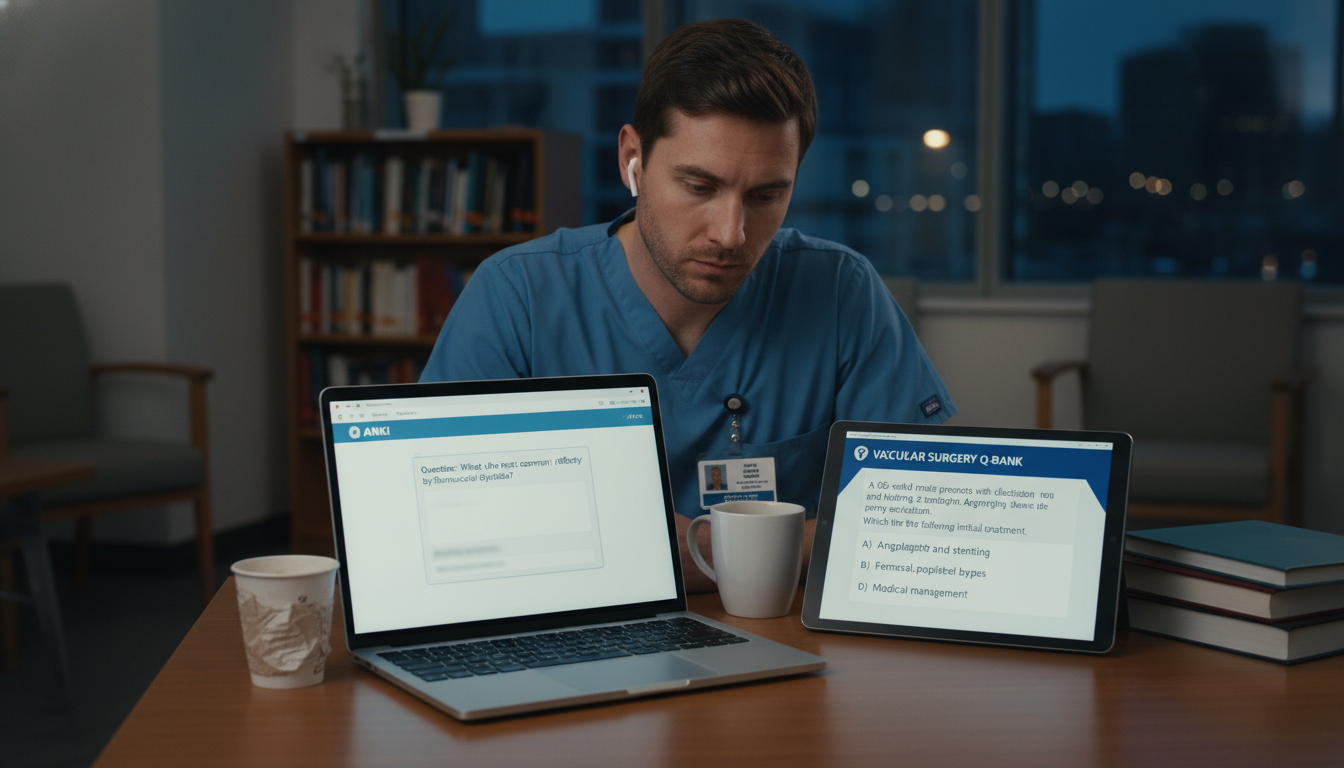
1. Anki for Vascular Surgery: Beyond “Anki USMLE”
Anki is ubiquitous in medical school, especially as “Anki USMLE” decks for Step 1/2. Those decks are useful for foundational physiology and general surgery basics, but they are not sufficient for vascular boards. You’ll need specialty-specific decks.
Building an Anki deck for vascular surgery:
- Sources for cards:
- VSITE and written board-style questions you miss
- High-yield tables from Rutherford’s and guideline summaries
- Operative indications and contraindications
- Classification systems and scoring tools (Rutherford, CEAP, WIfI, TASC, SVS risk scores)
- Card style:
- Prefer short, focused cards (one concept per card)
- Example:
- Front: “Indications for repair of asymptomatic infrarenal AAA in men?”
- Back: “Diameter ≥5.5 cm, rapid growth (>0.5 cm in 6 months), saccular aneurysm, or symptomatic aneurysm.”
- Avoid “chapter summary” cards that are too long and unmanageable
Daily Anki routine for residents:
- 15–20 minutes during commute or before bed
- Cap new cards to 10–15 per day
- Suspend low-yield or redundant cards before exam-heavy rotations
2. Multimedia and Visual Learning
Vascular surgery knowledge is highly visual and anatomical. Exploit this:
Duplex and CTA image libraries
- Save representative images from cases (de-identified) or institutional teaching files
- Pair imaging findings with pathophysiology in your notes or flashcards
Surgical videos and endovascular case libraries
- Many vascular societies, academic centers, and specialty channels provide:
- Step-by-step videos of carotid endarterectomy, EVAR, TEVAR, bypass, thrombectomy, etc.
- Use a structured viewing framework:
- Indication
- Key anatomy and landmarks
- Access strategy
- Critical steps and “no-go” zones
- Common pitfalls and complications
- Many vascular societies, academic centers, and specialty channels provide:
Podcasts and audio summaries
- Useful during commutes for:
- Guideline updates
- Landmark vascular trials (EVAR-1, DREAM, ACAS, NASCET, CREST, etc.)
- Case-based discussion of complicated vascular scenarios
- Useful during commutes for:
3. Digital Organization and Note Systems
Consider using:
- OneNote, Notion, or Evernote for organizing:
- Guideline synopses
- Operative pearls
- “Cannot miss” complications and management
- Tag content by:
- Anatomy: aorta, carotid, peripheral, mesenteric, renal, venous
- Content type: indications, imaging, interventions, complications, follow-up
- Revisit these summary notes monthly in the final year before testing.
Structured Study Strategy Across Training Years
You can own all the best resources and still struggle if you don’t have a strategy. Here’s how to build a longitudinal plan that works in vascular surgery residency or an integrated vascular program.
1. Early Training (PGY-1–2 or Years 1–3 Integrated)
Goals:
- Solidify general surgery and critical care foundations
- Build core vascular anatomy and pathophysiology
- Establish study habits and resource familiarity
Resources to emphasize:
- UWorld and other general surgery question banks (apply UWorld tips to maximize understanding)
- Anki USMLE-style decks for physiology/pathology refreshers
- Introductory vascular chapters from major texts
- Institution-specific vascular call manuals
Practical tactics:
- 30–40 minutes most days:
- 10–15 UWorld or general surgery questions
- 10 minutes of Anki
- 10–15 minutes of focused reading (e.g., “tonight: carotid disease basics”)
- Integrate learning with cases:
- After a case, read 10–15 pages on that topic (e.g., EVAR sizing, CEA indications)
2. Mid-Training (PGY-3–4 or Middle Years Integrated)
Goals:
- Transition to predominantly vascular content
- Prepare for VSITE and more advanced responsibility
- Consolidate guideline-based practice
Resources to emphasize:
- Vascular-specific question banks and case-based review books
- Rutherford’s selected chapters aligned with your rotations
- SVS and ESVS guidelines
- Anki deck focused on vascular content
Practical tactics:
- Aim for 3–4 focused study sessions per week:
- 20–30 vascular questions
- Short, targeted reading (1 topic per session)
- Daily Anki (10–15 minutes)
- After each clinic or OR day:
- Identify 1–2 “board-worthy” cases (e.g., TAA with difficult landing zones, CLI with tissue loss)
- Write 2–3 bullet points on indications, management, and follow-up
3. Senior and Chief Years (PGY-5+ or Final Integrated Years)
Goals:
- Targeted board exam preparation
- Refine decision-making logic, not just recall
- Practice oral exam style presentations
Resources to emphasize:
- Vascular board review books and high-yield summaries
- Intensive use of vascular qbanks and self-assessment exams
- Mock oral exams with faculty and peers
- Personal “high-yield notebooks” or digital notes
Practical tactics:
Written board (qualifying exam) preparation:
- 4–6 months out:
- 40–60 board-style questions per week (timed blocks)
- One major topic review per week (e.g., week 1: aorta; week 2: carotid; week 3: PAD; etc.)
- 2–3 months out:
- Full-length practice exam every 3–4 weeks
- Aggressive review of weak topics identified by performance analytics
- 4–6 months out:
Oral board (certifying exam) preparation:
- Start 6–9 months before exam date
- Weekly or biweekly mock orals with:
- Attendings
- Fellows or co-residents
- Use a standardized approach to each case:
- Opening summary
- Initial workup
- Imaging interpretation
- Operative vs nonoperative decision
- Technical strategy
- Management of intra- and postoperative complications
Balancing Clinical Work and Studying: Time Management and Well-Being
The best resources are useless if you’re burned out or chronically behind. Building a sustainable approach is critical.
1. Micro-Studying: Making Use of Small Time Blocks
- Commute:
- Audio reviews or podcasts
- Anki review on public transit (if safe)
- Pre-round or post-op downtime:
- 5–10 Anki cards
- One board-style question and quick discussion with a co-resident
- Call Nights (when possible):
- Keep a small, targeted reading goal (e.g., “If it’s quiet, I’ll read about iliac aneurysms for 15 minutes.”)
2. Weekly Planning
At the start of each week, define:
- One vascular topic you will master (e.g., “thoracic outlet syndrome”)
- A realistic number of questions (e.g., 40 questions this week)
- Specific times blocked for study (such as 2 evenings, 1 weekend block)
Use a simple tracking system:
- A small notebook or note app with:
- Checkboxes: “Questions done,” “Anki done,” “Topic reviewed”
- This keeps you honest without overcomplicating your life
- A small notebook or note app with:
3. Protecting Sleep and Burnout Prevention
- Cognitive performance and memory consolidation are tightly linked to sleep
- Minimum targets:
- 6 hours per night is a floor, not a goal; 7–8 is ideal when possible
- If you’re post-call and exhausted:
- Prioritize sleep and recovery over “checking the box” for study
- Make up for it with one slightly longer session later in the week
4. Leveraging Your Faculty and Peers
- Ask vascular faculty:
- “What did you use for boards?”
- “If you had to pick only two board exam resources, what would they be?”
- Form a small study group:
- 2–4 residents at similar training level
- Monthly or biweekly sessions
- Rotate who prepares a mini-teaching topic or oral board scenarios
Frequently Asked Questions (FAQ)
1. How early should I start using vascular-specific resources versus general surgery ones?
Begin integrating vascular-specific resources as soon as you start seeing vascular patients regularly—usually by PGY-2 or the second year of an integrated vascular program. However, don’t neglect general surgery and critical care foundations early on. A blended approach is best: UWorld and ABSITE-style questions for general principles, plus at least 1–2 vascular questions or a short vascular reading each study session.
2. What is the single most important resource for the vascular written boards?
There isn’t a true “single” resource, but the most efficient combination is: a strong vascular surgery question bank + selective use of Rutherford’s (or another major vascular text) + guideline summaries. Many residents pass by using questions as the backbone of their study plan and turning missed questions and guideline points into Anki cards for spaced repetition.
3. How should I use Anki during busy rotations without getting overwhelmed?
Keep your deck tightly curated and your daily goals modest. Add only high-yield, exam-worthy cards (indications, cutoffs, classifications, management algorithms). Limit new cards to about 10 per day, and allow some days with zero new cards during heavy call. Consistency with small daily reviews is more important than big, sporadic sessions.
4. How do I prepare differently for the oral boards compared to the written exam?
The written exam emphasizes recall and pattern recognition; the oral exam tests your reasoning, communication, and ability to manage complications under pressure. For oral boards:
- Practice verbalizing your thought process out loud
- Do frequent mock orals with faculty and peers
- Focus on organization: succinct case presentations, logical stepwise reasoning, clear complication management plans
- Review operative steps and “what if” scenarios more than esoteric details
By combining high-yield board exam resources with a realistic, structured plan, you can build durable vascular surgery knowledge while still thriving in a demanding clinical environment. Use textbooks and guidelines for depth, question banks and simulated exams for application, and digital tools like Anki and focused multimedia for retention. Over time, this integrated approach will not only prepare you for board exams—it will also make you a safer, more confident vascular surgeon.