Residency Match Day is one of the most defining milestones in a medical education journey. For medical graduates, it represents the transition from student to physician-in-training, from classroom and clerkships to the front lines of patient care. Understanding exactly what to expect—before, during, and after Match Day—can help you approach this high-stakes event with more clarity, confidence, and resilience.
Below is a comprehensive overview of Residency Match Day, including the timeline, the matching process, the emotional experience, and practical next steps whether you match, partially match, or go unmatched.
Understanding Residency Match Day in the Context of Your Medical Career
Residency Match Day isn’t just a single moment; it is the culmination of years of work and the bridge between undergraduate medical education and graduate medical training. It is central to how U.S. residency programs and medical graduates connect and determine the next stage in a career in medicine.
Why Match Day Matters
- Career-defining transition: Match Day determines where you will complete your residency program, which often shapes your early career trajectory, mentors, and clinical opportunities.
- Formal beginning of GME (Graduate Medical Education): The National Resident Matching Program (NRMP) match officially initiates your transition from medical school to structured residency programs.
- Emotional and symbolic milestone: This is when the sacrifices, long nights, and exams crystallize into a concrete next step—your residency position and location.
While Match Day carries enormous weight, it is also important to remember that:
- It does not define your ultimate success as a physician.
- Many paths exist in a career in medicine; Match Day is a major one, but not the only one.
- Every outcome—match, partial match, or no match—can be navigated with strategy and support.
The Countdown to Residency Match Day: Timeline and Preparation
Key Events in the Match Timeline
Residency Match Day typically falls on the third Friday in March each year for the NRMP Main Residency Match. However, the process that leads to that moment spans many months:
1. Application and Interviews (September–February)
- ERAS submission: You submit residency applications via ERAS (Electronic Residency Application Service), including your personal statement, letters of recommendation, MSPE, and transcripts.
- Interviews: Programs review applications and invite candidates for interviews (often October–January). This is where you explore program culture, clinical exposure, and fit.
2. Rank Order List (ROL) Certification (Late January–February)
- For applicants: You rank residency programs in true order of preference, not based on where you think you will match.
- For programs: Programs rank applicants based on interview performance, application strength, and perceived fit.
- Deadline: Both sides certify their Rank Order Lists with NRMP by a specified February deadline.
3. Match Week (The Week of Match Day)
Monday of Match Week:
- Applicants receive an email (and can log into their NRMP account) stating:
- “You are matched” – to a residency position.
- “You are partially matched” – for some specialties (e.g., advanced positions requiring a separate preliminary year).
- “You are unmatched” – to any position in the Main Match.
- If you are unmatched or partially matched, you become eligible to participate in the Supplemental Offer and Acceptance Program (SOAP) to obtain an unfilled residency spot.
Tuesday–Thursday of Match Week (SOAP):
- Unfilled programs list available positions.
- Unmatched applicants apply to these programs through ERAS and participate in multiple SOAP offer rounds.
- Offers are extended and accepted in timed rounds until Thursday.
Friday: Residency Match Day
- At 12:00 pm ET, matched applicants nationwide learn the specific program and location where they will train.
- Many medical schools host Match Day ceremonies aligned with this time.
Emotional and Practical Preparation in the Weeks Before Match Day
In the final weeks before Residency Match Day, applicants often experience:
- Anticipation and anxiety about where they will live and train.
- Second-guessing of rank lists and career decisions.
- Excitement to close one chapter of medical education and begin another.
You can manage this time productively by:
Connecting with mentors:
- Discuss what to expect from residency programs, possible outcomes, and backup plans.
- Seek their perspective on how Match results fit into long-term career goals.
Planning logistics scenarios:
- Think through potential cities, cost of living, and housing plans for your most likely match locations.
- Start a checklist for relocation, licensure, and credentialing, which you can finalize after Match Day.
Caring for your mental health:
- Normalize anxiety—everyone feels it.
- Use support systems: classmates, family, counselors, or student wellness services.
- Limit unhelpful comparisons with peers and social media hype.

How the Residency Matching Process Actually Works
Understanding the mechanics of the NRMP algorithm and SOAP can reduce uncertainty and help you interpret your Match Day outcome more rationally.
The NRMP Match Algorithm in Plain Language
The NRMP uses a “deferred acceptance” algorithm, sometimes called the applicant-proposing algorithm. Key principles:
You propose to your top choice first:
The algorithm treats your Rank Order List as a series of proposals, starting with your #1 program. It tries to place you there if that program also ranks you.Programs tentatively hold applicants:
Each program has a set number of spots. Initially, they tentatively hold the highest-ranked applicants who have “proposed” to them so far, up to their quota.Improvement is allowed:
If a program later receives a higher-ranked applicant proposal, it may “bump” a previously held applicant. The bumped applicant then “proposes” to their next program in order.Process continues until stable:
The algorithm continues until everyone is either matched to the most preferred program that also wants them or determined to be unmatched.
The algorithm is designed to favor applicants’ preferences. This is why advisors consistently recommend ranking programs in your genuine order of preference, not based on perceived competitiveness or chances.
What If You Don’t Match? The SOAP Process
If you do not secure a position in the initial match, the Supplemental Offer and Acceptance Program (SOAP) provides a structured mechanism to obtain an unfilled residency position:
Eligibility:
- You must be registered for the Main Residency Match.
- You must be fully or partially unmatched on Monday of Match Week.
How SOAP Works:
- NRMP publishes the list of unfilled residency programs (not visible to matched applicants).
- Unmatched applicants apply through ERAS to these unfilled positions (with limits on the number of applications).
- Programs review applications and conduct short, focused interviews (often via phone or video).
- Over multiple offer rounds, programs extend offers; applicants can accept or wait for potentially preferred offers.
Key Strategy Tips for SOAP:
- Work closely with your dean’s office or advisors to develop a targeted and realistic application list.
- Update your CV and have short, clear talking points about your strengths and why you’re a good fit for specific programs.
- Stay organized and responsive; SOAP moves quickly.
The Big Day: What Happens on Residency Match Day
Residency Match Day is simultaneously a formal ceremony, a social gathering, and a deeply personal moment for every medical student.
Typical Structure of a Match Day Ceremony
While specifics vary by school, many Match Day events follow a similar pattern:
Welcome and Speeches
- Deans, program directors, or faculty leaders share remarks about the graduating class, the meaning of Match Day, and the journey ahead.
- Some schools highlight match statistics or notable achievements (e.g., number of students going into each specialty).
Distribution of Envelopes or Digital Results
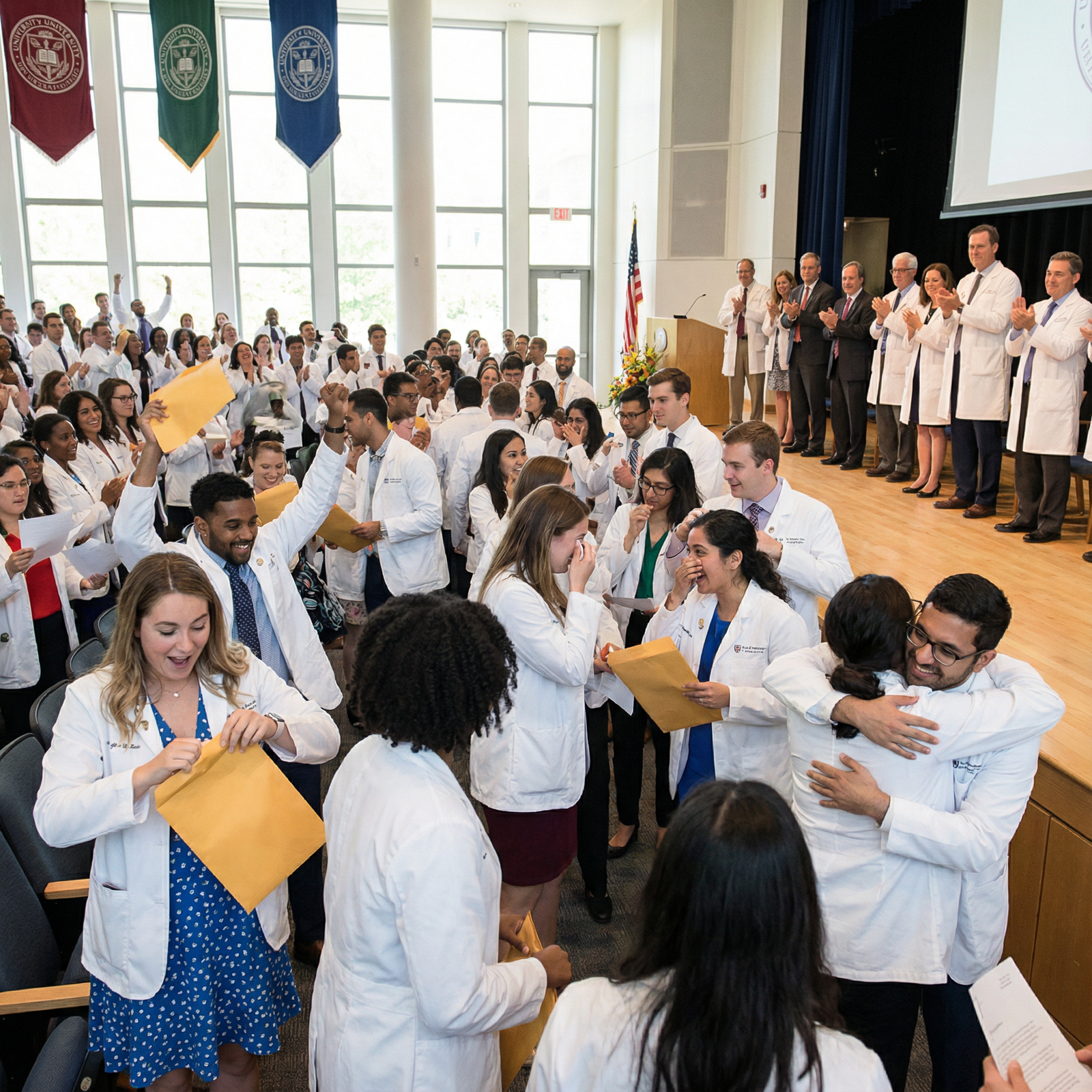
- At or shortly before 12:00 pm ET, students receive sealed envelopes.
- At some institutions, students instead open their results electronically via NRMP, sometimes simultaneously with their peers.
- Schools may call students one at a time, by small groups, or allow a more informal, all-at-once reveal.
The Countdown and The Reveal
- A collective countdown often precedes the exact moment envelopes can be opened.
- At noon ET, envelopes are opened, emails are refreshed, and the room fills with cheers, hugs, sometimes tears, and a spectrum of emotional reactions.
Celebration and Sharing
- Graduates announce where they’ve matched—sometimes on stage, sometimes informally among friends and family.
- Group photos, specialty-specific photos, and celebrations with loved ones are common.
Managing the Emotional Intensity of the Reveal
The reveal moment on Residency Match Day is charged with emotion:
For those who match at top-choice programs:
- Feelings of relief, excitement, gratitude, and validation.
- Often followed by rapid planning—mentally picturing your life in that new city and program.
For those who match but not at their top choices:
- Mixed emotions are very normal—gratitude for having a position, combined with disappointment or surprise.
- It’s okay to feel conflicted; both emotions can coexist.
For those whose friends are disappointed or who did not match at all:
- Compassion and sensitivity matter. Avoid bragging or insensitive comments.
- Offer quiet support, including practical help (e.g., walking them over to student affairs, staying with them if they want company).
Practical Tips:
- Consider ahead of time whether you want to open your envelope privately or in front of others.
- Decide who you want with you: family, close friends, or perhaps a smaller circle if you’re anxious.
- Give yourself permission to step away briefly if you feel overwhelmed.
After the Envelope: Immediate and Short-Term Next Steps
Once you learn where you matched, the next chapter in your medical education begins. The transition from Match Day to residency programs involves both emotional adjustment and practical planning.
Step 1: Connect with Your Matched Residency Program
Within days to weeks after Match Day, most programs will:
- Send a welcome email from the program director or coordinator.
- Provide onboarding information: start date, orientation schedule, required forms, and hospital credentialing steps.
- Share resident handbooks or guidelines about call schedules, benefits, and expectations.
Your action items:
- Respond promptly and professionally to any communication from your program.
- Complete required paperwork, background checks, and immunization/health clearance forms in a timely way.
- Clarify logistics such as:
- Start date and orientation dates.
- Dress code and equipment needs (e.g., stethoscope, white coats, reference texts).
Step 2: Plan Your Move and Personal Logistics
Your Residency Match Day result often determines where you will live for the next 3–7 years, depending on your specialty.
Consider:
Housing:
- Research neighborhoods close to the hospital or with easy public transit.
- Connect with current residents to learn where they live and get realistic advice on costs and commuting.
- Decide whether to live alone, with co-residents, or with a partner/family.
Licensure and Credentialing:
- Some programs help you navigate state licensure; others expect you to complete pre-licensure steps.
- Carefully track deadlines and required documentation (USMLE scores, diploma, immunization records).
Finances:
- Update your budget with your expected PGY-1 salary.
- Plan for moving expenses, housing deposits, and travel costs.
- Explore income-driven repayment options or deferment/forbearance for federal student loans if needed.
Step 3: Academic and Clinical Preparation
In the months between Match Day and residency start:
- Refresh core knowledge:
- Focus on common conditions, guidelines, and emergencies in your specialty (e.g., ACLS for internal medicine or emergency medicine; neonatal resuscitation for pediatrics).
- Review key skills:
- Procedures, physical exam techniques, and documentation.
- Optional prep resources:
- Boot camps offered by your medical school.
- Online modules or courses for interns in your specialty.
- Resident-level textbooks or handbooks recommended by your program.
Entering residency feeling prepared—clinically and mentally—will help you navigate the steep learning curve of intern year more effectively.

When Things Don’t Go as Planned: Unmatched or Unexpected Outcomes
Not every Residency Match Day leads to the desired outcome. Some medical graduates go unmatched or match into programs or specialties they did not initially envision. How you respond can be pivotal for your long-term career in medicine.
If You Go Unmatched or Partially Matched
Acknowledge the Emotions
- Shock, sadness, embarrassment, or anger are all normal.
- Give yourself space to feel, but also seek immediate support from advisors; decisions during SOAP are time-sensitive.
Engage Fully in SOAP
- Work with your dean’s office to:
- Identify realistic specialties and programs with unfilled spots.
- Tailor your applications and personal statements specifically to those programs.
- Be open-minded—preliminary or transitional year positions, less competitive specialties, or different geographic regions can all be stepping stones in your overall career.
- Work with your dean’s office to:
If You Still Don’t Secure a Position After SOAP
- Meet with your student affairs dean or career advisor for a detailed debrief.
- Analyze your application:
- Academic metrics: USMLE/COMLEX scores, course failures, remediation.
- Application quality: Personal statement, letters of recommendation, specialty alignment.
- Strategy: Specialty choice competitiveness, number and distribution of programs applied to.
- Consider:
- Taking a research year or additional degree (e.g., MPH, research fellowship).
- Enhancing clinical experience (e.g., additional clerkships, observerships).
- Reapplying with a revised specialty strategy.
Many physicians have experienced an unmatched cycle and later built successful, fulfilling careers. An initial setback does not end your path in medicine.
If You Matched But Feel Disappointed or Unsure
Even a match can sometimes feel complicated:
- You may have matched at a lower-ranked program, in a less-desired city, or into a specialty that you ranked as a backup.
- You may worry about program reputation, fellowship prospects, or proximity to family.
Consider the following steps:
Seek perspective:
- Talk with mentors, residents, or alumni who trained in similar settings.
- Many “non-dream” programs provide excellent training and strong fellowship matches.
Focus on controllable factors:
- Your work ethic, attitude, and engagement with mentors often matter more than program prestige.
- Exceptional residents stand out wherever they train.
If you’re questioning your specialty choice:
- Discuss with advisors before signing any contract to explore whether a waiver or reapplication is a realistic option (rare and complex).
- In many cases, completing at least an intern year while you reassess your long-term goals is the most practical route.
The Bigger Picture: What Residency Match Day Signifies for Your Medical Career
Residency Match Day marks the formal bridge between medical school and the next phase of medical education in residency programs. Its significance extends beyond a single day.
Professional Identity and Community
- You are joining a new community of trainees, faculty, and staff who will shape your growth as a physician.
- The co-residents you meet may become lifelong friends, collaborators, and mentors.
- Your match result helps define your initial professional identity: “internal medicine resident,” “surgery resident,” “pediatrics resident,” etc.
Commitment to Lifelong Learning and Service
- Match Day symbolizes your commitment to applying your training in service of patients and communities.
- Residency is a demanding apprenticeship in both science and humanity—medicine, ethics, communication, teamwork, and resilience.
- Regardless of specialty, you are stepping into a role of increasing responsibility, autonomy, and impact.
Gratitude, Perspective, and Forward Momentum
Take time after Match Day to reflect on:
- How far you’ve come—from premed to matched medical graduate.
- The people who helped you along the way: family, friends, mentors, faculty, and peers.
- The reality that Match Day is a beginning, not an endpoint. Your growth as a physician continues long after this moment.
Many physicians look back on Residency Match Day as a powerful memory, but not the sole determinant of their eventual career path. Opportunities for fellowship, subspecialization, academic roles, leadership, and alternate career pathways will continue to emerge throughout your professional life.
Residency Match Day FAQs
1. What exactly happens on Residency Match Day?
On Residency Match Day (the third Friday in March), at 12:00 pm ET, NRMP releases the results of the Main Residency Match. Most medical graduates:
- Attend a Match Day ceremony at their medical school.
- Receive either a sealed envelope or log into the NRMP website to see where they have matched.
- Learn the specific residency program and location where they will begin training on July 1 (or another official start date).
The week leading up to Match Day (Match Week) is when you learn whether you matched and, if needed, participate in SOAP.
2. What happens if I don’t match to a residency program?
If you don’t match:
- On Monday of Match Week, you are notified that you are unmatched or partially matched.
- You may enter the Supplemental Offer and Acceptance Program (SOAP) to apply to unfilled positions.
- You submit applications through ERAS to eligible unfilled programs and may receive interview invitations and offers during SOAP rounds (Tuesday–Thursday of Match Week).
- If you still do not secure a position after SOAP, you can work with your advisors to:
- Strengthen your application.
- Consider alternative specialties or programs.
- Plan a strategy for reapplying in the next cycle or pursuing an interim path (research, additional training).
3. How should I prepare for residency after Match Day?
After you match:
- Communicate with your program:
- Respond promptly to onboarding emails.
- Complete all forms, health requirements, and background checks by stated deadlines.
- Prepare clinically:
- Review core knowledge and guidelines in your specialty.
- Consider specialty-specific boot camps or online preparatory courses.
- Plan life logistics:
- Arrange housing, licensure steps, and relocation plans.
- Reassess your budget based on your resident salary and new living expenses.
Building early connections with co-residents and faculty will help you feel more comfortable when residency begins.
4. Can I change my mind after I match to a residency program or specialty?
Changing programs or specialties after matching is difficult and uncommon, but not impossible:
- The NRMP Match Participation Agreement is binding. Once matched, you are expected to honor that commitment.
- Rare exceptions may be granted through formal waiver requests to NRMP, but only under specific circumstances and usually with program and institutional involvement.
- If you’re uncertain about your specialty, discuss your concerns immediately with trusted advisors. In many cases, completing your intern year while exploring options is the most practical approach.
5. How can I celebrate Match Day in a meaningful way?
You can celebrate Residency Match Day in ways that honor both your journey and the diversity of experiences among your classmates:
- Attend your school’s Match Day ceremony and participate in group photos.
- Share your news with family and friends in person, over video calls, or on social media if you’re comfortable.
- Plan a small gathering or dinner with classmates or loved ones.
- Take time for personal reflection—journal about how you’re feeling, what you’ve learned, and what you hope for in residency.
However you celebrate, remember that Match Day is a step along a much longer professional path. Your resilience, curiosity, and commitment to patients will shape your career in medicine far beyond this single day.