
Home call is not a loophole. It is not “basically a night off with your phone nearby.” And yes—residents absolutely get burned when they treat it that way.
I’ve seen this mistake too many times: the schedule says “home call,” everyone acts like that sounds lighter than in-house call, and then nobody honestly counts the pages, charting, phone triage, order entry, callbacks, hospital returns, and zombie-level fatigue the next day. That’s how hidden duty hour violations happen. Quietly. Repeatedly. Predictably.
This article is here to stop that. We’re going to walk through seven common home call mistakes that create duty hour problems residents miss all the time.
Home call is different from in-house call, sure. You’re not physically in the hospital the whole time. But that does not mean the workload disappears or that programs get a free pass on monitoring it. Workload still matters. Rest still matters. Time spent going back in still matters. The biggest trap is simple: residents undercount work that feels informal, broken up, or “too minor to bother logging.” That’s exactly the work that comes back to hurt you.
Mistake #1: Assuming home call hours never count
This is the dumbest and most common error.
A lot of residents act like only time physically spent in the hospital counts as real duty hours. That’s wrong thinking from the start. If you get called back into the hospital during home call, that in-hospital time must be counted. Every time.
And the danger isn’t always one huge callback. It’s the slow accumulation:
- 11:30 p.m. return for a postop issue
- 2:15 a.m. back in for an unstable patient
- 5:40 a.m. early return because the service is overwhelmed
Each visit may feel “not that long.” Together, they can push your total hours well past what looked safe on the schedule.
Don’t make the lazy logging mistake of saying, “I was just on home call.” That tells the story badly. The real story is whether you were actually resting or repeatedly pulled back into active work.
Protect yourself with one habit: if you go in, log it that day. Don’t wait until the end of the week and try to recreate the timeline from memory. You won’t remember exact arrival times, departure times, or how many interruptions you had. Memory gets generous when you’re tired. Your duty hour report shouldn’t.
Mistake #2: Failing to count remote clinical work done from home
This one is sneakier, which makes it more dangerous.
A resident sitting at a kitchen table answering pages doesn’t always feel like they’re “on duty.” But if you’re reviewing charts, entering orders, finishing notes, responding to patient messages, doing phone triage, managing cross-cover decisions, or handling e-consults, that’s work. Real work. Clinical work.

Residents minimize this constantly:
- “It was just a quick chart check.”
- “I only put in a few orders.”
- “It was just three or four calls.”
- “I answered messages between trying to sleep.”
No. Stop rounding down your own workload.
Quick tasks are exactly how home call turns into a violation without anyone noticing. Ten minutes here. Seven minutes there. A 20-minute phone discussion. Fifteen minutes of chart review because the signout was thin. By sunrise, your “light night” may have included an hour or two of real clinical labor scattered in pieces too small to feel dramatic.
That fragmentation is the trap. Fragmented digital work is easy to forget and even easier to underreport.
Here’s the rule I want you to use: if the task required clinical judgment or patient-management responsibility, treat it as work worth tracking.
That doesn’t mean you need a courtroom-grade spreadsheet for every buzz of your phone. It means you stop pretending clinically meaningful work vanishes just because it happened in sweatpants instead of in the workroom.
Mistake #3: Ignoring the required rest window after overnight interruptions
A paper-compliant schedule can still be an unsafe schedule. Don’t confuse the two.
This is where residents get tunnel vision. They obsess over weekly totals and miss the more immediate problem: they are wrecked. They were paged all night, reviewed charts between calls, maybe went in once or twice, slept in scraps, then showed up for a full regular day acting like that’s normal.
It’s not normal. It’s just common.
Multiple overnight interruptions matter even when each individual interruption seems modest. If your sleep was repeatedly broken, your recovery was wrecked. And if your recovery was wrecked, you may have a patient safety issue and a resident safety issue even if the schedule software doesn’t scream.
The red flag I worry about most is this one: you did substantial overnight work and still reported for a full day without discussing fatigue, rest, or duty hour implications.
That’s how bad culture perpetuates itself. Everybody silently agrees to act tough. Nobody names the obvious problem. Then someone misses something, drives home half-asleep, or normalizes a pattern that should’ve been fixed months earlier.
Fatigue is not a character test. It is not proof you’re dedicated. It is a safety signal.
If home call leaves you functionally sleep-deprived, speak up. Escalate early. Don’t wait until there’s a near miss to admit the setup was unsafe.
Mistake #4: Logging only scheduled call, not actual interruptions and callbacks
This mistake poisons the data.
A resident enters, “Home call: 6 p.m. to 6 a.m.” Fine. But what’s missing?
- How many times you were paged
- How long you were awake
- Whether you did orders remotely
- Whether you had repeated phone triage
- Whether you returned to the hospital
- How disrupted your sleep actually was
When you log only the assigned call block and ignore the interruption burden, your report becomes falsely reassuring. It makes the program think the system is working when it isn’t.
And interruption burden matters. A lot. Ten short calls can destroy rest more effectively than one longer event. Residents often miss this because the overnight workload feels “small” in chunks. But sleep doesn’t care that the calls were short. Fragmented rest is still fragmented rest.
Use timestamps. They are your friend.
- Phone call logs
- Secure chat timestamps
- Order entry times
- Note timestamps
- Badge entry records for hospital returns
Contemporaneous tracking beats heroic reconstruction every time. Don’t trust post-call fog to produce accurate numbers. It won’t.
Mistake #5: Letting program culture pressure you to underreport
This one makes me angry because it’s so predictable.
Residents fear looking inefficient, weak, dramatic, or “not a team player.” So when home call creates duty hour problems, they shave the numbers. They round down. They omit quick tasks. They decide not to count callbacks that “weren’t that bad.” And suddenly the official record says everything is fine.
Everything is not fine.
Underreporting is dangerous because it blocks the very fixes the system needs:
- schedule redesign
- better backup coverage
- smarter handoffs
- cross-cover support
- realistic staffing
If the numbers are fake, the solution never comes.
Let me say this plainly: duty hour reporting is a systems issue, not a confession of personal weakness. Reporting your actual workload does not mean you failed. It means the schedule needs to reflect reality.
Watch for these culture red flags:
- “Just round down.”
- “Don’t count quick questions.”
- “Everybody goes over a little.”
- “Make the numbers work.”
- “You don’t want the program to get flagged.”
- “That wasn’t real work, right?”
Wrong. Those are warning signs of a bad reporting culture.
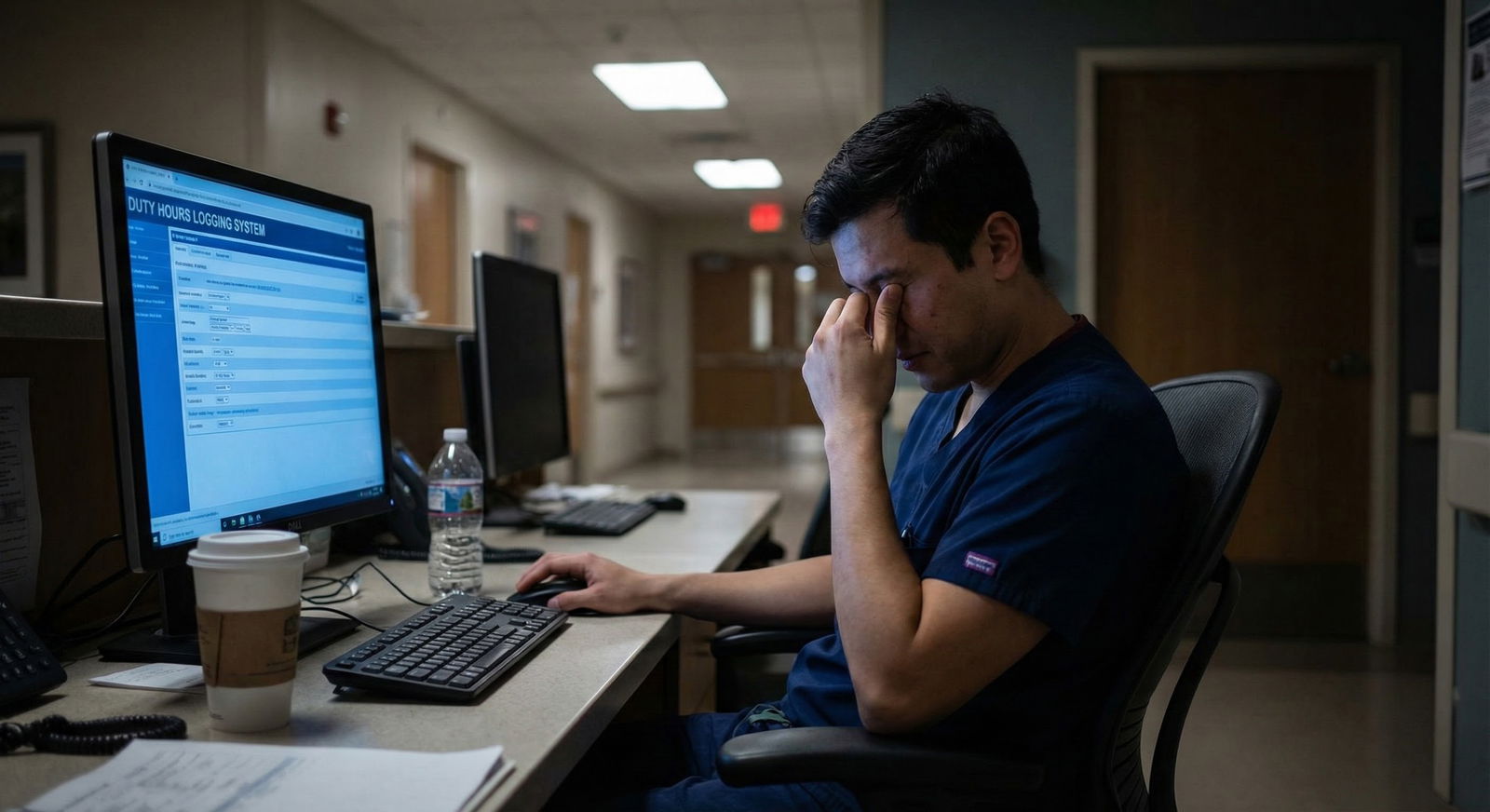
If your environment pressures residents to make the numbers look compliant instead of making the schedule safe, that is the problem. Don’t internalize it. Name it.
Mistake #6: Treating every specialty workflow the same
Home call is not one thing. It changes drastically by rotation, service, acuity, and backup structure.
Borrowing another resident’s logging habits can be a huge mistake. What “barely counts” on one service may be a major workload on another.
High-risk home call setups often include:
- surgical services with postop complications
- obstetric call with unpredictable triage volume
- ICU cross-cover with unstable patients
- subspecialty consult services that generate constant overnight questions
- small programs with thin backup and too few hands
I’ve seen residents compare notes across services in ways that make no sense. A dermatology resident’s home call pattern is not the template for an OB resident getting hammered with triage calls. A consult-heavy specialty with multiple remote decisions overnight should not be logged like a rotation where the phone rarely rings.
Your tracking has to match your actual workflow.
Use rotation-specific habits:
- track callbacks separately on high-volume services
- note every return to hospital on callback-heavy rotations
- review patterns with chiefs after rough weeks
- flag rotations where home call repeatedly destroys sleep
Don’t copy someone else’s system blindly. Their call burden may be nothing like yours.
Mistake #7: Waiting until the end of the month to reconstruct your hours
This is how residents erase their own evidence.
By the end of the month, all the overnight fragments blur together. You won’t remember whether the callback happened Tuesday or Thursday. You won’t remember whether you spent 12 minutes or 40 minutes handling orders remotely. You definitely won’t remember how many times your sleep got interrupted across four separate home call nights.
That’s not carelessness. That’s human memory. And human memory is terrible at fragmented overnight work.
Still, the effect is the same: inaccurate logs, underestimated workload, and bad data.
Use a protective system that is simple enough to survive fatigue:
- same-day duty hour entry
- brief timestamp notes in a secure personal method allowed by policy
- calendar blocks for call-backs
- checklist after each call shift: remote work, callback, sleep disruption, return to hospital
One caution here: be smart. Don’t create screenshot collections or store protected information in personal apps. You do not need PHI to track your time. You need timestamps and duration.
Clean records protect you. They also protect the program when leadership genuinely wants to identify ugly patterns and fix them.
How to avoid violations: a practical home call self-audit
You do not need a complicated system. You need an honest one.
After every home call shift, run a short self-audit. Fast. Consistent. No drama. Here’s the version I recommend:
Home call self-audit checklist
Did I do remote clinical work?
- chart review
- orders
- notes
- patient messages
- phone triage
- e-consults
Did I return to the hospital?
- what time did I leave?
- what time did I arrive?
- what time did I leave the hospital?
How long was I awake and actively working overnight?
- total active work time
- number of interruptions
- longest interruption
Was my rest meaningfully disrupted?
- repeated pages
- multiple wake-ups
- inability to return to sleep
- feeling unsafe to work or drive
Did the actual workload match the posted schedule?
- if not, log the real burden, not the fantasy version
That last point matters. Assigned home call is not automatically compliant home call. The posted schedule is a plan. Your actual overnight workload is the reality.
When to escalate
If you see a pattern, don’t sit on it. Escalate early through the right channels:
- chief resident
- program coordinator
- program director
- GME office
- institutional reporting systems
And be specific. Don’t say, “Home call has been rough.” Say:
- “I had three home call nights this month with multiple overnight interruptions.”
- “I returned to the hospital twice on one shift and still worked a full day.”
- “Remote orders and phone triage are not being consistently counted.”
- “This rotation’s home call burden is much heavier than the schedule reflects.”
That’s usable information. Vague complaints get brushed aside. Specific patterns force attention.
Self-auditing is not punishment. It is prevention. The goal is to catch problems before they become:
- citations
- burnout
- patient safety events
- resident driving risk
- a fake culture of “compliance” built on underreporting
Don’t wait for a citation to take home call seriously
The most common duty hour violations are often the ones residents normalize. That’s the real danger. Not the dramatic obvious mistake. The routine one everybody shrugs off.
If home call repeatedly interrupts your rest or adds meaningful work, treat it like trackable workload. Because that’s what it is.
This week, do three things:
- Review your local home call and duty hour policy.
- Tighten your logging habits immediately.
- Raise concerns early if a pattern looks unsafe.
Don’t guess. Don’t minimize. Don’t let culture bully you into fake numbers.
Protect your patients. Protect your training record. Protect yourself.