
The dirty secret is this: every program says they want you to report duty hour violations… and a lot of residents are terrified to actually do it.
You’re not crazy for being scared. You’re not “weak.” You’re just reading the room. You see how the chiefs talk about “team players.” You hear an attending mutter, “Back when I was a resident, we didn’t have these duty hour rules.” You watch the PGY‑3 who always speaks up somehow never get the benefit of the doubt.
So yeah, you’re scared you’ll be punished if you report duty hour violations. Same.
Let’s walk through what’s actually at stake, what’s real, what’s mostly in your head, and how to be smart about it instead of just silently drowning.
What “Punishment” Really Looks Like (And What’s Just Fear)
Everyone always jumps to the nuclear option: “If I report, they’ll tank my career. I’ll never get a fellowship. I’ll be blacklisted.”
Honestly? That’s not how it usually happens.
Punishment in real life is almost always petty and indirect:
- Your schedule mysteriously gets less favorable.
- You’re suddenly “not a team player” in your evals.
- You stop getting looped into opportunities.
- People roll their eyes when you mention fatigue or burnout.
Is that legal? No. Is it provable? Also usually no. And that’s what makes it so scary.
But here’s the other half of the truth: most programs are petrified of ACGME trouble. They know if residents start formally reporting systemic violations, it looks awful on site visits and surveys. Programs have actually lost accreditation or been placed on warning over duty hour noncompliance.
So they’re not free to just openly retaliate. They have to at least pretend to care. Many (not all, but many) actually do care, but they’re trapped by bad staffing, toxic culture, or ancient attendings who still worship 36‑hour calls.
This tension—your fear vs. their fear—is exactly where you live.
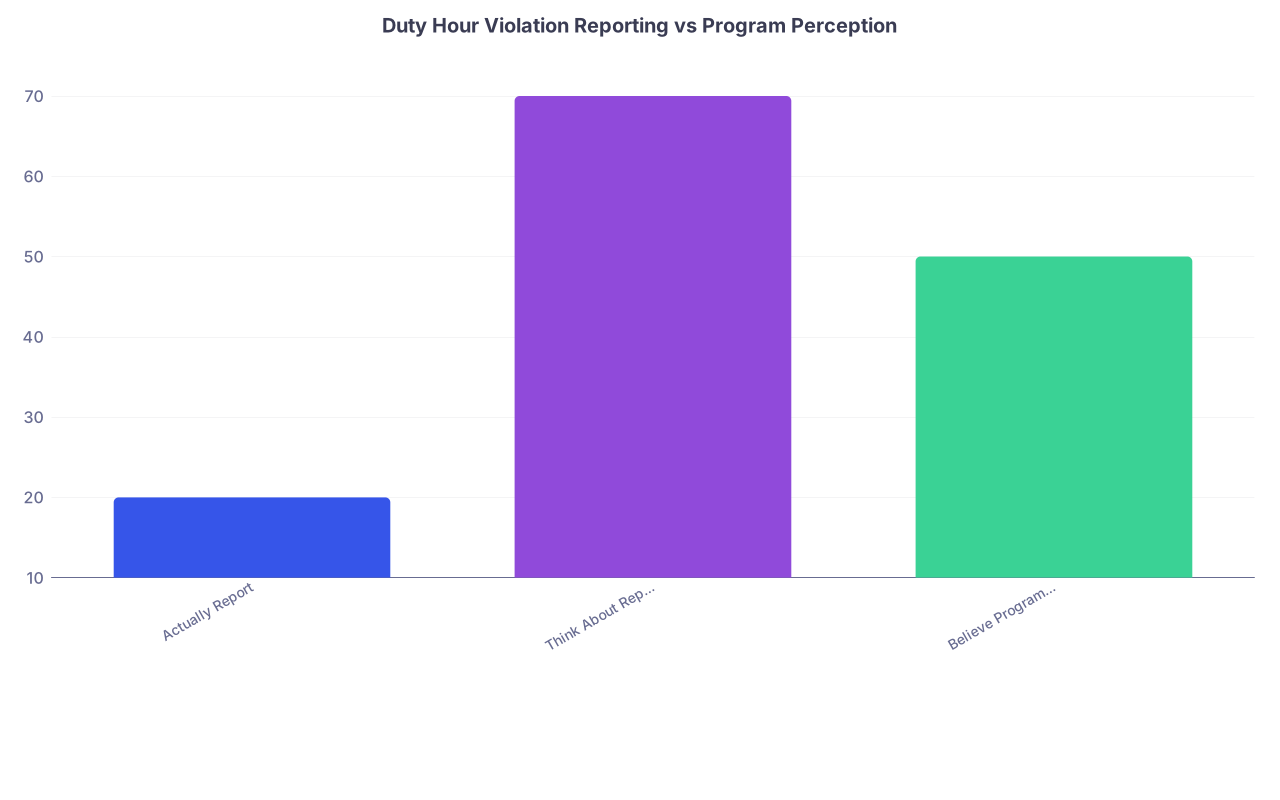
| Category | Value |
|---|---|
| Actually Report | 20 |
| Think About Reporting | 70 |
| Believe Program Wants Reports | 50 |
I’ve watched residents:
- Quietly under‑report hours to “protect” the program.
- Mass‑report violations as a class when things got unsafe.
- Get privately thanked by PDs for honest reporting.
- Get passive‑aggressively punished for “complaining.”
So yes, retaliation can happen. But not always. Which is what makes this such a mind game.
What the ACGME Actually Protects (And Where It’s Toothless)
The ACGME language sounds great on paper: you’re supposed to be able to raise concerns without fear of intimidation or retaliation. They say it in every orientation. It’s all over the website.
But you and I both know: policy and reality are not the same thing.
Here’s what the structure actually looks like:

| Step | Description |
|---|---|
| Step 1 | You notice violation |
| Step 2 | Chief or Rotation Director |
| Step 3 | Program Director |
| Step 4 | Fix locally or ignore |
| Step 5 | Institution GME / Anonymous system |
| Step 6 | ACGME Resident Survey or Complaint |
| Step 7 | Can talk to someone local? |
| Step 8 | Still unsafe or ignored? |
| Step 9 | Still ignored? |
Where you actually have some backing:
- Every accredited program must have a way to report issues, including anonymously.
- The ACGME Resident Survey asks directly about duty hours and the safety of reporting.
- Bad results can trigger warnings, site visits, or worse. Programs care about this. A lot.
Where it’s weaker:
- The ACGME is not your personal HR attack dog. They look at patterns, not one-off drama.
- They won’t swoop in the next morning to fix your call schedule.
- Proving retaliation is extremely hard. It usually comes down to vibes and patterns.
So no, you’re not defenseless. But you’re also not in some magical bubble of protection. That’s why this feels so risky.
The Emotional Math You’re Doing at 2 a.m.
Here’s what your brain is really doing when you’re about to log your hours:
“OK, I technically worked 18 hours, so this should be a violation. But if I put that in:
- Will the coordinator email me and make me explain?
- Will my name end up on some ‘problem resident’ list?
- Will my PD wonder if I’m just slow or inefficient?
- Will this screw over the chiefs who are actually pretty nice to me?”
So instead, you think: “I’ll just log 16.5. It’s kinda true.” And you hate yourself a little while you click submit.
You’re not alone. That’s exactly how duty hour culture erodes. Not from some evil PD yelling “lie about your hours,” but from a thousand small self-protective edits.
Here’s the awful part: unsafe duty hours are a patient safety issue. This isn’t you whining about being tired. It’s you wondering if your exhaustion is going to make you miss a potassium of 2.3 or discharge someone with a subtle STEMI.
You’re stuck between:
- Protecting your career in a toxic but prestigious program
- Protecting your sanity and your patients by being honest
And you’re terrified that choosing honesty is basically lighting a match under your own reputation.
Reading Your Program: Is It Safe to Report?
Not all programs are the same. Some really do back residents who report issues. Others… will throw you under the bus so fast it’ll make your head spin.
Brutally honest way to read the room:
| Signal Type | Example |
|---|---|
| Green Flag | PD explicitly thanks residents for honest reporting and actually changes schedules |
| Green Flag | Chiefs openly say, “Log accurately, we’ll fix the system, not blame you” |
| Red Flag | Faculty mock “work hour babies” or brag about 120-hour weeks in their day |
| Red Flag | Residents warn you privately: “Just don’t put violations in MedHub, it’s not worth it” |
| Red Flag | People who push back on workload magically have “attitude” comments in evals |
Green‑flag program:
- You report a violation.
- Someone talks to you to understand what happened.
- They adjust staffing or call schedules.
- You never hear loaded words like “complainer” or “weak.”
Red‑flag program:
- You report a violation.
- Chiefs tell you “just be more efficient.”
- Evals start mentioning “time management concerns.”
- Suddenly your shifts are under a microscope.
Be honest with yourself about which one you’re in. Denial doesn’t protect you.
Ways Programs Subtly Scare You Out of Reporting
There are classic moves programs use so they can say “we encourage reporting” while making everyone too scared to actually do it.
Common ones I’ve seen:
Turning duty hours into a performance metric.
“Why are you always over?” magically becomes a you‑problem instead of “Why is the service insane?”Public shaming in meetings.
Chiefs putting a slide up: “Look how many violations we had on wards last month,” with a tone that makes everyone feel like they failed.Using words like ‘resilient’ and ‘tough’ as currency.
Any mention of fatigue gets framed as weakness or lack of commitment.Backchannel comments that spread fast.
“Oh, that resident reports everything,” said just once in the workroom, is enough to label you.
You feel all this. Your body literally tenses when you think about being honest on your timesheet. And then they wonder why the ACGME survey looks rosier than reality.
Tactical Ways to Protect Yourself And Tell the Truth
You can care about safety and your career at the same time. You don’t have to throw yourself on a grenade. You just need to be strategic instead of impulsive.
1. Don’t be the lone voice if you don’t have to be
If everyone’s suffering, do not martyr yourself as the solo reporter.
Grab co‑interns or co‑residents you trust and ask: “Are you also over 80 hours? Are you logging it?”
If multiple people are seeing the same violations and reporting them, it’s much harder to paint it as a you problem.
2. Document patterns quietly
No drama. Just receipts.
- Keep a personal log: dates, shifts, actual hours, key events (e.g., “post‑call, was told I couldn’t leave until all discharges done”).
- Include approximate patient census if that’s the real issue.
- Note any odd comments about reporting or efficiency.
You are not doing this to wage war. You’re doing it so if someone ever says, “You’re just exaggerating,” you’re not scrambling to remember.
3. Start local and low‑stakes if it seems safe
Sometimes a calm conversation works better than a nuclear report.
Possible script with a chief you somewhat trust:
“I’m worried our team is regularly over 80 hours. I’m not trying to be difficult, but we’re logging under to avoid violations. I don’t feel safe doing that. Is there any way to look at the workload or call structure?”
If they respond with:
- “Thanks for bringing this up, let’s look at the schedule” → Green light.
- “Everyone struggles at first, just focus on efficiency” → Yellow/red flag.
If you get gaslit, you’ve learned what you needed to know.
4. Use anonymous or higher‑level options if needed
If local leadership is part of the problem, that’s what institutional GME and the ACGME survey are for.
- Many hospitals have anonymous concern portals. Use them smartly: be specific but non‑identifying.
- The ACGME Resident Survey is basically the one time you can shout the truth collectively. Don’t waste it.
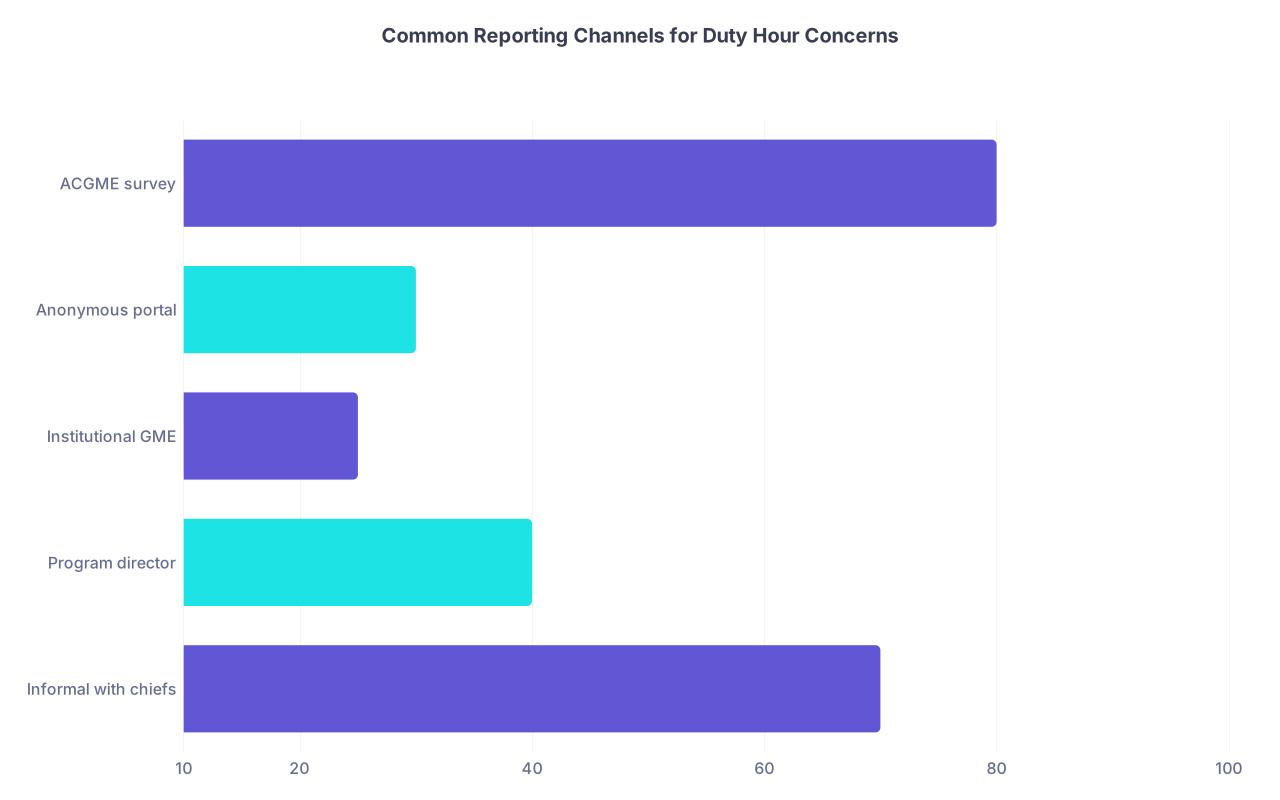
| Category | Value |
|---|---|
| Informal with chiefs | 70 |
| Program director | 40 |
| Institutional GME | 25 |
| Anonymous portal | 30 |
| ACGME survey | 80 |
Pro tip: Programs fear bad ACGME survey duty hour responses way more than your single MedHub violation.
5. Be boringly consistent
If you’re going to be honest in your hours, be consistent. Don’t pick random weeks to “take a stand.”
Patterns look legitimate:
- “This rotation is always 85–90 hours.”
- “Post‑call days almost never actually allow departure by the rule.”
Random one‑off spikes look like:
- “This person just had a bad week.”
- Or worse: “This person is slow.”
You don’t want that narrative.
The Dark Question: Is It Ever Smarter Not to Report?
I’m not going to lie and say you must always report everything, no matter what, or you’re unethical. You’re a resident in a system that can absolutely hurt you.
There are times people reasonably decide:
- “I’m PGY‑3, fellowship apps out, and I’m a few months from graduating. I’ll document privately and support juniors, but I’m not blowing this up myself.”
- “I’m on a malignant rotation where leadership is toxic. I’ll log more conservatively here, but be brutally honest on the ACGME survey and with GME outside these people.”
Is that morally messy? Yes. Is it understandable? Also yes.
Here’s my line in the sand: if it’s truly unsafe for patients or residents, someone has to say something. Not necessarily you alone. But someone.
You’re not required to immolate your career to fix a broken system. But you also can’t pretend chronic 100‑hour weeks with no supervision are just “part of training.”
Try to aim for:
- Collective action when you can
- Honest documentation
- Smart choice of timing and channels
Not zero risk. But not reckless either.
What Actually Helps You Sleep at Night
The fear doesn’t go away magically, even if you choose the “right” thing. But a few things do help:
- Knowing the rules cold so gaslighting doesn’t work on you.
- Having 2–3 residents you can be brutally honest with.
- Keeping your own quiet record so you don’t feel like you’re imagining things.
- Using the ACGME survey like the weapon it actually is.
- Remembering that you’re not whiny for wanting to follow the rules they made, not you.
You’re not asking for yoga and cupcakes. You’re asking for:
- Reasonable limits so you don’t harm patients.
- A life that doesn’t end with you crying in your car every post‑call day.
- Training that doesn’t equate suffering with excellence.
That’s not weak. That’s sane.
FAQ: Duty Hour Violations and Retaliation (The Stuff You’re Afraid to Ask Out Loud)
1. Can my program actually retaliate against me for reporting duty hour violations?
They’re not supposed to. ACGME standards explicitly prohibit retaliation for reporting concerns. But practically, retaliation is almost never a cartoon villain firing you on the spot. It’s subtle. Slightly worse evals. Fewer “nice” rotations. Being labeled as “not as resilient as peers.”
So yes, it can happen in small ways. That’s why you should be strategic: use collective voices when possible, document patterns, and consider higher‑level or anonymous channels if your local leadership is sketchy.
2. Would I ever actually get kicked out of residency over this?
Almost never just for reporting duty hours. Terminating a resident is a huge, heavily documented process that programs don’t enter lightly. They need a paper trail of performance issues, warnings, remediation, etc.
Could they try to frame it that way if they already don’t like you? Maybe. But that’s usually about much more than just duty hours. If you’re basically in good standing, you’re not going to be tossed because you logged 82 hours a week a few times.
3. Should I under‑report my hours if everyone else is doing it?
This is the nightmare question. I’m not going to sanctimoniously say “absolutely never.” Here’s the honest answer:
- Under‑reporting protects the program and sometimes your short‑term social comfort.
- Accurate reporting protects patients, you, and future residents—but can feel risky in some programs.
At minimum, keep your own personal true log, even if you’re pressured to round down officially. And use the ACGME survey to tell the unvarnished truth. If you feel safe, report accurately in the system too. If you don’t, look for collective action or higher‑level options.
4. What if my co‑residents tell me to just “suck it up” and not report?
That’s common. Their fear is talking. They’ve internalized that keeping the program’s numbers pretty is part of “being a team player.”
You can:
- Listen, but still make your own decision.
- Ask gently, “Do you really think this is safe? For us or for patients?”
- Try to find at least one other person who’s uncomfortable with the status quo. There’s almost always someone else.
Their comfort with suffering isn’t a moral authority. It’s a trauma response that residency normalized.
5. Is the ACGME Resident Survey actually anonymous? Can my program see my individual answers?
Programs cannot see your individual survey responses with your name attached. They only see aggregate data once enough residents respond. They also don’t get to see which specific residents commented what.
Could a tiny program with 4 residents on one service guess who wrote a particular free‑text comment? Maybe. But overall, the survey is one of the safest and most powerful tools you have to report systemic duty hour problems.
6. What’s one low‑risk thing I can do if I’m scared to report but know things are wrong?
Start by tracking your real hours for the next four weeks in a simple note on your phone. No one else has to see it yet. Just get the truth out of your head and into something concrete.
Once you’ve got that, you’ll be in a better place to decide:
- Do I bring this to chiefs/PD with actual data?
- Do I share it with co‑residents to see if their experience matches?
- Do I use it to inform my ACGME survey responses or an anonymous GME report?
You don’t have to blow everything up today. But you can stop gaslighting yourself today.
Open your time-logging app or spreadsheet right now and record your actual last shift length—no rounding down. Just that one honest data point. See how it feels to at least tell yourself the truth.