

Are International Residents Really Tougher on Hours?
Why does every program have that one line whispered on rounds: “The IMGs don’t complain about hours. They’re just built different”?
Let’s kill that legend properly.
Not with vibes. With what the data and actual behavior patterns show about international medical graduates (IMGs), US grads, and residency work hours.
Spoiler: the “international residents love 100‑hour weeks” story is mostly mythology mixed with selection bias, fear, and a misunderstanding of incentives.
The Myth: “International Residents Are Built for Abuse”
The legend usually sounds like this:
- “Our IMGs will stay as long as you need them. They don’t watch the clock.”
- “They came from countries with zero duty-hour limits; this is light for them.”
- “US grads quote ACGME rules, IMGs just grind.”
I’ve heard PDs say it. I’ve heard chiefs say it. I’ve heard residents say it half-proud, half-defeated: “We get the crappy coverage because we’re international; they know we won’t say no.”
The assumption buried underneath:
- IMGs have higher tolerance for long, brutal hours.
- IMGs are less likely to complain or report duty-hour violations.
- Therefore, piling work on them is somehow “fine” or even “expected.”
Let’s see what reality looks like.
What the Data Actually Shows About IMGs and Work
There’s no randomized trial of “suffering tolerance by passport,” obviously. But we do have clues from multiple sources: ACGME data, burnout surveys, specialty distributions, and some uncomfortable structural facts.
1. IMGs self-select for desperation, not for masochism
International residents don’t match accidentally. They jump through more hoops, spend more money, risk more, and face steeper odds.
That does not mean they “enjoy” or “tolerate” longer hours better. It means they have:
- More at stake (visa, career, family back home).
- More fear of rocking the boat.
- More pressure to “perform” and be seen as grateful.
So they’re more likely to:
- Say yes to extra shifts.
- Cover gaps quietly.
- Avoid formal complaints.
Not because their bodies don’t get tired. Because the cost of saying no feels higher.
That is not resilience. That’s risk management.
2. Burnout is not magically lower in IMGs
Surveys of resident burnout consistently show high rates across the board. Where IMGs cluster—internal medicine, primary care, prelim years—the burnout numbers are ugly for everyone.
In multiple studies:
- Burnout levels are similar or higher in cohorts with more IMGs.
- Feelings of depersonalization and emotional exhaustion are common.
- IMGs often report less institutional support and more isolation.
If IMGs were truly “built for” harsher hours, you’d expect them to sail through with less burnout. They don’t. They just complain less out loud.
Burnout doesn’t care where you did anatomy.
3. Duty-hour violations are under-reported, not absent
Official ACGME duty-hour compliance data tends to look pretty clean across programs. On paper, everyone is magically under 80 hours.
Reality in many places:
The rule is “document 79, do 90.”
Programs where IMGs feel less empowered are exactly the ones where:
- Under-reporting is worst.
- Cultural hierarchy is strongest.
- “Gratitude” is weaponized to keep people quiet.
So no, the lack of formal complaints doesn’t mean IMGs are fine with 30‑hour calls stacked on each other. It often means the opposite: they do not trust the system to protect them if they speak up.
Where the “Tougher on Hours” Perception Comes From
You’re not imagining it: in many programs, IMGs do seem to be the ones still on the wards at 8 pm, still volunteering to stay late, still picking up extra calls.
But that’s behavior, not biology. Very different thing.
Selection pressure and visa leverage
Common pattern I’ve seen:
- IMG on J‑1 or H‑1B visa.
- Family financially depending on them.
- Terror of non-renewal, bad evaluation, or lost fellowship chances.
That person will say yes to far more than the US grad whose backup plan is to move home, do locums, or shift specialties. Not because they love it. Because the consequences of refusal feel existential.
It’s not an accident that extra “unofficial” coverage often falls on:
- Visa holders
- Prelims hoping for a categorical spot
- Residents from weaker med schools terrified of bad letters
Programs aren’t always malicious. But systems drift toward exploiting whoever has the least leverage unless someone deliberately prevents it.
Cultural conditioning around hierarchy
A lot of IMGs trained in systems where:
- Questioning seniors is seen as disrespect.
- Speaking up about workload is “whining.”
- Suffering is worn like a badge of honor.
Then they land in the US, where the ACGME says “max 80 hours,” and wellness committees hand out pizza and mindfulness apps.
Internally, many IMGs think:
“I used to do 36‑hour calls with no post-call day. So this is… fine.”
On the outside, they’re quiet. On the inside, the same physiology as everyone else: sleep-deprived, cognitively slower, more error-prone, more burned out.
That’s not toughness. That’s habituation to bad norms.
Survivor bias and storytelling
Who do you see?
- The IMGs who survived a brutal pathway and got in.
- Not the ones who burned out, quit medicine, or never matched.
Program leadership sees a filtered sample: highly motivated, highly risk-tolerant, selection-hardened IMGs. Then they generalize:
“They can handle anything.”
No. You’re just not seeing the ones who couldn’t handle it because they never made it through your gate.
What Long Hours Actually Do to Everyone (IMG or Not)
This part is simple and not controversial in the literature anymore.
Chronic excessive hours:
- Impair cognitive performance and decision making
- Increase medical error rates
- Increase depression, anxiety, and suicidal ideation
- Damage physical health (metabolic, cardiovascular, immune)
No study says: “All this is true except for people who went to med school in India or Egypt or Nigeria or the Caribbean.”
Physiology doesn’t care about your passport.
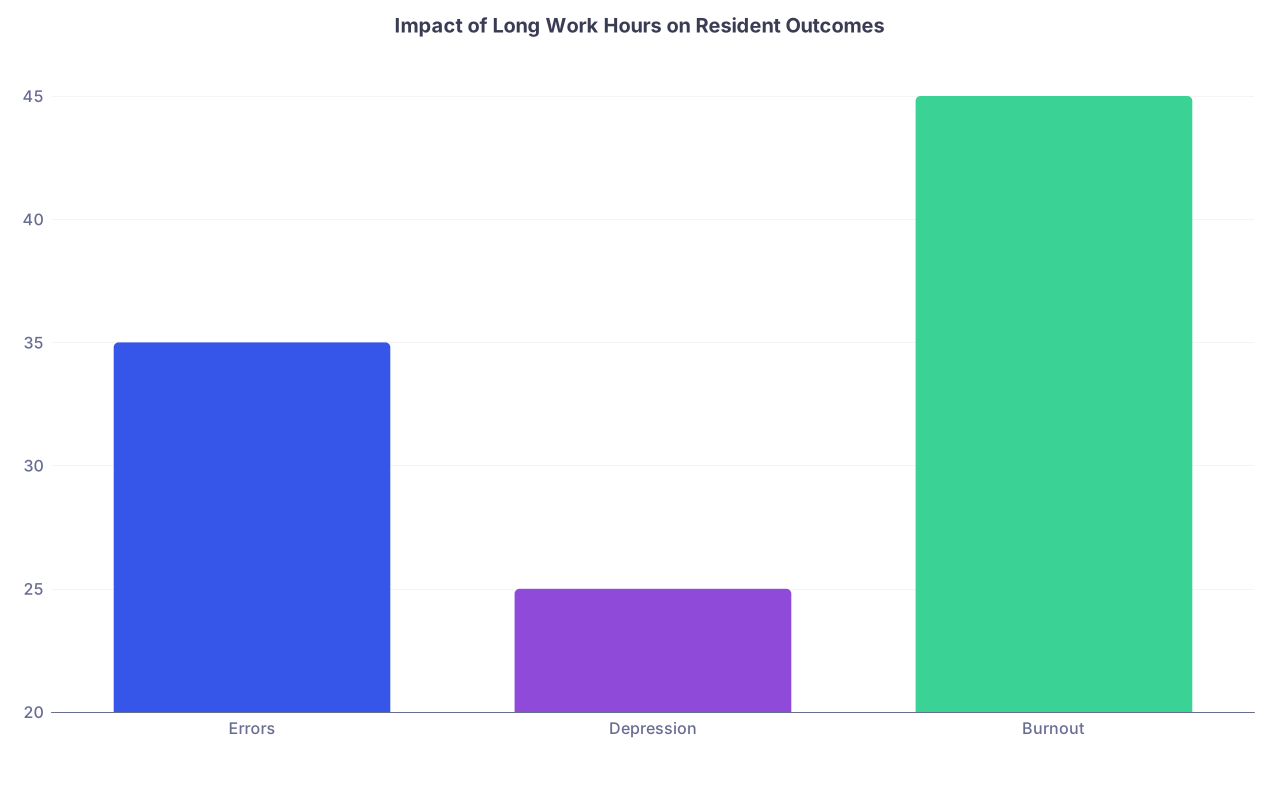
| Category | Value |
|---|---|
| Errors | 35 |
| Depression | 25 |
| Burnout | 45 |
(Example: relative percent increase associated with extended hours in multiple resident studies. Numbers vary by study, direction does not.)
There are tiny subgroups who tolerate sleep loss better. That’s genetics, not nationality. And you can’t safely design a clinical system around the rare insomniac who functions fine at 3 a.m.
How Programs Quietly Exploit the Myth
This is where it gets ugly.
The “IMGs are tougher” legend becomes convenient cover for bad habits:
- Extra patients? “Let’s put them on the IMG team. They can handle volume.”
- Short a night float? “Ask the international intern; he never says no.”
- Pre-rounding monsters? “She trained at a place with 150‑patient censuses; this is nothing.”

| Step | Description |
|---|---|
| Step 1 | Staffing Gap |
| Step 2 | IMG or visa holder |
| Step 3 | US grad |
| Step 4 | Extra shifts assigned |
| Step 5 | Burnout and fatigue |
| Step 6 | Still low complaint rate |
| Step 7 | Who to ask |
That last loop is the problem: low complaint rate feeds the myth that it’s “fine.”
This isn’t just unethical. It’s unsafe.
- You’re putting your sickest patients in the hands of your most sleep-deprived residents.
- You’re burning out a subset of your workforce you heavily rely on.
- You’re creating resentment and division within the resident body.
And yes, some PDs absolutely rationalize it as “they’re grateful to be here.” Gratitude doesn’t make your prefrontal cortex immune to sleep loss.
What IMGs Themselves Say (When They’re Honest)
I’ve heard variations of these from IMGs in IM, surgery, psych, FM:
- “I stay late because I don’t want them to think I’m lazy, not because I want to.”
- “I don’t log all my hours. I’m afraid it will reflect badly on my evaluation.”
- “Where I trained before was worse, but this is still not sustainable.”
- “The US grads refuse more, so work shifts to us. No one says it out loud, but it happens.”
Notice what you don’t hear:
“I actually love 90‑hour weeks. This is my passion.”
The mixed messaging is brutal:
- ACGME: “80 hours max, protections, wellness.”
- Whispered culture: “Real team players don’t complain. Especially you, our ‘hard-working IMGs.’”
So IMGs internalize: Speak up → risk. Suffer quietly → maybe safety.
Again, that’s not toughness. That’s coerced compliance.
The Real Differences: Incentives, Not Intrinsic Grit
Let’s break the “toughness” story into what’s actually going on:
| Factor | IMGs (Typical) | US Grads (Typical) |
|---|---|---|
| Visa status | Often dependent on program | Usually independent |
| Job alternatives | Fewer, riskier | More flexible |
| Fear of evals | Higher | Moderate |
| Cultural norms | More hierarchical | Slightly more assertive |
| Complaining | Seen as dangerous or ungrateful | Seen as uncomfortable but possible |
That table is the whole game.
Different constraints → different behavior → misread as “superhuman endurance.”
If you switched incentives—gave everyone equal visa security, normalized speaking up, and truly enforced hours—you’d see the “difference” mostly evaporate.
If You’re an IMG Resident: How Not to Get Crushed
You can’t fix the system alone, but you’re not helpless either. You just have to be strategic.
Stop internalizing “I should handle more because I’m IMG.”
You’re a resident, not a disposable workhorse.Document everything privately.
Actual hours, extra calls, unsafe situations. Not to weaponize immediately, but to defend yourself if needed.Use group voice whenever possible.
If duty hours are busted, push as a cohort (IMG + US grads). It’s harder to isolate and punish.Learn the ACGME language.
Not as a script to whine. As legal armor. “This pattern risks non-compliance” lands differently than “I’m tired.”Don’t confuse silence with safety.
Chronic overwork plus silence is exactly how people end up burnt out, making errors, and regretting their choices.
If You’re Leadership: Stop Lying to Yourself
If you’re a PD, APD, or chief:
- If your “strongest” residents are always the IMGs, check whether you’re confusing compliant exhaustion with strength.
- Audit your schedule by who ends up doing the extra. Visa, gender, IMG status. If patterns emerge, that’s not random.
- Treat all bodies as equal in vulnerability to overwork. Because they are.
Use IMGs for what they actually bring: diverse training backgrounds, broader clinical perspectives, language skills, grit. Not as built-in overtime.
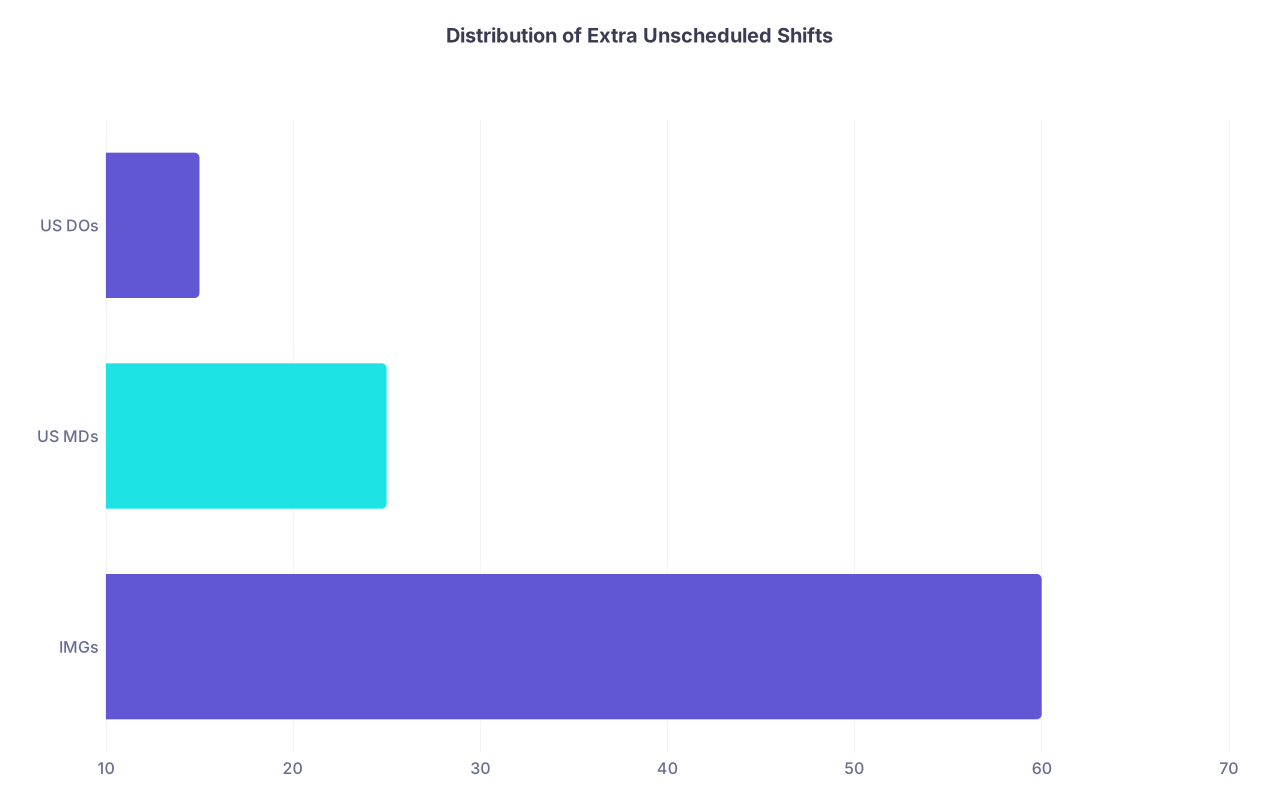
| Category | Value |
|---|---|
| IMGs | 60 |
| US MDs | 25 |
| US DOs | 15 |
(If your internal chart looks anything like that, you have a structural exploitation problem, not a “toughness” story.)
FAQ: International Residents and Work Hours
1. Do IMGs actually work more hours than US residents?
In many programs, yes informally, no officially. On paper, everyone logs under 80. In reality, IMGs are often the ones picking up extra pages, staying late for discharges, or covering schedule gaps. That’s not mandated by the ACGME; it’s how programs distribute burden when no one’s looking.
2. Are there countries where residents truly work longer and tougher hours?
Yes. Plenty. Residents in parts of South Asia, the Middle East, Latin America, and Eastern Europe often work brutal schedules with minimal regulation. But adapting to a bad environment doesn’t grant permanent immunity to harm. Those residents still get exhausted, burned out, and make errors. They’re not magically conditioned superheroes; they’re just used to suffering.
3. Is it wrong to ask IMGs to cover more if they “don’t mind”?
Yes. Because “don’t mind” in this context is often “don’t feel safe refusing.” If you can’t imagine asking your most connected, citizenship-holding US grad to do the same thing with no pushback, you probably shouldn’t be asking the IMG either. Ethics doesn’t depend on who has weaker bargaining power.
4. How can programs genuinely protect IMGs from workload abuse?
Three practical moves:
- Anonymous, enforced duty-hour reporting with real follow-up.
- Transparent call/shift distribution that’s periodically reviewed by an independent committee (including IMGs).
- Explicit messaging from leadership that visa or future opportunity will not be tied to silent over-compliance—and then behavior that backs that up.
Key points, stripped down:
- IMGs aren’t inherently tougher; they’re more constrained and more afraid of the consequences of saying no.
- Long hours damage everyone the same way, regardless of where you went to med school.
- The “international residents can handle more” story is mostly a convenient myth that lets programs ignore uneven, unsafe workload distribution.


