

43% of residents admit to under-reporting work hours at least once during training.
Not “suspect.” Admit. In anonymous surveys.
Let me walk you through why that happens, what it actually means legally and ethically, and where the landmines really are. Because people talk about “duty hours” like it is a benign checkbox. It is not. It is a compliance system wrapped around patient safety, resident exploitation, and institutional reputation—all at once.
The Real Context: Why Under-Reporting Happens At All
Under-reporting is not random. It is a pattern that comes from specific pressures.
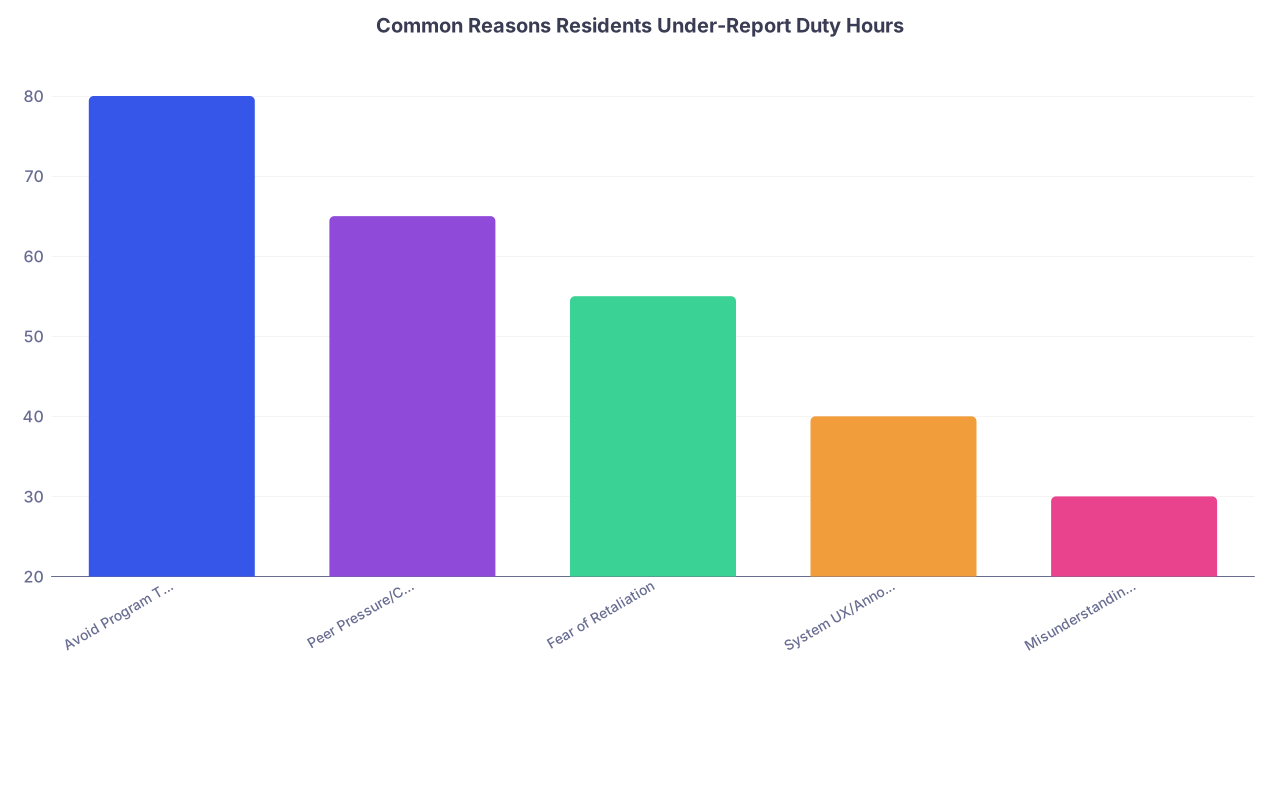
| Category | Value |
|---|---|
| Avoid Program Trouble | 80 |
| Peer Pressure/Culture | 65 |
| Fear of Retaliation | 55 |
| System UX/Annoyance | 40 |
| Misunderstanding Rules | 30 |
Translated into the real world, those numbers look like this:
- You are on a malignant surgery service. Everyone “magically” clocks out at 79 hours.
- A chief tells you, “If you log that, we will lose this rotation. Do you want that on you?”
- You get a not-so-subtle email from the program coordinator: “Please double-check your hours. They seem inconsistent with other residents on the same service.”
You learn fast: there is the “official” duty-hours policy, and then there is the underground culture of “getting the work done” and “not rocking the boat.”
Under-reporting usually takes a few concrete forms:
- Logging 79 hours when you actually worked 90.
- Ignoring that post-call noon departure that never happened and logging it as if it did.
- Splitting an overnight at-home call into “just a few hours” when you were actually awake and working all night.
And then one day you realize: this is not just gaming a form. Now you are part of a falsified compliance system that accreditation bodies, state boards, and plaintiff attorneys all assume is accurate.
Let me break down what that really means.
The Regulatory and Legal Framework You Are Actually Sitting In
You are not just lying to “MedHub” or “New Innovations” or whatever duty-hours tracker your hospital uses. You are generating records that multiple entities rely on:
- Your residency program and sponsoring institution
- ACGME (or equivalent accreditor)
- Sometimes CMS (Medicare/Medicaid) indirectly
- Potentially state licensing boards
- Plaintiffs’ attorneys in malpractice cases, if things go badly enough
ACGME and Institutional Obligations
ACGME duty-hours standards are not “suggestions.” They are tied to accreditation. Key duty-hour rules you already know but usually ignore in practice:
- Maximum 80 hours/week, averaged over 4 weeks
- One day off in 7, averaged over 4 weeks
- 24 + 4 rule for in-house call (24 hours of clinical + 4 “transitional”)
- Minimum time off between shifts (varies a bit by specialty and level)
Programs must attest annually that they are in “substantial compliance” with these standards. How do they prove that?
With exactly the data you are falsifying.
If ACGME investigates a program (complaints, site visit, probation issues), they will look at:
- Duty-hours reports
- Resident surveys
- Any internal audits or remediation plans
So when residents under-report, they are doing something very specific: providing cover for the program to claim compliance. Which is where the legal piece creeps in.
Is Under-Reporting “Illegal”?
On its face, under-reporting hours is not usually a standalone crime. There is no federal statute saying “thou shalt not misreport resident duty hours.”
But legality is not that narrow. This behavior can plug into broader legal concepts in nasty ways:
Fraud or false statements (institutional level)
If a hospital knowingly submits false attestations to an accrediting body, or even to CMS related to training structure and supervision, and uses those to get paid or maintain accredited status, that can edge toward fraud territory.
Your individual false report becomes one data point in a pattern the institution might be accused of “knowing” about.Negligence and standard of care (malpractice)
Plaintiff attorney in a bad outcome case:- “Doctor, what were your documented work hours that week?”
- “The system shows 76 hours.”
- “And in reality?”
- “Probably more like 95.”
That is a credibility disaster. And it invites an argument that the care was delivered under fatigue beyond recognized standards.
Document falsification / professionalism violations
State boards and hospital MECs take dishonesty in documentation seriously. Even if they do not care about “80 vs 88 hours,” they absolutely care if they perceive a pattern of falsifying institutional records.
So no, you are probably not going to be handcuffed over a mislogged week. But you can absolutely be dragged into:
- Institutional investigations
- Malpractice scrutiny
- Professionalism or board issues
Because the record is the record. And you signed your name to it.
Ethical Analysis: Why This Is Not Just “Helping the Team”
Residents often rationalize under-reporting like this:
- “Everyone does it.”
- “The rules are unrealistic.”
- “We are protecting our program from ACGME.”
- “If we report honestly, they will cut our cases or clinic exposure.”
I have heard all of that on rounds, in lounge conversations, and in exit interviews.
Ethically, you are dealing with at least four competing obligations:
- Duty to patients (nonmaleficence, beneficence)
- Duty to your own well-being (and that of co-residents)
- Duty to honesty and integrity
- Duty to your training program and its survival
Let’s be blunt: Under-reporting primarily protects the institution, not you
There is a myth that under-reporting keeps residents safe from “ACGME punishment.” That is backwards.
If duty-hours are honestly documented:
- Chronic violations force the program to change staffing, coverage models, or case distribution.
- There is at least a paper trail that the workload is incompatible with the standards.
When you under-report:
- The program can claim everything is “average 72–75 hours, post-call out by noon, golden weekends preserved.”
- Any burnout or error spike can now be framed as a “resident resilience” issue, not a systems problem.
You think you are playing along to protect yourself and your peers. In reality, you are often protecting the exact structure that is chewing you up.
Patient safety: the quiet ethical anchor
Everyone loves to quote studies showing that fatigue increases error rates. Very few actually connect that to their own duty-hours behavior.
For example:
- You do three 28-hour calls in 8 days, all of them brutal.
- You log them as clean 24 + 4, get out by noon, and “average <80.”
Now a catastrophic event happens—delayed recognition of sepsis, missed STEMI, wrong-dose insulin. Ethically, ask:
- Were you functioning at a level you would consider safe if you were the patient?
- Does your documentation truthfully reflect the conditions under which the care was delivered?
When the record says “compliant duty hours,” any fatigue-based defense evaporates. You are left owning the error as if you were rested and supported. That is an ethical and practical trap.
Honesty vs “team loyalty”
Many residents treat duty-hours honesty as betrayal. “Snitching.” Or “not being a team player.”
That logic falls apart fast:
- You would not accept altering lab results “to help the team.”
- You (hopefully) would not re-write a progress note to hide an attending error “for the program’s reputation.”
- You would not forge a consent form to avoid delaying a surgery.
Falsifying duty-hours is not at that level of direct harm. But it is the same ethical category: altering institutional records to conceal reality. To protect the system, not the patient.
Once you normalize that, the slope is steeper than you think.
Concrete Legal Risk: How Misreported Hours Show Up In Real Cases
People assume duty-hours data lives in a vacuum. It does not. It bleeds into other legal domains.
1. Malpractice litigation
Picture a serious adverse event:
- Resident working “documented” 72 hours that week; actual was 100+.
- Plaintiff attorney subpoenas duty-hours reports + call schedules + EMR login times.
Those can be overlaid:
- EMR shows you actively entering orders at 2 am on a night you “logged out” at 10 pm.
- Badge access data shows you leaving hospital at 4 pm post-call when system says 12 pm.
Now there is a discrepancy. And once your credibility is questioned on hours, it is fair game to question your entire narrative.
Worse, if an attending or program leader ever sent an email implying “fix your hours so we stay compliant,” that is exactly the kind of document that ignites a jury.
2. Employment and contract issues
Most residents are employees, even if they are also learners. Under-reporting may intersect with:
- Overtime or wage claims (in some systems, especially non-house staff analogues)
- Disputes over moonlighting rules or work outside GME-approved hours
- Termination cases where “professionalism” and “dishonesty” are cited
No one may care about your individual weekly log in a vacuum. But patterns of mismatch between reality and institutional records are low-hanging fruit if anybody wants you gone.
3. Institutional accreditation or investigation
In big GME scandals (chronic duty-hour violations, toxic culture, probation situations), internal reviews often uncover:
- Systemic pressure to falsify hours
- Chiefs or attendings explicitly telling residents not to log accurately
- “Miraculous” perfect compliance patterns despite insane workloads
Residents might be interviewed by outside reviewers (ACGME, ombuds, legal). If you admit:
- “We under-reported because we were directly or indirectly pressured to,”
now the institution’s exposure is larger. Your own role is usually not the primary legal target, but again: you are now in the record as someone who falsified institutional data. Hard to spin that as “professionalism excellence.”
Cultural Mechanics: How Programs Implicitly Push Under-Reporting
Very few programs are stupid enough to write, “Do not log more than 80 hours.”
What they do instead is create an environment where accurate reporting feels dangerous or pointless.
Some classic moves:
- “Our ACGME survey results last year were very concerning. Please be mindful of how you report your experiences this year.”
- Chiefs quietly “correcting” outlier residents: “Nobody else on that service logs more than 75. You sure you’re logging right?”
- “Remember, if we lose this rotation because of duty-hours violations, we lose important cases.”
This is subtle coercion. It frames system-level noncompliance as resident-level disloyalty.

| Step | Description |
|---|---|
| Step 1 | Real Workload |
| Step 2 | Resident Logs Hours |
| Step 3 | Feedback or Pressure |
| Step 4 | Resident Adjusts Future Logs |
| Step 5 | Records Show Compliance |
| Step 6 | Exceeds 80 or violates rules |
Once this loop runs a few months, the data set is sanitized. Program looks clean. Residents feel trapped.
Practical Strategies: How To Handle This Without Torching Your Career
You are not going to fix GME culture alone. But you need a strategy that is:
- Ethically defensible
- Legally protective
- Realistic in a high-pressure training environment
1. Log accurately for yourself, even if you compromise in the system
If you are in a truly malignant program where honest reporting is punished, at least protect yourself:
- Keep a personal, time-stamped log (even a simple note app) of:
- Arrival and departure times
- Call shifts, page volume, major events
- Any explicit instructions you receive about “fixing” hours
This gives you contemporaneous documentation if:
- You are involved in a serious adverse event
- There is a later investigation
- You need to defend yourself or show a pattern of unsafe scheduling
Is this ideal? No. But it is better than nothing in a hostile culture.
2. Understand the actual rules better than your chiefs
You should know your program’s written policy and ACGME’s baseline standards cold. Why?
Because a lot of pressure relies on residents not knowing where the actual lines are.
For example, some programs misrepresent:
Claim: “You cannot ever log over 80 hours in a week.”
Reality: 80 is averaged over 4 weeks. A single bad week can be >80 if offset elsewhere, but chronic patterns are not acceptable.Claim: “Post-call you can work until 6 pm as long as it’s ‘education.’”
Reality: That is usually not how site visitors interpret 24 + 4.
Knowing the rules lets you say, “I am logging according to the written policy,” rather than debating vague expectations.
| Rule Area | Actual Standard (Typical ACGME) |
|---|---|
| Weekly hours | ≤80 hours, averaged over 4 weeks |
| Day off | 1 day free in 7, averaged over 4 weeks |
| In-house call | Max 24 hr clinical + 4 hr transition |
| Between shifts | 8–10 hr recommended rest, context-specific |
| Night float | Must comply with weekly hour caps |
3. Use the safest channels available before going nuclear
If you want to push for honesty without getting crushed:
- Start with your class group. If everyone is quietly under-reporting, you have zero leverage. If the whole class agrees to log honestly, the program cannot single you out easily.
- Use faculty you trust—someone outside your direct chain of command. “I am concerned we are being informally encouraged to under-report hours.”
- Use anonymous reporting mechanisms if your institution has them: GME office hotlines, compliance lines, ombuds.
Be precise. Not dramatic.
Bad: “My program is abusive and lies to ACGME.”
Better: “Residents are regularly surpassing 90+ hours/week on X rotation and fear retaliation if they log accurately.”
4. Know when the risk is too high to ignore
There is a spectrum. Logging 79 vs 81 hours is wrong, but I have seen residents survive that compromise in bad systems.
There are scenarios where under-reporting becomes high-risk, both ethically and legally:
- You are so fatigued you are endangering patients routinely.
- There is pressure to under-report in the context of a serious sentinel event.
- You are explicitly instructed in writing to falsify reports.
- The entire program pattern is egregious (100+ hour weeks routinely, no real days off, no post-call relief).
At that point, you are not just smoothing edges. You are participating in an unsafe, potentially indefensible system. That is where involving GME leadership, the DIO, or even external bodies becomes realistic.
5. Protect your future statements
Whatever you do now, remember: five years from now, someone may ask, under oath:
- “Were your duty-hours reports accurate?”
You want to be able to say something that is:
- True
- Defensible
- Not an immediate self-indictment
For example:
- “I did my best to log according to policy, but the workload on some rotations exceeded what the system was designed for. I documented my hours contemporaneously for my own records and raised concerns through available channels.”
Much better than:
“I logged whatever my chiefs told me so the program would not get in trouble.”
The Institutional Side: Why Programs Play This Game
To be fair, programs are under their own pressures:
- ACGME citations can threaten accreditation.
- Hospitals rely on residents for cheap labor.
- Faculty schedules and service lines are built assuming resident coverage.
- Changing workflows is expensive and politically painful.
So when duty-hours data starts flagging problems, leadership faces two broad choices:
- Fix the system: hire PAs/NPs, redesign night coverage, reduce non-educational scut, redistribute rotations.
- Fix the data: “educate” residents on how to log, quietly discourage “over-reporting,” normalize under-reporting as “professionalism.”
Too many choose door #2. Because it is easier and cheaper.
You, stuck in the middle, feel like your only options are: suffer and lie, or suffer and be labeled “difficult.”
That is the real nuance: under-reporting is not a single resident issue. It is a systems issue that residents execute one checkbox at a time.
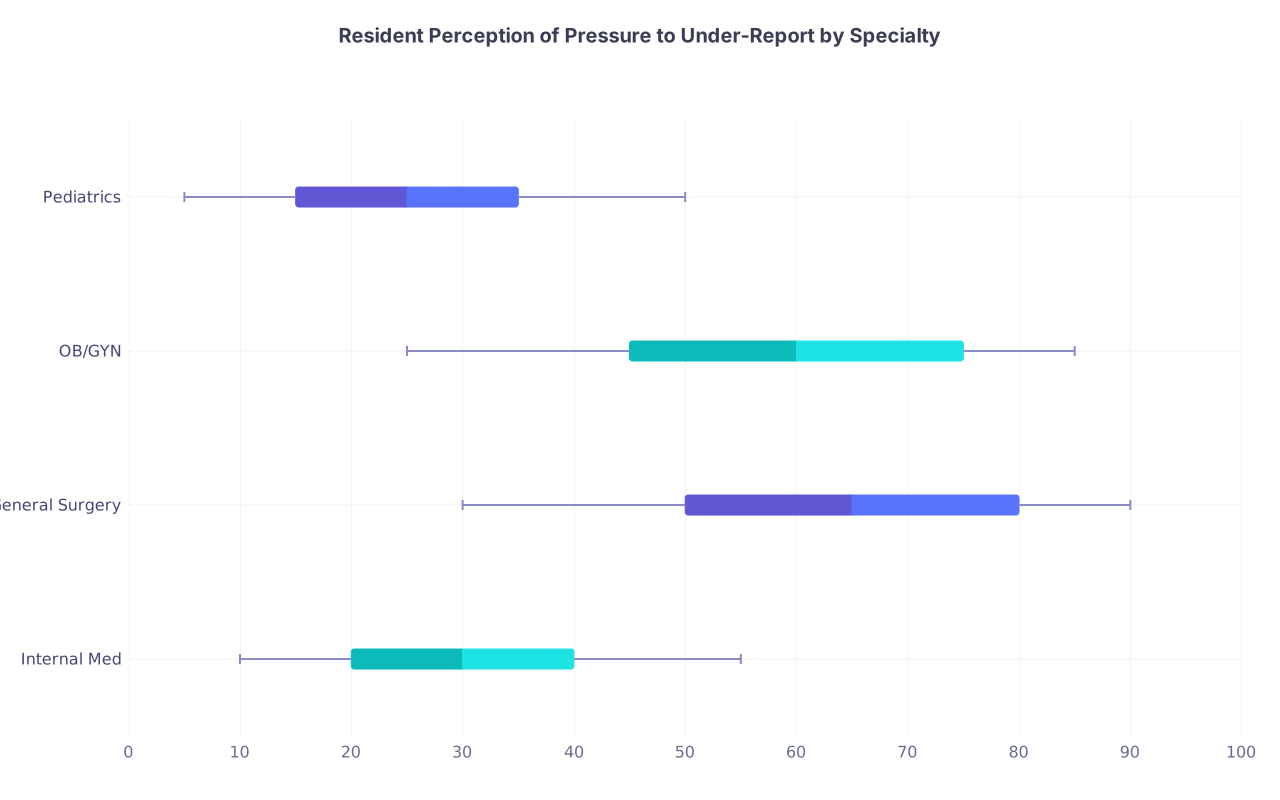
| Category | Min | Q1 | Median | Q3 | Max |
|---|---|---|---|---|---|
| Internal Med | 10 | 20 | 30 | 40 | 55 |
| General Surgery | 30 | 50 | 65 | 80 | 90 |
| OB/GYN | 25 | 45 | 60 | 75 | 85 |
| Pediatrics | 5 | 15 | 25 | 35 | 50 |
You can guess which boxes belong to which cultures. I have seen general surgery programs where 70-hour weeks only exist in PowerPoint slides.
A Few Concrete Scenarios and How I Would Handle Them
To make this less abstract, let me walk through some specific situations.
Scenario 1: You worked 90 hours 1 week, 70 the next three
You are on a brutal ICU block. One week hits 90 hours; the remaining three are 70. The system averages out to 75 overall.
Ethically:
- I would log the 90 honestly. The overall block is still within the 80-hour average. You are signaling a temporary surge that might need attention but is not necessarily catastrophic.
Legally:
- Very low risk to you. Honest reporting documents reality and preserves your credibility.
Scenario 2: Chiefs explicitly say, “No one logs more than 80. Fix it.”
This is coercion, even if “friendly.”
My approach:
- Log accurately for yourself in a private record.
- Decide how confrontational you can safely be:
- Minimum: “I am just following the written duty-hours policy from GME.”
- If confident: quietly talk to a trusted faculty or APD and describe the situation.
- If retaliation is threatened or occurs, escalate to GME or ombuds with specifics (dates, statements, screenshots if they were foolish enough to document it).
I would not just shrug and quietly change it. That is how you get stuck later when someone asks why your hours magically improved the day after you complained.
Scenario 3: A bad outcome occurs after extreme fatigue, and your log is “clean”
This is the nightmare.
If you under-reported:
- Your credibility is compromised.
- The hospital can argue: “Our data shows he/she was within duty-hours and well-rested. This was an individual mistake.”
If you reported honestly:
- The institution may have to own that the system contributed—long hours, sleep deprivation.
- You have a more ethically defendable narrative.
I have sat in morbidity and mortality meetings where everyone knew the intern had just done three 28-hour shifts, but the slides pretended duty-hours were perfectly fine. That disconnect is how cultures rot.
FAQ (Exactly 5 Questions)
1. Can I get personally sued or criminally charged just for under-reporting my work hours?
You are unlikely to face a standalone civil or criminal case solely for misreporting hours. The legal risk comes when misreported hours intersect with something else: a malpractice case, a licensing board investigation, or an institutional inquiry about falsified records. In those settings, your inaccurate logs can be used to question your honesty or to argue that you contributed to systemic misrepresentation. So the hours themselves are not usually the “crime,” but they can become damaging evidence.
2. What if my entire program under-reports—does that dilute my responsibility?
No. Collective misbehavior does not absolve individual responsibility. That said, regulators and investigators usually focus more on leadership and systems than on individual residents. If you can demonstrate that there was explicit or implicit pressure to falsify hours, and that you attempted to raise concerns appropriately, that context matters. But “everyone was doing it” is not an ethical defense; it is a description of a dysfunctional culture.
3. Is it ever ethically acceptable to slightly “round” my hours?
There is a difference between minor rounding at the margins (e.g., logging 6:55 as 7:00) and knowingly turning a 95-hour week into 79. Small approximations will always exist in self-reported data. Ethically, the line gets crossed when your adjustment changes the substantive picture—turning chronic noncompliance into apparent compliance, or hiding patterns that affect safety and training quality. If your rounding systematically pushes you under official limits, you have moved from approximation into falsification.
4. How much protection do I really get from anonymous reporting about duty-hours abuse?
Anonymous reporting can be useful, but it is not magic. In small programs, patterns and details can make it obvious who is speaking up, even without names. Some institutions take anonymous reports seriously and investigate; others treat them as background noise. If you use these channels, keep your report factual, specific, and free of emotional overstatement. And do not rely solely on anonymity if the situation is severely unsafe—you may need direct conversations with GME leadership or an ombuds.
5. If I am already in a system where I have under-reported, what should I do now?
First, stop compounding the problem. Start logging as accurately as the environment reasonably allows, and keep your own detailed records. Second, assess how bad the discrepancy has been: occasional weeks smoothed downward, or chronic, severe misrepresentation. For modest past issues, a course correction and better documentation going forward may be enough. For more serious patterns—especially if there has been a major adverse event—you may want to quietly discuss your concern with a trusted faculty member, GME leader, or legal counsel provided by your institution. The goal is not to self-incriminate dramatically but to realign your behavior with ethical and legal best practice before something forces the issue.
Key points:
- Under-reporting duty hours is not a harmless “team move”; it primarily protects the institution and erodes your ethical and legal footing.
- Your logged hours become part of the official record used in accreditation, malpractice, and investigations—falsifying them can come back on you.
- The smartest strategy is to know the rules precisely, document reality for yourself, and push for honest reporting as much as your local culture and personal risk tolerance allow.


