
It’s 4:45 AM. You’re on the road because your clinic month is at the satellite site this week, not your usual hospital. GPS says 38 minutes. That’s a lie and you know it. There’s always a backup at the bridge, always a line at the employee garage, always that one shuttle that seems to vanish when you need it most. So you leave at 4:45 for a 6:00 expectation, not because anyone officially told you to, but because residents learn fast: “start time” and “safe arrival time” are not the same thing.
By the time you finally badge in, you’ve already burned through a chunk of your attention. You’ve hunted for parking, speed-walked in bad weather, checked your phone at red lights for overnight messages, and started mentally organizing pre-rounds before you’ve even touched the chart. Then someone says, casually, “Glad you made it, we try to be flexible here.” Flexible. Right. Programs love that word. What they mean is that the system is rigid, and you’re expected to absorb the friction personally.
Let me tell you what really happens. Commuting is treated like it exists outside training, outside duty hours, outside the program’s responsibility. That’s fiction. A long or unreliable commute is part of the fatigue system. Program directors know it. Chiefs know it. Attendings absolutely know it when they see a resident stumble in already depleted. But because commute time doesn’t fit neatly into the spreadsheet, it gets pushed into the category of “life stuff.” That’s convenient for the institution, and brutal for the resident.
What PDs Quietly Know: Commuting Is a Fatigue Multiplier, Not a Neutral Detail
Here’s the behind-the-scenes truth nobody says out loud in orientation: program directors track commute burden mentally even when they don’t acknowledge it publicly. They know which sites are miserable to get to. They know which rotation starts early enough to force residents into absurd wake-up times. They know the resident driving 55 minutes after a 28-hour call is not functioning the same way as the one who lives eight minutes away. They may not have a formal column in the schedule called “commute toxicity,” but they absolutely factor it in when they think about reliability, morale, and risk.
I’ve watched this play out for years. The resident with the punishing cross-city commute is more likely to arrive frazzled, skip breakfast, delay coffee until rounds, and spend the first hour of the day trying to catch up physiologically. That matters. Sleep opportunity shrinks first. Then recovery time. Then meals become random. Exercise disappears. Studying gets pushed later into the night, which means less sleep again. It’s a nasty little cycle, and commuting is often the trigger nobody names because naming it would force the program to admit that “duty hours compliant” can still mean “functionally exhausting.”
And yes, PDs avoid opening this topic on purpose. Not because they don’t care, but because they know how messy it gets. The second they publicly validate commute burden as a real training issue, they inherit fairness problems. Why should one resident get schedule accommodation and another not? How do you redesign site assignments when staffing is already fragile? What do you do when everyone wants the closer hospital and nobody wants the suburban VA with the 5:30 AM report time and the parking lot three zip codes away? Their silence is often administrative self-protection.
That doesn’t make the silence harmless. It just explains it.
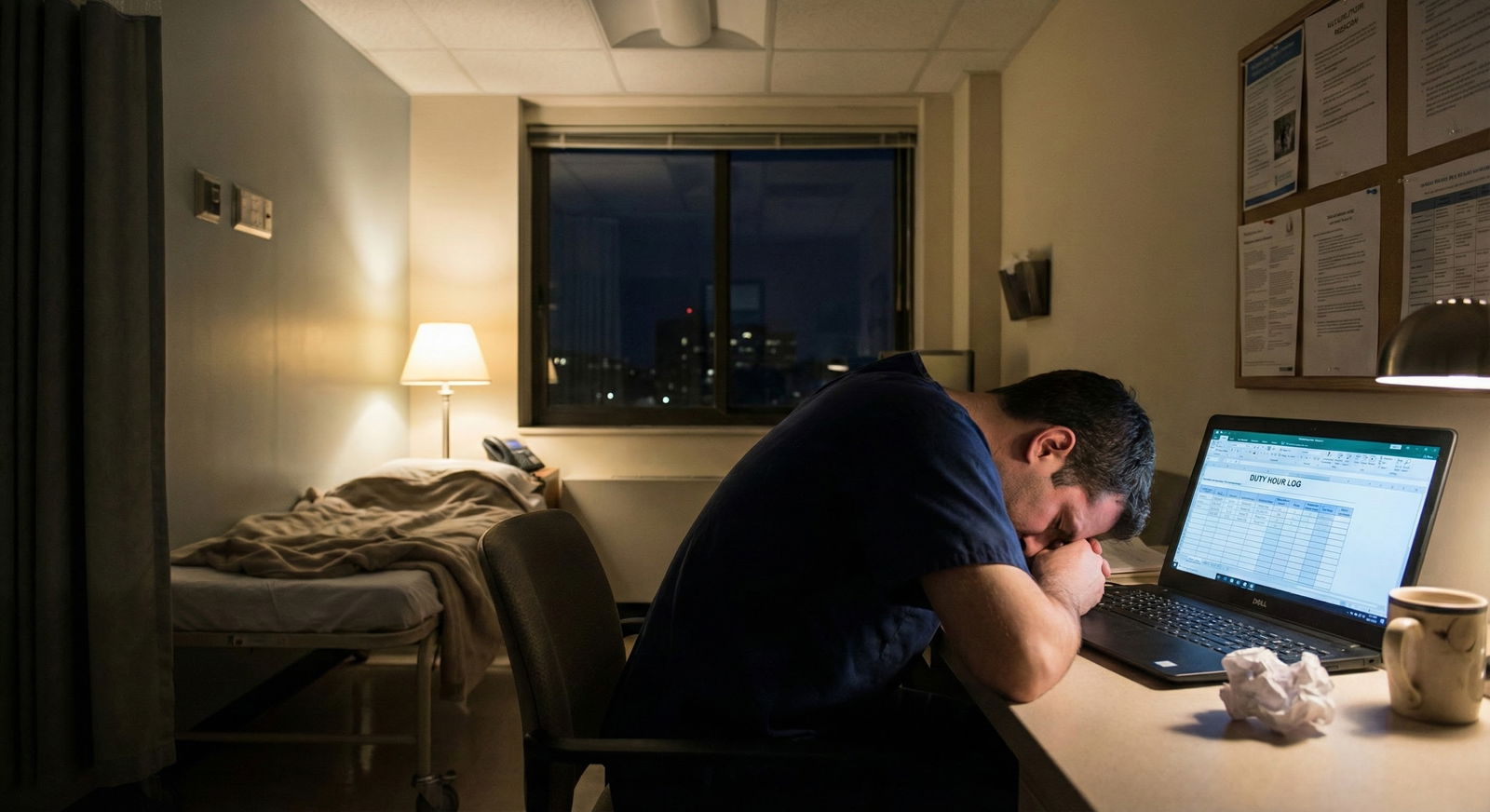
Duty Hours, Commuting, and the Hidden Math Residents Rarely Do
This is where programs hide behind compliance language. Duty hours count the hours you’re working. They do not count the 70-minute drive that forced your wake-up time into the middle of the night. So a schedule can be perfectly legal on paper and still be physiologically stupid in real life.
Do the actual math. If your shift starts at 6:00 AM, but the culture requires you there by 5:40 so you can print lists, glance at vitals, and not look lazy, your real target arrival isn’t 6:00. If parking adds 15 minutes and the shuttle adds 10, and traffic has a 20-minute swing, your departure time gets pulled earlier and earlier. Residents call this “building in a buffer.” Programs call it nothing, because if they acknowledge the buffer, they’d have to admit it functions like unpaid labor wrapped around the official workday.
And that’s before the end-of-day nonsense. Sign-out runs long. Your senior asks for one more note. The attending finally places the discharge order at 6:12. You still have to retrieve your car, sit in rush-hour traffic, and get home with just enough energy left to eat something embarrassing over the sink before setting your alarm again. Technically, maybe you worked 12 hours. Functionally, the day consumed 14 or 15.
The blind spots are always the same. Parking. Shuttles. Weather. Road construction. The clinic site that looks close on a map but requires three left turns across impossible traffic. Public transit schedules that work beautifully at noon and betray you completely at 5:00 AM. None of this gets captured in duty hour software. But it absolutely changes fatigue, judgment, reaction time, and your margin for error.
How Programs Really Think About Rotations With Hard Commutes
Here’s the hierarchy, stripped of the PR language. First: patient safety. Second: staffing coverage. Third: accreditation compliance. After that, maybe resident convenience gets a hearing. That’s not cynical; that’s just how the machine works. If a rotation needs a body on site and the service is thin, your commute complaint is not winning unless you translate it into one of the top-tier priorities.
That’s the trick most residents miss. “This drive is awful” rarely moves anyone. “I’m concerned about unsafe post-call driving after this site assignment” gets attention. “The shuttle delay has made me late twice despite leaving over an hour early” gets attention. “This schedule creates repeated childcare failures that affect my reliable arrival” gets attention. The issue has to be framed in the language programs actually respond to: safety, reliability, and educational function.
PDs are much more likely to help when the problem is raised early and specifically. Not after three months of resentment. Not after you’ve accumulated lateness and people have quietly decided you’re disorganized. If there’s a predictable route barrier, a known dangerous post-night-float drive, a childcare constraint with hard time limits, or a site arrangement that repeatedly cuts into required learning time, bring it up before the schedule hardens. Chiefs can sometimes swap months. Coordinators can sometimes cluster assignments. PDs can sometimes protect post-call transitions. But only if they know early enough to do something useful.
And yes, there are soft signals they notice. More than you think. Chronic lateness, even by five minutes. Looking foggy at conference. Missing the first teaching point because you arrived in survival mode. Repeatedly describing one site as “impossible” without data. Complaining to co-residents instead of documenting the system issue. Faculty may sympathize privately and still conclude publicly that you’re struggling with professionalism. That’s the part no one likes to admit. Commute strain can be real, and if you handle it sloppily, it still gets used against you.
What Residents Should Do Before the Schedule Goes Live
The smartest residents don’t wait to discover commute misery in real time. They run the route before it matters. That means checking the actual drive at the actual hour, not trusting the optimistic Sunday-afternoon estimate on your phone. Test parking. Test the shuttle. Figure out whether “arrive at 5:55” really means “leave the house at 4:50.” You need the real number, not the fantasy number.
Map all the moving parts. Hospital entrance. Employee lot. Badge access delays. Where you can stash food. Whether the call room exists and whether it’s usable. If you’re rotating between two sites in one day, time that transfer too. I’ve seen residents lose 35 minutes between “nearby” campuses because one garage was full and the intercampus shuttle operated on vibes instead of a schedule.
Then raise concerns strategically. Don’t lead with inconvenience. Lead with impact. Say: “I tested the route during expected arrival times over three days. Total travel plus parking averages 68 minutes, with frequent variability. On this rotation, that means leaving before 5:00 AM to reliably arrive for pre-round expectations. I’m concerned this creates unsafe post-call driving and repeated missed educational time when sign-out runs over.” That’s adult language. That sounds credible. That gets heard.
If the issue persists, document it. Keep commute screenshots with timestamps. Save schedule emails. Note days when shuttle failures or parking overflow materially affected your arrival or departure. If childcare is part of the problem, document the hard limits. If fatigue is affecting safe driving after call, write that down while it’s fresh. Escalate when this is not a one-off annoyance but a repeated system strain. Start with chief residents if they’re functional. Move to the APD or PD if it’s a safety pattern. Be calm. Be specific. Be impossible to dismiss as vague whining.

Reflection: The Unspoken Lesson About Training, Time, and Burnout
Here’s the lesson underneath all of this: burnout is rarely one dramatic event. It’s accumulation. It’s the 52-minute drive before the ICU month. The parking hunt after overnight call. The meal you skipped because the shuttle was late. The study hour that disappeared because traffic got ugly. Small logistics. Repeated daily. Quietly corrosive.
Programs often won’t volunteer solutions because commute burden sits in an awkward institutional gray zone. Too personal to own fully, too consequential to ignore honestly. So you have to see the system clearly before it grinds you down. That means recognizing commuting for what it is: not an annoying side issue, but a structural fatigue variable that shapes how you perform, how you learn, and how long your tank lasts.
I’ll put it plainly. Pretending commute stress is irrelevant is dumb. It leads to preventable exhaustion, shaky driving, short tempers, missed teaching, and the kind of low-grade depletion that residents normalize until it becomes their personality for a year.
The residents who handle this best aren’t tougher. They’re earlier. They notice the hidden math, document the strain, and speak up before the problem gets misread as poor performance. That’s the real insider move. Not suffering silently. Seeing the trap before it closes.