Only 27% of U.S. medical students report using AAMC Careers in Medicine “often” for specialty decision-making, despite almost every school paying for universal access.
That gap is exactly where student leaders can quietly become indispensable.
Most student organizations treat AAMC’s Careers in Medicine (CiM) like a brochure—mention it during orientation, drop a link in a slide deck, then move on. In reality, it is a powerful, underused platform that can anchor your organization’s programming, data, and mentorship in a way that looks extremely sophisticated to faculty and shockingly helpful to classmates.
Let me break down, very specifically, how you as a student leader can leverage Careers in Medicine not just as a resource, but as infrastructure for your group’s events, advising, and leadership brand.
1. Understand What Careers in Medicine Actually Offers (Beyond “Some Assessments”)
Before you can build anything around CiM, you need a working knowledge that goes deeper than “it has personality tests.”
Here is what is actually inside the platform and how it maps to concrete uses for a student organization.
Core Components You Should Know Cold
Self‑assessment tools
- Medical Specialty Preference Inventory (MSPI) – ranks specialties based on interests.
- Physician Values in Practice Scale (PVIPS) – matches personal values with practice environments.
- Skills and Work Activities inventories – help students articulate strengths.
Specialty profiles
For each specialty (e.g., Internal Medicine, Orthopaedic Surgery, Pathology), CiM provides:- Typical patient population and conditions
- Practice settings and lifestyle factors
- Competitiveness and match trends (integrated from AAMC / NRMP data)
- Training path length and fellowship options
Career development timelines and checklists
Separate guidance for:- Pre‑med / early exposure
- M1–M2 exploration phase
- M3–M4 decision and application phase
Residency application and match planning tools
- Worksheets to prioritize programs
- Guidance on away rotations
- Sample CV formats and reflection prompts
Data and reports
- Links to Charting Outcomes in the Match, NRMP Program Director Survey, and workforce trends
- Specialty‑specific competitiveness indicators
As a student leader, you do not need to memorize every subsection. You do, however, need to know enough to say, “For that problem, there is a specific CiM tool we can build into our event.”
That is the shift: thinking “program design” rather than “resource awareness.”
2. Design Events That Integrate CiM Tools, Not Just Mention Them
Most student orgs will hold the standard panels: “Choosing a Specialty,” “What I Wish I Knew in M1,” “Road to Residency.” Useful, but generic. You can elevate these rapidly by structurally integrating CiM.

A. Structured M1 Career Exploration Workshop
Target: M1 fall or spring
Goal: Move students from vague anxiety about “picking the right specialty” to concrete self‑knowledge plus a short list of specialties to explore.
Step‑by‑step design:
Pre‑work (online, using CiM):
- Have registrants complete:
- MSPI
- PVIPS
- Ask them to screenshot or print their top 5 specialty recommendations and values profile.
- Have registrants complete:
60–90 minute in‑person session agenda:
0–10 minutes – Framing
- Briefly explain why early, low‑pressure exploration matters.
- Show one live demo of where to find assessments in CiM and how often they can be retaken.
10–30 minutes – Guided reflection using CiM outputs
- Provide a worksheet with prompts like:
- “From your top 5 MSPI specialties, circle 2 you know almost nothing about.”
- “From PVIPS, mark your top 3 ‘non‑negotiable’ values (e.g., schedule control, continuity, procedures).”
- Have students write one concrete question for each circled specialty (e.g., “How much continuity is there truly in emergency medicine?”).
30–60 minutes – Specialty “speed‑dating” with CiM profiles
- Set up stations with laptops/tablets opened to CiM specialty profiles.
- Each station covers 2–3 specialties that often appear in MSPI results (IM, FM, EM, Peds, Surg, Psych, etc.).
- Students rotate every 7–8 minutes:
- Quickly review the CiM profile section on lifestyle, required skills, and training timeline.
- Answer one reflection question on the worksheet (e.g., “Do the day‑to‑day tasks fit my PVIPS values?”).
60–75 minutes – Small group debrief
- Break into groups of 4–6, each facilitated by a senior student.
- Prompt: “Based on your CiM results and what you read, name one specialty you want to actively explore this year and one you are comfortable de‑prioritizing for now.”
Post‑event follow‑up:
- Email a PDF of their blank or partially completed worksheet template (so they can revisit as their interests shift).
- Include direct links to:
- CiM specialty profiles for their top 3 interests
- The CiM “Timeline” for their current year
From the outside, this looks like a sophisticated, evidence‑based career development workshop. Under the hood, you mostly leveraged existing CiM content and layered in structure.
B. MS2 “Spring Career Checkpoint” Co‑Branded with CiM
By spring of M2 year, many students feel behind with specialty thinking but are consumed by exams. You can meet that anxiety with a very targeted CiM‑based session.
Format: 1‑hour lunchtime event
Anonymous live poll at the start:
- “How many have completed any CiM self‑assessment in the last 6 months?”
- “How confident are you about a shortlist of 3 specialties?”
Data from that poll becomes your opener. Students tend to think they are the only ones “behind.” They are not.
15–20 minute live demo:
- Show, click‑by‑click:
- Where to generate and interpret MSPI results.
- How to bookmark specialty profiles.
- Where the M2‑specific timeline lives in CiM.
- Show, click‑by‑click:
Handout: “CiM‑Powered M2 Career Task List”
Build this around CiM’s recommended milestones but rephrase in student language, for example:- “By the end of M2, using CiM, you should have:
- Completed at least 2 self‑assessments
- Bookmarked 5–8 specialty profiles
- Written down 3 specific questions to ask attendings on your first clerkship about their career path.”
- “By the end of M2, using CiM, you should have:
Action close:
- Have each student write a 2‑item commitment:
- One CiM task to complete in the next 2 weeks.
- One faculty or resident to talk to, using a question derived from CiM’s specialty profiles (e.g., “CiM mentions X about your specialty. Has that been true in your experience?”).
- Have each student write a 2‑item commitment:
Your organization becomes the group that de‑mystifies timing and expectations.
C. Specialty‑Specific Nights Anchored in CiM Content
For each Interest Group (e.g., EMIG, SURG‑IG, PIG), shift from generic “what is this specialty” sessions to CiM‑calibrated ones.
Concrete structure:
Before the event:
- Ask attendees to:
- Complete MSPI if they never have.
- Read the CiM specialty profile for that field.
- Ask attendees to:
30‑minute faculty panel:
- Provide panelists with a 1‑page “CiM snapshot” in advance:
- Lifestyle summary
- Common practice settings
- Personality / skills CiM highlights for the specialty
- Ask them directly:
- “CiM describes your specialty as X. Where is that accurate and where is it misleading?”
- Provide panelists with a 1‑page “CiM snapshot” in advance:
15‑minute student perspective:
- A 4th‑year applying or matching into the specialty briefly maps their own path against CiM’s advised timeline, saying explicitly where they deviated and why.
10–15 minute small group breakout:
- Have pre‑written discussion questions derived from CiM fields:
- “How does this specialty align or clash with your top PVIPS values?”
- “What concern do you have that CiM does not address?”
- Have pre‑written discussion questions derived from CiM fields:
Repeated across specialties, this creates coherence: students recognize Careers in Medicine as the backbone rather than a random website.
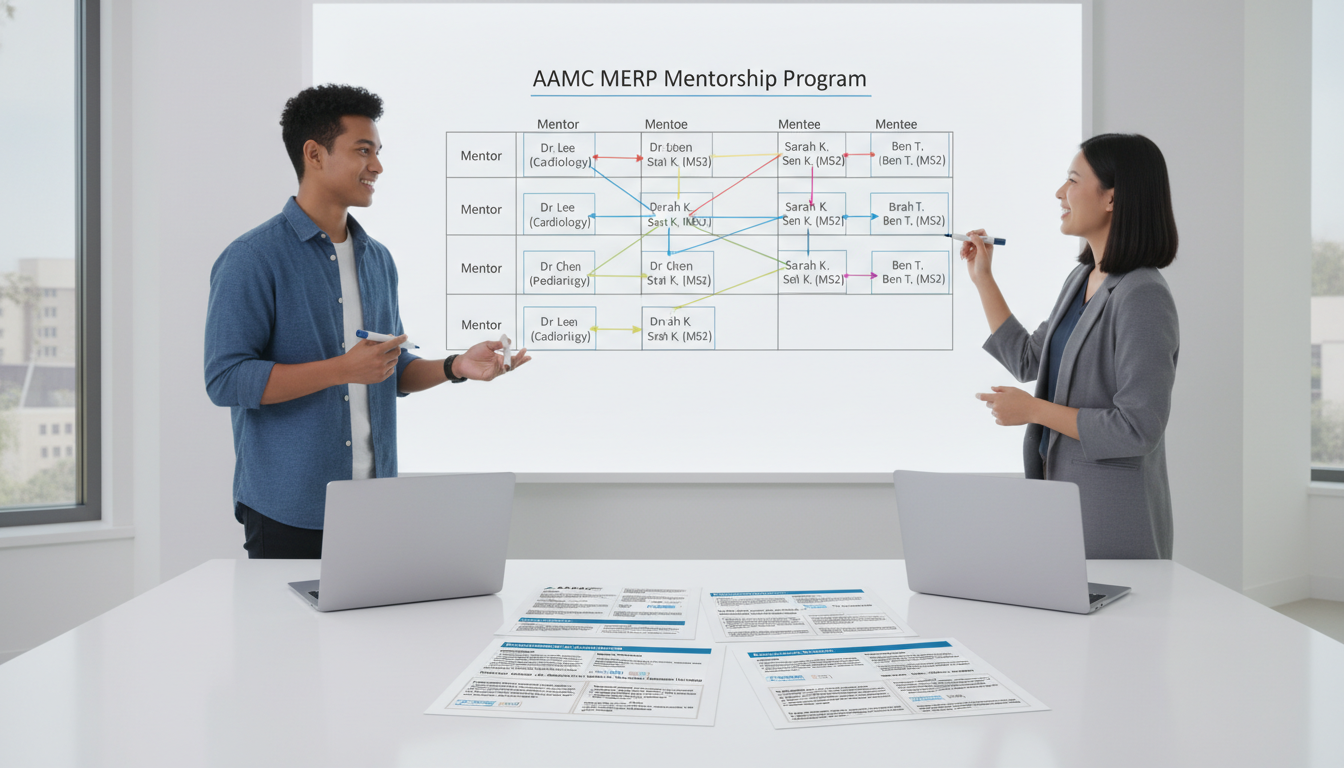
3. Use CiM to Make Mentorship Systems Smarter and Less Random
Most student orgs handle mentoring by pairing “someone interested in surgery” with “someone in surgery.” That works, but it is crude. CiM lets you add nuance.
A. Data‑Informed Peer Mentor Matching
Instead of asking “what specialty are you interested in?” on your mentorship sign‑up form, build in CiM language.
For mentees (early students):
Include items like:
- “Have you completed any AAMC Careers in Medicine self‑assessments?” (Y/N)
- “Which CiM‑recommended specialties are you most curious about? List top 3.”
- “From CiM’s PVIPS, rate 1–5 how important these are to you:
- Predictable schedule
- Procedural work
- Long‑term patient relationships
- Intellectual variety
- Inpatient vs. outpatient balance”
For mentors (senior students or residents):
Ask:
- “Primary specialty (or target specialty if unmatched yet).”
- “Top 3 PVIPS values you believe fit your actual career path.”
- “Settings you have experience in: academic, community, rural, VA, etc.”
When you match, you can pair not just by “specialty interest” but by values alignment:
A mentee whose PVIPS emphasizes lifestyle predictability and outpatient care could be paired with a mentor in:
- Outpatient Internal Medicine
- Outpatient Pediatrics
- Pathology
…even if the mentee listed “Cardiology” in a casual conversation, because their values profile reflects a mismatch with that subspecialty’s reality.
You can then say transparently to both: “We used AAMC Careers in Medicine value profiles to prioritize matches where your values and work settings align, not just titles.”
That sentence alone signals a higher level of thoughtfulness.
B. Structured Mentor‑Mentee Meetings with CiM Guides
Do not let mentoring devolve into vague chats. Provide CiM‑guided session templates.
For example:
First meeting template (early in training):
- Review mentee’s MSPI and PVIPS results together (if they are comfortable sharing).
- Pull up CiM’s specialty profile for the mentor’s field and go through 3 sections:
- A “typical week” description
- Practice settings
- Training path
- Ask:
- “Where does your daily work diverge from this CiM description?”
- “What personality or skill traits do you think CiM underemphasizes for success in your specialty?”
Later meeting template (pre‑clerkship or early clerkship):
- Use CiM’s clinical year guidance:
- Identify 2–3 rotations where the mentee will get meaningful exposure to their top CiM specialties.
- Plan 1–2 specific questions they will ask on those rotations that connect to CiM’s listed pros/cons.
You are not inventing content. You are simply organizing conversation around an existing, standardized framework.
C. Small Cohort “Career Pods” Built on CiM Outputs
Instead of only one‑to‑one pairs, consider 4–6 person “career pods” grouped by overlapping CiM specialties.
Example:
- Pod A: Students whose top MSPI suggestions cluster in cognitive specialties (IM, Neuro, Psych).
- Pod B: Students whose top MSPI suggestions skew procedural (Surgery, EM, Anesthesia).
- Pod C: Students with high PVIPS emphasis on continuity and outpatient care (FM, Peds, Med‑Peds).
Each pod meets monthly with a senior student and occasionally a faculty member. Each meeting uses a CiM‑linked topic:
- Month 1: Values and lifestyle (PVIPS + specialty profiles)
- Month 2: Training length and fellowship pathways using CiM’s training diagrams
- Month 3: Misconceptions vs. reality—compare CiM’s “Day in the Life” to actual stories from mentors
This structure scales. One faculty mentor can interact with 15–20 students effectively, as discussions are pre‑framed.
4. Leverage CiM Data to Upgrade Your Programming and Advocacy
CiM is plugged into AAMC and NRMP data streams: match outcomes, program director priorities, workforce needs. Most students never see that systematically. Student organizations can.
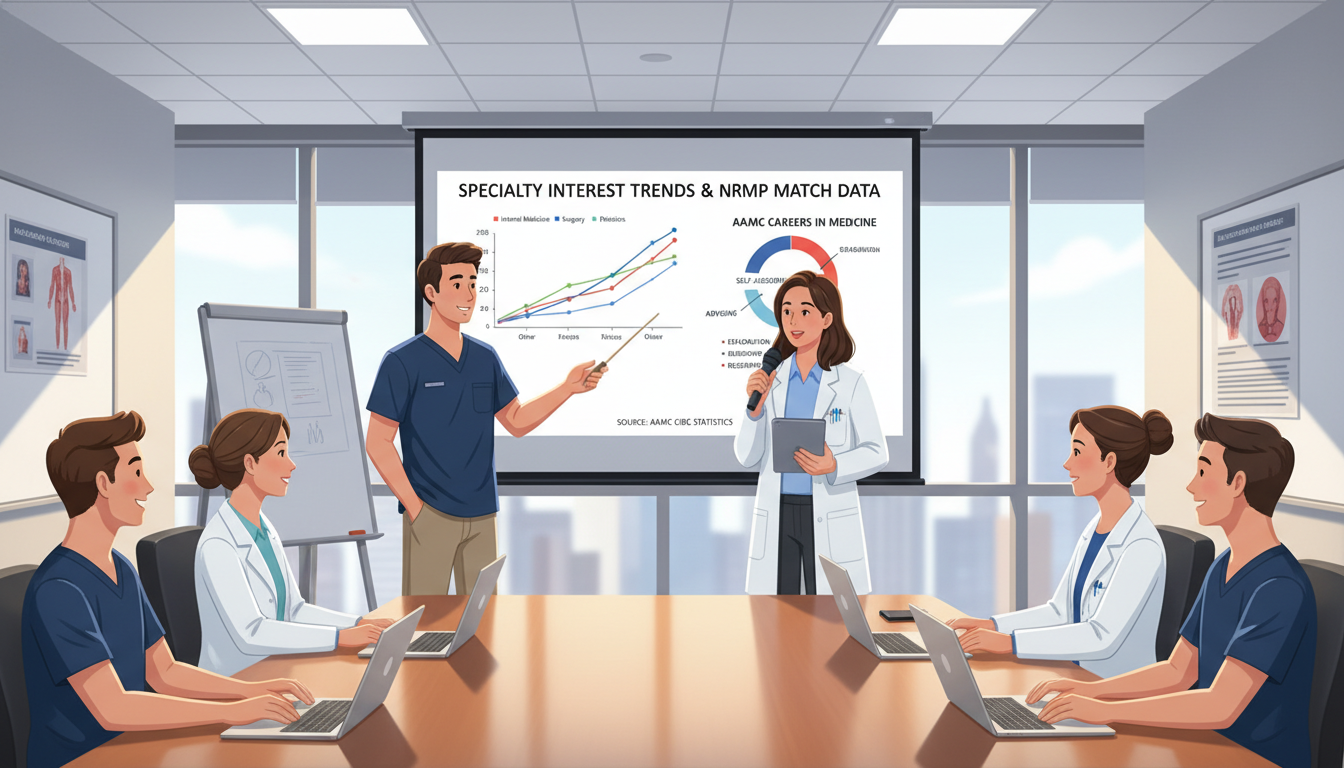
A. Create a “CiM‑Informed Specialty Trends” Annual Report
Once a year, your organization can publish a concise, visually clean PDF summarizing:
National data (from CiM‑linked reports such as Charting Outcomes in the Match and AAMC workforce reports):
- Which specialties are becoming more competitive
- Trends in applicant numbers
- Shifts in work‑hour expectations or practice settings
Local data (if your Student Affairs / Dean’s office will share anonymized statistics):
- Distribution of matched specialties over the last 5 years
- Percentage of students matching into “lifestyle‑friendly” vs. highly procedural fields
- Changes in interest group membership numbers over time
Position the report as: “Using AAMC Careers in Medicine and related data to understand where our students are headed.”
You then present this report at:
- Student Council meetings
- Curriculum committee meetings
- Pre‑med pipeline events
This does two things:
- Gives your classmates realistic context for competitiveness and workforce needs.
- Shows faculty that your organization is using AAMC tools to support evidence‑driven advising, not just ad‑hoc panels.
B. Align Student‑Run Sessions with CiM Timelines
CiM lays out recommended milestones by year. Map your event calendar onto that.
Example mapping:
Pre‑med pipeline programs (hosted by SNMA, LMSA, AMSA, or your Pre‑Med Society):
- Use CiM’s early exploration resources to structure shadowing discussions.
- Show sample specialty profiles during “What Doctors Actually Do” sessions.
M1 fall:
- Self‑assessment launch event (MSPI + PVIPS workshop as above).
M1 spring:
- Specialty speed‑exploration series using CiM profiles.
M2 fall/spring:
- “CiM‑Guided Planning for Clerkships” session—help students see which rotations are pivotal for certain specialties based on CiM’s guidance.
M3:
- Clerkship debrief nights where students compare real rotation experiences to CiM’s descriptions.
M4:
- Residency application prep sessions using CiM’s application and CV guidance as a base.
When you propose events to Student Affairs or request funding, anchor them explicitly:
“This workshop implements the M1–M2 advising milestones recommended by AAMC Careers in Medicine, adapted for our students.”
That language resonates with administrators, because you are aligning student programming with national advising standards.
C. Use CiM in Advocacy for Equity and Inclusion in Advising
Certain groups—first‑generation students, non‑traditional entrants, IMGs—often lack informal advising networks. CiM can be a leveling tool, but only if it is actually used.
Your organization can:
Audit awareness gaps:
- Survey: “Have you logged into AAMC Careers in Medicine in the past year?”
- Break down responses by class year, race/ethnicity, first‑gen status, or affinity group membership (with appropriate privacy protections).
Advocate with data:
- Present to the Dean:
- “Among first‑gen students, only X% are using CiM regularly. These students also report lower confidence in specialty choice.”
- Propose targeted sessions co‑sponsored by affinity groups:
- “First‑Gen in Medicine x CiM: Using National Tools When You Have No Family in Healthcare”
- “LGBTQ+ Students and Specialty Choice: Reading Between the Lines of CiM Profiles”
- Present to the Dean:
Customize reflection prompts:
- Encourage students to interrogate CiM’s descriptions:
- “Does this specialty description capture the experiences of underrepresented physicians?”
- “What questions do you need to ask beyond what CiM presents to assess inclusivity in this field?”
- Encourage students to interrogate CiM’s descriptions:
You move from passive consumers of CiM to critical, equity‑oriented users.
5. Train Your Leadership Team to Be “CiM‑Literate” Advisors
Student leaders are often informal advisors. Whether you want that role or not, classmates will ask, “Do you think I can match X?” or “How do I choose between Y and Z?” If you anchor your responses in CiM, you add structure and credibility.
A. Internal “CiM Boot Camp” for Officers
At the start of each leadership year, run a 1–2 hour training for your officers that covers:
Live navigation:
- Every officer logs into CiM on their own device.
- Together you click through:
- Self‑assessments
- Specialty profile layout
- Career development timelines
- Application resources
Scenario practice: Assign officers specific, realistic questions:
- “I am an M1 who loves procedures but wants lifestyle flexibility. Where do I start?”
- “I am an M3 torn between Psychiatry and Neurology. How do I compare them logically?”
- “My Step score is below average. How do I use CiM + NRMP data to reassess specialty competitiveness?”
For each scenario, officers must answer using at least one concrete CiM feature. For example:
- “Let us pull up both Psych and Neuro CiM profiles and compare:
- Average work settings
- Type of patient interactions
- Training pathways.”
Boundary‑setting language: Train officers on phrases like:
- “I cannot tell you what to choose, but we can work through what CiM shows about these options.”
- “Your advisor or Dean’s office should interpret your competitiveness; let us first understand the baseline data in CiM and NRMP reports.”
That framing keeps student leaders helpful but within their lane.
B. Standardize Event Slides and Handouts with CiM References
Design a set of 3–5 “standard slides” that appear in most career‑related events:
- Slide 1: “Where to find AAMC Careers in Medicine” (URL, login instructions, institution access notes).
- Slide 2: “Which CiM tools pair with this session” (e.g., MSPI + PVIPS for exploration workshops; specialty profiles + NRMP data for competitiveness talks).
- Slide 3: “Year‑specific CiM timeline snapshot” (one graphic per class year, pulled from CiM and simplified).
Make sure every event handout points to:
- The specific CiM page relevant to that event.
- At least one “do this next in CiM after this session” action item.
Students then start to internalize:
“Whenever I go to a career session by this group, they tie it back to CiM and leave me with concrete next steps there.”
C. Collaborate with Your Dean’s Office or Career Services
Faculty sometimes see “student organization advising” and “official advising” as separate silos. You can bridge them using CiM as shared ground.
Approach your Dean’s office with a very concrete offer:
- “We would like to run 3 student‑led workshops this year that extend the Careers in Medicine programming you already do. Can we review your current CiM curriculum and fill gaps?”
Then:
- Align your sessions with what they are not covering deeply (for example, early‑year exploration, alternative careers, or nuanced specialty comparisons).
- Ask if they will:
- Advertise your sessions as “CiM‑aligned.”
- Share anonymized utilization stats (e.g., number of CiM logins) so you can track impact.
If you can show that CiM logins spike after your events, you will have hard evidence of your organization’s contribution to institutional goals.
6. A Note for Pre‑Med Organizations: How to Use CiM Without Full Access
Pre‑med students often do not have the same login privileges to CiM as matriculated students. That does not mean you must ignore it.
You can:
Use public‑facing AAMC career materials that mirror CiM content:
- AAMC specialty snapshots and videos
- Roadmaps describing training pathways
- Public sections of the Careers in Medicine site
Partner with nearby medical schools:
- Invite M1–M2 students who actively use CiM to present specialty overviews grounded in the CiM framework:
- Values
- Skills
- Lifestyle
- Training time
- Invite M1–M2 students who actively use CiM to present specialty overviews grounded in the CiM framework:
Teach pre‑meds how to think in CiM categories: Even without access, introduce the constructs:
- Interests vs. values vs. skills
- Practice setting variation within a specialty
- Training length and fellowship options
When they later matriculate and gain formal access, they will instantly recognize the structure and vocabulary, making them more likely to engage deeply.
Closing Thoughts: How Student Leaders Actually Add Value with CiM
Three core points matter most:
Stop treating Careers in Medicine as a hyperlink and start using it as scaffolding. Build your events, mentorship, and timelines around specific CiM tools—assessments, specialty profiles, and timelines—rather than mentioning it in passing.
Use CiM language and data to make advising more structured and equitable. Values‑based mentor matching, specialty pods, and equity‑focused workshops all become easier when you lean on CiM’s standardized frameworks.
Make CiM literacy part of your leadership identity. Train your officers to navigate the platform, align your programming with CiM milestones, and collaborate with your Dean’s office so that your student organization becomes a recognized extension of formal career advising rather than a parallel, disconnected track.
Student organizations that do this well are remembered not just for social events and interest groups, but for quietly reshaping how an entire class approaches career decisions—with a national, data‑driven tool as their backbone.